A bra wash bag can solve one problem and create another: it may keep hooks away from the rest of the load, yet be too short, too shallow, or too cramped for the bra you actually wear. A product photo rarely makes that obvious. The useful check is to compare the bag’s usable space with the bra’s natural shape before buying, then make sure the bra can be loaded and zipped without forcing either one.
This guide is for anyone choosing a reusable wash bag for underwire, molded-cup, full-coverage, or larger-size bras. It explains how to measure the garment, what the main bag shapes do, and how to test a candidate in your own laundry routine. Cup letters alone cannot guarantee fit, and a mesh bag does not make every machine cycle suitable. Follow the bra’s care label first.
Start with the care label and the problem you need to solve
Some bras are hand-wash only, and some manufacturers recommend hand washing even when a machine has a delicate programme. A bag does not override the garment label. If the label permits machine washing, follow its temperature, cycle and drying directions. General bra-care guidance often advises fastening hooks, using a mesh lingerie bag, choosing a cool delicate cycle and air drying, but those are generic recommendations — the instructions sewn into your own bra remain the controlling reference for that garment.
Be specific about the failure you are trying to prevent. If hooks catch on other clothes, a closed pouch with a protected zipper end may address that snagging route. If the cups are being crushed in a flat bag, a roomier or shaped bag may be worth testing. If the bra comes out twisted, adding more bras to a small compartment is unlikely to help. These are different problems, and the same bag shape will not solve all of them.
Recent shopper discussions show how practical these distinctions are. In one laundry thread, users compared flat pouches with divided cylindrical bags; one commenter said a divided cylinder trapped a bra so badly they had to cut it out. In another thread, a wearer who had moved to a larger cup size said their bra no longer fit the old bags and that multi-bra bags forced it into the wrong orientation. These are individual reports, not evidence of how often a product fails. They are useful reminders to test the actual garment rather than relying on “bra size” claims in a listing.
Measure the bra you plan to wash
Do not select a bag from the cup letter alone. Cup letters are relative to band size, bra cuts differ, and foam, wire, padding or a longline band can change the space a bra occupies. One reviewer may find a nominally large bag comfortable while another finds the same shape too tight. Measure your bra in its natural position instead.
Lay the dry bra on a flat surface and fasten the back hooks so they cannot catch while you handle it. Arrange the straps as they would sit when worn. Do not fold one cup into the other or press molded cups flat to make the outline smaller. Measure the widest front-to-back span of the garment with the cups relaxed, then note its height and the depth created by the cups. If it is an underwire style, include the full wire arc and any side panel that sticks out. Record the garment type as well as the measurements: “molded underwire, full coverage” is more useful than “large bra.”
The measurements are a comparison aid, not a universal sizing formula. A flat mesh pouch has flexible walls; the dimensions printed on its package may describe it lying empty. A framed bag has a cavity whose internal shape may be smaller than its outside measurement. For a soft bralette, a little movement may be acceptable. For a molded cup, the important question is whether the cup can sit without being folded, crushed, or held under tension by the zipper.
If the product page gives only “small,” “large,” or a cup range, ask for the actual dimensions and how they were measured. A claim such as “fits D to G” is not a promise for every band size, cut or padded style in that range. Treat it as a starting point and use your own bra as the fit reference.
Match the bag shape to the garment
Flat mesh pouches are flexible and easy to store. They can work for unpadded bras, bralettes and other lightweight delicates when there is enough room for the garment to lie loosely. They offer little structural support, however. A small pouch may fold a molded cup even if the zipper closes.
Structured or semi-structured bra bags use a frame or shaped panels to hold a three-dimensional space. That can keep the pouch from collapsing against a cup, but only if the bra fits inside without being pushed into the frame. The outside may look roomy while the usable opening is narrow. A rigid ring or divider can also make loading awkward for a bra with a wide wire or tall cup.
Multi-compartment or divided bags promise separation, but each compartment has its own size limit. Check whether the divider is fixed, whether it can catch straps or lace, and whether you can remove the garment without pulling against a wire. If your bra has to be twisted to pass through the opening, the design is not a good fit for that garment.
Larger general-purpose mesh bags offer more room than many bra-specific cages, but they do not preserve cup shape by themselves. They may be a practical choice when the main concern is preventing hooks and straps from tangling with other laundry. Use them only if the care label permits machine washing and the bra can lie without being compressed.
Lingerie care guidance often recommends laying bras naturally in a flat bag and leaving room rather than packing the bag full. That is a general practice, not a universal fill standard, but it supports a sensible fit check: the garment should enter and close without force, and the bag should not be packed so tightly that the bra is pressed into a new shape.
Inspect the opening, zipper and inside edges
The opening can be the limiting dimension even when the bag body looks large. Compare the width of the zipper opening with the widest part of the bra. Check whether the opening runs along one edge or across the centre, and whether a frame blocks the path. You should be able to place the bra inside and remove it without bending a wire or dragging lace across the zipper teeth.
Look at the zipper end after closing the bag. A fabric tab, elastic guard or covered zipper pull can keep the metal or plastic slider from rubbing against other garments, but the feature matters only if it actually covers the pull when the bag is shut. Run a finger along interior seams and edges. A stiff binding or exposed seam allowance can snag delicate fabric even when the mesh itself feels smooth.
Fasten the bra hooks before it goes in. Then place the bra in the bag and close the zipper slowly. Stop if the slider catches fabric, the bag bows outward, or the bra has to be folded. Do not assume a zipper that closes under tension will stay closed in a moving load. Avoid adding a pin or other improvised fastener unless the bag maker specifically permits it; a loose metal object can create a new snag or damage risk.
Do a dry fit before the first wash
Use the bra you measured, not a smaller one, as the test garment. Start with the largest or most structured bra you expect to put in that bag. Place it inside in its natural orientation. The cups should not be inverted or folded merely to get through the opening. Close the bag and check whether the zipper pulls smoothly without pressing the cups together.
Next, reopen it and remove the bra. Notice whether a strap catches, whether the wire is forced against a seam, and whether the cup rebounds to its original shape. A dry fit cannot predict every outcome in a washing machine, but it can reveal an obvious mismatch before detergent and a wet garment make handling less convenient.
If the listing encourages several bras in one bag, test the exact number and combination you plan to wash. Two soft bralettes may occupy less space than two molded underwire bras. A stated capacity describes that product’s own design; it is not a guarantee that several bras of your type can move freely or be washed together appropriately. Begin with one bra per compartment until the fit and care instructions make the intended load clear.
Wash bag options
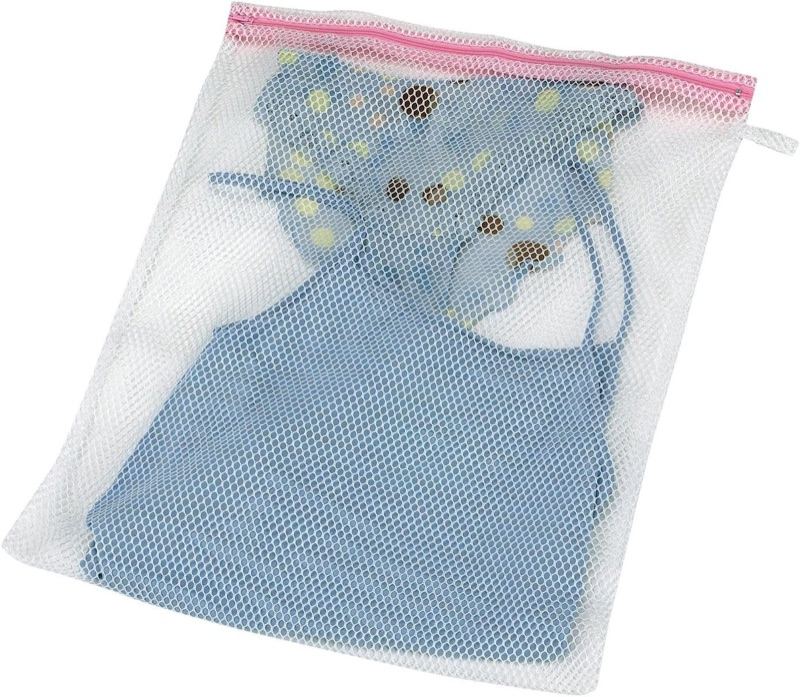
Zippered lingerie wash bag with mesh body
A single flat pouch with a protected zipper end, aimed at keeping hooks away from the rest of the load. Check the listed dimensions against your bra rather than the cup range, and confirm whether the zipper pull is covered when closed.
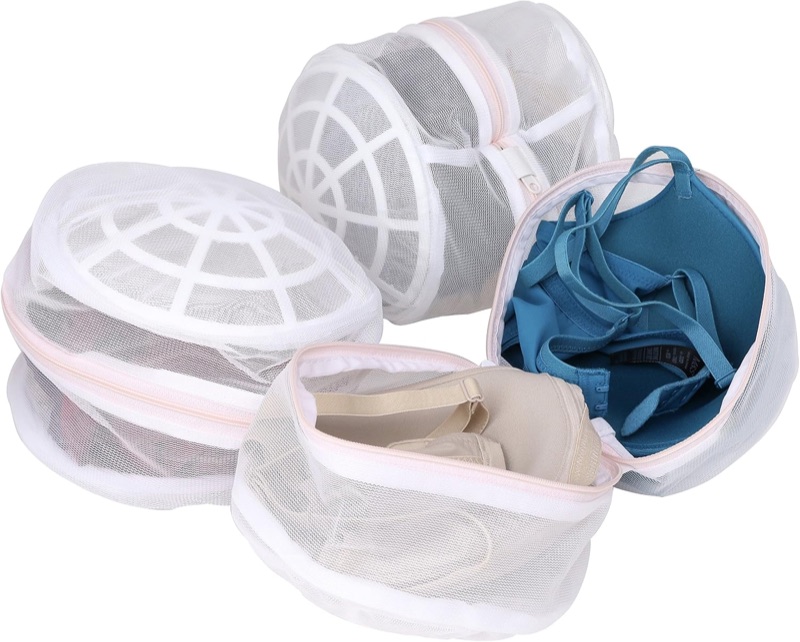
Framed mesh bra wash bag set of three
Three bags with a shaped frame rather than a single soft pouch. Useful when you want to keep one bra per bag; check each compartment's internal space and the opening length, since the outside size is larger than the usable cavity.
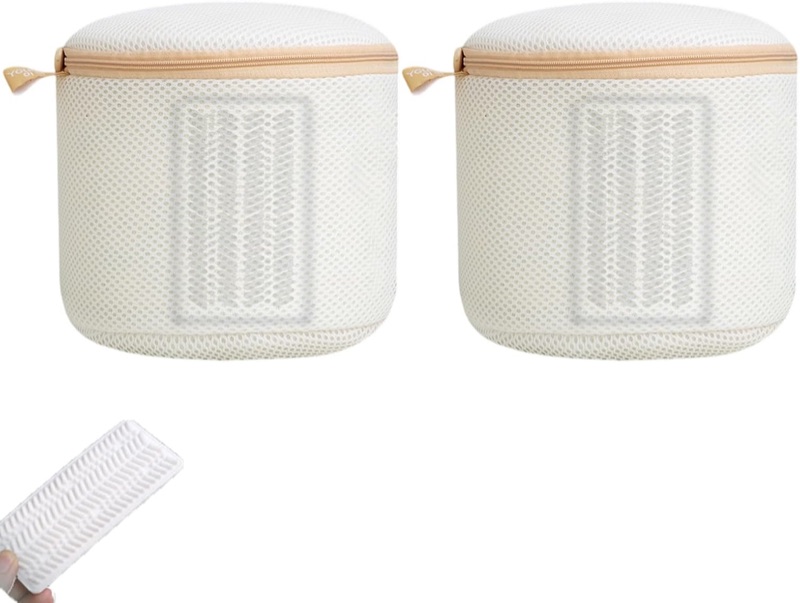
Oval mesh bra wash bags, two pieces with zipper guard
A flexible pouch shape suited to unpadded bras and bralettes, not to holding a molded cup. Confirm the flat and loaded dimensions and whether the guard covers the slider before you rely on it in a mixed load.
Card photos are the current marketplace listing images and may differ from the delivered product; confirm details on the live listing.
Use the bag as one part of a careful wash routine
When machine washing is allowed, place similar delicate items together and choose the cycle and water temperature specified by the bra label. General care guidance tends toward a cool, delicate cycle; other manufacturers may give different directions. Do not use a wash bag as permission to mix a delicate bra with heavy garments, abrasive fasteners, or a full load that presses it against other items.
After the cycle, remove the bra promptly and check whether the bag stayed closed. Look for a wire that has shifted, a cup that remains creased, a snagged strap, a pulled seam, or a slider that has moved. One wash is not a durability test, but it can tell you whether the bag’s opening, closure and interior are compatible with the garment. Follow the bra label for drying; air drying is commonly recommended in lingerie-care guidance, but check the label for your specific item.
Inspect the wash bag itself periodically. Stop using it if the mesh has a hole, the seam is opening, the frame is cracked, or the zipper no longer closes securely. A damaged bag can expose hooks or wires and may catch on other laundry. Rinse or clean the bag according to its own care instructions and let it dry fully before storing.
What to check on a product page
Before buying, look for the usable dimensions, not only the product name or staged photo. Check the opening length, bag depth, whether there is a frame or divider, zipper protection, and the number of bags in the set. Search customer photos for a bra similar in shape to yours, but treat them as examples rather than a fit guarantee. If the listing has a size variation, confirm that you selected the larger or correct variant before checking out.
A flat mesh set is a reasonable candidate to compare against your own measurements, but its stated dimensions describe the pouch lying empty. Confirm the current variant and the product details on the live listing before buying, and do not treat a published star rating as evidence that the bag will suit a structured cup.
Skip vague claims such as “universal fit” unless the seller gives a clear measurement basis. Be cautious with product claims that a bag will prevent all stretching, preserve every cup shape, or make a bra last longer; those outcomes depend on the garment, the wash conditions, and how the item is loaded and dried. A well-fitting bag can reduce some contact and tangling, but it cannot correct an unsuitable cycle or a poor fit between the bra and the bag.
A simple decision rule
Choose a structured bag when its internal space and opening allow your bra to sit naturally, with no forced folding and no tension on the zipper. Choose a flat or larger pouch when flexibility and separation are the main needs and you do not expect the bag to support the cup shape. For a divided design, check every compartment separately. If a bra only fits when you compress it, size up or choose another shape.
Keep the product page, care label and your own fit check in view at the same time. The best bag for your laundry routine is the one that fits the particular bra, closes without force, and works with the care instructions — not the one with the most persuasive photo or the broadest cup-size claim.