A bra bag has two jobs that pull against each other. It has to hold a bra without forcing the cups, wires or straps into an awkward fold, and its zipper has to stay shut without becoming the thing that snags the garment.
A pouch that looks generous when flat can be too shallow for a moulded cup, and an empty zipper test says very little about a full, wet bag in motion. Washing guides tell shoppers to use a lingerie bag and to close or cover the zipper; a brand has to approve the bag before ordering cartons.
This guide is about that approval. It complements the storage-and-fit side in choosing a bra wash bag that fits without folding the cups: that page is about cup volume in a bag, this one is about the closure and the loaded wash.
Treat complaints as clues, not a defect rate
Two recurring complaints are worth designing around. One is a bag zipper opening during a wash and damaging the load. The other comes from buyers with larger cup sizes whose bags either did not fit or held the bra in the wrong orientation.
Those are individual accounts, not a measure of how often bags fail. They do point at two separate acceptance questions. First: does the closure stay shut and keep its hardware away from garments? Second: does the interior fit the intended bra without compressing the cups or loading the wire channel?
A bag can pass the first and fail the second. Retail care pages mention zip covers, hooks, underwires and snag protection, but those words do not tell you what happens with your size range, your wash load and this construction.
Define which bras the bag must fit
"Bra bag" describes at least four different products: a small pouch for one bralette, a domed cage for a moulded cup, a flat mesh sleeve for an unpadded underwire style, and a larger bag meant to hold several garments. They are not interchangeable.
Pick representative bras from your own line rather than the easiest sample. Include the largest cup volume and longest underwire span you sell, plus a moulded or padded style if it is in the range, plus a non-wired style if the same bag will be marketed for it.
Record for each test bra: style code, band and cup size, cup construction, wire type, padding, clasp position and condition. Use saleable production examples — not a stretched sample or a one-off prototype. The bag should be judged against the garments buyers actually receive.
Measure the usable interior, not the flat outside
Supplier dimensions usually describe the bag laid flat. Those numbers do not tell you what remains after seams, binding, a zipper curve or a shaped insert. For a domed bag, depth is a separate dimension. Ask for internal usable dimensions and clarify where each measurement starts and ends.
Measure the bra in the form it will enter the bag. If the instruction is to place it flat, do not turn a cup inside out or nest the cups to make it fit. For a padded cup, watch whether the bag presses the cup edge, distorts the bridge, pulls the straps or forces the wire into a tight angle.
A practical check: close the hooks, place the bra in with your intended instruction, then close the zipper without pulling the fabric toward the slider. There should be enough ease for the stated use, without so much volume that the bra can twist into a knot. Photograph from above and from the side before closing, and repeat after opening.
For multi-bra capacity, test the full stated count. Two soft bralettes are not two moulded underwire bras. If the bag is sold for one bra, do not infer two because the zipper can be forced shut.
Treat the opening as its own dimension
A bag can have a generous interior and an opening too small for the wire shape to pass through without twisting. Record the clear opening width and length with the closure fully open, then check whether the zipper pull, garage, binding or frame creates a snag or pinch point. "Overall size" and "opening size" are separate fields in the specification, and suppliers rarely volunteer the second one.
Agree how each dimension will be measured before you set a tolerance. A soft mesh pouch stretches under hand pressure; a framed cage has a firmer boundary, so the same nominal width does not describe the same usable space. Ask the supplier to measure without pulling the fabric taut, and record whether a figure is taken flat, expanded, or with the closure shut. Tie any acceptance range to your reference bra and closure test rather than adopting a tolerance that was written for a different construction.
Check mesh, seams and contact points together
Mesh choice affects visibility, airflow, and the size of the openings a hook or strap can poke through. It also changes how the bag catches against other laundry. Ask the supplier to identify the mesh and seam finish on the submitted sample — two similar-looking bags may not use the same material.
Inspect every seam where the zipper joins the body, where loops attach, and where panels meet at the corners. Those carry more load than a flat panel. Look for skipped stitches, loose tails, exposed edges, fraying, puckering, and zipper tape caught unevenly.
Load the bag and lift it by the base and by any hanging loop. That is a screening check for obvious weakness, not a certified strength test. Then run a hand over the inside and outside edges for rough seam allowances, cut mesh ends, rigid labels or hardware that can touch the garment.
Build a repeatable sample test
Use the same bra, the same load and the same wash programme for each sample, and write down what you used. A bag that only survives a delicate cycle is a different product from one sold for a normal wash.
After the cycle, check the closure first: migrated slider, bent pull, separated teeth, puckered tape, loosened end stop. Then check the garment: snagged lace, pulled straps, a wire that has pushed through, or a cup that has been creased. Photograph both the bag and the bra.
Repeat the wash at least twice before approving. A single pass is easy to over-read, and zipper hardware tends to fail on repetition rather than the first outing.
Specify the zipper as a system
A zipper is more than a slider. Record usable opening length, zipper type as stated, tape width, teeth or coil construction, end stops, pull tab and any guard that covers the pull. Then note whether it runs along a straight edge, a curve, or three sides of a shaped bag — a curved opening loads differently when the bag is full.
Run the slider slowly from end to end with the bag empty, then with the largest representative bra inside. It should not catch on mesh, binding, loose threads or a seam intersection, and it should reach a positive stop. A "tight" feel is not evidence that it will stay shut through a wash cycle.
If the design has a zipper garage, elastic band, fabric tab or covered pull, test that exact feature. Close fully, park the pull as instructed, and see whether the cover stays put when the loaded bag is turned and moved. The guard also has to be usable by a normal customer and must not create a bulky corner that catches lace.
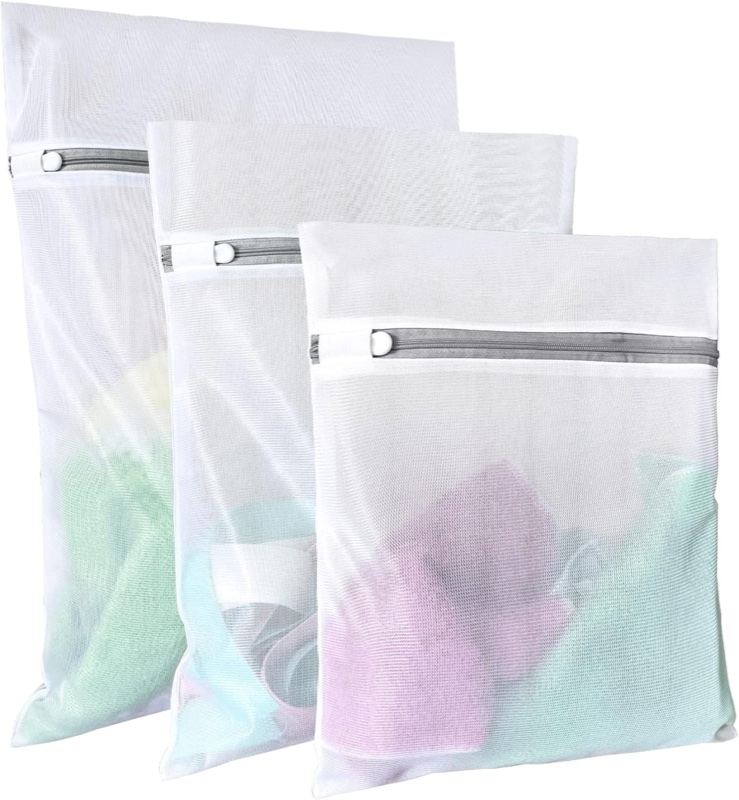
Fine mesh lingerie laundry bags, 3 sizes with zipper closure
A retail example of the format under test: fine mesh, zippered top, several sizes in one set. Useful for comparing how a loaded bag behaves rather than as a fit guarantee for a specific cup size.
Product photos and current pack contents can change; confirm the sizes and closure type on the live listing.
Write pass, revise and fail conditions first
Decide what counts as a pass before the first wash, so a marginal result cannot be talked into approval afterwards.
- Pass: the closure stays shut through the agreed number of cycles, the pull parks where it should, no mesh opening admits a hook, and the test bra comes out undamaged.
- Revise: the bag holds the load but a seam puckers, the guard loosens, or a larger bra has to be forced. These are construction fixes, not a new product.
- Fail: the slider separates, teeth gap, tape pulls away from the mesh, or the garment is snagged or deformed.
Record the cycle count, load and programme beside the verdict. "It held up fine" is not a condition a supplier can act on, and it is not repeatable when the bag is reordered a year later.
A receiving checklist
| Check | What to record | Hold the order if… |
|---|---|---|
| Garment fit | Representative bra sizes and constructions | The largest bra must be forced in |
| Interior | Usable length, width, depth | Flat dimensions hide a shallow body |
| Zipper | Type, length, stops, guard, loaded operation | It separates or catches when full |
| Mesh and seams | Material, openings, stitch quality | Hooks can protrude or seams are unfinished |
| Wash test | Programme, load, cycles completed | The closure opens or the bra is damaged |
| Marking | Bag size label, lot, supplier confirmation | Bags cannot be told apart by size |
| Repeat order | Reference sample kept, version noted | A substitute construction arrives unannounced |
Write the supplier brief
State the job instead of asking for a good-quality laundry bag.
We are sourcing a zip mesh bag for one moulded-cup bra up to [band/cup] and for [second style]. Please confirm: internal usable length, width and depth; mesh material and construction; seam finish; zipper type, length, stop type and guard; whether the pull is covered; available sizes with dimensions; sample cost; MOQ by size; packaging; and whether the production construction matches the sample.
Ask separately whether the bag is sold by size label or by dimension, because "large" varies between suppliers. If your range includes larger cup sizes, say so explicitly — a bag marketed as universal often is not — and ask for a sample in the size you would actually stock.
Keep an approved reference bag with its size label and lot, and compare each delivery against it: dimensions, mesh, seam quality and how the zipper parks. A saved product name is not version control, and a bag that quietly shrinks by two centimetres will show up first as customer complaints rather than as a receiving problem.
Make the fit claim narrow enough to be true
Once a sample is approved, say which styles or garment range it was fit-checked against, and point customers back to each bra's care label. Avoid "fits all cups", "prevents deformation" or "protects every bra" — a supplier's listing title does not prove what your finished product does, and a wash bag cannot make a hand-wash-only garment machine-safe.
If the bag goes to retail, include an instruction card stating the tested capacity, the orientation the bra should be loaded in, how the closure is secured, and when hand-washing is still required. The durable assets are the reference bra, the usable-space measurements, the approved sample and the reorder comparison — not the wording on the pack.