A bra extender only works when its two fastening edges match your bra. Hook count is a quick filter, not a fit guarantee: two three-hook closures can have different spacing, and a piece that clips on under tension can still pull the band out of shape.
Before ordering, count the hooks, measure the centre-to-centre distance between neighbouring hooks, compare the overall closure width and height, and test the extender while the bra is off your body. Sellers publish different configurations, and people hunting for extenders report mismatches even when the hook count looks right. No single dimension fits every bra.
This guide shows how to measure your own closure, decide whether an extender is the right fix at all, and reject a poor fit before it becomes an uncomfortable workaround. If you are the one specifying extenders for a lingerie range rather than buying one for yourself, the buyer-side workflow in specifying a bra extender covers the sample and reorder checks this page does not.
Start with the problem an extender can solve
A bra extender adds length at the back band. It can help when a bra otherwise fits and the band is temporarily or slightly too snug: the first wears of a firm new band, a few weeks of body change, or a garment that needs a little extra room.
The practical question is whether extra band length fixes the one issue you actually have. It cannot correct a cup that is too small, a band that rides up, straps that keep slipping, or a bra whose wires and cups no longer sit where they should.
If the bra is uncomfortable in several places at once, changing the fit or replacing the bra is more sensible than adding length. A longer band relieves pressure, but it also changes how the cups sit and how firmly the bra is anchored. Treat an extender as a fit adjustment, not a substitute for checking the whole bra.
Measure the fastening, not just the number of hooks
Lay the bra flat with the closure unfastened and the fabric relaxed. Count the hooks on one side, then count the matching eye columns on the other. Record both if the closure is asymmetric or the bra has several rows.
Hook count tells you the layout, not the distance between the fasteners. Retail listings show why this matters: one seller lists its narrow two-hook version at 3/8 inch centre spacing, its standard two-hook at 1/2 inch, and a three-hook at 3/4 inch. Those are that seller's specifications, not an industry standard.
Use a ruler with millimetre markings and measure from the centre of one hook to the centre of the next, not from the outside edges of the metal. If the centres are hard to see, mark the midpoint of each hook with a fine removable mark and measure between the marks. For three or more hooks, check every interval instead of assuming they are equal.
Write the result down in millimetres and inches if you are comparing listings from different markets. One inch is 25.4 mm, so 1/2 inch is 12.7 mm and 3/4 inch is 19.05 mm. Conversion helps you compare descriptions; it does not make differently measured products interchangeable.
Then measure the closure's total width from the outer edge of the first hook to the outer edge of the last, plus its height from top to bottom. These are a cross-check, not a replacement for centre spacing. A wide closure can carry a few widely spaced hooks or several close ones. Where the fabric is curved, lay it naturally rather than stretching it flat.
Photograph the closure next to the ruler and keep the image with your notes. It settles the argument when a seller's stated dimension turns out to mean total width rather than hook pitch.
Run a no-force test before you wear it
Clip the extender to the bra while both are off your body. Start with the bra's loosest row if that is how you normally wear it, then bring the edges together without pulling either side sideways.
The hooks should enter the eyes cleanly, sit centred, and leave the fabric lying flat. Do not stretch the closure until it clicks, bend a hook to make it fit, or drag one edge across to catch the last hook. Those are signs of a mismatch, not a successful fit.
Look at the fastening from the front and back. The rows should stay parallel, the fabric should not bunch sharply between hooks, and no hook should be twisted against an eye. If the extender is visibly narrower than the bra closure, the outer hooks pull inward. If it is much wider, the fabric buckles or rubs.
Only after that off-body test should you try it on. Fasten the extender to the bra first, then put the bra on and attach the bra's hooks to the extender's eyes. Move, take a full breath, lift your arms, sit down. The band should feel easier without riding up or shifting the cups.
If the centre front lifts, the band climbs your back, or the cups pull away, reassess the bra fit rather than tightening or stretching the extender into place. Remove it if it irritates your skin or makes the fastening unstable.
Decide how much extra length you need
Extenders come in different lengths and with several eye rows. More rows give you adjustment choices; they do not guarantee a better fit. Choose the smallest extension that creates comfortable breathing room while leaving the bra stable — a long extender adds slack, which is the last thing a band that already rides up needs.
If the page gives only a total length, check whether that number includes the hook-and-eye panels or refers only to the connecting fabric. Where it is unclear, ask for the usable added circumference.
Some products use elastic; others are firmer or sold as non-stretch. Stretch softens the feel but may not give the same stable adjustment as a firm band, and the combination matters: a stretchy extender on a firm closure behaves differently from a rigid connector on an elastic band. "Soft" and "comfortable" are seller claims, not measurements. If seams or hardware bother your skin, check the back-facing surface and the return policy rather than judging scratchiness from a photo.
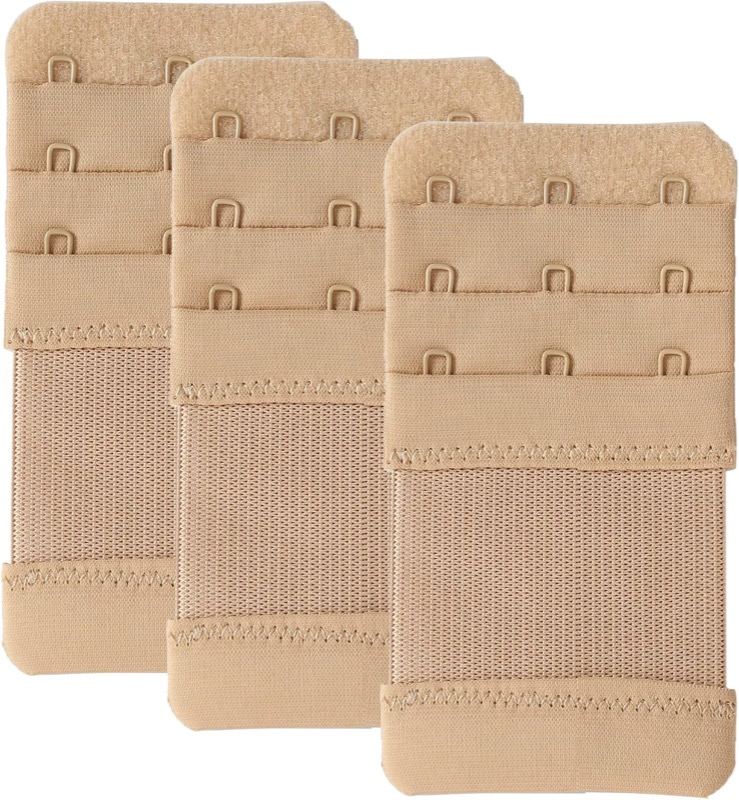
Three-hook elastic bra extenders, pack of three
A three-hook, multi-row format in three neutral colours. Its stated spacing is 3/4 inch between hook centres, which suits bras built to that pitch — measure yours before assuming it matches.
When an extender is a bad workaround
If the band feels tight because the cups are too small, the band gets pulled forward and feels tighter than it should. An extender can mask that sensation while leaving the cup problem in place.
If the band rides upward at the back, it may already be too loose or the fit may be off in another way; adding length moves in the wrong direction. If the wires sit on breast tissue, the cup edge cuts in, or the straps are doing most of the support work, reassess size and shape instead of buying a longer connector.
A new bra is usually judged on its loosest fastening row, so there is room to tighten as the band relaxes with wear. Individual designs differ and the feel has to be judged by the person wearing it. An extender can bridge the first weeks of a firm band; if you need one every day to make a bra tolerable, the bra's fit is the thing to check. Persistent pain, numbness, skin injury or breathing discomfort is a reason to stop wearing that combination and get proper fitting advice.
Read the listing for the numbers that matter
Read the size chart before you read the colour names. Look for hook count, number of eye rows, centre-to-centre spacing, total width, total height, extender length, fabric composition, and whether the band stretches. "Three hook" answers only one of those questions.
A listing that says "45 mm" without saying whether that is the full width, the distance between adjacent hooks, or something else has not given you enough to confirm fit. Retail pages and marketplace listings do not share a format, and a single seller may publish different spacing values for its narrow two-hook, standard two-hook and three-hook models.
Do not transfer a dimension from one seller's chart to another seller's product, and do not assume a supplier keeps the same pattern across every variant. Ask for measurements on both mating sides: the extender's hooks have to align with your bra's eyes, and its eyes have to accept your bra's hooks.
If a dimension is missing, ask a short, specific question: what is the centre-to-centre distance between adjacent hooks in millimetres, what are the total closure width and height, and can the seller send a straight-on photo of that exact variant beside a ruler. A reply of "fits most bras" is not an answer.
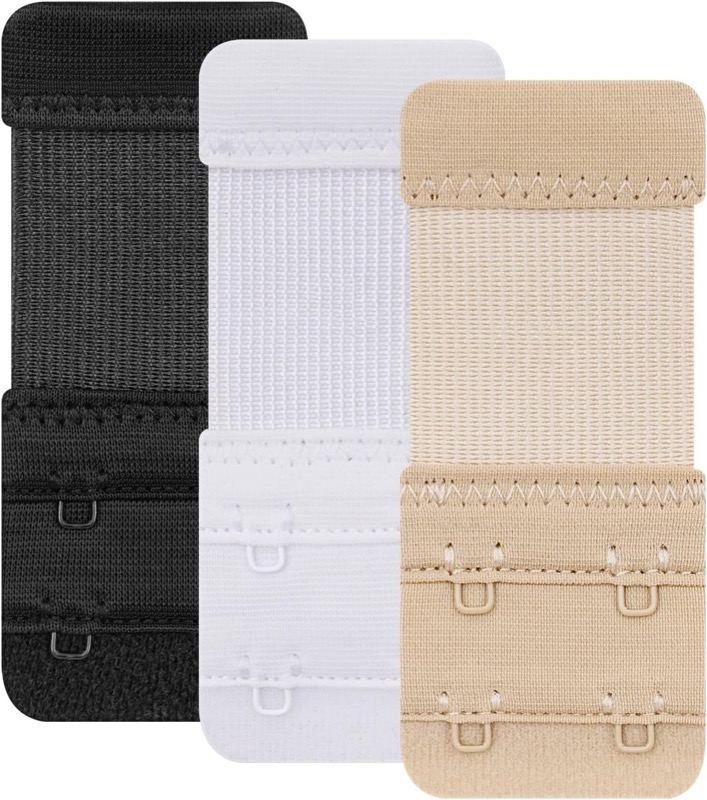
Bra extenders in 2, 3, 4 and 5 hook versions
A listing that publishes hook count and centre-to-centre spacing per variant, which is the combination worth comparing against your own closure. Check the spacing of the version you select, not just the number of hooks.
Listings change; confirm the spacing of the exact variant on the live page.
A simple buying checklist
Before checkout, confirm:
- The hook and eye counts match your bra.
- The centre-to-centre pitch matches on each closure.
- Total width and height are compatible with your bra's panel.
- You know how much usable length the extender adds.
- The listing says whether the fabric stretches.
- The size chart identifies the exact variant, not just the product family.
- Returns are possible if the measured item differs from the description.
Keep a note of the bra's brand, style, your measurements and a photo of the closure. A size that works with one bra is not automatically compatible with another, even when both carry the same nominal hook count.
What a supplier listing can and cannot tell you
A marketplace listing is a starting point for a sample request, not evidence that a variant fits your customers' bras. One supplier page for a bra extender shows width options in millimetres and lists polyester, but does not clearly define those numbers as hook-centre spacing — and its item page showed no product reviews when checked. A high store-level rating belongs to the supplier, not to that item.
For a first sample, request one unit per proposed spacing and compare each against physical bras from the styles you plan to support. Measure them yourself, close the connector repeatedly, and inspect for coating damage, loose stitching, sharp edges and distortion. Do not advertise a size as universal on the strength of one sample or a broad supplier description, and print the measurement convention on your own packaging so customers can compare centre spacing instead of guessing from hook count.
The short answer
Count hooks, but buy by measurement. Match the centre-to-centre spacing first, then compare total width, height and added length. Test the extender off the body without forcing the closures; if the fabric bunches or the hooks twist, stop and choose another size.
If the band is only slightly snug and the rest of the bra fits, an extender is a useful adjustment. If several parts of the bra feel wrong, revisit the fit instead of asking a small accessory to solve a larger problem.