A reusable pad can move even when its snaps are closed. Fit depends on how the pad's snapped width matches the underwear gusset, whether the underwear holds the pad close, and where the wings sit.
Before replacing a whole stash, check the failure pattern. Sideways movement often points to a width mismatch. Sliding front to back can involve underwear fit, pad length, or wing placement. Those are different problems, and they need different checks.
Start by describing the movement
"It shifts" is too vague to guide a product change. Note where the pad begins, where it ends up, and what the underwear looks like afterwards.
- A pad that travels front to back is a different fit problem from one that rotates sideways.
- A pad that stays centred but wrinkles or bunches may have a shape mismatch, a bulky multi-layer construction, or fabric gathered by the wings.
Reusable pads commonly attach by wrapping the wings around the gusset and fastening them underneath. That mechanism keeps the pad connected to the garment; it does not make every pad fit every gusset.
Start with one specific pair of underwear, in the cut and size the wearer normally uses. Lay it flat without stretching. Find the narrow area where the wings close, then note the gusset width and the shape of the front and back coverage. A thong, a wide boyshort gusset and a close-fitting brief give a winged pad very different fabric to wrap around. Loose underwear lets a pad move; a gusset much wider than the pad's snapped width gathers fabric under the wings.
Wearer reports confirm the pattern without settling it: one person describes backward movement and bunching despite close-fitting underwear, and the replies mention textured backing and adjustable snaps. That is useful language for a product brief, not evidence of how common the problem is.
Do not immediately size down the pad. A narrower snap setting may help with one pair of underwear, but a pad that is too narrow for another gusset bunches the fabric or feels uncomfortable. If the snapped pad is wider than the gusset, the wings may not wrap firmly enough to hold it. The target is a stable, comfortable wrap, not the smallest possible measurement.
Check the width after fastening
Pad measurements are easy to misread. A listing may give the overall width with the wings open, the width of the absorbent core, or the width when the wings are snapped. For fit, the last one is usually the useful number.
Ask the supplier for the snapped width at every setting, measured in a defined way, and compare it with the gussets that represent your intended range. "One size" and "adjustable" are not measurements.
If the wings have more than one snap position, record the width each position creates. Then close the pad around the gusset without pulling hard on the fabric. It should hold the underwear without dragging the fabric sharply inward, and the wearer should not feel a hard ridge or a concentrated pressure point. One position may suit a narrow gusset while another suits a wider one. Publish the available settings clearly rather than assuming the same snap design fits all underwear.
Check the direction of coverage
A pad can stay snapped in place and still leave the front or back uncovered. Look at where the wings sit relative to the narrowest part of the gusset.
If the wearer needs more coverage toward one end, shifting the whole pad may put the wings at an awkward angle. A longer front or back section, or a pattern with offset wings, can keep the fasteners aligned while adding coverage where it is needed. Compare the coverage and shape of a pad the wearer already knows, then choose a reusable pad with a similar length and end profile.
This is a fit check, not a guarantee against leaks. Flow direction and volume differ by person, and absorbency is a separate product property. A pad that moves can expose underwear even when its core has capacity left; a pad that stays centred can still be inadequate for the wearer's flow. Keep those observations separate in sample notes.
Run a simple fit test before buying a set
For a personal purchase, test one pad with the underwear you actually wear. For a brand or importer, request samples in the intended sizes and fastener settings. Use new, individually assigned samples for wear trials; do not pass an intimate-use textile from one wearer to another. Wash before first use as the maker directs.
- Write down the baseline. Underwear cut, size, material, gusset width at the closure point, and whether the elastic still holds its shape. Then the pad's open width, length, snapped width, wing shape and snap setting. Use one measurement method for every sample.
- Fit it without stretching. Lay the pad on the gusset and close the wings underneath. The centre panel should sit where the wearer expects, the snaps should meet without a tug, and the underwear should not be pulled into a painful or bulky twist. If it cannot close securely on the target underwear, mark that combination incompatible.
- Move normally and inspect. Wear it over clean underwear during ordinary activity — walking, sitting, standing — then recheck. Record whether it moved forward, backward or sideways, rotated, or wrinkled. A trial should not need strenuous activity to reveal an obvious mismatch.
- Repeat across the intended range. Try the sample on more than one representative gusset width if the product is meant to serve them. Compare different lengths and snap settings only when those options are actually listed, and keep the wearer, underwear and activity the same when comparing two samples.
- Check the care cycle. Wash and dry exactly as the label directs, then remeasure and inspect the wings, seams, backing and snaps. Set acceptable shrinkage and closure criteria with the supplier before purchase; no single tolerance applies to every fabric and pattern.
Stop if the pad or underwear causes discomfort. A fit sample does not establish absorbency, skin compatibility or leak protection — those need their own evaluation. Follow the maker's use and care instructions, and change a pad as needed for the individual's flow.
Look at wing shape and backing together
Narrow tab wings create less material under the gusset. Wider wrap wings cover more of the underwear and may help some wearers keep the pad centred, but can add bulk when wrapped around a different cut. Those are trade-offs, not a ranking. A design that lies flat on a brief may bunch on boyshorts.
The backing also touches the underwear. Sellers promote fleece, textured fabric, silicone dots and "non-slip" finishes. Treat each as a design feature to test, not proof of performance: grip depends on the underwear fabric, laundering and the finish itself. Ask what the backing material is and whether the grip treatment is integral or applied, then check that it survives the product's stated care process.
Snaps deserve the same scrutiny. Both sides should align when the pad is wrapped around the intended gusset, the closure should not pop open during ordinary movement, and it should open without a struggle. A secured wing is only useful if the fastener survives handling and does not make the pad painful to remove.
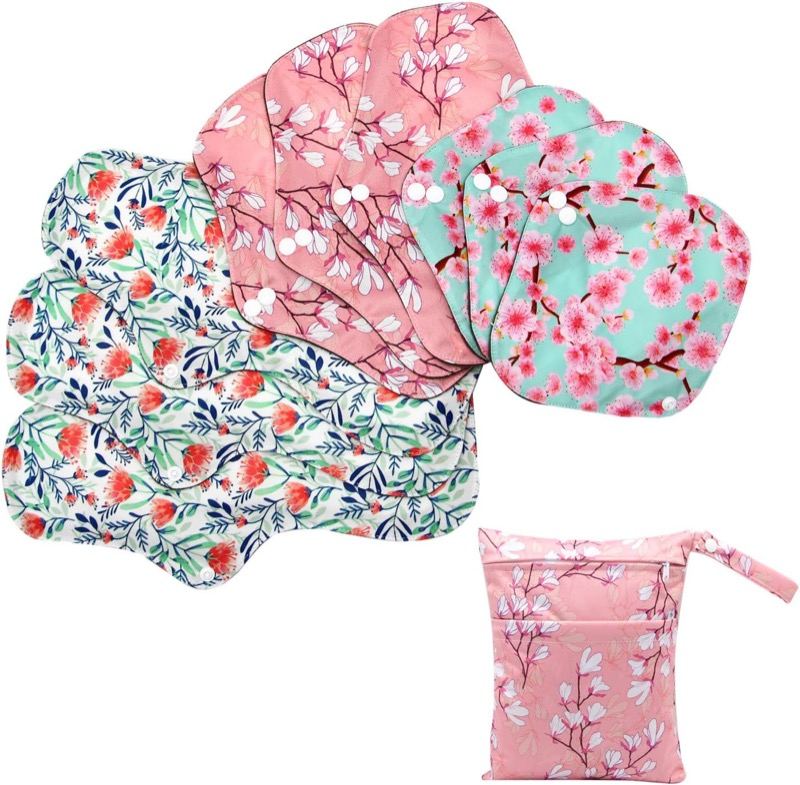
Reusable cloth pads with adjustable snaps, nine-piece set
A multi-size set with snap wings, sold with a small wet bag. Because the snap positions change the closed width, ask for the snapped width per setting rather than treating the set as one size.
What to ask a supplier to specify
Ask for information that can be measured or checked on a sample, not phrases like "universal fit" or "anti-leak":
- Finished dimensions: total length, core width, open wing width, and snapped width for each closure position.
- Pattern options: centred or offset wings; straight, contoured or flared profile; which end gives extra coverage.
- Closure details: snap material, number of settings, spacing, how settings are measured, any repair option.
- Layer construction: face, absorbent layers, backing, and any coating or grip treatment — composition by layer, not a generic "bamboo charcoal" label.
- Care instructions: washing and drying directions supplied with the product, plus the intended condition after care. "Machine washable" does not describe every temperature, detergent or drying method.
- Order configuration: pads per set, sizes and colours in a set, sample price, MOQ, packaging, and whether MOQ counts pads or sets.
For a product intended to fit several underwear sizes, ask for a sample matrix rather than one "best" sample. Compare snapped widths and wing profiles against the target gusset measurements, and ask the supplier to identify the exact option behind each sample — marketplace pages often group several sizes under one listing. Photograph each sample closed around underwear and label it with SKU, setting and measurement method.
Keep the matrix small: one row per sample and underwear combination, with gusset width, snap setting and observed movement. If a pad shifts, repeat the setup once before changing a variable; otherwise you will not know which change helped.
Write a short acceptance rule before the samples arrive: which underwear combinations must close without stretching, what counts as a shift, and what closure or comfort problem triggers rejection. The rule should reflect your customers and your own testing, not an invented industry standard. If one size fails but a second snap position works, decide whether that option belongs in the range or needs clearer sizing guidance.
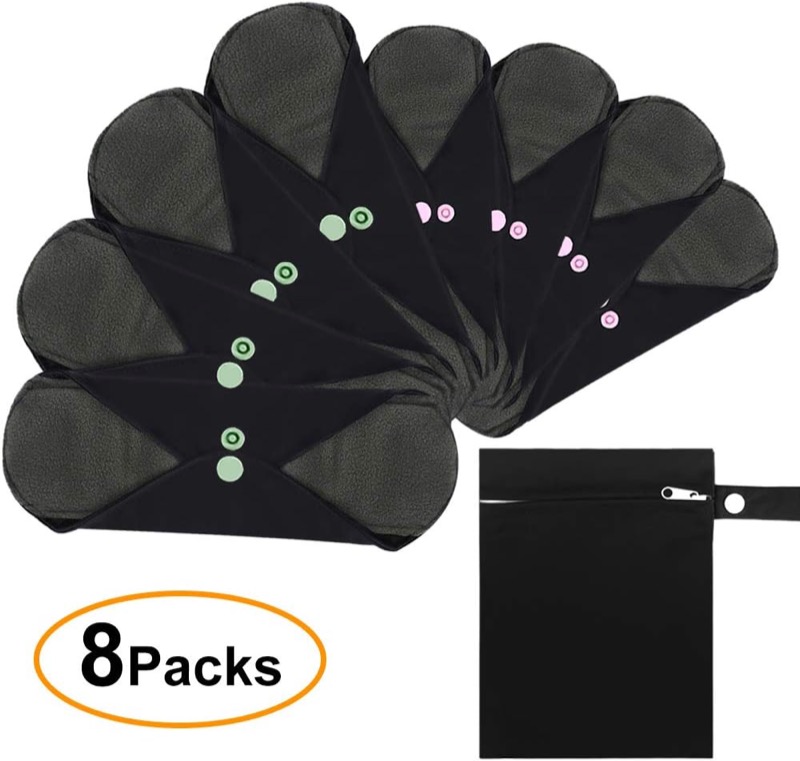
Reusable cloth pads, eight-pack with wet bag
A two-size pack with a waterproof outer layer and snap wings. Bulkier multi-layer pads can bunch on a wide gusset, so compare the closed thickness and snapped width with your own underwear.
A candidate listing to inspect
One supplier listing is titled around adjustable snap waterproof wings, from a wholesale supplier in Yiwu. When checked, the page showed no product reviews, a displayed sample price around US$2, and a unit price falling from roughly US$3.05 at 50–499 pieces to US$2.75 at 5,000 or more.
The title suggests adjustable snaps, but the visible attributes did not give a snapped-width chart, exact material composition, pad dimensions or snap positions. Treat it as a candidate for a sample request, not an endorsement or proof that it solves shifting. Confirm the precise variant, specifications, shipping, care label and current terms with the seller.
Marketplace listings also use "anti-slip" alongside absorbency claims. That shows how sellers position the category, not what the pad does in wear. Ask what physical feature creates the grip and whether it lasts through the stated care routine.
The practical decision
Diagnose which way the pad moves, check the underwear gusset and the pad's fastened width, then test the actual pattern with the underwear and movement it is meant to serve.
If the snap does not wrap securely, changing the backing alone will not fix it. If it stays fastened but the pad still moves or bunches, compare a different snap setting, wing shape or length before committing to a larger order.