A reusable makeup remover pad is a small, simple product with a surprisingly long list of claims attached. "Made from natural bamboo." "Up to 1,000 washes." "Removes waterproof mascara with water alone." "Antibacterial." "Zero waste." Each is easy to write and hard to check from a listing photo, and each one, if it turns out to be false, comes back as a return, a bad review or — for the material claims — a labelling problem.
The pad itself is a few layers of fabric sewn into a round or a square. What goes wrong is predictable: the mascara stain that never comes out of the stitching, the edge that frays after a few washes, the fabric that sheds lint onto a clean face, the "bamboo" that turns out to be something else, and the pad that smears makeup instead of lifting it.
This guide is for small brands and sellers about to approve a reusable pad, and for buyers who want to know what the listing is really saying. It covers the material words, a repeatable removal, wash and lint test, and how to word claims so the page says only what you have shown. It recommends no particular product and makes no skin-health claims.
What is in the pad: layers, fibres and finishes
Most reusable pads are one to three layers of knitted or woven fabric, often a terry or fleece-like face, sewn at the edge. A listing may call this "3-ply", "triple-layer" or "plush". For each sample, write down five answers:
- What fibre is each layer? A pad might be bamboo viscose on the face with a cotton or polyester back, or microfibre on both sides.
- What is the construction? Terry loops, fleece, flat knit or woven. Loops and pile hold makeup differently from a flat surface.
- How is the edge finished? Overlocked, bound, or cut and sealed. The edge is where most pads start to fail.
- What size and thickness? Listings range from small rounds of about eight centimetres to cloths of fifteen by fifteen or more. Weigh a sample; a heavier pad usually means more fabric.
- Is the surface dyed or printed? A dark pad that bleeds colour onto the face or into a wash load is a different problem from a stained white one.
If the supplier cannot answer these in writing, treat the rest of the description as unverified. The same applies to the packaging: if the set includes a laundry bag, ask what it is made of and how it closes, because a bag that opens in the machine defeats its purpose — the bra wash bag test covers what to look for.
"Bamboo" is a claim with rules
Bamboo is the most common material word on reusable pad listings, and the one most likely to cause trouble.
The US Federal Trade Commission has been clear for years. If bamboo has been chemically processed into a manufactured fibre, the fibre is rayon (also called viscose), and it must be labelled and advertised as rayon, viscose or "rayon made from bamboo". A textile may be called "bamboo" only if it is actually made from bamboo fibre processed mechanically. A laboratory bulletin summarising the FTC position makes the same point, and notes that fabrics of rayon made from bamboo do not retain the natural antimicrobial properties of the bamboo plant.
The FTC has acted on this repeatedly. Settlements with major retailers over textiles advertised as bamboo but made of rayon ran into the millions of dollars, and the agency's guidance said that relying on other people's claims is not substantiation — including for the claim that the rayon keeps bamboo's antimicrobial properties. Those cases concerned large retailers and household textiles, but the principle applies to a small brand: the label and the listing must name the fibre actually in the product.
In practice:
- If the supplier says "bamboo", ask whether the fibre is bamboo viscose, rayon, or mechanically processed bamboo fibre, and get the answer in writing. Much of the "bamboo" fabric sold in this category is viscose.
- Write the composition as it should be written: "bamboo viscose" or "rayon made from bamboo", with percentages per fibre.
- Do not describe the pad as antimicrobial, antibacterial or naturally hygienic because it is bamboo. Do not copy those claims from a supplier page.
- Be careful with "eco-friendly" and "sustainable". The FTC's guidance on environmental claims treats broad, unqualified benefit statements as likely to mislead.
Fibre rules and the scope of US labelling law vary by product classification and by market. This guide cannot settle which apply to your pad, so check with a compliance adviser. The safe approach is simple: name the fibres accurately and make no claim you cannot document.
Microfibre, natural fibres and what actually sheds
Sellers often say polyester microfibre pads shed microplastics while bamboo and cotton do not. The picture is more complicated.
A study published in PLOS ONE in 2021 measured microfibre release from 37 consumer textiles over five domestic wash cycles. Polyester fleeces and jerseys shed several times more than woven nylon, shedding rose with fabric thickness for nylon and polyester, and cotton and wool also shed large amounts. The spread between the lowest and highest shedding fabrics was more than 850-fold, so construction mattered as much as fibre. Lint traps retained up to 90 per cent of polyester fibres in that study, less for nylon.
A separate laboratory study of synthetic fabrics found fibre release rose with wash temperature and was greater with detergent than with water alone. These studies concern apparel and whole machine loads, not small face pads, so do not extrapolate numbers to your product. What they support is narrower and still useful:
- "Natural fibres don't shed" is not a safe claim. Natural-fibre textiles shed too.
- Construction matters. A thick, brushed or looped pad is likely to release more fibre than a tightly woven or flat-knit one.
- If you sell a microfibre pad, say what it is made of and do not call it "plastic-free". If you sell bamboo viscose or cotton, do not call it "shed-free".
- A mesh laundry bag is a reasonable care instruction, but a bag is not a filter. Do not claim it prevents microfibre release.
What "1,000 washes" really means
A long-life number is one of the strongest selling points for a reusable pad. Claims in the hundreds, and up to 1,000, appear on listings and brand pages. We could not find an independent test supporting a specific number for a specific pad, and a supplier-side buying guide that cites hundreds of washes for cotton, bamboo and microfibre presents it as a typical figure, not a measurement.
Treat a wash-life figure as a supplier's design target unless they can show a test report with the method, wash conditions and failure criteria. For your own listing:
- Do not publish a wash count you have not tested.
- If you tested twenty washes, say so ("tested through 20 machine washes"), not "built to last".
- Describe what you looked at: shrinkage, edge fraying, pilling, colour change, thickness loss, layer separation.
- The same caution applies to comparisons such as "more absorbent than cotton": if you make one, say how absorbency was measured.
The removal test
A pad that does not remove makeup is a failed product however well it washes. This is a proposed in-house screening test, not a standard, and it measures only what happened on your test surface.
Use a reproducible surface — a smooth white card, or a plain section of a volunteer's forearm with their consent and no known sensitivities — rather than a face. Decide in advance which products you will test and keep them the same across samples.
| Step | What to do | What to record |
|---|---|---|
| 1. Prepare swatches | Apply equal swatches of foundation, lipstick, waterproof mascara and waterproof eyeliner in marked spots | Product names, shades, time applied |
| 2. Define the method | One method per run: water only, a micellar water, or a cleansing oil or balm | The exact product and amount, applied the same way each time |
| 3. Wipe | A fixed number of passes at the same light pressure | Passes needed to remove each product |
| 4. Look | Photograph the area and the pad under the same light | Residue left on the surface; how much colour sits on the pad |
| 5. Repeat | Use the other side of the pad, then a second pad of the same type | Whether the second pad matches the first |
| 6. Compare | Run a disposable cotton round as a reference | How each reusable pad compares with the reference |
A few observations carry special weight. Smearing — spreading the product rather than lifting it — is a failure even if the result looks clean. Residue after the same number of passes means the pad is less effective than the reference. Pad colour matters too: a pad that picks up colour but never releases it in the wash will look permanently stained.
Sellers often say microfibre cloths remove makeup with water alone while bamboo and cotton need a remover. That is a plausible design difference, but brand copy is not a test. If you want to say "removes makeup with water only", test it with water only on the products you name, and say which products and how many passes. Do not say "removes all makeup", and avoid "waterproof" unless you tested a waterproof formula.
The stain and wash test
The commonest complaint about reusable pads is not that they fail to clean the face — it is that they never look clean again. Buyer reviews of bamboo pad packs mention staining from mascara mostly along the stitching at the edge, and that is exactly where to look first: edge stitching and any seam hold pigment that the face of the pad releases.
The stain test used for cosmetic bag lining adapts here. For pads:
- Soil the pads in a controlled way. Use the removal test above so the pads carry a known set of products. Leave half to sit for twenty-four hours before washing, and wash the other half straight away.
- Wash as the label says. Use the temperature and method you intend to print, in the same machine and detergent for every sample, in a mesh bag.
- Check after each wash. After the first, then after five, ten and twenty, photograph each pad on a white surface — front, back and edge.
- Record what changed. Shrinkage (measure diameter or side length before and after), edge fraying, pilling, colour change, thickness, stiffness, layer separation.
- Check the stitching. Pull gently on the edge stitching; it should not open or unravel. Look for loose threads that catch.
What temperature to put on the label
Care instructions vary widely across brands. We saw pages recommending a 30 °C wash, a normal wash at 40–60 °C, and in one case a hot wash for cotton cloths. Some sellers say a 60 °C wash eliminates essentially all common skin bacteria. A hygiene article published by a reusable-pad brand notes that the evidence behind standard wash-temperature advice is softer than it sounds, and that drying habits matter as much as the wash. These are seller sources, not clinical guidance.
Practical rules for a seller:
- Put on the label the temperature you tested. If you only tested at 30 or 40 °C, do not write 60.
- Check that the fabric tolerates the temperature. A supplier-side guide warns that hot water degrades natural fibres and makes microfibre pill. Test at the highest temperature you intend to print.
- Do not claim the pad is sanitised or hygienic after washing. You have not tested hygiene, and a home wash test is not a microbiological test.
- Include drying instructions. A damp pad left in a closed bag is a different hygiene question from a dry one, as covered in the makeup sponge case ventilation test.
- Dermatologist commentary in consumer articles says to treat reusable pads like small towels and wash them regularly. That is common sense, not a specification. Your care label should be a tested method, not a hygiene promise.
Absorbency and feel
- Drop test. Place a measured drop of water on a dry pad and time how long it takes to soak in. Same drop size every time. This is a screening test, not a standard, and only compares pads with each other.
- Hold test. Dampen with a fixed volume of water, then squeeze lightly. A pad that releases nearly all of it may be too thin; one that holds it all may be slow to dry.
- Dry time. Weigh a damp pad, hang it up, weigh it at fixed intervals. A pad that takes a long time to dry is more likely to smell if stored in a bag.
- Hand and skin feel. Ask volunteers to rate the softness of face and edge. A rough or stiff edge near the eye is a reason to reject the sample.
- Fit to the finger. For cloths with a finger pocket or loop, check the opening fits several hand sizes.
Do not publish absorbency as a number or compare it with another material unless you ran the test the same way on both and can show your method.
The lint test
Lint on a clean face or a freshly cleaned eyelid comes up with any fabric pad, especially new ones and pile fabrics. The lint-free nail wipe test uses the same method.
- Wipe a dark, smooth surface. Take a new, unwashed pad and wipe a black glossy card, then photograph it in raking light.
- Repeat with a damp pad. Wet it, squeeze out the excess, repeat.
- Wash once, then repeat. Many pads shed most in the first wash. Compare the first wipe with the result after one and after five washes.
- Look at the pad as well. Shake a pad over a dark cloth and see what falls out.
Record the visible lint at each stage and how many washes it takes to settle. A pad that keeps shedding visible fibre after five washes is a poor candidate near the eyes.
The first wash matters in another way: several brands tell customers to wash pads before first use. If you do, say so on the pack and the listing, because a pad that must be washed before use is not ready to use out of the packet.
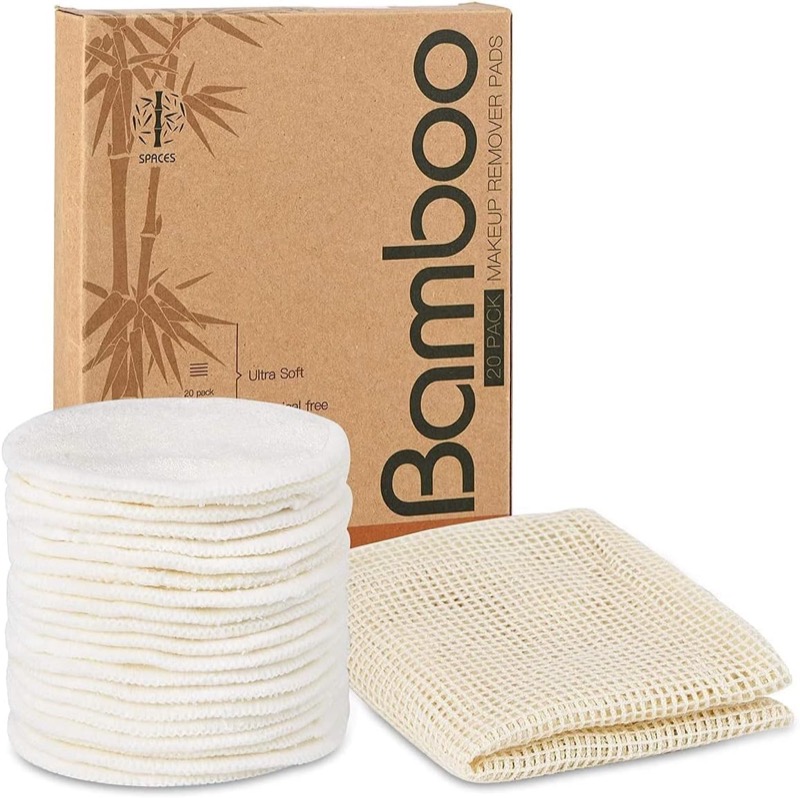
20-pack reusable bamboo cotton rounds with laundry bag
A retail example of the format: round pads, a cotton laundry bag and a 'bamboo' claim in the title. The listing is the reason this guide exists — bamboo in a product name usually means bamboo viscose, which is a fibre the label should name.
Skin, eyes and the claims to avoid
Pads are used on the face and around the eyes, which raises wording questions this guide cannot resolve for your market.
- "Hypoallergenic", "dermatologist-tested", "safe for sensitive skin". Claims about biological response. Do not use them without documentation you understand.
- "Antibacterial" and "antimicrobial". Some brands add an antimicrobial treatment. If yours does, ask what it is, what it was tested for, and what your market requires you to say. If it does not, do not imply it through the fibre name.
- "Chemical-free". All fabrics are made of chemicals. The phrase is vague and invites a challenge.
- Eye-area use. If the pad is meant for eye makeup, test that with volunteers who agree to it, and avoid instructions that encourage rubbing hard.
- Allergies and sensitivities. If a fabric is dyed, ask about the dye and any finishes. A volunteer reporting irritation is a result to record, not to explain away.
If the pad is sold to children or teenagers, product-safety rules may be stricter. Ask a compliance specialist before listing.
Pack size, pad size and the routine they imply
The number of pads in a set and their size quietly decide whether the product fits a routine, and so whether it earns good reviews.
A buyer who removes makeup once a day and washes weekly needs at least seven pads to avoid reusing a soiled one. A buyer who uses one pad per eye and one on the face needs three a day. A set of three or four sold as a "starter" forces frequent washing and can feel like a poor deal even when the pads are good. A supplier-side guide suggests seven to ten pieces to cover a week; treat that as one person's rule of thumb and work out your own from how your customers describe their routine.
Size matters as much. A small round pad of around eight centimetres suits toner and light removal but soils quickly. A larger cloth of fifteen centimetres or more covers the face but is awkward around the eyes and dries slowly. If you sell more than one size, say what each is for, and test each in the routine it is meant for rather than assuming results carry across.
Finally, storage. A pad that goes into a mesh bag or a small box while damp, or sits in a bathroom drawer, behaves differently from one dried on a rack. Say how to store and dry it, and include a drying step in your own wash test so the care instructions are the ones you actually ran.
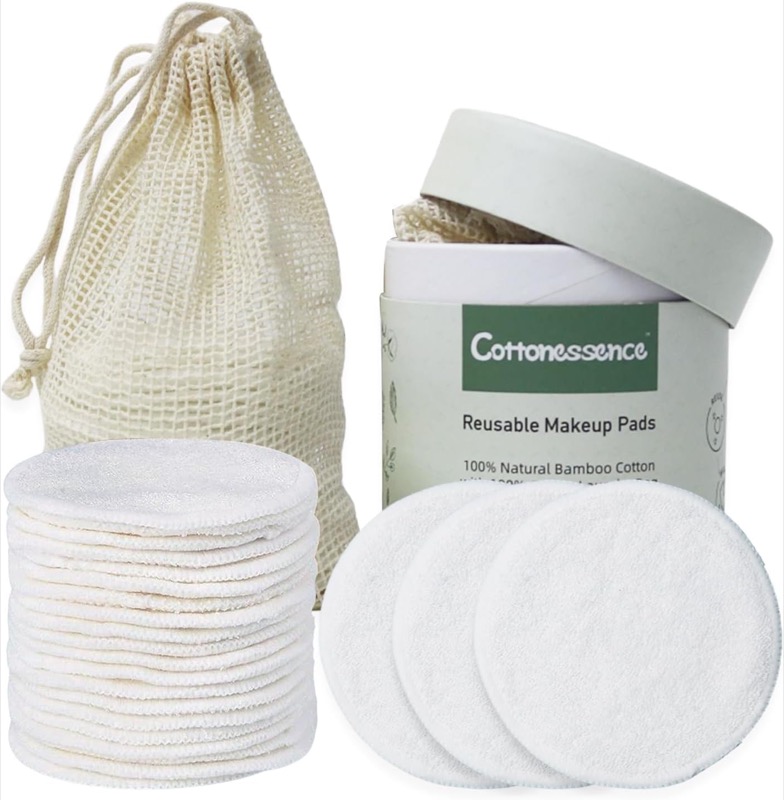
25-pack reusable rounds with laundry bag and storage box
A second pack format worth comparing: more pads and a rigid storage box. Pack size is a routine decision, not a quality one — decide what a customer's week actually needs before matching the count.
Pass, revise and fail: decide first
| Area | Pass | Revise | Fail |
|---|---|---|---|
| Fibre disclosure | Each layer's fibre and percentage confirmed in writing, bamboo named correctly | One layer unclear | Supplier will not specify, or insists on "bamboo" for viscose |
| Removal | Matches or beats the disposable reference on the named products | Needs more passes on one product | Smears or leaves residue on most |
| Stain, first wash | Wipes out to an acceptable level | Faint staining at edge only | Stains on the face that do not wash out |
| Stain, twenty washes | Looks the same as after the first | Gradual dulling | Visible permanent staining or colour loss |
| Shrinkage | Within the tolerance you set | Slightly above | Visible distortion |
| Edge and stitching | Intact after the agreed washes | Minor loose threads | Fraying or open seams |
| Layers | Stay together | Slight puckering | Separate |
| Lint | No visible lint after the agreed washes | Fades by the fifth wash | Keeps shedding |
| Dry time | Dries in the time the care label states | Slightly slower | Stays damp and smells |
| Laundry bag | Closes securely and survives the washes | Closure needs improving | Opens or tears |
| Documentation | Fibre and care statements in writing | Pending | None |
A single pad passing is a first step, not a green light. Test at least three pads of each type, and ideally one set from each production batch you plan to sell.
The supplier brief
- Product definition: shape, size and thickness, number of layers, whether the pad has a loop, finger pocket or backing.
- Materials: fibre content of every layer with percentages, and exact fibre names ("bamboo viscose", not "bamboo").
- Construction: terry, fleece, flat knit or woven; edge finish; stitch type and density at the edge.
- Dyes and finishes: whether the fabric is dyed or printed, and whether any antimicrobial, softening or water-repellent finish is applied.
- Care instructions: the wash temperature and method the supplier has tested, in writing.
- Laundry bag: material, size and closure type.
- Samples: at least three units of the final construction, plus a cutting of each fabric for destructive tests.
- Change control: a commitment to tell you before changing fabric, dyes or finishes.
If you source through a trade platform, keep answers in the platform's message history. When a reply says "natural bamboo, very soft", ask again: "what is the fibre content of each layer, as it would be written on a care label?"
What your listing can say
- State the fibre content of each layer with correct names, with bamboo described as viscose or rayon unless the supplier documents otherwise.
- Describe the removal test in plain terms ("tested on foundation, lipstick and waterproof mascara with a micellar water").
- Give the wash temperature and drying method you tested, and the number of washes you tested through.
- Say how big the pad is in centimetres, and how many layers it has.
- Avoid wash-life numbers you have not tested, comparisons you have not measured, and any hygiene, antibacterial or skin-health claim.
- Avoid "shed-free", "plastic-free" or "chemical-free" unless you can support the exact claim.
Frequently asked questions
Is bamboo better than cotton for makeup remover pads? Not necessarily. "Bamboo" on most pads refers to bamboo viscose, a manufactured fibre, and performance depends on weave, density and finishing at least as much as fibre. Compare actual samples with the same test.
Can I call my pads "bamboo"? Only if they are made directly from bamboo fibre. If the fibre is regenerated cellulose from bamboo, the US FTC says to call it rayon or viscose, or "rayon made from bamboo". Check the rules in your market.
Are microfibre pads worse for the environment than cotton or bamboo? Research on laundry shedding finds big differences between textiles and finds natural fibres shed too, so a blanket answer is not supported. Construction matters as much as fibre, and claims in either direction are risky.
How many washes will a pad last? It depends on the pad, the wash conditions and what you count as failure. Published figures of hundreds of washes, and up to 1,000, are supplier claims. Test your own samples and report what you did.
Do I need to wash a pad before first use? Many brands say so. If you do, put it on the pack and the listing, and test lint after the first wash.
What wash temperature should the label say? The one you tested, in the machine and detergent you tested with. Do not print a higher temperature than your samples have been through.
Can I say reusable pads are hygienic? We would not. A wash test is not a microbiological test, and temperature advice varies across brands. Say how to wash and dry the pad, and leave hygiene claims out unless you have proper data.
Should I include a laundry bag? It is sensible, since pads are small and easy to lose. Test that the bag closes securely and survives the same washes. Do not describe it as preventing microfibre release.