The retail bag is not automatically a travel system
A customer opens a new long wig, keeps the branded bag, and later takes it on a weekend trip. The bag may have been designed for dust protection in a drawer, not for a carry-on pressed under other packed items. When the wig reaches its destination looking flattened or tangled, the customer sees a product that did not travel well.
That is why a hair brand should treat travel as a separate pack-out question. A soft storage bag can be a useful component, but it is only one layer. The right system depends on the wig's length, construction, amount of styling, and the kind of trip the customer is likely to take. A straight 16-inch unit, a long loose-wave wig, and a high-volume curly unit do not occupy luggage in the same way. Nor should a brand promise the same travel outcome for all three.
Travel questions are visible in user discussions. People ask for a travel case as well as storage ideas, and experienced wearers point out that hooks may suit some cap constructions but not others. Cosplay users with long wigs ask how to get to an event without rebuilding the style on arrival. Search results mainly answer the wearer's immediate question: prepare the unit, contain it, keep it away from crushing items, and refresh it after arrival. The gap for brands is how to make that travel claim specific and testable.
This guide turns the consumer problem into a packaging brief. It does not say that any bag, hair net, box, or material will prevent damage. It gives a brand a way to choose the travel level it can reasonably support, sample the components, and write honest customer instructions.
First decide what kind of travel you are designing for
"Travel friendly" is too broad for a product page and too vague for a supplier. Start with the scenario, not the accessory.
Light carry use
The customer is taking one unit to a nearby appointment, overnight stay, or short trip. The task is containment and easy repacking. A bag and net may be enough if the item can sit without sharp folds or pressure.
Carry-on travel
The product travels in a suitcase or structured cabin case alongside clothing and toiletries. The brand has less control over orientation and pressure. Test the bag in an actual luggage arrangement, not empty beside a wig.
Styled, long, or high-volume units
Some products ask more of a travel system because their presentation depends on a particular shape, curl pattern, hairline, or volume. A brand should not imply that they can be rolled into any pouch and emerge unchanged. A common piece of stylist advice is to use a net and a bag in luggage rather than leaving the wig loose among other items. That is a useful starting point, not proof of a brand's own bag design.
Professional or event travel
For an item sold for stage, bridal, photo, cosplay, or repeated travel, the brand may need a separate case, form-support insert, or travel kit for styles that have passed an internal check. It does not mean adding a large box to every order.
The decision is not about making packaging look more expensive. It is about matching the promise to the journey. If your retail bag only supports at-home storage, call it a storage bag. If you have tested a carry-on routine for a named group of styles, say what the routine includes and where its limits are.
Build a travel pack-out around the finished wig
Do not create a travel kit from a supplier catalogue alone. Start with the actual retail unit, fully prepared as a customer will receive it.
Use this sequence on the packing bench:
- Prepare the unit. Work from the maker's care guidance. The wig should be in the condition in which you would normally ask a customer to store it. Do not use a wet or freshly treated sample merely to make it easier to compress.
- Choose the intended arrangement. Decide whether long hair stays extended, folds once, sits in a loose coil, or is secured in another documented arrangement. Photograph it before adding any components.
- Add containment. If the system includes a hair net, record the net size and how it is fitted. Some marketplace listings show hair nets sold as both a wearing accessory and a packaging or storage item; that demonstrates an available product role, not a universal packing method.
- Add shape support only when needed. A soft insert, clean tissue, or a cap-shaped support may help maintain the form you are testing. But it should be specified by position and purpose, not included as random filler.
- Place the unit in its retail or travel container. Check the closure, usable internal dimensions, and the route from packing bench to outer luggage.
- Write the customer version. If a person unfamiliar with the kit cannot follow the instructions in a minute or two, simplify the arrangement before you approve it.
The outcome should be a repeatable photo set, not only a product mock-up. Keep front, side, closure, and outer-case views. When a sample changes, repeat the set.
Pick components by their job, not by their marketing language
The basic travel set often contains some combination of a bag, net, support, and outer container. The useful question is not "Which is best?" but "What specific job is still uncovered?"
| Component | Job to test | Common failure to watch for |
|---|---|---|
| Hair net | Keeps the intended arrangement together while the wig is moved | Too tight, difficult to fit, or not large enough for the style |
| Storage bag | Separates the unit from other packed items and makes repacking understandable | Long hair must be forced into the closure, or the bag is too loose to control the pack |
| Light shape support | Holds a named area in the tested shape | Support shifts, creates a pressure point, or becomes confusing for customers |
| Outer box or case | Takes the pressure and organisation burden of luggage | Fits the wig but not the real carry-on, or adds bulk without solving a documented problem |
| Care card | Shows the customer how to repeat the approved arrangement | Broad promises replace practical packing instructions |
A marketplace listing may advertise a transparent window, hook, stated size, and travel suitability. These are useful comparison prompts, not verification for your length, density, styling, or shipping method. Use retail products to understand formats; use samples to decide whether one belongs in your line.
The same applies to any second retail reference. Before adopting a bag with a hanger, test what happens when the filled bag is carried horizontally, placed in a case, and returned to a customer. A hanger that works well in a closet may be irrelevant, or even awkward, in a compact travel pack.
The distinction that prevents overpromising
There are three statements a brand can make, and they should not be treated as equivalent.
"Includes a storage bag." This is a component statement. It is appropriate when the bag is part of the retail set and you have accurately described it.
"Designed for travel." This is a design statement. Use it only when the product has a defined travel arrangement and the relevant styles actually fit in it without an unreasonable step for the customer.
"Protects the style in travel." This sounds like a performance promise. It needs much stronger, product-specific evidence than a supplier description or a single internal pack-out. Unless you have a robust testing programme and can state its boundary, replace this claim with practical guidance about the intended arrangement and circumstances.
If a wavy, long, or heavily styled wig is sold with a light drawstring pouch, the honest statement may be that the pouch is for storage and light carry use, with separate advice for longer journeys. The answer may be different information, a travel option, or a narrower claim.
Retail and sourcing references
The following links are retail and sourcing references for comparing travel-pack-out components. We may earn a commission from qualifying purchases through these links. Product pages and supplier descriptions do not prove fit, durability, travel performance, current customisation availability, or CPS eligibility. Recheck the current listing and sample the exact configuration before ordering.
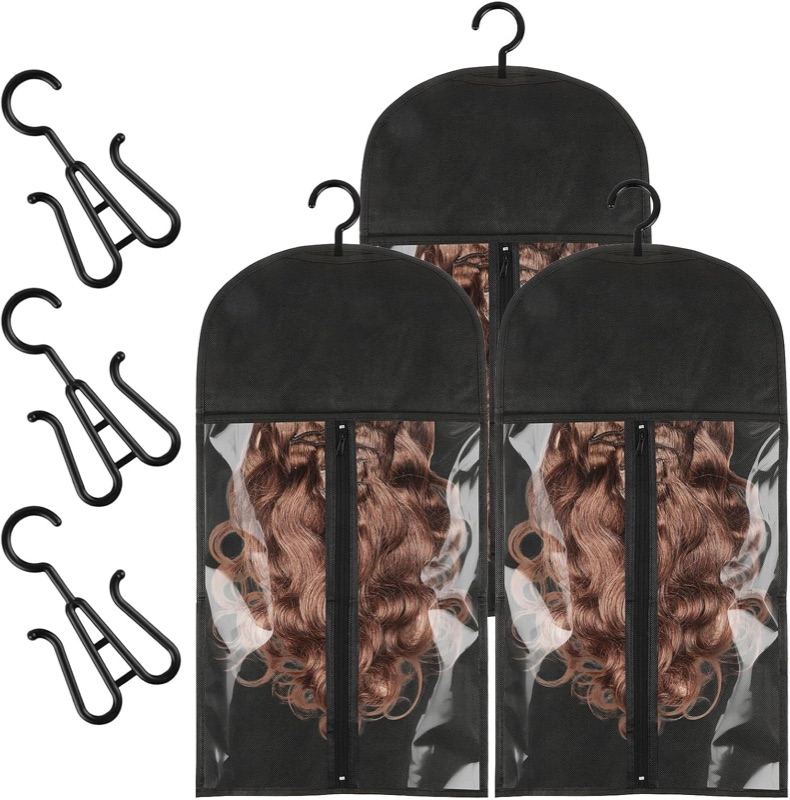
Wig storage bags with hanger, 3 pack
A three-pack of hanging wig storage bags with stated dimensions. A retail reference for the containment and hanging format discussed above — measure your own packed unit against the listed size before treating it as a travel bag.
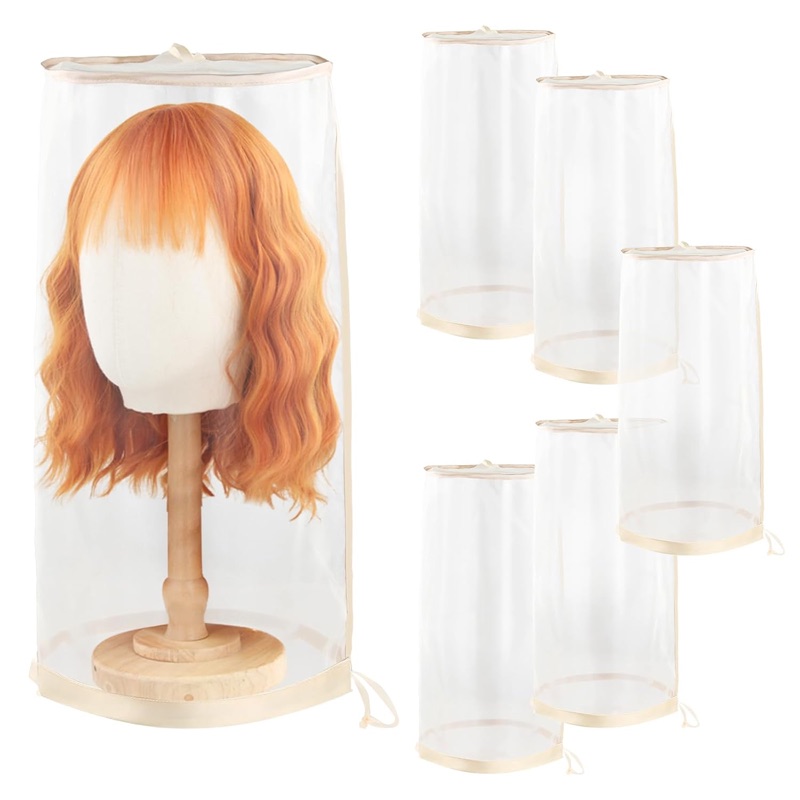
Wig storage bags for multiple wigs, 5 pc with holder
A five-piece wig storage set with a holder stand, aimed at keeping several units separated and fresh. Useful for comparing storage-first formats against a bag you would actually carry.
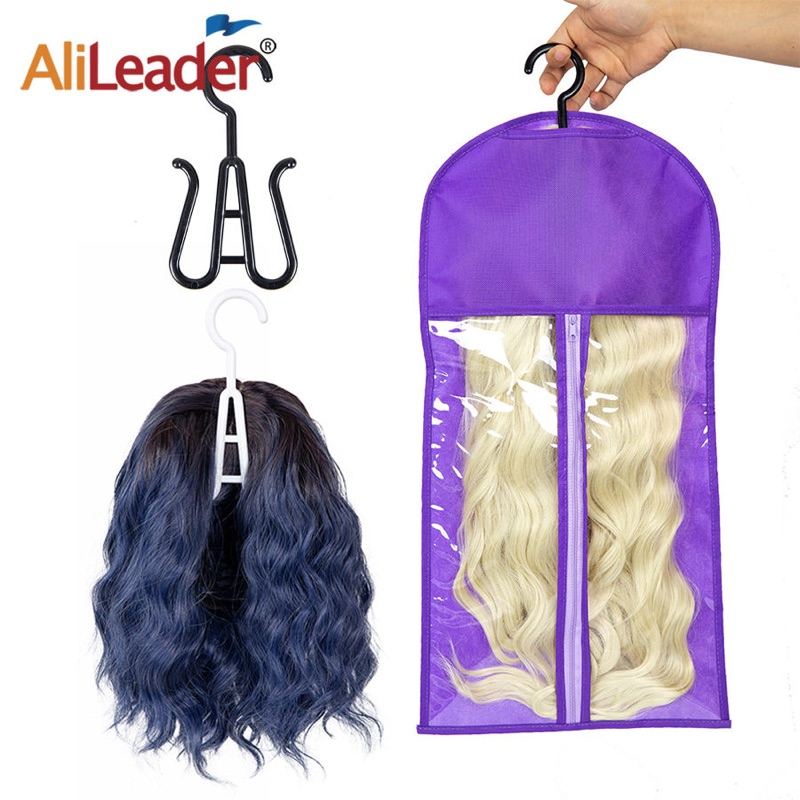
Non-woven hair extension packaging bag with hanger
A wholesale non-woven hair extension packaging bag with a zipper, dust-proof flap and hanger hook. A supplier listing to verify directly for material, listed size, logo process and current ordering conditions before relying on it for travel.
Card photos are the current marketplace listing images and may differ from the delivered product; confirm details on the live listing.
Test the pack-out in the situation you are describing
A packed product can look fine on a table and fail once it is placed in a suitcase. Run a simple, consistent check before approving your travel language.
Pack and close
Ask someone who did not create the layout to follow the card and pack the finished unit. Watch for caught hair, a closure that requires pressure, or instructions that assume expertise. Record hesitation and the final shape.
Carry-on placement
Place the set inside the kind of carry-on or travel tote the product page depicts. Add clean stand-ins for clothing and a toiletry pouch. Recreate the reasonable use case you intend to describe. Photograph it before closing and after reopening.
Arrival check
Remove the wig and compare it with the pre-pack image. Check cap shape, hairline, parting, ends, curls or waves, and supported areas. The result is a pass, revise, or fail decision for one product and one handling routine, not a universal rating.
If the pack-out fails, identify where it failed. A longer bag cannot solve a pressure problem created by an overfilled case. More filler cannot solve a closure that cuts across the longest hair. A box cannot solve a care card that leaves the customer guessing how to put the wig back. The revision should address the observed failure rather than adding components at random.
Translate the test into a supplier brief
When a travel component is suitable for your line, send the supplier a brief that a production team can act on. A generic request for "premium custom wig travel packaging" invites an attractive but untested proposal.
For a bag, include finished usable length, width, depth, opening orientation, closure type, and the largest style it must accommodate. State whether it is intended only for the retail storage set or whether it must work inside a defined outer case. If a clear panel, logo, label pocket, hook, or hanging point is included, state its location and test it with a filled sample.
For an outer box or travel case, include the packed internal dimensions, preferred orientation, whether it needs to carry a net or support, and the actual carry-on or carton limit you are checking against. Do not treat a product listing's custom colour, size, or logo options as confirmation that the supplier can deliver your final specification. Confirm sample availability, current minimums, customisation terms, production timing, and shipping conditions directly.
A supplier listing for a wig storage bag with a hanger is a useful sourcing reference and a way to compare an available format. It is not evidence that the listing supports every travel scenario or that its listed terms will apply to your order. Sample the exact configuration before you commit.
Give the customer a short packing card
The best packaging system fails if the customer cannot recreate it. Keep the card product-specific and plain.
- Start with a clean, dry unit prepared according to the product's care instructions.
- Arrange the hair as shown in the photograph; do not force the longest lengths into the closure.
- Fit the included net only if the set contains one, using the illustrated direction.
- Return the wig to the bag or case with the closure facing the stated side.
- Keep it separate from sharp accessories and liquid containers in luggage.
- For styled or specialty units, follow the product-specific instructions or use the travel option named for that style.
Avoid phrases such as "crush-proof," "damage-proof," or "keeps curls perfect." They create an expectation that packaging cannot responsibly guarantee across different journeys and customer packing choices.
What to approve before using a travel claim
Approve the travel language only after you can name the product style, packing sequence, included components, and outer-carry situation it refers to. If any part remains unknown, keep the promise smaller. A clear storage system and honest instructions usually serve a hair brand better than a dramatic travel claim that has not been tested.