The storage bag looks generous when empty. Hang a long wig inside, draw the zipper upward, and a few loose fibres reach the track. The customer stops, pulls the strands free, and tries again. If she has to repeat that manoeuvre every time, the bag is not performing the ordinary task it was sold to do.
A comment on a wig-storage video described exactly that irritation: the owner liked her bags but said stray wig hairs caught in the zipper. One marketplace reviewer described placing a paper barrier behind a zipper to keep hairs away. These are individual reports, not a measured rate of failure. They are enough to give a hair brand a concrete sample question: can a person place and remove the finished unit without feeding loose hair, lace or a lining flap into the closure?
This is a bag-approval guide for small wig and extension brands. It addresses zipper placement, working clearance and the pack-out method for the item being sold. A buyer who needs an at-home solution can use the same observations to compare bags, but a retail listing cannot establish protection for every hair length and density.
Separate a rough zipper from a crowded bag
There are at least three ways a closure can snag. A damaged tooth, exposed edge or rough seam can catch fibres even when the bag has space. An otherwise smooth zipper can sweep hair into its track if the usable width narrows where the wig is full. Or the hanging point can let the piece swing toward the closure while the user zips. Fixing one mechanism does not automatically fix the others.
Inspect the empty bag first. Open and close the zipper several times. Note any place the slider hesitates or the bag fabric folds into the track. Look at both sides of the zipper tape, its ends, seams and hook attachments under good light. A smooth exterior does not tell you whether the inside edge is rough. Published wig-care guidance already advises checking teeth, seams and hooks on an empty bag, then isolating hardware from the fibres. That consumer advice covers a useful first pass; the product-development decision is whether the finished bag allows that isolation without extra improvised materials.
Now put the actual unit inside. If the closure operates normally without a wig but pulls hair when filled, avoid blaming only the zipper brand. Measure the packed width and depth where the hair spreads, not just the bag's flat length. A long straight unit, a layered wig, and a dense curly style can occupy the same nominal length in very different ways. Capacity is a three-dimensional fit, while many listings publish a flat outer measurement.
Do not force a stuck slider. Reverse it carefully while supporting the trapped hair, then examine the point of contact. Pulling harder may increase tension on hair or on a lace edge. If fibres are already tangled in hardware, the correct next step depends on the wig construction and extent of damage; a storage-bag article cannot promise a universal removal trick.
Choose a reference unit that makes failure visible
Do not approve the bag using the easiest wig in inventory. Select a production-intent unit at the upper end of the length and volume you plan to put in that format. Add a second, different construction if the same bag will serve both straight and high-volume styles. Keep the cap, lace, clips and accessories configured as a customer would store them, following the wig maker's care directions. A display mannequin that conveniently holds every strand in place can conceal problems that appear when a customer packs the unit alone.
Record the item's measured hanging drop from its supported point, its widest packed zone, and where the free ends sit once inserted. Note whether it must be folded to close the bag. If folding is necessary, decide whether that fold is appropriate for this style and material; it should not arise accidentally when a buyer zips a too-short enclosure. The approved reference should identify the exact unit and prepared condition, not just "24-inch wig." Advertised hair length alone does not describe the packed profile.
The storage goal also matters. A bag used only to hang a clean, dry unit in a closet has a different job from one placed into luggage, compressed under other items, or mailed as retail packaging. A hanging travel bag with a front zipper and clear panel is described with advice that the wig be dry and detangled before storage. Those are stated features and care directions for that product, not evidence that it protects a different wig under your shipping conditions.
Test the closing motion, not only the final photograph
Take a short sequence of photos or video from the first placement to full closure. Watch the track at the widest part of the hair, where the bag narrows, and at the final few centimetres. Ask someone who did not design the bag to do the task using only the printed directions. Record the number of times that person has to move hair out of the way, reopen the zipper or straighten the body of the bag. A closed product photograph cannot reveal this handling burden.
Then repeat the test after removing and reinserting the same unit. People do not always return a wig to precisely the position selected by the packaging team. Run the sequence with the bag hanging and, if relevant, lying flat. A hanging bag may allow gravity to keep lengths straight but also swing toward its front zipper. A flat bag can present a different crowding point near a side seam. These are observations to make in your sample, not predictions that one layout always wins.
Check the reverse motion. Hair can enter a zipper when opening the bag too, especially if ends migrated during storage. Document whether the user can see the path before moving the slider, whether a transparent panel makes the contact area visible, and whether the opening is wide enough to remove the wig without dragging hair across exposed teeth. If visibility depends on a clear window, check how the bag performs when it hangs in the intended closet light rather than only on a white studio table.
Keep a failure log with the unit, bag sample, date and action. "Caught at the lower left seam on opening" is more useful than "bad zipper." Retain the physical bag and a few representative photos. If a supplier changes the slider, zipper tape or bag dimensions after approval, use the reference to determine whether the revised sample solves the same fault.
A guard must work with the hair inside
A fabric flap or zipper guard can place a smooth barrier between fibres and teeth. It is worth sampling, but it is not automatically a fix. A loose guard can fold into the track, reduce usable interior width, or push bulky hair back toward the slider. Specify where it is attached, how much it overlaps the track, which side of the hair it faces, and whether it stays in place through repeated loading.
Compare at least two production-intent constructions under the same pack-out: the current zipper arrangement and a guarded or repositioned version. If the bag is already too small, a guard alone may make it tighter. A move of the closure to a side with more clearance, a wider gusset or a different hanger position may address the actual mechanism more directly. Get a physical sample before approving artwork, because a flat drawing will not show what the hair does during closure.
Consider the cost of customer instructions. "Keep all loose hairs two finger-widths from the zipper while closing" can be helpful as care advice, but it should not compensate for a design that puts the full unit against the track. A separate smooth sleeve may help contain hair for a particular unit, but adds another component, packing step and care question. If you decide to include one, test the sleeve and bag together and say what each piece does.
Do not assume a drawstring pouch removes every snag risk. Cord channels, knots and exposed eyelets can catch fibres, and a narrow mouth may require squeezing a styled unit. A drawstring style can be a useful comparison where a zipper bag cannot achieve adequate clearance, provided the opening, fabric, closure and intended storage method are also sampled with the same wig. The comparison is between working systems, not labels such as "zipper" and "satin."
Retail and sourcing references
The two links below are hanging, zippered bag formats at different pack sizes. We may earn a commission from qualifying purchases through these links. Neither has been tested for this article, and a larger pack is not evidence of better zipper clearance.
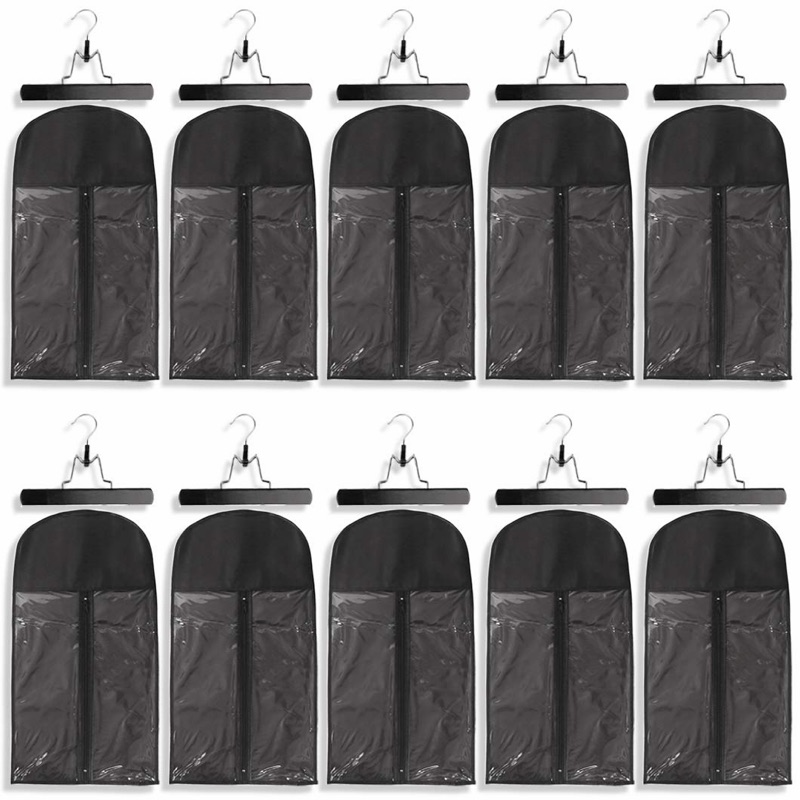
Hair extension storage bags with hanger, 10 pack
A dust-proof hanging bag format sold in a multi-pack, the configuration this article's closure test is written for. Sample it with your longest, densest unit — a bag that zips smoothly empty can still sweep hair into the track once the wig fills the width.
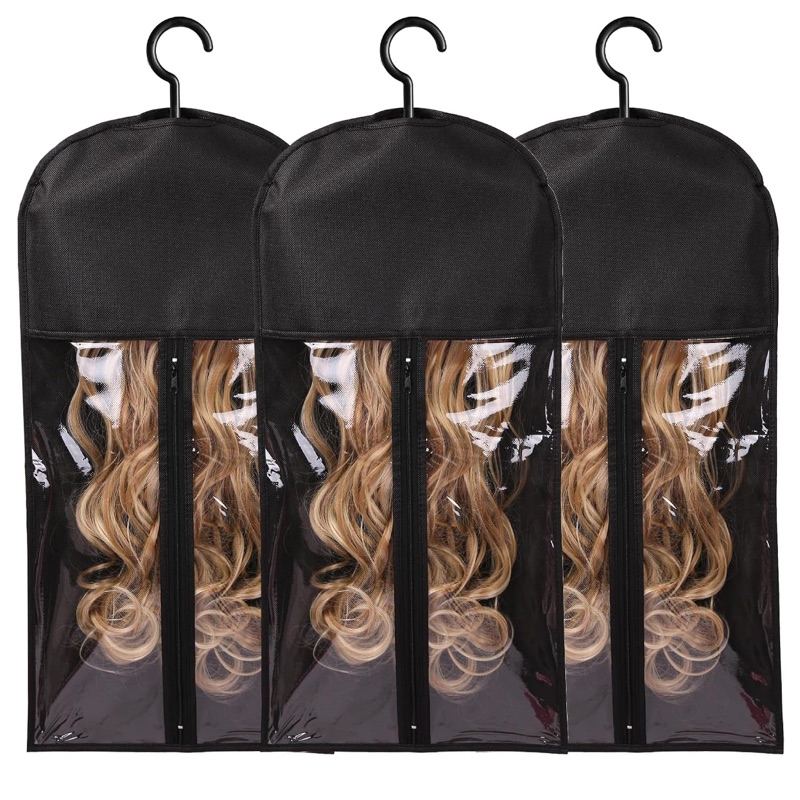
Wig storage bags with hanger, 3 pcs
A three-piece hanging set with a transparent closure, presented for holding more than one unit. Useful as the second construction to compare: run the same insertion, close and removal sequence and log where the hair reaches the track on each.
Card photos are the current marketplace listing images and may differ from the delivered product; confirm details on the live listing.
What a supplier brief needs to say
Send the supplier a drawing or marked photo showing the zipper path, interior side, hanger point and the zones that contact the unit. Add the packed width and drop of your reference wig and the minimum clear route you need during loading. Request the bag's usable internal width and depth when hung with a unit inside, not just the outer dimensions measured flat. Ask for component details on teeth, slider, tape, lining, guard, hook and seam finishing.
Ask how the bag will be sampled and whether a different zipper colour or logo treatment changes the construction. A supplier's product image can identify features, but cannot verify your specific pack-out. A wholesale listing for a nonwoven hanging wig bag with a zipper and custom logo states features to check on a sample, not proof of a protected hairline, and it is a product reference rather than an affiliate offer. Confirm minimum order, labelling and country delivery for the actual proposal before promising them to a customer.
If ordering multiple sizes, name the wig families assigned to each and make a separate approved pack-out for each size. A seller who swaps a longer unit into a previously approved bag can lose the clearance on which the first test depended. Keep a dated sample and the supplier's component record. Ask how substitutions are communicated, especially if a new zipper tape or seam finish is proposed after purchase order approval.
For a shipment check, do not rely solely on carton labels. Open a sample from more than one carton according to your receiving plan; compare zipper path, internal guard, seams, hook, usable dimensions and operation against the approved reference. Run a closure cycle with the representative wig or a controlled packing form that reproduces its occupied space. The form is useful for routine screening, but it does not replace periodic checks with real hair and lace, whose movement is part of the issue.
Calculate the cost of the usable bag
The cheapest unit price is not the whole purchasing decision. Add any inner sleeve, extra handling and replacement allowance required for the design to work. A bag that can be closed only by a trained packer may look acceptable in a warehouse yet fail at home. Conversely, a more expensive zipper guard has little value if the pack-out still crowds the track. Compare candidate costs only after both pass the same handling task.
Write the customer promise narrowly. "Includes a hanging storage bag" can be checked against the box contents. "Prevents tangling" or "protects the lace in travel" implies broader performance that a zipper-only test cannot support. If the bag is for closet storage, avoid turning that into a travel-protection claim without a separate packed-journey test. If the wig is intended for display on a stand, a bag may serve a different, occasional-storage role altogether.
In care instructions, show the customer's actual unit entering the bag, the direction of the zipper, and the position of long ends and front lace. State that the wig should be clean and fully dry according to its maker's directions. A short, credible instruction with a useful image is better than a claim that the customer will never have to check for loose strands.
The decision at sample approval
Approve the system only when a first-time user can insert, close, reopen and remove the reference wig without a trapped strand or a forced correction under the intended conditions. Record exceptions honestly: perhaps the bag works for short, straight units but not the longest curly style, or works hanging in a closet but not compressed in a suitcase. That result can support a narrower product assignment instead of a failed universal bag.
The social complaint is small but precise. A few hairs in the zipper can turn a useful storage accessory into an item a customer avoids. The brand's advantage is to make the closure route, the guard and the wig's occupied space a repeatable sample decision before the bag is ordered again.