A storage bag is part of the product experience
For a wig customer, the bag is easy to ignore until it fails. The closure catches the hair. A long unit has to be doubled over. The bag is technically long enough but too narrow once the curls, cap, and lace are inside. Or a beautiful branded pouch arrives with a wig that looks compressed before the customer has even tried it on.
For a hair brand, those are packaging decisions that affect fulfilment, customer storage, travel, returns conversations, and the way a product feels when it is unboxed. A bag that looks polished on a flat supplier photo may be wrong for a curly wig, a frontal unit with a fragile hairline, or a compact bundle-and-closure set.
That is why the first question is not "Which wig storage bag looks premium?" It is: what does this particular product need to sit in, from packing bench to customer closet?
Consumer advice already covers basic storage: some wearers use boxes or drawers because they need to save space; others ask how to prevent dust or pack a wig for travel. Retail listings also make length, hangers, clear windows, and label pockets visible features. The missing step for a small brand is turning those needs into a repeatable sample brief. This guide is for that step. It does not prescribe one universal fabric, closure, or size. It shows how to test a bag against the item you actually sell.
Start by separating the three jobs a bag may have
"Wig bag" is too broad to be a purchasing specification. Before requesting a sample, decide which job the bag has to perform. One bag can serve more than one job, but the priorities are different.
Retail presentation
This is the bag a customer receives with a new wig or extension set. It may carry a logo, care card, SKU label, or a small accessory. It needs to fit without a struggle and show that storage was considered after purchase.
At-home storage
Here the customer may keep several units in a closet, drawer, or storage bin. Identification becomes more important. A clear panel, label slot, or easy-to-read external tag can be useful if it is tested with the brand's own naming system. Marketplace listings show both shorter 23.6-inch bags and extra-long 31.5-inch versions, often with hangers, clear fronts, or labels. That tells a brand the market recognizes differing storage needs; it does not prove that either length works for every wig.
Travel and temporary packing
Travel adds compression, movement, and contact with other items. A common piece of stylist advice is to contain a wig rather than throw it loose in a suitcase, using a net and bag as part of the packing routine. That is useful consumer insight, not a packaging specification. Test the travel situation you are promising, especially if a buyer may place the retail bag directly inside luggage.
Once these roles are separate, many vague supplier conversations become clearer. A lightweight dust cover can be appropriate for a closet. A retail bag may need a more deliberate closure and branding area. A travel kit may require room for a net, a shaped cap, and protective packing around the bag. Do not ask a supplier for "the best wig bag" before deciding which job it must do.
Measure the packed product, not the advertised length
A 24-inch wig is not a 24-inch rectangle. Product length is only one part of the pack-out. Curl pattern, density, cap construction, the way the hair is arranged, and any included accessories change the occupied space.
Set up the measurement on a normal packing day. Use a finished wig, not a loose factory sample if the finished item will include a care card, hang tag, lash case, or accessory pouch. Record the following before looking at a bag catalogue:
- Uncompressed hair length. Measure from the top of the cap to the longest hair when it is arranged as it will be packed. Record inches or centimetres and use the same unit throughout the brief.
- Packed width. Place the product in its intended shape, then measure its widest point. Do not measure only the cap.
- Packed depth. Include the cap, curls or waves, net, and any accessory that will travel inside the bag.
- Closure clearance. Leave a real margin above the longest point. A bag that closes only when the hair is pressed down is not a successful fit.
- Branding and label zone. Mark where a logo, barcode, shade label, length label, or customer name would remain visible once the bag is filled.
The output is not a magic formula. It is a pack-out record. If the range includes straight, body-wave, curly, and deep-wave units, make a record for each. The largest style should not silently dictate every retail bag if that creates needless bulk for smaller products, and the smallest should not determine the bag if it leaves premium units cramped.
Choose the bag format after the measurements
The sample brief should describe the product first and the bag second. Then select the format that matches the physical use case.
Hanging bag with hook or hanger
This format is commonly sold for closet storage. It can suit a brand that expects customers to keep a unit extended rather than folded. Test the hanger opening, hook strength, top seam, and whether a full bag twists or pulls at the cap. A hanger is not automatically better for every lace or style; it changes the stress points and needs to be evaluated with your actual unit.
Flat or gusseted zip bag
A zippered bag can make SKU identification and travel packing straightforward. The main decision is not simply whether it has a zip. Check the available depth after the zipper is closed, whether the zipper track contacts hair during packing, and whether the bag has enough structure to avoid a sharp fold. A transparent panel may help warehouse picking, but make sure it does not create a misleading "one size fits all" appearance when the products differ.
Drawstring pouch or dust bag
Pouches work well when the product is folded or nested intentionally and the bag is part of a gift-like retail experience. They need testing for access: does the opening comfortably take the packed product, can the drawstring be closed without snagging, and does the customer have room to return the wig to the pouch after first use? A pouch can be a retail accessory; it should not be described as travel protection unless your own packing test supports that claim.
Box plus inner bag
For a shaped, curly, highly styled, or higher-value product, a two-part system may be worth testing. The inner bag separates the product from the box and helps the customer store it later; the outer box takes the warehouse and shipping load. This is not automatically more protective or more sustainable. It is simply a different pack-out, with more components to sample and inspect.
Build a sample brief that a supplier can actually quote
Supplier listings can be a useful starting point, but a searchable listing does not resolve your requirements. For example, a supplier listing may show a non-woven bag, plastic hanger, multiple colours, a 60 by 29 centimetre listed size, logo customization, and a small stated MOQ. Those details are specific to that listing at the time it was reviewed. They are not a substitute for confirming material, dimensions, logo process, sample terms, and current ordering conditions with the seller.
Give every supplier the same brief. It makes comparison possible and reduces the temptation to choose only by the first attractive mock-up.
| Field | What to state |
|---|---|
| Product being packed | Wig type, longest length, hair arrangement, cap or accessory considerations |
| Intended bag role | Retail, closet storage, travel kit, or a named combination |
| Finished internal target | Required usable length, width, and depth based on your packed sample |
| Format | Hanging, zip, drawstring, box insert, or another defined construction |
| Opening and closure | Opening position, closure style, desired ease of packing, and any no-contact zone |
| Identification | Logo location, SKU or shade label placement, barcode and care-card requirements |
| Included components | Net, hanger, tissue, card, or other item that must fit inside |
| Sample request | Quantity, deadline, colour reference, and which samples must be compared |
Do not write "dustproof," "waterproof," "anti-tangle," or "premium" as your only requirement. Those are marketing words unless you define the scenario and acceptance check behind them. Ask instead: "The zipper must close with the finished 26-inch body-wave sample arranged as shown in the pack-out photo, with the included net and care card inside." That gives the supplier something practical to respond to and gives your team something practical to inspect.
Retail references for your sampling bench
The following are retail and sourcing references for comparing storage-bag formats. We may earn a commission from qualifying purchases through these links. The linked products are not proof that a material or design will work for your line. Recheck current product details, sample availability, minimum order requirements, and CPS eligibility before ordering.
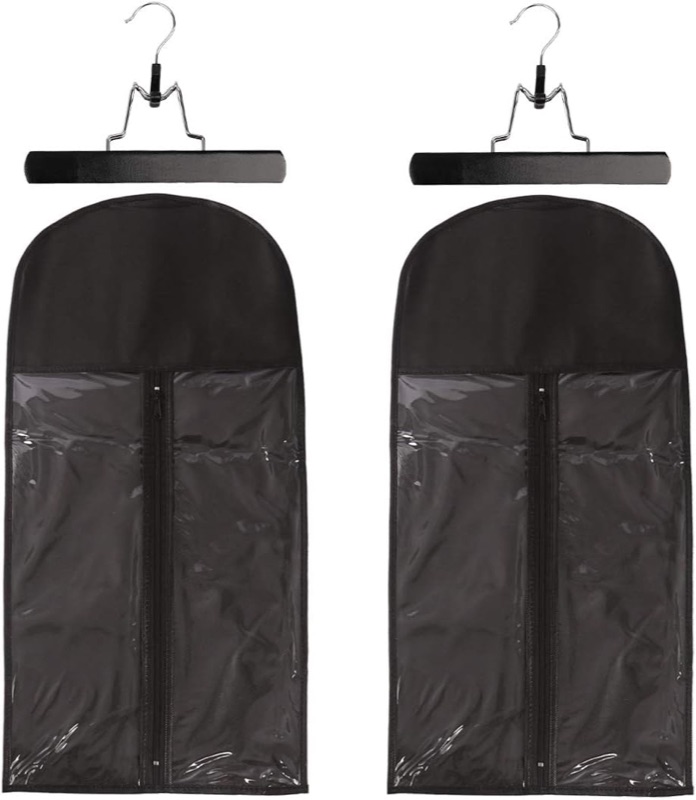
Hair extension storage bag with hanger, 2 pack
A two-pack of dust-proof hair extension storage bags with hangers, as a consumer-facing format comparison. Check the stated dimensions against your own packed-wig measurement before using it as a reference.
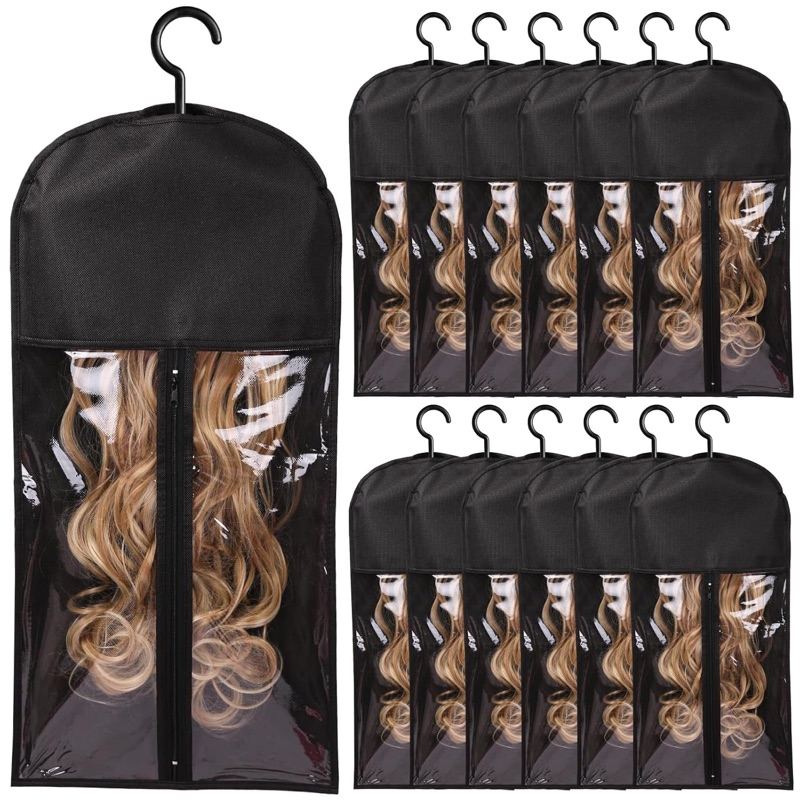
Hair extension holder and wig storage hangers, 12 pc
A 12-piece hair extension holder and wig storage hanger set for multiple units. A second retail comparison for how a hanging format handles several wigs at once rather than a single packed unit.
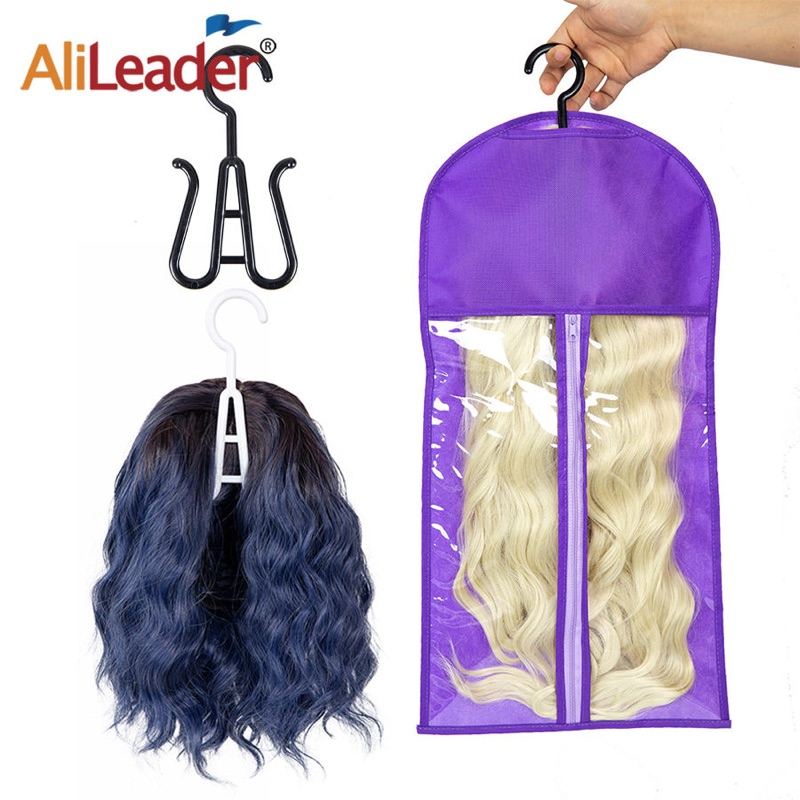
Non-woven hair extension packaging bag, custom logo
A wholesale non-woven hair extension packaging bag with a zipper, dust-proof flap and hanger hook. A supplier listing to verify directly for material, listed size, logo process and current ordering conditions.
Card photos are the current marketplace listing images and may differ from the delivered product; confirm details on the live listing.
Run three simple sample tests before approving the bag
You do not need a laboratory to find obvious packaging mismatch. You do need a repeatable routine and notes that compare samples fairly.
1. Pack and repack test
Have one person who did not design the sample pack the actual product using only the proposed customer-facing instructions. Record how long it takes, where hair catches, whether the closure feels forced, and whether a first-time customer could reasonably put the item away again. Photograph the packed sample from the front, side, and closure area.
2. Hold and hang test
If the bag is intended for a closet, leave the filled sample hanging for a defined period in the normal orientation. Check the hook, upper seam, closure, and whether the unit slides, bunches, or becomes difficult to remove. If the product will not be stored hanging, do not create a hanger test merely because the supplier offers one.
3. Pack-out and transit check
Place the filled bag into its intended mailer or box with the same inserts you expect to use. Move it through a modest, documented handling routine: packing-bench handoff, shelf storage, and a short journey in the outer carton. Open it and compare it with the pre-test photographs. This is a screening check, not a claim that you have proven shipping performance. If the item arrives visibly pressed, the solution might be different bag dimensions, less internal content, a different packing method, or an outer-box change.
Use a one-page acceptance sheet. Give each check a pass, revise, or fail result, plus a photo. When a supplier makes a revision, run the same check again rather than relying on a new product photo.
Plan the retail set around a customer's next use
The right contents depend on the product, but a branded set should make sense after the unboxing moment. Consider these roles, then remove anything that does not earn its place:
- The bag: the main storage and presentation component.
- A hair net: a containment item if it works with your packing method and customer instructions.
- An identifier: a label, card, or external window that helps the customer find the correct unit later.
- A care card: concise, product-specific handling and storage directions rather than generic promises.
- A protective outer layer: only when shipping, product shape, or the retail position requires it.
Keep the care instructions honest. Do not claim a bag prevents all tangling, preserves every curl, or protects any wig in every travel situation. Explain what the customer should do: keep the item separated from sharp accessories, use the included net if supplied, and return it to the bag in the demonstrated arrangement. That is more useful than a broad guarantee.
The approval decision should be physical, not visual
A logo mock-up is not an approval. Approve the bag only when it packs the finished product without forced compression, closes cleanly, fits the outer packaging, and gives the customer a believable way to store or carry the unit afterwards.
That standard does not require a costly packaging programme. It requires the discipline to pack a real wig inside every candidate bag, write down what happened, and revise the brief before the bulk order. For a hair brand, that is where a storage accessory becomes useful packaging rather than an afterthought.