A wet bag has one job: get a used period pair home without letting it touch everything else in your handbag. It becomes very obvious when it fails — a damp notebook, a smell, or a bag that leaks at the zip corner after a month.
"Waterproof" on a listing does not tell you whether the zipper ends hold, whether the lining survives washing, or whether a folded pair even fits. Here is what to look at before you buy, and how to get more than a few months out of the one you have.
Decide what you are actually carrying
Most disappointment comes from buying the wrong size, not the wrong material.
Think through your real routine: one used pair until you get home? A clean spare plus a used one? A reusable pad as well? And where does the bag live during the day — a large tote, a small shoulder bag, a gym bag?
A tiny bag looks discreet in photos and turns out to be a wrestling match with a folded pair. An oversized one takes over your bag. The useful size is the one that holds your folded pair with a little slack, not one that fits it exactly.
Size it from your folded pair
Fold a pair of your own period underwear the way you would fold it to store, then measure length, width and thickness without squashing it.
Now compare that with the bag's internal dimensions — not the outside. Outside numbers describe a pouch lying flat; seams, binding and the zipper curve all eat into what fits.
Rough guide:
- One pair, handbag: internal around 20 × 15 cm is usually enough for a folded bikini or brief.
- One pair plus a spare, or heavier overnight pairs: look for 25 × 18 cm or a two-compartment bag.
- Pads only: a much smaller pouch is fine, and easier to keep discreet.
If the listing only gives outer dimensions, assume you lose 1–2 cm each way and size up.
Two compartments are worth the extra
A single pocket means clean and used items share a space, which defeats the point. A divider — ideally with a closure on each side — lets you carry a clean pair and a used one without them touching.
Check that the divider is sewn at the sides and bottom. A divider that stops short lets the used pair slide underneath.
If you only ever carry one used pair and nothing else, a single pocket is fine and easier to wash.
Check how it closes and how it carries
A bag that only closes with a zip and has no handle is harder to pull out of a deep tote. A small loop or tab helps, and it also gives you somewhere to hang it to dry.
Test the closure with the bag loaded, not empty. Fill it with your folded pair, close it, then turn it upside down and give it a gentle shake, as it will get in a handbag. If the zip opens under that, it will open in your bag.
Odour: what actually helps
No fabric bag makes a used pair smell like nothing. What helps is containing moisture and getting air out of the equation until you wash it.
Practical steps: wring nothing, fold the pair so the absorbent panel faces inward, close the bag fully, and empty it the same day. A bag left in a warm car for two days will smell regardless of what it cost.
Be sceptical of "odour-proof" claims. A charcoal layer or a coated lining can reduce smell, but if the bag is sealed with a damp garment inside, the smell is waiting for you at the zip.
Look at the seams and the zip ends
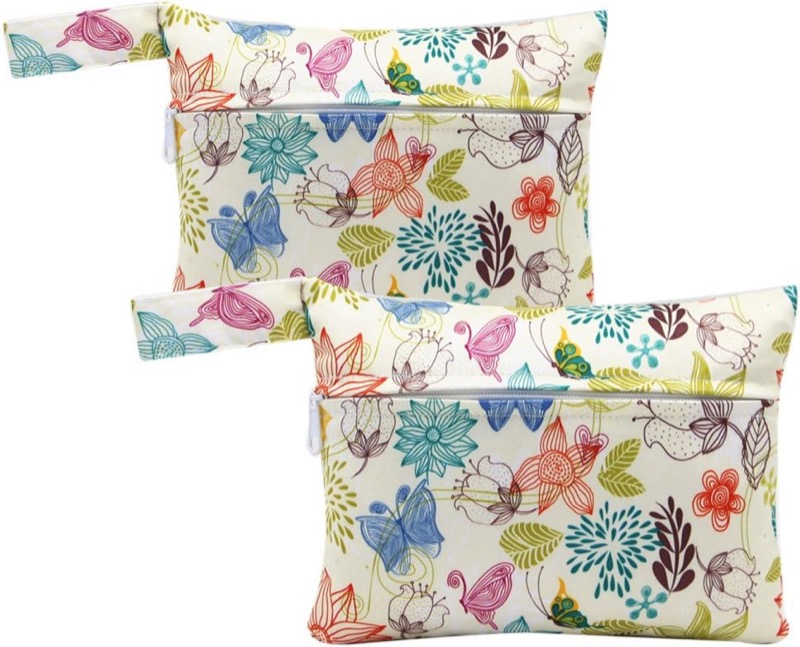
Waterproof wet bags, two-pack for pads and period underwear
Small zipped pouches sold for carrying used reusable pads and period underwear. Check the internal size against your folded pair, and buy a set so a clean and a used one never travel together.
A two-pack solves the clean/used problem without relying on a divider.
This is where cheap bags actually fail, so it is worth reading photos closely:
- Zipper ends. Where the teeth meet the tape and stitching is the most common leak path. Look for a bag with the zip ends finished or covered, not left raw.
- Stitching. A photo taken inside shows whether seams are tight and whether there are needle holes along the coating.
- Coated edges. On a laminated fabric, the cut edge is where the coating starts to peel. A bound or sealed edge lasts longer.
- The zip itself. A plastic coil zip is more forgiving than a metal one, which can corrode with washing.
Reviews that mention "leaked at the corner" or "zip broke after a month" are the ones to pay attention to. Reviews that say "so cute" are not.
Washing it without wrecking the waterproofing
Most of these bags are hand wash or gentle machine wash, cool, and air dry. Heat is the enemy: a hot wash or a tumble dryer softens the coating and stiffens the zip.
- Turn it inside out and wipe or rinse the inside first.
- Use a little mild soap; skip fabric softener, which coats the lining.
- Air dry open, inside out, away from direct sun.
- Do not iron, and do not wring it hard.
After a few washes, check the inside corners: if the coating has started to lift at the seam, that bag is now a separator, not a waterproof bag. Replace it, or demote it to carrying clean spares.
When a disposable bag makes more sense
If you travel, or you are out for twelve hours and cannot wash anything until the next day, a thick zip-top bag is cheap, sealable and disposable. It is not elegant, but it does the job with no laundry.
A good compromise is one reusable bag for normal days and a couple of disposable bags kept in your bag for emergencies. That covers the day the reusable one is in the wash.
Quick checklist before you buy
| Question | What you want |
|---|---|
| Does my folded pair fit? | Internal size, with 1–2 cm slack |
| Clean and used separated? | Two pockets, or buy a two-pack |
| Are the zip ends finished? | Covered or bound, not raw |
| Will it survive washing? | Hand wash, cool, air dry, no softener |
| Can I carry it discreetly? | Neutral print, loop or tab to pull it out |
Buy the size that fits your folded pair, keep a clean bag and a used bag separate, and wash it cool. That is most of what separates a bag you keep for years from one you throw away in a month.
If the pair inside is leaking at night rather than in your bag, see how to choose period underwear for overnight back leaks.