A press-on nail set can contain more than twenty pieces and still fail the customer who buys it. The number on the front of the box tells a shopper how many nails are inside. It does not tell them whether the two sizes needed for both thumbs are present, whether a small pinky tip has a usable twin, or whether the same size map will work in the next shape they order.
For a brand, that distinction matters before production. A ready-to-wear set is not merely ten display nails plus extras. It is a size assortment: a planned mix of widths, outlines, and repeats that needs to give a real customer a workable ten-nail selection. If it does not, the cost is not limited to an unhappy first order. It becomes returns, replacement requests, discarded extras, support conversations, and a launch design that cannot be replenished cleanly.
This guide explains how to plan the assortment inside a pre-sized press-on set. It is for a brand comparing a 24-, 30-, or 32-piece approach, or reviewing a supplier's proposed size mix. It does not claim that one count fits every market, and it does not treat a marked tip number as a universal measurement.
Count pieces and coverage separately
The first mistake is to treat the number of pieces as proof of size coverage. A 30-piece pack with 15 marked sizes can be a sensible starting configuration. It can also be an arbitrary one if the repeated sizes do not match the people the brand intends to serve. Likewise, a 24-piece pack may work for a narrow, clearly defined size range but leave no practical recovery option when a customer needs a duplicate.
Piece count answers a packaging question: how many finished nails, and therefore how much art, assembly, and packaging material, will go into one retail unit. Coverage answers a fit question: can a customer find an acceptable tip for each of ten fingers without forcing a bad match? The two questions overlap, but they should be reviewed separately.
Start by writing the proposed pack in plain language. For example: fifteen marked sizes, with two of every size. Then write what that format does not solve. It does not guarantee that two of each size are the right repeats. Some customers use the same marked size on more than two fingers. Some need only one of a size, while another size becomes the bottleneck. A marked number is meaningful only within one tip family, shape, and size chart.
The customer-side signal is easy to see. Press-on users regularly describe boxes full of unused pieces while a size they need appears only once, is missing, or arrives damaged. That is not evidence that every brand needs the largest possible pack. It is evidence that repeated counts are a product decision, not a free bonus.
Define what the assortment is meant to do
Before changing quantities, decide which retail promise the set makes. There are three common models, and they require different planning.
A ready-to-wear mixed-size set is intended for a customer to open, choose ten nails, and apply them without prior measurement. Its assortment needs a credible range of widths plus sensible repeats. It should not present a generic S, M, or L label as if that alone explains every included tip.
A pre-sized set is sold in a named configuration, often after the customer has used a sizing kit or supplied measurements. The finished pack can contain exactly ten nails, plus a small number of planned spares if the brand chooses. Its fit risk moves upstream: the sizing kit, final tip family, and production mapping have to stay consistent.
A made-to-order set is assembled from a customer's stated sizes. It can reduce unused pieces, but it requires reliable intake, clear confirmation, and an honest policy for measurement error and later replacement. It is not automatically more inclusive if the customer is asked to measure against an incomplete or mismatched size chart.
Do not combine these models carelessly. A pack described as ready to wear but supplied with a narrow, one-of-each distribution can create the expectation of choice without delivering it. A custom option that still uses a fixed stock assortment may create a different version of the same problem. State on the product page which model the customer is buying and what the included extras are for.
Build a small fit panel before setting repeat counts
There is no useful shortcut from a supplier's size count to your brand's final mix. The information you need comes from actual try-ons with the exact tip family, shape, and length you intend to sell.
Build a small fit panel with deliberately different nail outlines. Include people who have previously struggled with wide thumbs, narrower pinkies, flatter or more curved nails, and longer nail beds where relevant to the product. Do not label one hand as normal. The goal is to learn where the proposed family works and where it does not.
For each tester, record the marked size chosen for every finger, plus any alteration needed. A simple ten-finger row is enough: left thumb through left pinky, then right thumb through right pinky. Add columns for the tip family, shape, length, dry-fit result, and any light filing. If a tip works only after major reshaping, mark it as a failed fit for assortment planning. Otherwise, the size data will hide a mold problem.
Review the panel in two directions. First, look across people: which marked sizes are repeatedly selected? Second, look within each person: which size appears on multiple fingers on the same hand? The second view often matters most for a ready-to-wear pack because it reveals where two pieces are not enough.
Keep this information attached to a physical sample set and photographs. If a supplier changes the mold, the numbers printed on the back may remain familiar while the actual widths or curve change. The old assortment data cannot simply be carried forward without rechecking the new sample.
Turn fit observations into a repeat plan
Once the panel is complete, build an internal table with one row per marked size. Add four fields: how often the size was selected; how often a tester needed two or more of it; whether it was used only after adjustment; and whether the same need appeared in more than one shape.
This is the point at which you decide whether a symmetrical assortment makes sense. Two of every size is easy to count and easy to explain. It may also leave the most-used sizes short while creating a large pool of leftovers at the extremes. An asymmetric assortment can be justified when your own records show a consistent pattern, but it must be documented carefully so the packing line knows what belongs in the box.
Avoid declaring that a particular number is "standard" for every shape. A short round and a long almond may need different decision records even when they carry the same marked range. Shape changes the outline, usable width at different points, and the way a customer accepts a close size. The right question is not whether both packs have the same number of pieces. It is whether each pack gives the intended customer a sensible route to ten usable nails.
Use a version number for every approved assortment. A label such as "Short Almond v1, 15-size mixed pack" lets you distinguish the original distribution from a later revision. That matters when support reports begin to identify one missing or frequently exhausted size. Without it, customer feedback is attached to a product name but not to the actual arrangement sold.
Add spares for a reason, not just a larger number
Spare nails can serve several jobs. A duplicate may allow for a matching pair, give the customer an alternative if one piece is damaged during application, or support a small adjustment before fitting. But a larger pack does not automatically make the product more useful. It may increase art production, assembly complexity, package size, and unused material without fixing the real coverage gap.
Decide what each spare is for. If the aim is application recovery, the package insert can say so clearly: retain any unused close-fit pieces until the set is applied. If the aim is pair coverage, the planned repeats should reflect the fit panel. If the aim is a replacement program, the brand needs a separate way to identify and stock the relevant design, shape, and size.
Do not promise that every unused nail is a reusable backup. A spare may have a different design placement, or it may be unsuitable after the customer has filed another piece to fit. Keep the customer-facing wording precise. "Extra sizes included to help you find your fit" is different from "a complete replacement set in every box."
Product and sourcing options
The links below are retail and sourcing references for comparing ready-to-wear nail counts and size distributions. We may earn a commission from qualifying purchases through these links. The linked products are not proof that a specific size mix will fit every customer. Recheck current product details, sample availability, minimum order requirements, and CPS eligibility before ordering.
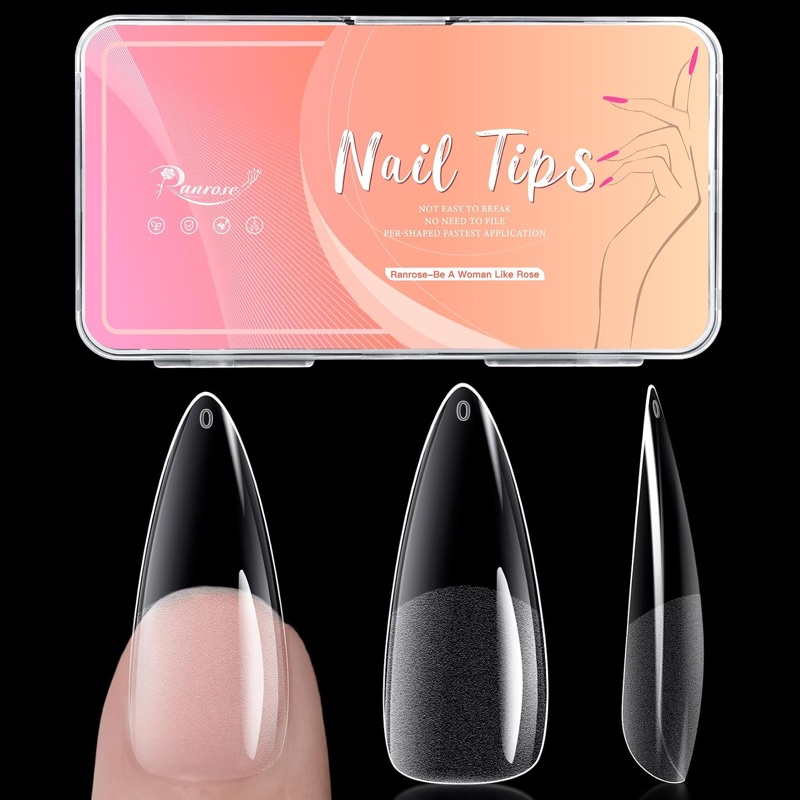
Long almond nail tips, half matte, 12 sizes, 240 pc
A 240-piece long almond full-cover half-matte tip set across 12 sizes. Useful for comparing how one marked range distributes across a shape when you plan repeats for a mixed pack.
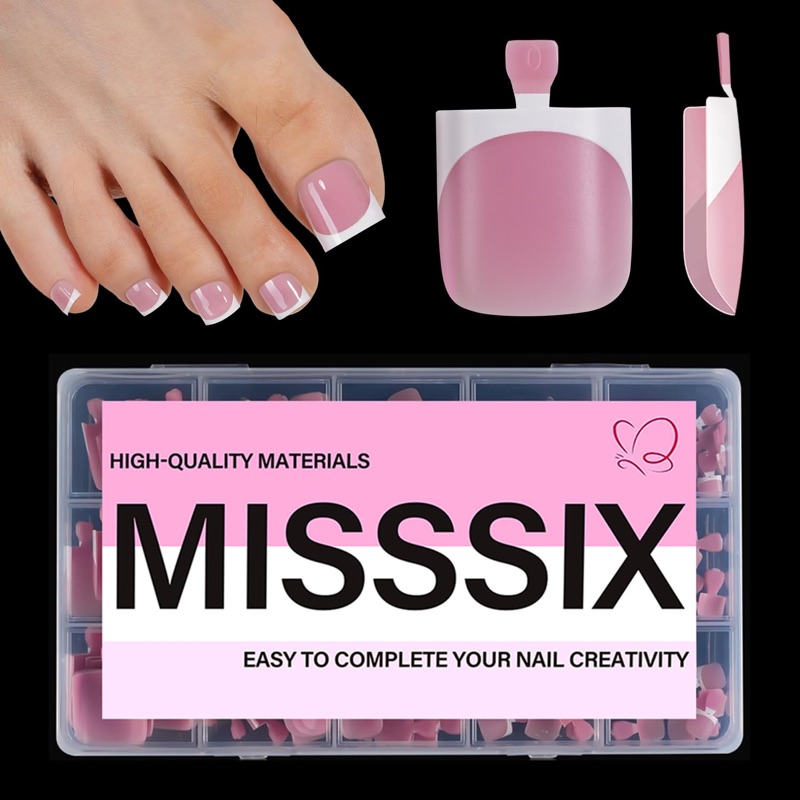
Short square French-tip press-on toenails, berry pink, 150 pc
A 150-piece short square French-tip press-on set in berry pink. A second ready-made count to compare against, so the piece number on a box does not stand in for the size coverage inside.
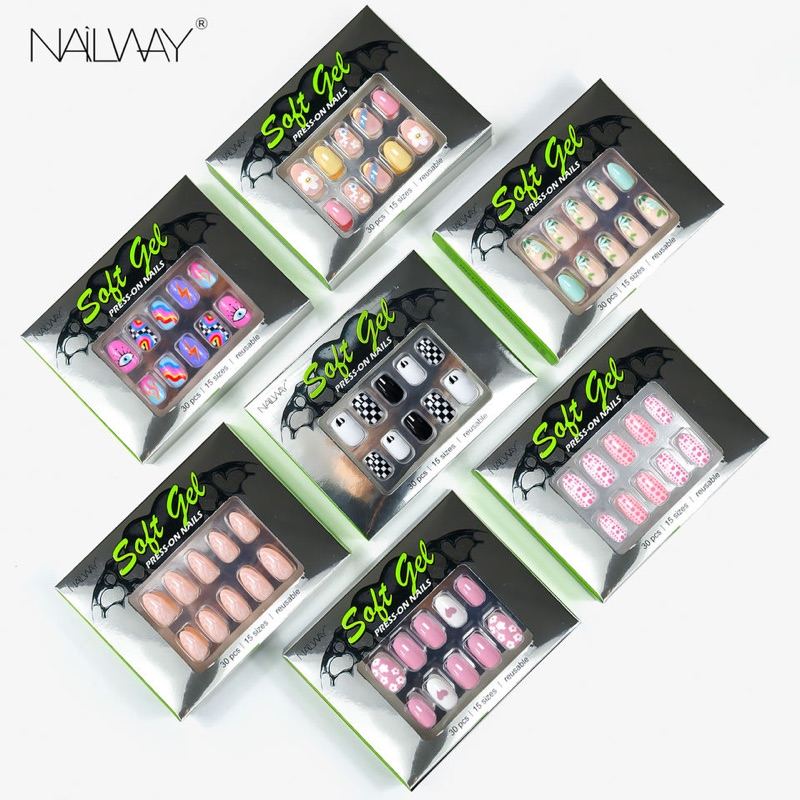
Soft gel almond press-on nails, 30 pcs, 15 sizes
A wholesale soft gel almond press-on listing at 30 pieces across 15 sizes. A sourcing route for confirming how a supplier's proposed size mix maps to a ten-nail selection before you adopt it.
Card photos are the current marketplace listing images and may differ from the delivered product; confirm details on the live listing.
Sample the pack as a pack
Many teams approve the finished art first and treat the pack-out as an administrative detail. That is how a correct-looking nail design can reach a customer with the wrong distribution. The proposed retail pack needs its own sample check.
Ask the supplier to assemble the exact count and size distribution proposed for sale, using the intended art, adhesive components, instruction card, and packaging. Count the pieces one by one. Confirm the marked sizes on the back where applicable, and compare the assortment with the written specification rather than a memory of the supplier's display photo.
For a mixed pack, test whether one panel member can select a complete ten-nail set from the actual production-style sample. This does not prove that the pack fits every customer. It does reveal errors such as repeated sizes being omitted, one member of a needed pair being absent, or the same number appearing with a visibly different outline.
Check the pack after ordinary opening and handling. A delicate small tip that is present but arrives scuffed, bent, or lost under a loose tray does not function as useful coverage. Keep packaging defects separate from size planning in the record, but do not ignore their effect on the customer experience.
Make replenishment part of the original design
An assortment is easier to launch than to replenish. If a customer loses one nail from a design that was sold only in a mixed pack, the brand must decide whether it can offer a matching replacement, a partial replacement, or no replacement at all. That answer depends on how the components were designed and stored before the first order ships.
Create a simple component map: collection name, design version, shape, length, tip family, marked size, and pack-out version. If the art placement differs by finger, record that too. A request for "one size 5" is not enough when the size 5 design is different on the thumb and pinky, or when a later production run uses a new mold.
For a small brand, the most realistic option may be a limited replacement policy rather than permanent single-size inventory. The important part is to decide it in advance and write the policy accurately. Do not imply that every supplier supports individual-size replenishment unless you have verified that arrangement for the specific order.
Replenishment data also improves the next assortment. If support records show the same size is repeatedly requested, check whether the initial pack carried too few pieces, whether that size is prone to damage, or whether the size chart directs customers toward a poor match. The solution may be a different repeat count, a new tip family, clearer sizing instructions, or a packaging correction.
The approval decision
Approve a retail assortment only when the brand can answer four practical questions: what size range it contains; how many pieces of each marked size are included; what evidence supports the repeat plan; and what happens if a customer needs a replacement. The answer does not need to be a complicated mathematical model. It needs to be traceable.
The strongest assortment is not necessarily the one with the highest nail count. It is the one whose pieces, shape, size map, packaging, and replenishment plan work together for the customer you are actually trying to serve. That is how a box of press-ons becomes a fit system rather than a random collection of extras.