A press-on can be the right width and still be the wrong nail. This is where many size charts stop being useful. The tip may cover the natural nail from sidewall to sidewall, yet its centre can sit too high, its free edge can hover, or the wearer may have to press so firmly that the set becomes uncomfortable.
For people with flatter nail beds, the problem is often described as a fit failure: press-ons pop off, the tips feel painfully curved, glue squeezes out at the sides, or there is a visible gap near the tip. For a small press-on brand, it is a product-development problem. A width-only size system cannot tell a customer whether the mould's curve is compatible with their nail. And a product page that calls every tip "flexible" does not tell a buyer how much shape adjustment the tip will tolerate.
That does not mean every brand needs a separate mould for every nail shape. It does mean that curvature should be handled as a real product variable. The work begins with an honest description of the tip, a sample check that distinguishes width from profile, and customer instructions that do not tell people to force a mismatch into place.
A size match has two dimensions
Width is easy to see. Hold a press-on over the natural nail and it either reaches the sidewalls or it does not. Curvature is less obvious until the tip is pressed down. A highly curved press-on contacts the natural nail first at its centre or edges, depending on the two shapes. A flatter nail bed may leave a gap at one end even when the side-to-side width is right.
This explains why "size up if you are between sizes" is not a full answer. Sizing up may stop sidewall pinching but create an overhang. Sizing down may look neat before application and then require too much force. Neither choice changes the moulded curve.
The practical check is to place the unglued tip on the nail without pressing it flat. Look from the side as well as from above. Is there a small, even contact area that disappears when the tip rests naturally, or is the press-on visibly bridging over the nail? Does the tip need to be bent hard to make contact? Does one side touch while the other lifts? Those observations are more informative than trying to judge the fit from the top view alone.
Do not use pressure as the test of a good fit. A customer may be able to hold a mismatched tip in place long enough for adhesive to set. That does not prove that the tip follows the nail's natural profile. If the press-on is under visible strain from the start, ordinary hand movement can expose the mismatch later.
Why the C-curve matters in retail sets
"C-curve" is commonly used to describe the cross-sectional arch of a nail. In a retail press-on set, that arch is built into the mould. The customer cannot choose it the way they choose length or colour. They only discover it after opening the set and trying individual tips.
This makes curvature a quiet source of returns and poor reviews. A shopper may blame glue when the real issue is that the tip cannot sit flush. Another may call a set too small because a strongly curved tip touches the sides before it settles over a flatter nail. Those reports are not proof that one curve is universally bad; they show that different nail profiles need different product information.
The usual retail wording—short almond, medium coffin, natural fit—does not reliably communicate this. Shape and length describe the visible outline, not whether the underside is shallow, moderate, or pronounced.
For a brand selling a finished set, the most useful starting point is a profile photograph. Place one sample tip on its side next to a simple ruler or a neutral background that makes the arch visible. Do not present that image as a universal fit chart. It is simply a more honest clue than a flat product photo. A second image showing the tip resting on a shallow and a more curved sample surface can help explain what customers are comparing, provided the brand labels it as an illustration rather than a performance test.
Flexibility is helpful only within a reasonable fit range
Many shoppers look for "soft gel," "flex," or "bendable" when a standard press-on feels too curved. That makes sense as a search behaviour. A tip with some give may accommodate a modest difference in profile more comfortably than a very rigid one. But flexibility is not a licence to promise that any tip will fit any nail bed.
Material, thickness distribution, length, reinforcement, and decoration can all affect how a finished press-on responds when it is pressed. A thin cuticle edge may sit differently from a thick one. A long, heavily decorated tip may behave differently from a short plain sample from the same supplier. A claim made about a raw blank tip should not automatically be carried over to a finished set with several additional layers of colour or embellishment.
For consumers, the sensible question is: "Does this tip rest near my nail shape before I rely on adhesive?" Stronger glue cannot make mismatched geometry suitable. Glue can fill small irregularities; it is not a substitute for a tip that begins far above or below the natural nail surface.
For brands, avoid writing "fits flat and curved nail beds" unless there is a defined test behind it. A narrower, more credible claim would state the characteristics actually supplied: the product uses a particular mould; the sample has a thinner cuticle edge; or the set was developed with a specified profile range. If there is no fit study or physical comparison data, say less and show more.
Look for a profile mismatch before the glue comes out
The best time to discover a curve problem is during sizing, while the tip is still clean and reusable. Put several candidate tips on each nail. Do not stop when you find the right width. Look for these signs:
- The press-on rocks from side to side on the nail instead of resting steadily.
- The centre of the tip sits high while the sides make contact, or the sides pinch while the centre touches.
- A gap remains near the free edge or cuticle even when the width appears correct.
- The tip needs a strong manual bend before it follows the nail.
- The bottom edge touches skin at the sidewalls because the tip has been forced down.
None of these signs is a reason to alter the natural nail aggressively. A customer should not have to reshape their nail bed, flood the sides with adhesive, or ignore pain just to make a retail set work. If several tips show the same mismatch, the product's curve is probably not a good starting point for that nail profile.
There is a useful distinction between a minor finishing adjustment and a structural mismatch. Light filing at the cuticle edge may improve the visual transition for a tip that already rests well. It cannot turn a deep arch into a flat one. The same is true of trimming length: shortening a tip may change how it feels in use, but it does not change the moulded shape at the contact area.
What a small brand should record from customer feedback
"Too curved" is valuable feedback, but only if it is recorded in a way that separates it from size and adhesive problems. A returns form or customer-service note can ask three short questions: which finger was affected, whether the tip was too narrow or the profile felt wrong, and where the gap or pressure appeared. That is enough to spot a repeat pattern without asking customers for complicated measurements.
Do not collapse every complaint into an "application issue." Repeated reports of side pressure or tip gaps from similar nail profiles point to mould selection. Scattered feedback may instead justify checking the size mix and individual moulds.
Keep profile feedback separate from aesthetic feedback. A customer may dislike a thick-looking cuticle edge because of both visual finish and the way the tip sits. Those are related but not identical. The product team needs to know whether the issue appears before the set is decorated, after a top coat is added, or only after the press-on has been applied with a particular adhesive method.
The useful internal record looks more like a case log than a star rating. It notes the mould or collection, the nail shape and length, the affected finger, the customer's description of the mismatch, and whether a different size solved it. Over time, that record can inform a size guide, a sample order, or a decision to carry a flatter profile alongside an existing range.
Retail options
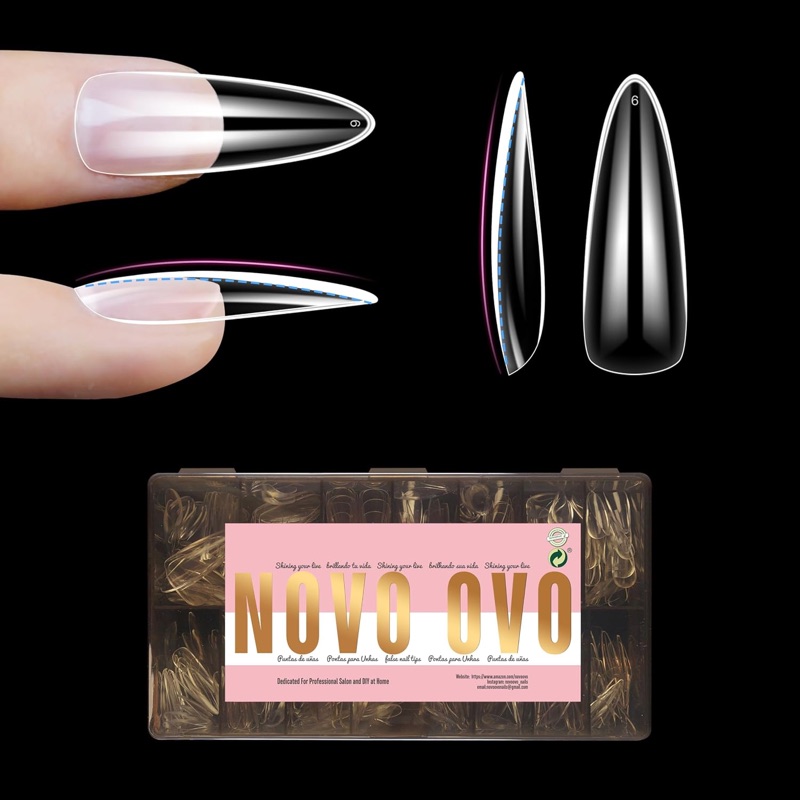
Long almond nail tips for flat nail beds, extra thin
A long almond full-cover tip line sold specifically for flatter nail beds, with a thinner profile than sculpted tips. Use it to check whether a shallower underside reduces the bridging gap on flat nails before committing to a mould.
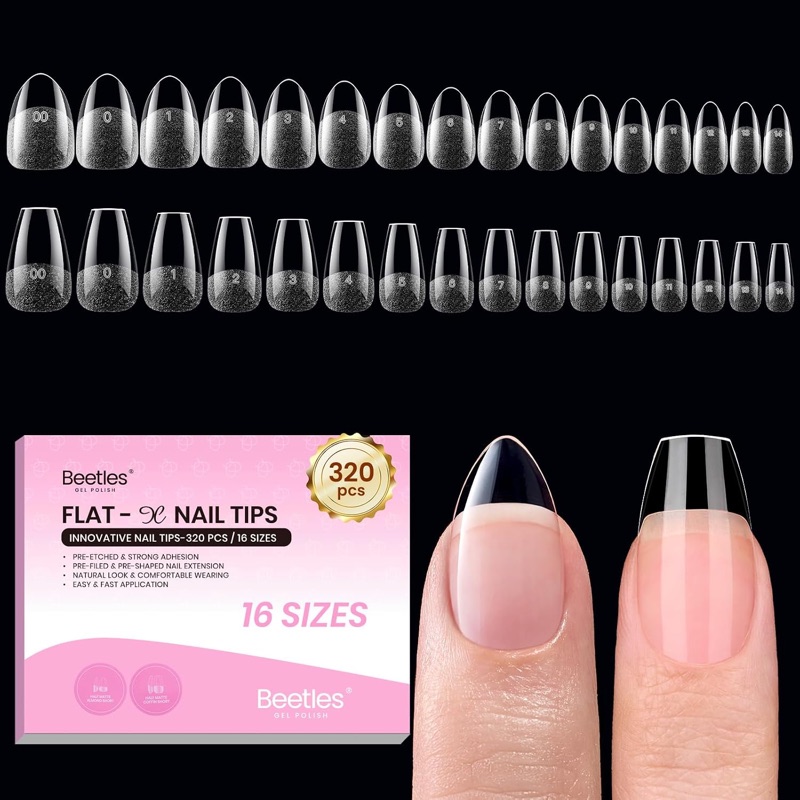
Gel nail tips Flat-X, almond/coffin short, 320 pc, 16 sizes
A 320-piece pre-etched gel tip set in 16 sizes with a flatter arch, listed for almond and coffin shapes. Useful as the second profile comparison when you test whether a lower C-curve improves the fit without changing the width.
Sampling a new mould: test the underside, not only the design
When a supplier sends blank tips or a pre-production sample, the first instinct is to compare colour, finish, and decoration. Those checks matter, but they are not enough for a press-on product whose main promise is fit. The underside needs its own review.
Start with three things. First, compare the width range in the sample with the measurements the brand intends to use for its sizing system. Second, view a selection of tips from the side and identify whether the arch is consistent across sizes. Third, place the tips on profile boards or on testers with different nail shapes. The aim is not to certify the sample as suitable for every person. It is to learn what profile it actually represents.
This is where a simple reference board is useful. A brand can keep shallow, medium, and pronounced curved forms as internal comparison surfaces. They are not consumer diagnostic tools. Their job is to make mould differences visible during sampling, more clearly than a hand-held product photograph.
Ask the supplier precise questions rather than asking whether the tip is "good quality." Which mould is used for this finished set? Is the same mould used across all listed shapes? Are the samples and bulk tips made from the same material specification? Does the factory have an alternative mould with a shallower profile? Can the brand approve the underside and the finished front separately? These questions force the conversation onto the product features that will affect fit.
Do not convert a supplier's answer into a universal claim. A supplier may describe a tip as flexible, natural, or suitable for a certain style; that is supplier information, not independent fit evidence. Keep the description attributed in internal notes, then compare it against the approved sample.
The finished design can change the fit you thought you approved
A blank tip is not always a finished press-on. Thick chrome layers, heavy charms, sculpted gel, stones, and multiple top coats can alter weight, rigidity, balance, and the apparent thickness at the cuticle. A collection that looks fine as a raw blank may become less forgiving after decoration.
That is why one finished sample from each construction family matters. If a brand sells a plain glossy set, a French design, and a heavily embellished set, testing only the plain version leaves a gap. The goal is not to make an unsupported statement about durability. The goal is to see whether the application edge, curve, and overall feel remain within the product's intended standard.
The packaging should preserve that approved condition. Before approving a box, place the longest and most decorated tips in the actual tray, close it, and inspect them after normal handling. Packaging matters when it can change the shape the customer receives.
What belongs on a product page
A good press-on page does not need to overwhelm shoppers with technical language. It should avoid hiding a relevant decision. Give the customer the width sizing method, a clear image of the side profile, the set's shape and length, and plain advice to test fit without adhesive first. If a brand has two genuinely different mould profiles, name the difference in useful language and show it rather than making both look interchangeable.
Do not state that a set works for all nail beds. That promise creates the wrong expectation for a product with a fixed mould. It is better to say that fit depends on both width and natural curve, then offer a sizing kit or a customer-service route for people who have struggled with strongly curved or very flat press-ons before.
For a buyer building a product line, the conclusion is equally straightforward. Treat C-curve as a mould specification, keep it alongside width in the sample record, and approve the finished set rather than the blank tip alone. The customer may never use the term "profile mismatch," but they will notice when a press-on sits quietly on the nail instead of fighting it.