If one press-on nail is missing, start with the unused nails from that exact set. Look for a piece that fits the same finger without forcing it, then compare its length, shape, and design with the remaining manicure. A similar color or matching printed number is not enough. If none of the spares fits, ask the original seller about a replacement before buying a whole set solely for one nail.
This is different from reattaching a nail you have found. A recovered piece needs its own condition check and the maker's guidance on reuse. Here, the main task is choosing an unused substitute and keeping enough information to find it. You cannot guarantee a spare for every finger just by saving every leftover nail.
Find the original set before searching the entire drawer
Keep the search narrow at first. Find the box, order confirmation, or product photograph for the manicure you are wearing. Check the exact style, shape, and length, not just the brand. Two sets with similar French tips may have different base colors, tip proportions, or curves.
In a community discussion about leftover nails, wearers describe accumulating extras that still do not fit. That is an important limitation: the number of nails left in a packet does not tell you how many usable replacements you have. Some may all be too small for the missing finger.
Put the original set's unused pieces on a clean surface where they cannot mix with other designs. Separate anything already worn. If you have combined several boxes, identify what you can from packaging and order photographs, but leave uncertain pieces unconfirmed rather than assigning them to a brand from appearance alone.
Do not remove a well-attached nail from the opposite hand simply to compare its underside number. Use your records or compare the visible shape. The purpose is to replace the missing piece, not create another removal task.
Check the replacement on the finger it must fit
Before adding fresh adhesive, inspect the candidate for cracks, distortion, damaged decoration, or adhesive already on its underside. An unused piece can still have been bent or contaminated in storage. Set it aside if its condition makes the comparison unreliable.
For a plain, glue-applied piece, dry-fit it as its maker directs. Look at coverage along both sides and the cuticle end. It should sit in the intended position without having to flatten it against your nail. A piece that only appears wide enough when pressed hard is not a confirmed match.
Treat pre-applied adhesive differently. Leave the backing in place while selecting the size and follow that product's fitting instructions. Removing the backing from several candidates just to try them can turn unused spares into exposed adhesive surfaces. Do not add a different adhesive unless the maker permits it.
Next compare the profile. Look from the side as well as from above. A candidate can be close in width yet sit differently because its curve or base shape differs. If you cannot achieve the intended placement without force, move on rather than treating extra glue as a way to correct the mismatch.
Fit and appearance are separate decisions. A piece can fit your finger but be visibly longer than the others. Conversely, a perfect color match can be the wrong size. Confirm the fit first, then decide whether the visual difference is acceptable.
Filing is an option only within the product instructions
Some brands permit fitting adjustments. Current removal and fit guidance from a press-on maker advises choosing the larger size between sizes and checking the fit while filing the sides or cuticle end. That is guidance for those products, not permission to reshape every kind of press-on.
If your maker allows filing, make a small adjustment and check again. Stop before removing so much material that the edge loses its intended shape or the decoration is damaged. Filing a side cannot make a piece wider, and it does not reliably correct a different underside curve.
Consider the design before shortening. A French tip, border, printed motif, or raised embellishment may sit near the area you would remove. You might obtain the desired length while cutting away the feature that made the replacement look like part of the set.
If no permitted adjustment gives a suitable result, reject that candidate. The useful outcome is knowing it does not fit, rather than gradually working through every spare until none remains intact.
Choose between an exact replacement and an intentional accent
For a plain set, a close match may be visually acceptable to you. For a highly detailed design, compare the decoration's position and orientation. A motif intended for one side of the manicure may look different when placed on the opposite hand. Check the original product image if the arrangement is unclear.
An intentionally different accent is another option, provided the piece fits. It does not need to imitate an exact match. Decide whether you like the combination before applying it; do not choose a poor fit simply because its color makes the mismatch less obvious.
Compare the candidate beside the existing manicure in the same light. A seller's studio photograph and your bathroom lighting are poor references for judging a subtle shade difference. If you send a photograph to the seller, include an adjacent nail and describe the finish in words too. A screen image alone cannot establish that a replacement will look identical in person.
| What you find | Practical next step | What remains uncertain |
|---|---|---|
| Original-set spare with suitable fit and design | Follow that product's application instructions | Future wear time is not established by the fit check |
| Suitable fit but noticeably different design | Decide whether an accent looks intentional to you | It is not an exact replacement |
| Similar number from another style or brand | Treat it as a new fitting candidate | Number equivalence and matching construction |
| No suitable spare | Ask the original seller or plan a different set | Single-nail availability and delivery |
Do not pull off the remaining attached nails to make the manicure symmetrical. If you choose to change the set, follow its removal instructions and allow the required time. A missing decorative nail is not a reason to rush removal.
Ask the original seller with enough detail
Single-nail replacement is a service to verify, not a feature of every press-on brand. A retailer may sell only complete sets, while a custom artist may offer individual remakes subject to the original order and available materials.
For example, a single replacement listing on a marketplace is restricted to customers who previously ordered a set. It asks for width, shape, and nail-art details. This illustrates why the original order matters; it is not a recommendation that another seller can reproduce your existing manicure.
A useful message would read: "I bought [style] in [shape and length], order [reference]. I need one replacement for my right index finger. The original size was [number, if recorded]. I have attached the set photograph and my fitting notes. Can you supply that piece, and what are the total delivered cost and expected dispatch date?"
Add whether the original piece was filed, particularly at the sides or cuticle end. If you do not know its number, say so. A photograph with a ruler can provide context, but do not present it as a precise measurement of a curved nail unless you know how the seller measures.
Compare the delivered total, not just the single-piece price. As an illustrative calculation, a $3 replacement plus $5 shipping costs $8 before any applicable tax. Those are example figures, not a live quote. Compare the actual quote with a complete set and consider how many of that set's pieces you would use.
Timing can decide the purchase. Ask about making time as well as shipping; a custom remake is not necessarily ready to post. If you need it for an event, get a clear answer before ordering rather than interpreting a marketplace delivery estimate as a promise.
Retail and sourcing references
The following links are retail references for the storage formats discussed above. We may earn a commission from qualifying purchases through these links. These are catalog-based candidates, not independently tested organizers: neither product supplies a replacement nail, and neither proves that your particular extras fit. Check actual internal clearance and mounting suitability on the live page before ordering.
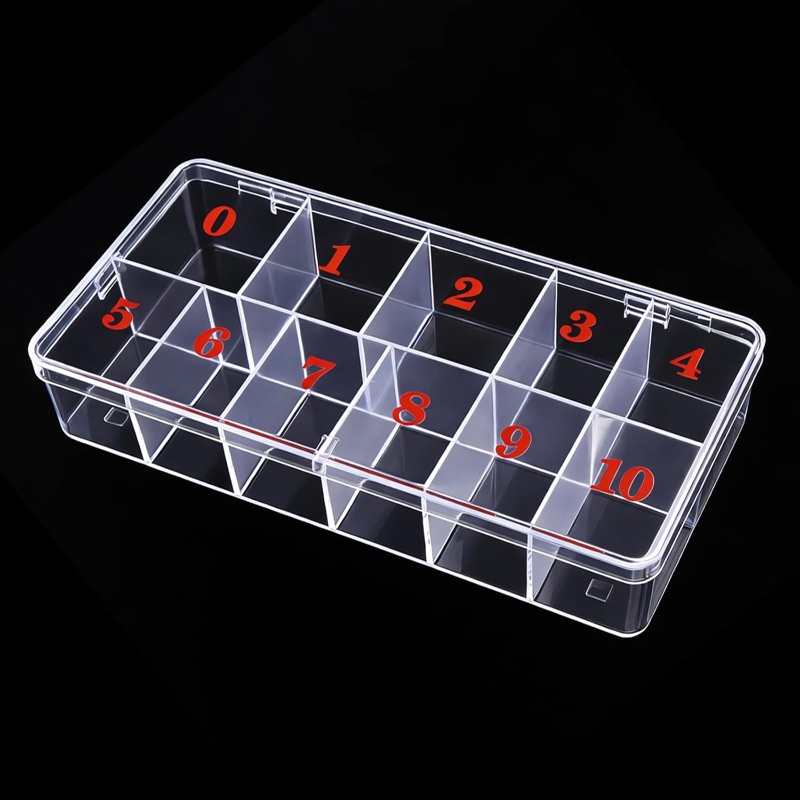
Clear nail art tip storage organizer box, 11 compartments
A clear organizer box with eleven compartments marked 0 through 10, for unused spares from one clearly identified product. Those labels come from the box, not from any brand's sizing system, and the outside dimensions do not tell you the usable space in each compartment.
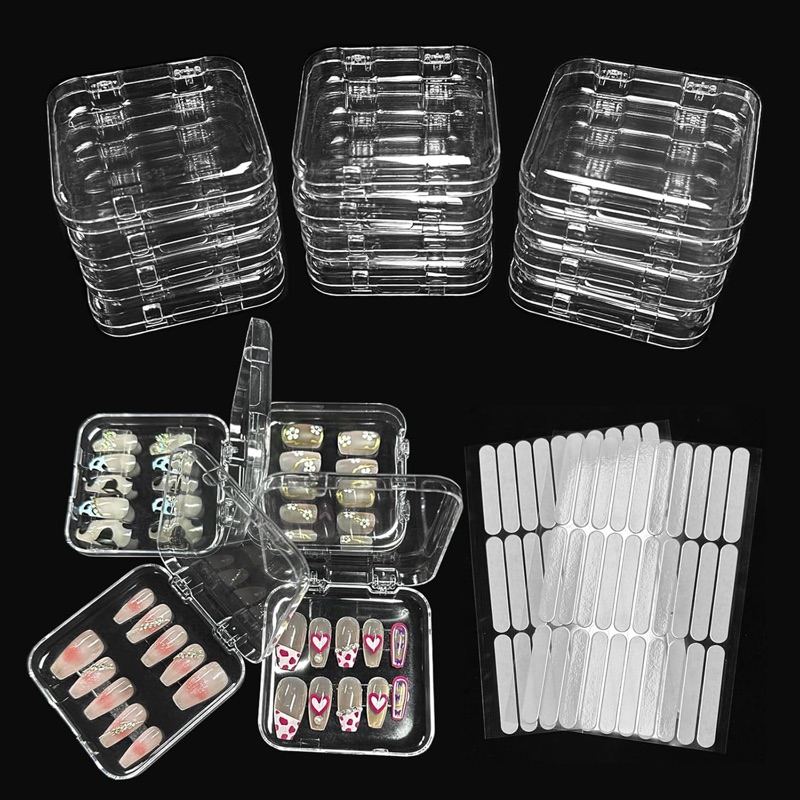
Clear acrylic press-on nail storage boxes with tape, 12 pc
A twelve-piece set of clear display boxes with adhesive mounting strips, described primarily for short and medium nails where longer pieces can be awkward to retrieve. Useful only if a separate case per design solves a problem your original box does not.
Card photos are the current marketplace listing images and may differ from the delivered product; confirm details on the live listing.
Save a fit record while all ten nails are present
The easiest time to record sizes is before the first application. Note the brand, exact style, shape, and length, then record each finger separately. Left and right fingers should have separate entries even when their numbers happen to match.
Write the printed number and any adjustment beside the finger. "Right index, size 5, sides filed" is more useful than "medium." It also makes clear that an untouched size 5 from the packet may need checking again. Treat the number as an identifier within that product, not a universal measurement.
Take a photograph of the selected ten pieces beside the record before wearing them. Include the original packaging in another image. For a set with different designs, the photograph helps preserve both the finger assignment and the intended orientation.
Mark a spare as confirmed only after checking it for the relevant finger. A simple note such as "unused, right index candidate, not yet checked" keeps uncertainty visible. Do not call a packet a backup set because it contains ten pieces if those pieces cannot form ten suitable fits.
When you use the last confirmed spare for a finger, update the note. That is a reasonable point to ask about future replacement availability if you intend to keep wearing the design. It is not an automatic reason to buy another complete box.
Before a trip or event, choose any usable spares while you still have time to check them. Put those candidates with the correct set's note in a small protective case. Carrying every leftover size is less useful than knowing which two or three pieces could actually help. Keep any application products in their original labeled containers and follow their handling directions rather than decanting glue into an unmarked travel pot.
Store spares by the exact set before sorting by size
For a small collection, keep unused spares in their original packaging with the fitting note. If you prefer a separate container, label it with the complete set identity. Putting every size 5 from every brand into one compartment preserves a number while losing the information needed to interpret it.
A practical division is one labeled group for the selected or previously worn pieces and another for unused spares. Within the spare group, keep the original size markings visible where possible. Any removed pieces should be handled and stored according to the maker's reuse guidance, rather than quietly joining the unused stock.
In a community storage discussion, one wearer describes labeling the brand, style, size, and finger. A storage video shows a different approach, grouping sets in small bags and organizing by shape. These are personal systems, not tested protection standards. Choose an arrangement that preserves the exact set first.
Before closing a replacement container, check the longest and tallest piece inside. The lid should not press against a curved tip or raised decoration. Check the interior, not just the advertised outside dimensions. Carry the closed case gently over a tray on its side and reopen it to see whether small pieces have moved between compartments.
This is a handling check, not a drop test or a guarantee of travel protection. If pieces migrate, use a different container or separate labeled inner packets that fit without compression. Do not solve the problem by packing the nails tightly enough to bend them.
Compare two storage formats only if the original box is inadequate
A numbered organizer can suit unused spares from one clearly identified product. The compartment labels do not establish compatibility with a set's own sizing system, nor do the outside dimensions establish usable space in each compartment.
A separate case for each design serves a different purpose. A twelve-box pack with adhesive mounting strips is described primarily for short and medium nails, and longer pieces can be awkward to retrieve. Check actual clearance and whether mounting is appropriate for your particular nails before using the strips.
Neither product supplies a replacement nail or proves that your extras fit. You may need neither: a clean original box plus a legible card can be enough. A twelve-box pack is poor value if you only need one case and have no use for the others.
What a small nail brand can make easier
A brand offering individual remakes should preserve the original tip reference, shape, length, design version, and any agreed fitting adjustments. When the underlying tips or decoration change, an old order number alone may not identify an identical replacement. Confirm what can still be matched before accepting payment.
A care or storage card can give the customer room to record ten finger assignments and identify unused spares separately. That modest addition is more useful than calling every leftover nail a replacement. If single-piece service is unavailable, say so clearly before the customer relies on it.
For the wearer, the decision ends with a specific result: a spare that fits, an accent you actually want, or a clear request to the original seller. Keep the pieces and records that support those choices. A larger collection of unidentified leftovers does not make the next missing nail easier to replace.