An adjustable bonnet sounds like the obvious answer to a familiar problem: a cap that slips off when it is loose but feels uncomfortable when it is tightened. In practice, “adjustable” describes a category of solutions, not a guarantee that every closure will work for every head shape, sleep position, hairstyle, or amount of hair inside the bonnet.
That distinction matters to shoppers and to small brands. A shopper wants a bonnet that stays in place without creating unwanted pressure. A brand needs to know which closure details deserve a sample check before committing to a product description, packaging run, or reorder. Simply copying “adjustable fit” from a marketplace title does not answer either task.
The productive question is not “Which bonnet never slips?” No product can promise that for every wearer. Ask instead: what closes the bonnet, where does that tension sit, how is it adjusted, and what happens when the product is worn with the amount of hair it is designed to hold?
This guide gives six closure checks that turn a vague fit claim into a more useful buying and sourcing decision. It is not medical advice and does not assume that a particular closure is right for every person. Comfort, hair arrangement, skin sensitivity, and sleeping movement vary.
1. Identify the actual closure, not the headline
Start with the part that controls the circumference. A bonnet may use a continuous elastic edge, an elastic panel, long ties, a drawstring, a toggle, a wide wrap band, hook-and-loop fastening, or a combination of these. Two products can both be called adjustable while behaving very differently at bedtime.
A continuous elastic edge stretches around the whole opening. It is simple to put on, but its fit depends on the elastic’s recovery and the opening size. An elastic panel may concentrate the stretch in one area while the rest of the band is less flexible. Long ties let the wearer set the tension more deliberately, but the knot, bow, or loose ends have to sit somewhere. A drawstring can create a variable opening, though its channel, stop, and cord ends all become part of the comfort and durability question.
The useful listing detail is not simply “adjustable.” It is “adjustable by what mechanism, in what position, and over what practical range?”
When shopping online, zoom in on the band and closure photos. Look for an inside view as well as a styled front view. If the product description does not explain the closure, check customer photos and questions. If it is still unclear, do not make a performance assumption from a stock image.
For a brand, name the mechanism in the sample brief. “Adjustable bonnet” is not a construction instruction. “Rear drawstring in a covered channel,” “long front wrap ties,” or “continuous elastic band with no separate adjuster” is actionable. It lets a factory understand what must be sampled and lets the brand inspect the correct part on arrival.
2. Check where the tension lands
The location of a closure can matter as much as the closure type. A wide band that sits near the front hairline may feel different from a rear adjustment, an all-around elastic edge, or long ties that cross around the head. The same total tightness can be experienced differently depending on where the force is distributed.
For a shopper, do not assume that “wide” automatically means gentle or that “thin” automatically means uncomfortable. Look at how the band is sewn, whether it is folded, and where an adjuster or knot would sit when lying down. Think about your usual sleeping position. A bulky knot at the back may be less appealing to a back sleeper, while a front tie may be inconvenient for someone who dislikes pressure close to the forehead.
Hair placement changes this further. A bonnet holding loose curls, a low bun, braids, locs, extensions, or a high pineapple may pull in a different direction. A closure that feels fine with little volume can shift when the interior is filled. This is why an apparently generous bonnet may still slide: the problem can be the relationship between the opening, the load inside it, and the closure position rather than the fabric alone.
For a brand sample, check fit with the intended hair capacity. If you market the style for long braids, do not approve the closure only on an empty bonnet or short hair. Use a realistic amount of volume, then note where the edge rides after movement. You are not trying to certify every wearer; you are checking whether the chosen structure is consistent with the stated use case.
3. Separate size range from adjustment range
“One size” and “adjustable” are often used together, but they describe different things. One size may mean that a manufacturer offers one finished bonnet size. Adjustable means that some part of the opening can change. Neither phrase tells you the useful range by itself.
A shopper can look for a measurement, a circumference range, or a clear explanation of how much the strap, tie, or drawstring changes the opening. If none is given, consider the claim incomplete. Do not expect a generic “one size fits most” line to resolve concerns about a particularly small, large, or sensitive fit.
A small brand should define the range it wants to test rather than accepting an undefined “free size.” Ask the supplier for the relaxed opening, the maximum practical opening, the band width, the closure length, and the method used to measure each. If a dimension is only approximate, record it as an approximate target instead of turning it into false precision on your product page.
Most importantly, distinguish a theoretical range from a usable one. A tie may technically pull a bonnet much tighter, but that does not mean the tightest setting is comfortable or stable. A drawstring may open very wide, but a fully open channel may bunch fabric in a way that changes fit. Sampling is where you find the range that is both usable and repeatable.
4. Inspect the adjustment path and finishing
Closures fail in more ways than snapping outright. A tie can fray at the end, a drawstring can pull through its channel, an elastic can twist, a toggle can catch, and a seam can become bulky against the head. These are product-construction questions, not just cosmetic details.
Before buying, inspect close-up images for exposed raw edges, uneven stitching, loose thread, a visibly narrow tie attachment, or a cord that appears difficult to rethread. Read recent reviews with a specific question in mind: do buyers mention stretching, slipping after repeated use, broken hardware, uncomfortable seams, or difficulty tying? A single review is not proof of a defect, but repeated descriptions can tell you which detail to check when the item arrives.
Compare current adjustable-bonnet listings on Amazon by looking beyond the title: inspect the closure photos, listed care instructions, and the newest customer feedback. Product-page details, price, and variants can change, so treat the live listing rather than this article as the source for a particular item’s current features.
For a brand, add a simple movement check to the sample review. Adjust the closure from relaxed to the intended working position several times. Pull gently in the directions a wearer would use to tie, stretch, or remove it. Look for twisting, exposed stitch holes, cord movement, and changes in the band shape. Record what happens in photos and note the sample revision. This is not a laboratory durability test; it is a repeatable early check that can expose an avoidable production issue.
5. Test the closure with the bonnet’s capacity
A closure and a bonnet body must work together. A long-braid or high-volume bonnet can have generous interior space while still having an opening that does not stay positioned on the wearer. Conversely, a very secure opening may not be comfortable once the bonnet is filled with a large hairstyle.
For a shopper, start by matching the bonnet’s claimed capacity to the hairstyle you wear most often, not to a styled product photo. Then inspect whether the closure appears designed to handle that load. A long tie, elastic panel, or drawstring may be useful for adjustment, but it is not a substitute for adequate depth, length, or interior volume.
For a brand, make capacity part of the closure test plan. Define the intended user scenario in one sentence: for example, “overnight use with long braids,” “curly hair worn loose,” or “a low-volume protective style.” Then test the sample in that scenario. Do not let a generic adult fit test stand in for the product promise.
This is also where a brand should avoid overextending a variant. A standard bonnet and a long-braid bonnet may share fabric and printing, but the closure placement or tie length may need its own approval. Reusing a pattern without testing the changed volume is a common way to create a product that looks consistent in photos but behaves differently in use.
Practical routes
These links are starting points for comparison. Confirm current product details, dimensions, material, pack configuration, pricing, and affiliate terms on the live destination before relying on them.
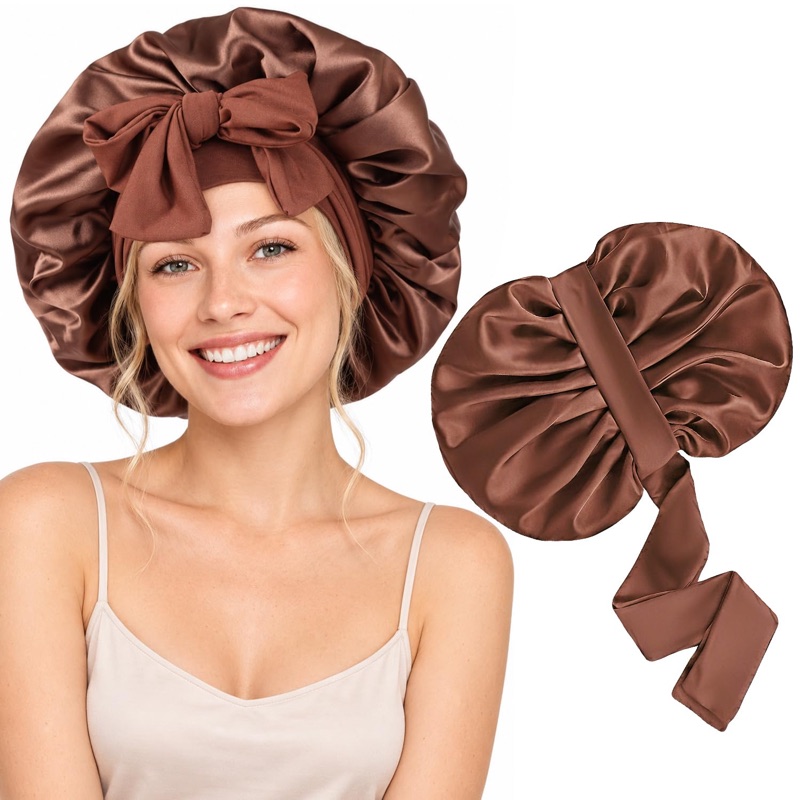
Double-layer satin sleep bonnet with an elastic tie band — coffee
A double-layer satin bonnet closed by a soft elastic tie band rather than a wide band or a drawstring. Use it as the tie-band side of this comparison: check how the closure holds tension overnight and whether it leaves a mark across the forehead.
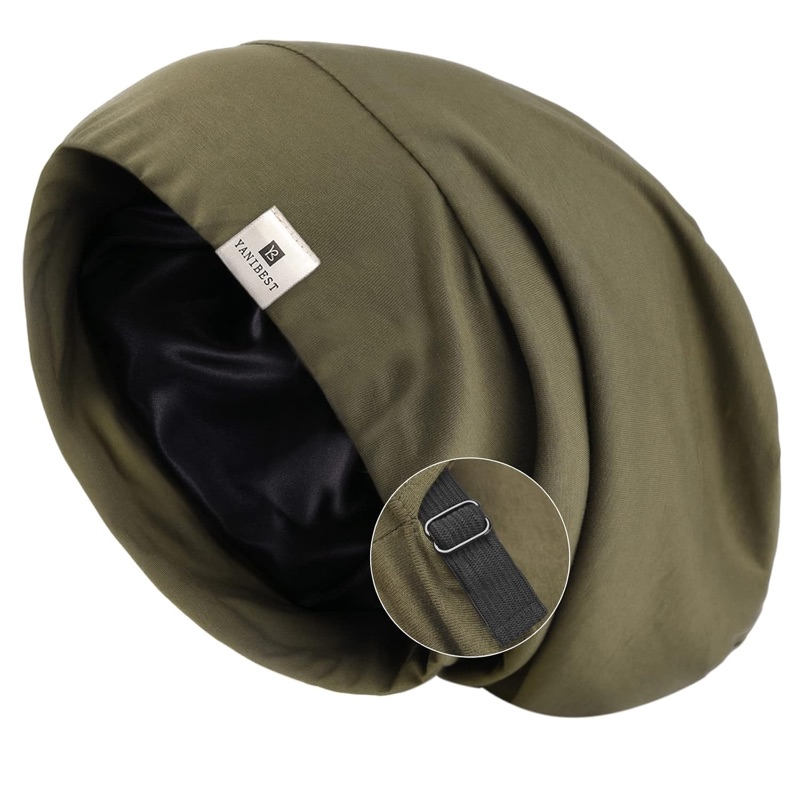
Satin-lined slouchy sleep cap with an adjustable back closure
A satin-lined slouchy cap with an adjustable back closure, listed as unisex. Compare it against the tie-band bonnet when you decide which closure to specify: an adjustable band loosens differently across a night's wear.
Card photos are the current marketplace listing images and may differ from the delivered product; confirm details on the live listing.
6. Plan for what changes after repeated wear
Fit is not fixed at the moment a bonnet is unboxed. Elastic can change, ties can soften, seams can loosen, and a closure that was acceptable when new may behave differently after normal care. The responsible goal is not to promise a permanent fit. It is to provide clear care guidance and to make the closure inspectable before the buyer needs a replacement.
For shoppers, follow the manufacturer’s care instructions, and check the closure after washing or when the fit changes. If an item becomes uncomfortable, leaves persistent irritation, or repeatedly fails to stay in place, stop using that setting or product and choose a different construction. Do not solve a poor fit by overtightening it or adding improvised fasteners that create new pressure points.
For brands, request care instructions before finalizing the label. Ask what washing method the supplier recommends for the specific fabric, elastic, ties, and decoration. Ask whether the closure components are identical across colours and whether a substitution would be communicated before production. Keep those answers with the approved sample and pack copy.
Use a second Amazon listing as a comparison point when assessing how brands present fit, images, care information, and adjustable features. It is an affiliate link, not a guarantee that the product will suit every wearer. Review the live page for the exact version before purchasing.
A small brand’s closure brief
When sourcing an adjustable bonnet, a practical brief can be short and still prevent confusion. Use a structure like this before requesting a sample:
| Brief item | What to specify | What to check on the sample |
|---|---|---|
| Closure type | Elastic, ties, drawstring, toggle, or combination | Mechanism matches the written request |
| Adjustment position | Front, rear, side, or all-around | Pressure and bulk in normal sleep positions |
| Band construction | Width, layers, seam position, and edge finish | No unexpected twisting or exposed rough areas |
| Intended capacity | The hairstyle or volume scenario | Bonnet stays positioned when filled as intended |
| Range | Relaxed and intended working settings | Adjustment is usable, not merely theoretical |
| Care and reorder | Care wording and component consistency | Supplier confirms the same construction for reorders |
Avoid adding an unsupported claim such as “non-slip,” “headache-free,” or “fits all head sizes.” Those phrases create an expectation that a sample check cannot honestly prove. Better product copy explains the closure and the intended use, then lets the shopper make an informed fit decision.
Choose the closure that answers your own problem
An adjustable closure is useful when it makes the product easier to fit without turning the entire burden onto the wearer. The best choice depends on what needs adjusting: a slightly loose opening, variable hair volume, a tendency for a band to move, or a preference to avoid a particular pressure point.
For a buyer, the practical order is: confirm the closure, inspect its location, compare it with your hair volume and sleeping habits, then check care and recent feedback. For a brand, the order is: define the intended scenario, specify the closure, sample with realistic capacity, verify the label and care wording, and preserve the approval record for future reorders.
That process will not make every bonnet suitable for everyone. It does make the next purchase or production decision less dependent on a broad word such as “adjustable.”
Affiliate disclosure: Some links in this guide are affiliate links. HerBrandKit may earn a commission at no extra cost to you.