A sleep scarf is often sold as the simplest overnight hair accessory: fold it, tie it, and go to bed. In use, it is less simple. A scarf can cover every strand when it is first tied and still migrate off the head after a few hours. A knot can remain intact while the entire scarf slides backward.
That does not mean a scarf is the wrong sleep option. It means the purchase decision is not just "silk or satin." A scarf is an open, user-tied format. Its performance depends on the relationship between head circumference, hair volume, folding method, available tie length, fabric behavior, edge construction, and the sleeper's movement. Shopper discussions repeatedly describe this exact split: full initial coverage, followed by slipping, flattening, or a knot that becomes the uncomfortable part of the setup. A buyer needs to decide whether a scarf gives enough adjustment for their hairstyle, or whether a bonnet, pillowcase, or a combined routine is a better fit.
For a product brand, that same problem becomes a useful development brief. Do not begin with a print or a generic "silky" claim. Start by deciding the wrapped hairstyle, the tying route, the finished dimensions, and the edge treatment. Then make a sample that can be tied by people with different hair lengths and worn in bed without turning the product into a tight headband.
First, decide whether a scarf is the right format
Choose a sleep scarf when the buyer wants an adjustable wrap and is comfortable tying it. It can suit a flatter wrapped style, a low-bulk setup, or a routine where the wearer wants to control fabric placement. It also works outside bedtime, which can make it easier for a brand to sell one product across several use cases.
Do not treat a scarf as a guaranteed substitute for every bonnet. A scarf has no fixed elastic opening or built-in volume chamber. The wearer creates the enclosure each time. That is an advantage for someone who wants a specific wrap position, but it is a limitation for someone who needs room around braids, a high pineapple, rollers, or dense hair. If the only reliable way to keep the scarf on is to pull the tie very tight, the format and hairstyle may be mismatched.
Use this quick screen:
- Choose a scarf if you can tie it with enough tail left to release it easily in the morning.
- Consider a bonnet if your hairstyle needs enclosed volume rather than a flat wrap.
- Choose a different construction if the knot has to sit directly under your head or at one tender spot every night.
If several tie positions still loosen during active sleep, a different closure system may solve the task better. An honest product page should say this rather than making a universal stay-put promise.
Read the dimensions as a tying allowance, not a decorative number
Square scarves are commonly listed by one side length. That number matters because the diagonal becomes the wrap path after a triangle fold. But it is not a universal fit measurement. Usable tie length shrinks when the scarf is folded into a narrower band or gathered around hair.
Start with the user's tying method. A triangle needs enough of the two corners to meet and tie after covering the hair. A narrow band uses more material in the band and leaves less for the tail. A wrap tied at the front also distributes bulk differently from one tied at the back.
Instead of asking, "What size is best?", ask four questions:
- Which hair area must remain covered: crown only, full length, a wrapped style, or braids?
- Where should the knot sit during sleep?
- How much loose tail remains after making a comfortable knot?
- Does folding the scarf to control the hairline leave enough material to tie without pulling?
For a brand, publish the finished size clearly and show the same product tied in at least two relevant methods. A flat photograph does not answer the buying question. State whether the figure is a finished measurement and allow a manufacturing tolerance in the specification sheet.
Avoid copying a competitor's size as a default. A compact scarf may suit a short style or fashion tie; a larger square may offer a different tying route. Neither is automatically the better sleep product. The failure is marketing one as universal without testing its available tail after the intended hair is inside it.
Choose the shape around the tie route
Most hair scarves are square because they can be folded into a triangle, band, or narrow wrap. That versatility also creates setup variability. If the user must follow a particular wrap route, include it in the instructions and photography.
A pre-cut triangle removes one folding step but is less versatile. A long rectangle can give generous tails yet create more fabric at the knot or neck. A shaped tie-band is no longer a general scarf and needs its own fit testing.
Think of shape as an operating instruction embedded in fabric. The more universal the shape, the more the listing must teach the customer how to use it. The more specialized the shape, the more carefully the product needs to state its hairstyle and closure limits.
For an initial product, square is often the clearest development route. The sample brief should still name the primary bedtime configuration. Otherwise the factory may deliver an attractive square while the brand assumes it has developed a dependable hair wrap.
Treat the knot as a comfort and stability component
"Tie it tighter" is not a useful buying instruction. A knot must hold position, avoid excessive pressure, and stay away from a pillow pressure point. Tightness alone cannot solve all three.
Check knot position while lying down, not only in a mirror. A back knot can become a pressure point for back sleepers. A forehead knot may avoid the pillow but interfere with a sleep mask. A side knot will not suit a side sleeper. Offer alternatives instead of declaring one correct location.
A thick hem, doubled corner, large label, or dense print at the scarf end can make a compact knot impossible. Look at the corners, not only the face fabric. That is the material that forms the knot.
During development, ask testers to use their normal routine, lie in their usual position, and report where they first notice pressure. A sample is successful only if they can recreate it without detailed instructions.
Inspect the edge finish before deciding a scarf is "soft"
The edge finish is not a cosmetic afterthought. It affects how the scarf folds, how much bulk lands in the knot, how the corners behave, and what the wearer feels along the hairline. A narrow machine hem, a rolled edge, and a visibly overlocked edge can all look acceptable on a product photo while behaving differently in use.
Inspect these points when shopping:
- Is the hem even on all four sides, without a visibly wavy edge?
- Are the corners flexible enough to tie into a small knot?
- Is there a hard, thick, or scratchy label where the scarf will touch the head or knot?
- Is the print positioned so a folded edge does not turn the main motif into an awkward partial image?
- After a careful wash according to the item's label, do loose threads or distortion appear at the edge?
For a brand sample, request close photographs of all four corners and measure the finished scarf after hemming, not only the cut fabric before it is sewn. Confirm the hem type in writing, including whether it is hand-rolled, machine-rolled, or another construction. Those terms are not interchangeable styling language; they are part of the finished product specification. If the brand cares about an especially low-bulk knot, include a physical reference sample or an approved corner photograph in the purchase order.
Retail options
Use these Amazon links to compare retail scarves. Confirm the stated dimensions, fibre content, edge finish, and care instructions on the live listing before purchase because listings and variants can change.
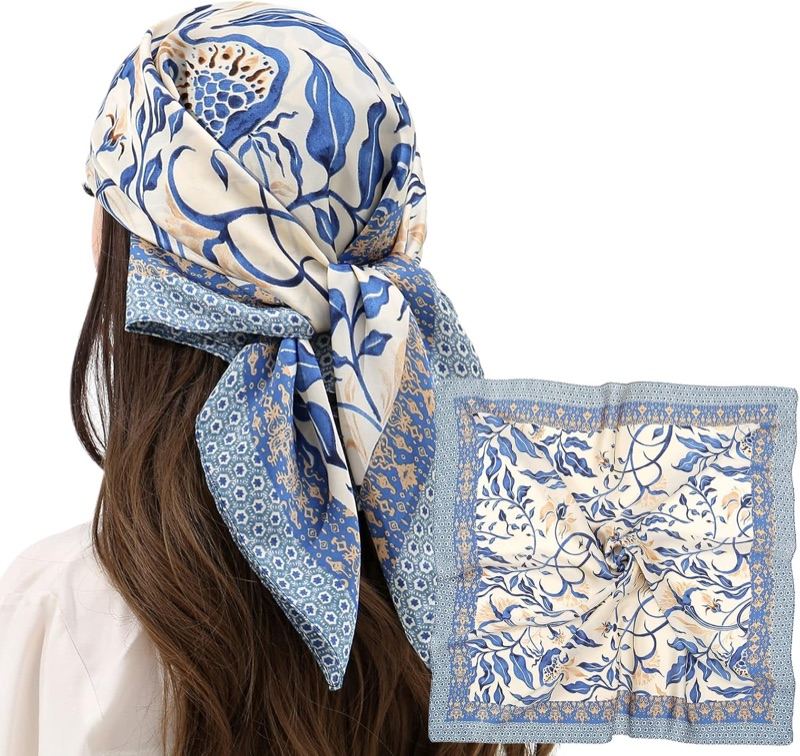
Satin hair scarf for sleeping, 27.5 in
A satin head scarf listed at 27.5 inches for wrapping and sleeping. Use it to check the tie allowance and edge finish described in this guide before relying on a size label alone.
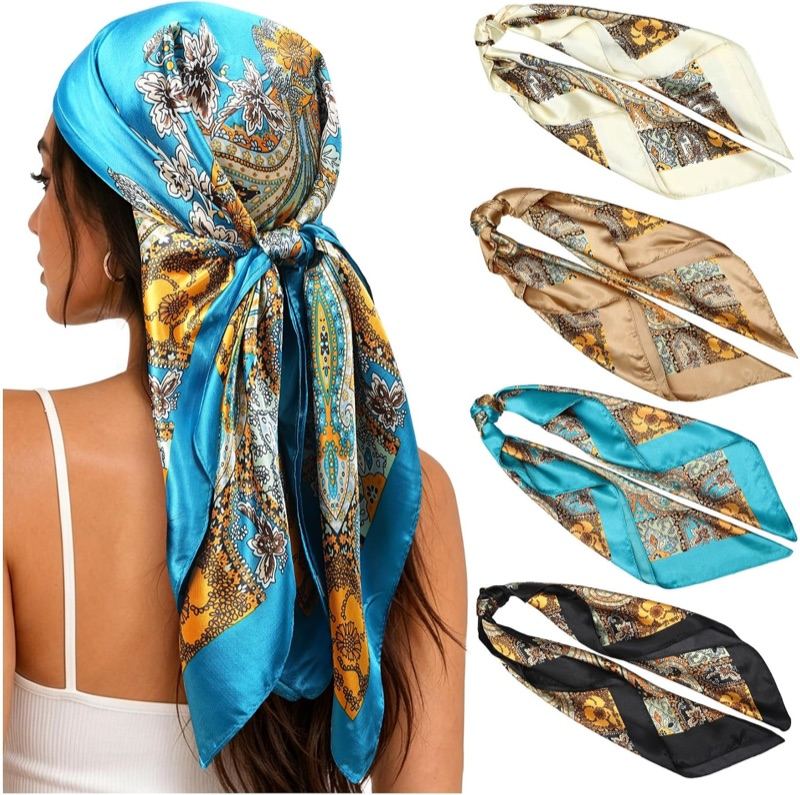
Satin head scarves, 35 in, four-pack
A four-pack of 35-inch satin head scarves in assorted colours. Useful as the longer-tail comparison when you test how much loose tail remains after your usual knot.
Do not infer fibre content from the word "satin"
Satin describes a weave or surface effect, not one fibre. A listing can use "satin," "silk-like," or "silky" while referring to very different materials. That does not make the item misleading by itself, but it means shoppers should read the fibre-content field rather than treating the surface description as proof of silk.
For a consumer purchase, look for a clear materials statement, care instructions, and the stated finished dimensions. If the listing does not state those basics, it is difficult to compare one scarf with another or decide whether a fabric change would matter to your routine. Avoid translating a material label into a health, anti-frizz, or hair-growth guarantee; those outcomes depend on the wearer, routine, and the full sleep setup.
For product development, select the material only after deciding the intended claim and care expectation. Ask for a material swatch and a sewn sample. Compare opacity, hand feel, edge behavior, print clarity, and how the fabric behaves when tied—not just how it looks flat under studio lighting. If the product is sold as a sleep scarf, the tied configuration is the core product condition.
Build a sample test that reflects real sleep use
One person successfully tying a pre-production sample is not enough. The most common failure is not dramatic fabric damage; it is the product gradually sliding, exposing hair, or becoming uncomfortable enough that the wearer removes it.
Make a small test sheet with these fields:
| Check | Record |
|---|---|
| Hair setup | Wrapped, loose, braided, pineapple, or other |
| Tie route | Front, back, side, or another position |
| Coverage at bedtime | What is enclosed before sleep? |
| Coverage on waking | What moved, if anything? |
| Comfort | Pressure point, heat, label irritation, or none reported |
| Knot condition | Intact, loosened, or scarf shifted while knot stayed tied |
| Edge condition | Any thread, curl, snag, or deformation after care test |
Separate a loose knot from a shifted scarf. They call for different changes. A loose knot may require a longer usable tail or a different folding instruction. A scarf that shifts while the knot remains tied may point to fabric movement, hair shape, placement, or a format mismatch. Do not solve either issue automatically by reducing the opening or making the tie more restrictive.
For a small brand, keep the raw test notes with the sample version. If version two changes only the dimensions or hemming, the notes will tell you whether that change improved the actual failure mode. They also become the basis for a more honest product page, care card, and customer-support answer.
Write a purchase order that a factory can execute
A design file alone is not a sleep-scarf specification. It may communicate the print but not the product's operating requirements. The purchase order or tech pack should state:
- Finished width and height, plus the permitted measurement tolerance.
- Finished shape and whether the design is intended to be folded into a triangle for the primary use case.
- Fibre content and fabric construction as supplied by the chosen factory.
- Required hem method, corner appearance, label position, and label material.
- Print placement, including any border and the orientation after a triangle fold.
- Sample approval points: dimensions after hemming, print alignment, edge consistency, knot bulk, and care-test observation.
- Unit packaging: folded method, whether a care/instruction card is included, barcode location, and protection against snagging in transit.
Ask the factory to return the spec with each requirement confirmed, questioned, or proposed as an alternative. This prevents the vague "same as sample" instruction from carrying too much weight. If an alternative is offered—such as a different hem or label placement—test it in the tied position before approving it.
Alibaba and other wholesale marketplaces can be useful for identifying factories that list custom size, print, and hem options. A listing is not proof that a particular seller will accept your order, use a certain material, or meet your quality standard. Treat it as a starting point for a documented enquiry and sample comparison. Verify minimums, dimensions, material, decoration, lead time, packaging, and inspection process directly with the supplier before placing a bulk order.
The practical buying decision
Buy a scarf when you value adjustment and can make a comfortable knot with the hairstyle you actually sleep in. Prioritize declared dimensions, clear material information, a low-bulk edge, and product images that show the intended tie configuration. If you repeatedly wake up with the scarf elsewhere in the bed, do not keep escalating tightness. Test a different tie position once, then move to a bonnet or another format if the scarf is not compatible with your sleep movement.
For a brand, the strongest differentiated product is not simply a printed square. It is a scarf whose dimensions, corners, instructions, and packaging were designed around a specific sleep task and checked by real users. That gives the customer a clearer choice and gives the production team concrete pass-or-fail points before the first bulk order.