A thigh band stops skin-on-skin contact under a dress without the coverage of shorts. It only works while it stays where you put it. When a band rolls, slides down, digs in or leaves a new red line, the advice you will find most often is "size down" — and that is often the wrong answer.
The useful approach is to work out what the band is actually doing, measure the spot where you wear it, then compare width and grip instead of just picking a smaller letter. This guide does that in the order that saves you a return.
Start with the way it fails
Three problems look similar in a mirror and need different fixes.
- The edge curls. The top or bottom edge rolls while the middle stays put. That usually means too much tension against a part of the leg that changes shape quickly, or a band too narrow to hold its shape.
- The whole band slides down. No curling, just travel. That points to a band that is too loose at that height, or an inner grip that is not touching the skin consistently.
- It stays put but rubs. Pinching, a red line, irritation that gets worse when it is hot. This is not a success just because the band did not move. A band that becomes the rubbing surface has not solved anything.
Knowing which one you have matters, because a curling band and a sliding band usually need opposite size changes. That is why the advice online contradicts itself so much.
Measure the place you will wear it
Thigh circumference changes as you move down the leg. A measurement near the top can be very different from one a few inches lower, and the height that works under one dress may be uncomfortable under another.
Measure standing, on bare skin, at the height where you want the band to sit: tape level, snug, not pressing into the skin. Write down the height as well as the number — "about a hand's width below the groin, 24 inches" is more use than "24 inches" alone.
Do this for the outfit you have in mind. Under a fitted skirt and under a loose dress the band may sit at different heights, and the right size can change by one.
Use the chart for that exact product
Sizing is product-specific. A "large" in a wide lace band is not the same garment as a "large" in a narrow silicone-grip band, and a chart built from waist or hip measurements will put you in the wrong size.
Look for a chart that gives thigh circumference in centimetres and inches and says where to measure. If the page only lists clothing sizes, message the seller for the band circumference and recommended thigh measurement — a good seller answers this quickly.
If your measurement falls between two sizes, the right direction depends on the failure you already have:
- Bands that roll on you: try the larger size. Rolling usually means tension, not looseness.
- Bands that slide without curling: try the smaller size, or one with more grip coverage.
- Bands that mark your skin: neither. Look for a wider band with a softer edge.
Most sellers' contradictory size advice exists because they are answering different failures.
Compare width, grip and edge, not just size
Two bands with the same circumference behave differently for three reasons.
- Width. A narrow band concentrates pressure on a small strip, which is where rolling starts. A wider band spreads the load and stays flat, but adds warmth and can bunch under tight clothing.
- Inner grip. Silicone strips, grip dots, shirred elastic and plain stretch fabric all hold differently and wear differently. Silicone grips best on clean, dry skin and can feel tacky in heat; shirred elastic is more comfortable but travels more when you sweat.
- Edge finish. A soft folded edge is far less likely to cut a line into your leg than a thin or raw one. Lace looks better and grips less.
Match the band to the outfit. Under a fitted skirt you have less room, so a wide band may bunch; under a loose dress a wider band with silicone is usually more stable.
Test it under the clothes you actually wear
Put the band on with the outfit you bought it for, not with leggings in a bedroom. Then:
- Walk around the room and up and down stairs.
- Sit down and stand up several times.
- Bend to pick something up.
- Sit in a car seat or a low chair, then get out.
Check where the band has ended up. A band that has crept two inches down in ten minutes will not survive an afternoon. A band that stays put but leaves a mark is still going back.
If you are between two bands, check the return terms first: most are returnable unworn, which makes it worth trying the size the chart actually says rather than living with a compromise.
Care: keep the grip working
Grip degrades faster from residue than from washing. Body lotion, sunscreen and fabric softener all leave a film on silicone, and a filmed band slides.
Hand wash in cool water with a little mild soap, rinse well, and air dry flat. Skip fabric softener and dryer sheets. If the inner strip starts to feel slick instead of tacky, wash it with a drop of dish soap and warm water before deciding the band is worn out.
Then re-test it the same way you tested it new: does it still hold at the same height through the same movements? That is the check that matters, not the first wear.
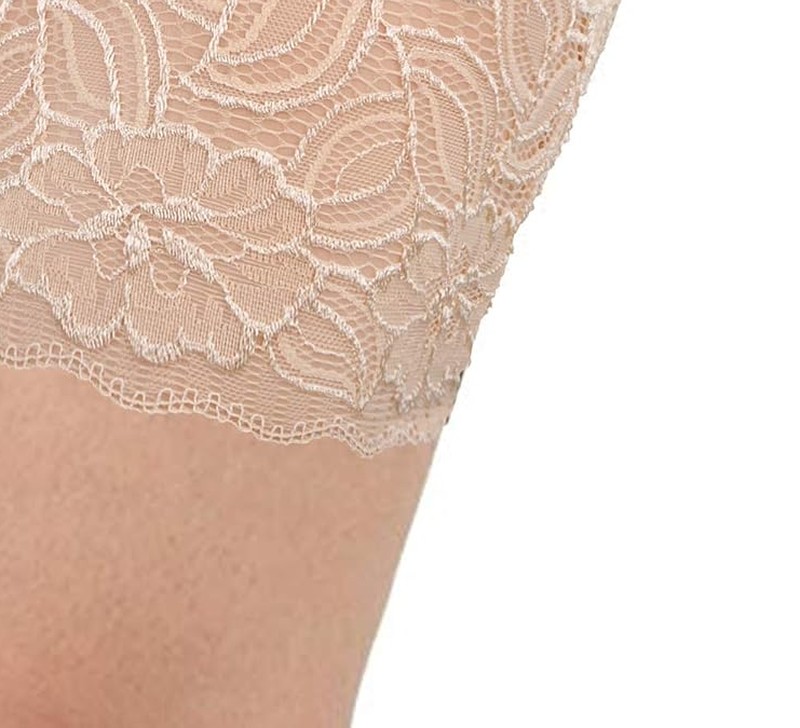
Lace anti-chafing thigh bands with inner grip
A wide lace band with a grip surface inside, sized by thigh measurement rather than clothing size. Check the seller's measuring instructions and the band width before choosing a size.
Sizing is by thigh circumference at the wear point; clothing size is not a reliable substitute.
Two tricks if you are between sizes
If you are right at the edge of the chart:
- Wear the band slightly lower. An inch further down the thigh usually adds circumference, which helps a band that digs in.
- Wear it under a dress with more room at the hem. The looser the garment, the less it pushes the band down.
Neither rescues a band that is the wrong shape for you, but both are free to try before ordering another pair.
When a band is not the answer
Bands suit short wear, warm weather and outfits where shorts are not an option. They are less reliable for a full day of walking in heat, and they are not a substitute for shorts if your skin is sensitive or the event is long.
If you chafe mainly at the top of the thighs and it gets worse when you sweat, a wide silicone strip usually works better than narrow lace. If you mainly want a smooth line under a slip dress, a soft wide band beats a decorative one.
If a band keeps leaving a red mark in the right size, stop wearing it. Chafing is friction plus moisture; a band pressing into the same spot adds a second problem rather than removing the first.
Quick checklist before you buy
| Check | What good looks like |
|---|---|
| Size chart | Thigh circumference in cm and inches, with a measuring point |
| Width | Wide enough to stay flat under your outfit |
| Grip | Silicone or shirred, described in the listing |
| Edge | Soft or folded, not thin and raw |
| Care | Hand wash, no softener, air dry |
| Returns | Unworn exchanges allowed |
Buy the size your measurement supports rather than a size smaller in hope. Then judge the band by whether it stayed at the same height after twenty minutes of real movement — that one test predicts how the next month will go.
For another fit problem where measuring beats tightening, see why bra straps keep slipping.