Choose a cup if you want the more established option, the widest choice of sizes and a design that is easy to find. Choose a disc if a cup has felt like pressure or suction, or if you want the vaginal canal left clear. That is the short answer, and it holds across the clinical pages and brand guides we read. What brand pages tend to skip is the cost of that choice: a disc is usually harder to remove cleanly, and the tuck behind the pubic bone is a technique you have to learn.
This guide covers how the two differ in the body, what to expect on day one, where the sources disagree and how to decide. It is general information, not medical advice; if anything hurts, stop and ask a clinician.
For cup sizing, see menstrual cup size and firmness; for cleaning, sterilising a cup; for backup coverage, the period underwear fit test.
What is the real difference between a disc and a cup?
Position. Healthline puts it plainly: a cup sits below the cervix and extends into the vaginal canal, while a disc fits back in the vaginal fornix, where the canal meets the cervix. Both collect blood rather than absorb it.
That single difference explains most of the rest. A disc is flat and wide, so it rests in the space behind the cervix and is held by tucking the front rim behind the pubic bone. A brand comparison says the disc does not need suction, while a cup relies on one to seal. A cup is deeper and narrower and sits lower, which is why cups come in sizes tied to cervix height and why a cup has to be removed before penetrative sex.
How do you insert and wear each one?
Planned Parenthood describes the disc routine in three moves. Pinch the disc into a figure-eight, angle it down and back toward the tailbone, then push it as far back as is comfortable and tuck the front rim up behind the pubic bone. It is seated when the front edge rests against a firm ridge. If it is not secure, Planned Parenthood warns, it can shift and leak.
A cup is simpler to describe: fold it narrow, slide it in, and let it open. Planned Parenthood notes some cups sit high near the cervix and others lower, and if one is uncomfortable you should take it out and try again.
Wear time is the same on paper. Planned Parenthood says up to 12 hours for a disc and 8 to 12 for a cup; the FDA says a cup may stay in up to 12 hours and tells users to follow the label. Heavy days can mean emptying sooner, and Healthline says the same of discs.
Which one holds more?
Brands say the disc does, but their numbers are inconsistent.
| Source | Capacity claim |
|---|---|
| Healthline | A disc holds about five regular or three super tampons' worth, roughly five to six teaspoons |
| One brand's comparison table | Its disc: seven regular tampons; its cup: up to six |
| Another brand | Its reusable disc holds 70 mL, the same as six or more super tampons; average loss about 15 mL per 24 hours |
Different companies, different units. Do not compare them directly.
Most people do not bleed enough for capacity to decide the question: Healthline says a full period involves roughly 4 to 12 teaspoons of blood in total, so fit and leaks matter more. One retailer suggests checking a disc after about four hours at first, until you learn your own flow.
Is a disc really easier for a beginner?
Mixed, and this is where marketing and experience diverge.
On paper a disc is simpler: many are one size, and one brand says its disc is easier to fit than a cup because it sits at the base of the cervix and does not rely on suction. On forums, though, first-time disc users describe the tuck as the sticking point. One poster says every guide tells you to tuck it behind the pubic bone and she cannot tell whether she is doing it right. Another tried two sizes in a kit and found both leaked. These are individual posts, not data, but support pages echo them: one brand tells newcomers to practise insertion before their period, and another admits there is a natural learning curve with discs.
If you are choosing a first product and want the gentlest start, there is no neutral source that ranks one above the other. Planned Parenthood treats both as ordinary options.
Why is disc removal messier, and can you fix it?
Because a disc is held by its rim and sits higher, you lift it out by hooking a finger under the rim or loop. Healthline's advice is to sit on the toilet, keep the disc level as it comes out and bear down if it is hard to reach. Planned Parenthood adds that you should take a deep breath to relax your pelvic floor and can squat, lift one leg or sit with knees apart.
Mess is the most common complaint. One brand says the first few removals may be messy and suggests practising in the shower. A retailer says removal aids — a double loop, a string or a removal notch — can reduce or even eliminate mess, naming specific brands. That is a seller's claim, and you should expect individual variation.
Related is "auto-dumping": bearing down while using the bathroom pushes the disc out of its tuck and empties it. One brand describes this as useful for some people; Planned Parenthood notes a small leak during bathroom visits can be normal because the disc can slide down when pelvic muscles move. Test it rather than assuming it is a flaw or a feature.
If you have a high cervix, removal is harder. One brand says a stuck disc is common for first-time users and more frequent with a higher cervix, and a retailer suggests choosing a disc with a removal loop or tail if your cervix is high.
What about sex?
This is the single biggest reason people choose a disc, and the sources agree on the principle. Healthline says a disc takes up no real space in the vaginal canal, which is why it suits period sex. A cup maker with a clinician-written guide calls it the biggest reason to pick a disc.
Healthline is more cautious than the brands, though. It notes that deep or vigorous sex may shift a disc and that some user reviews mention feeling it or leaking. One brand says the vagina lengthens during arousal, which can make a disc harder to reach if you try to remove it right away — a manufacturer's explanation, not a study. The reasonable reading: a disc leaves the canal clear but does not guarantee comfort or a mess-free result.
A cup, by contrast, must come out first.
Is it safe with an IUD?
Sources disagree, and you should know that before you buy. The FDA's cup page says anyone with an IUD should talk to a gynaecologist first, because a cup can interfere with the strings and placement, and Cleveland Clinic says some evidence suggests a cup may raise the chance of dislodging an IUD, with more research needed. A hospital guide, by contrast, quotes a doctor as saying it is safe to use a cup with an IUD or contraceptive ring, and says the same of a disc as long as you know where the strings are.
We did not find a source that settles it for discs specifically. The FDA statement is about cups. Treat that as the cautious position for either product and ask your own gynaecologist.
Disposable or reusable?
Healthline notes most discs are disposable, which makes them less eco-friendly than reusable cups, though it also points to reusable disc-like options. The market has changed: several brands now sell reusable silicone discs. One says its disc can be used for up to 10 years; another says one disc lasts for years. Lifespan figures come from the sellers, not independent testing.
Reusable products need care between cycles. The FDA says reusable cups are typically washed with soap and water and, at the end of a cycle, placed in boiling water for one to two minutes, following the instructions for use. One disc brand tells users to boil for three to five minutes before storing. Those two numbers differ, so follow the instructions that came with your own product rather than blending them.
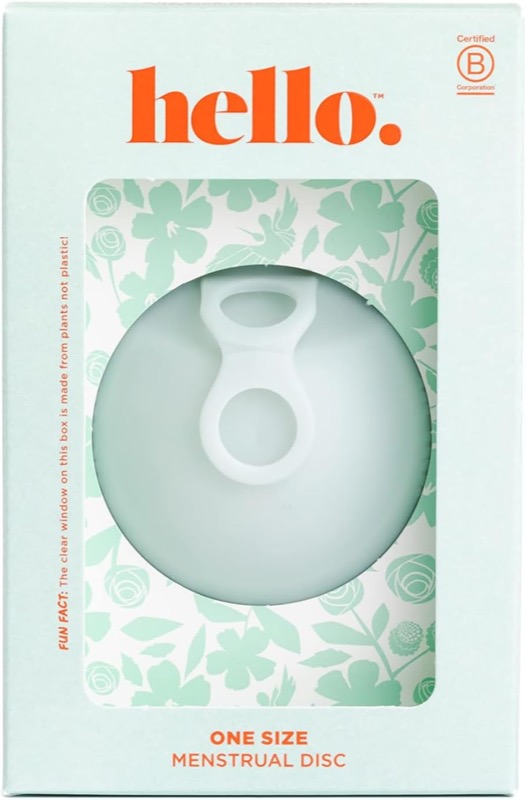
Reusable disc with double loop removal tab
A retail example of the design answer to messy removal: a double loop you can hook a finger through. It is also one of the few listings that states capacity and diameter as numbers rather than tampon equivalents.
What are the safety limits?
Four points are consistent across the sources.
- Do not exceed the labelled time. One brand does not recommend wearing its cup or disc longer than 12 hours and says longer wear can raise infection risk, though the chance remains low compared with other products. In Australia, a retailer notes some makers say 8 hours while the TGA recommendation is 12.
- Not for non-period bleeding. The FDA says cups are not for drainage from an infection or bleeding after recent pregnancy or childbirth. That page is about cups; check the instructions on any disc before using it after childbirth.
- Stop if something is wrong. The FDA lists itching, rash, pain, swelling or discomfort as reasons to stop and contact a healthcare provider. One brand's instructions say not to wear its disc during a yeast or bacterial infection.
- Toxic shock syndrome. Healthline says no serious risks specific to discs have been reported, but cups have been linked to a few cases. One health brand says there is a slight risk with any internal product. Planned Parenthood lists the warning signs (vomiting, high fever, diarrhoea, muscle aches, sore throat, dizziness or fainting, weakness and a sunburn-like rash) under tampons, so we would not claim they are identical for discs. If you feel acutely unwell while using any internal product, remove it and seek care.
How should you decide?
Use your own history rather than a generic verdict. These are starting points drawn from the sources, not rules.
- Pick a cup if you want the longest track record and the widest choice of lengths and firmness, you are comfortable with suction and a stem, and period sex is not a priority.
- Pick a disc if you have tried cups and felt pressure or struggled to get a seal, if you want the canal clear, or if you are willing to learn the tuck.
- Be cautious with a disc if you have a high cervix and a long reach, or you hate messy removal. Look for a loop, string or notch, and expect a learning period.
- Ask a clinician first if you use an IUD, have pelvic pain with insertion, or are recovering from childbirth.
Whichever you pick, give it two or three cycles, change one variable at a time (size, firmness or brand, not all three), and keep a pad or period underwear as backup while you learn. One disc maker itself recommends a liner or period underwear for peace of mind.
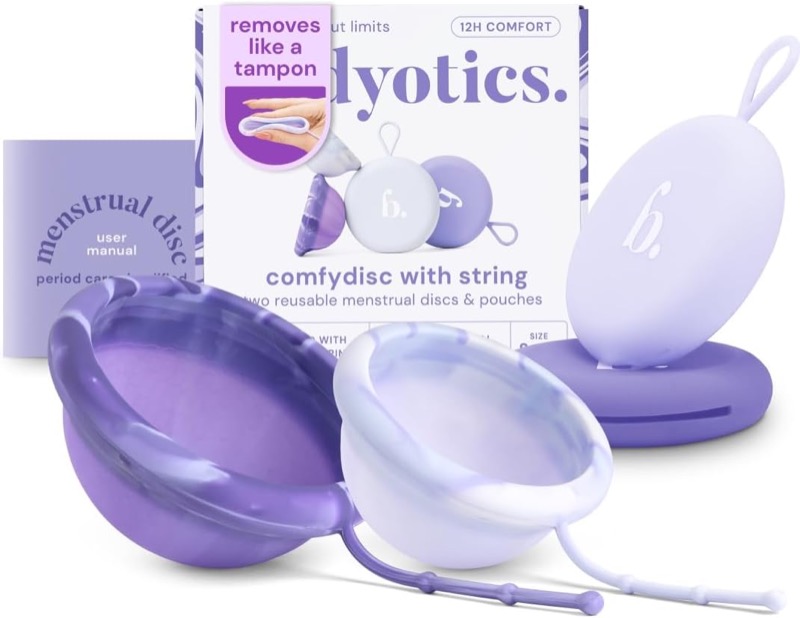
Reusable disc two-pack, small and large
Discs are often sold as one size, so a two-size pack is worth noting: it lets you test the fit question — cervix height and reach — without committing to a second purchase.
What should you check before buying?
- A clear sizing method. Many discs are one size, but not all; some brands sell a single size while others offer more than one. Check whether the brand explains fit at all.
- Removal aid. Notch, loop, string or tab, especially if your cervix is high.
- Material and certification. Silicone versus plastic or polymer, and whether the brand states regulatory status.
- Return or exchange terms. Fit is hard to predict.
- Care instructions in the box, matching the boil times and wear limits above.
If you sell these products, what should the listing say
Safe to print, if true:
- "Reusable medical-grade silicone disc; capacity 50 ml; diameter 68 mm" — numbers, not tampon equivalents alone.
- "Removal loop / string / notch" — the design feature that answers the main complaint, and one you can photograph.
- "One size fits most; suits a low to average cervix" — or the two sizes you actually make, with ranges.
- "Wear up to 12 hours or per local guidance."
- "Boil 3–5 minutes at end of cycle" — your own tested instruction, stated once.
Avoid: "no leaks guaranteed", "you won't feel it", "safe with an IUD" (the sources disagree; point to a clinician instead), "TSS-free", and any claim that a disc is "easier than a cup" without the qualifier that removal takes practice. The honest differentiators — clear canal, no suction, loop for removal — are strong enough without overpromising.
Frequently asked questions
Can a disc get lost inside you? Healthline says it is no more likely to get lost than other insertable products, though there is no string, so you may need to bear down or change position to reach it. One brand adds that the vagina ends at the cervix, so nothing can travel beyond it.
Can I put a disc in before my period starts? One retailer says yes, because a disc does not absorb fluid. Practising before your period is also what one brand advises.
Do I need a different size for a disc? Sometimes. Planned Parenthood says that if a disc keeps leaking or slipping, it may be the wrong size. Some brands make a single size.
Is a disc or a cup better for period sex? A disc, on the sources' reasoning: it sits behind the cervix and leaves the canal clear. Healthline cautions that deep sex may shift it.
Which is better for a high cervix? A disc is harder to remove with a high cervix; look for a loop or string. Cups come in longer bodies for exactly this reason.
Can I use either with an IUD? The FDA says talk to a gynaecologist first for cups. Sources disagree on the risk, so ask your own clinician.