You have a first run of press-on sets ready. Some will be sold at a market table, some through a short-form video shop, and some shipped one at a time. A holographic bag with a display card is light and quick to assemble. A magnetic box looks more like a finished gift. A clear case lets a customer keep the nails after wear. The attractive option is not automatically the sensible one: each format changes the unit cost, the work required to pack an order, and how much protection the outer shipment still needs.
For a small nail brand, the better question is which format fits the product and selling channel without tying up cash in unused stock. Sellers discussing packaging and shipping costs — including one new market seller worried about overbuying before demand is clear — describe a practical buying task, not a market-wide trend: choose a format you can use and reorder consistently.
Separate the package the customer sees from the package the carrier handles
The retail pack is the unit the customer opens: perhaps a nail card, instructions, adhesive, and file. The shipping pack is the mailer or carton carrying that unit. They are separate decisions, even if one supplier offers both.
A pouch keeps a set together but is not automatically crush-resistant. A rigid retail box can present the product, but still needs a check inside the actual mailer. Decide what the inner pack must do, then test the complete parcel. Do not buy a heavy retail box to solve a problem better handled by the outer carton.
Ask suppliers whether dimensions refer to the retail pack, shipping carton, or card sleeve. "Nail box" is too vague if one quote includes a tray and another only a cover.
Three formats solve different jobs
Use the table as a first sort, not as a universal ranking. The right choice depends on the size of the set, the sales channel, how it is packed, and what you want the buyer to do with the package after opening it.
| Format | Works well when | Main trade-off | Check before ordering |
|---|---|---|---|
| Bag plus display card | Light sets, flexible designs, small runs | Limited crush protection; assembly and adhesive matter | Card stiffness, pouch size, nail attachment, mailer |
| Rigid paperboard box | Gift presentation, counter display, organized kits | Higher unit and shipping volume; custom print may raise MOQ | Insert fit, inside dimensions, print sample, closure |
| Reusable case or binder | Buyer needs storage or a multi-set organizer | More bulk and material; may be wasteful if not reused | Latch, internal layout, material, included versus add-on |
A bag and display card suit lean pack outs
A pouch with a printed backing card works well when the nails are already arranged on a card, the set has few extras, and the seller adds a separate mailer. It stores flat and leaves room for a brand mark, size information, or short instructions. It can also be assembled in small runs without a custom die.
The card-and-bag system is only as good as its details. The card must hold its shape, the nails must stay in order, and tape or adhesive dots must hold without visible residue. A loose set can shift or overlap; a pouch can wrinkle or scuff. Check the assembled pack before describing it as protective.
Use the card to answer the questions the shopper is likely to have before purchase: which design is inside, how many nails are included, and what adhesive or tools come with it. Keep those facts legible at actual package size. A QR code or care link can carry longer instructions, but it should not replace information needed to distinguish one SKU from another on a market table or in a picking bin.
The bag-and-card kit linked below is one example of a ready-to-use format. Its current page describes 100 bags, white cards, and double-sided tape, with 4.8 stars from 349 ratings and 100+ bought in the past month. Those signals may change, and ratings do not prove that the kit fits every nail shape or brand layout. Use it as a low-commitment format to inspect, not as a substitute for measuring your own card and testing the adhesive.
A rigid box makes sense when the set needs a finished presentation
A paperboard box may be worthwhile for a giftable set, organized kit, or counter display. A window can show the design and a magnetic closure can make the box easy to reopen, but each adds cost and volume. Give every feature a job beyond appearance.
List the contents before requesting a quote. Ask if the insert is included, what holds the pieces, and whether artwork is in the price. Check that a window actually reveals the nail card rather than empty space.
The magnetic box linked below is a custom book-style format. Its listing states 171 × 82 × 26 mm, 1200 g greyboard, a magnetic closure, a window, and a displayed minimum order of 100 pieces, with 100 sold but no item reviews at the time checked. The company profile says trading company while its description uses manufacturer language, so verify who makes and prints the box. Confirm whether dimensions are internal or external, what the price includes, and whether a sample is available. These are listing claims, not test results.
Do not approve a custom box from a render alone. Request a physical sample with the finished card and inserts. Check closure, window placement, and whether anything presses on or shifts the nails.
A reusable case is a product feature as well as a package
A rigid case or binder-style organizer fits a set the buyer is expected to store, sort, or reuse. Its bulk may be justified by that storage function, but the inside layout and latch must be useful. If customers are unlikely to keep it, the added material and shipping volume may not pay off.
"Reusable" is not a sustainability claim on its own. Check the material, hinge, latch, and edges, and state clearly whether the case is included or sold separately.
If the case is part of the product promise, make the storage use specific. Can a buyer sort a complete set by finger, keep the adhesive separate, or carry a few replacement nails? A case that only looks like an organizer in a photo can create another return reason. Confirm the usable compartments, whether the lid closes when filled, and whether loose parts can cross between sections during ordinary carrying.
Let the sales channel choose the format
For made-to-order website sales, a pouch and backing card can be easier to keep across changing designs. Standardize the card and vary the label or print. If a kit has several tools or cards, consider a box only after checking the assembled size.
At a pop-up or salon counter, the design and size information need to read at a glance. A standing box or windowed card may help; a bag and card may suit a compact rack. Test with the real product under the display lighting and handling conditions.
For marketplace or social-commerce orders, prioritize a pack that is quick to assemble. Marketplace search results show bags, boxes, and organizer cases side by side — evidence of multiple formats rather than proof that one sells best. Packing videos provide visual references for order assembly, not shipping tests or supplier specifications.
For wholesale, plan the number of retail units per master carton, SKU separation, and retailer labels. Ask to approve the production sample with the same insert and labelling planned for the order.
Avoid creating a new package for every design unless the channel requires it. If the same card, pouch, or box can carry a variable design label, the business may hold one base packaging stock and apply SKU-specific information during assembly. That can make replenishment simpler, but it depends on the actual supplier workflow and on whether the label stays secure and readable. Confirm who applies it and whether the placement is consistent across production batches.
Retail and sourcing references
These two links illustrate the bag-and-card and rigid-box formats compared above; they are examples for comparison, not a ranking. We may earn a commission from qualifying purchases through these links, which does not change the assessment of either format. Check the current product page, delivery, MOQ, sample terms and all-in cost before ordering.
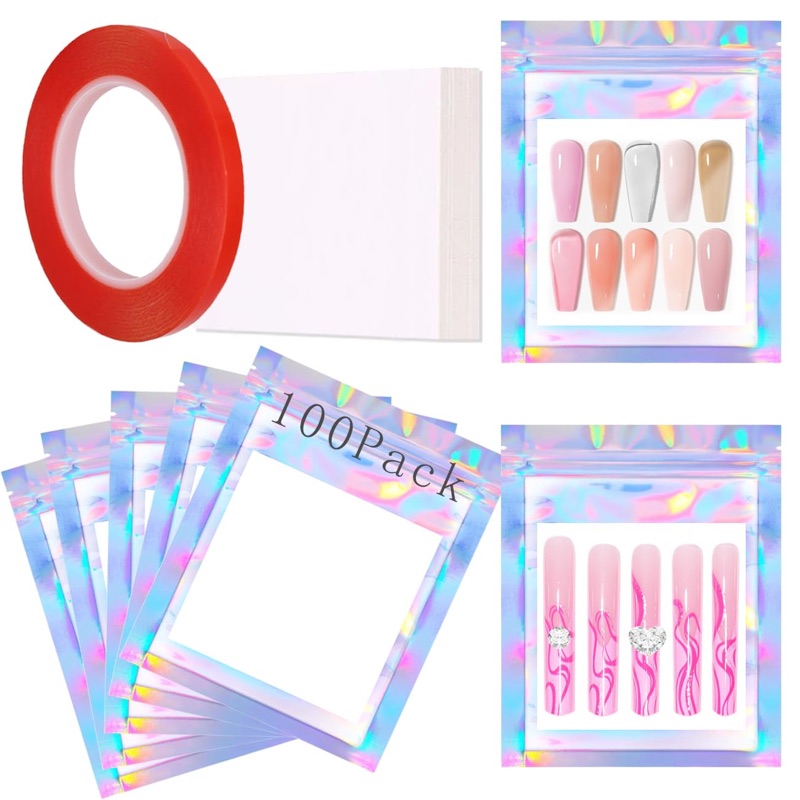
Press-on nail packaging bags with cards, 100 pcs
A ready-to-use bag-and-card kit: 100 bags, white cards and double-sided tape, listed at 4.8 stars from 349 ratings and 100+ bought in the past month. The low-commitment format to inspect first — measure your own card and test the adhesive before treating it as protective.
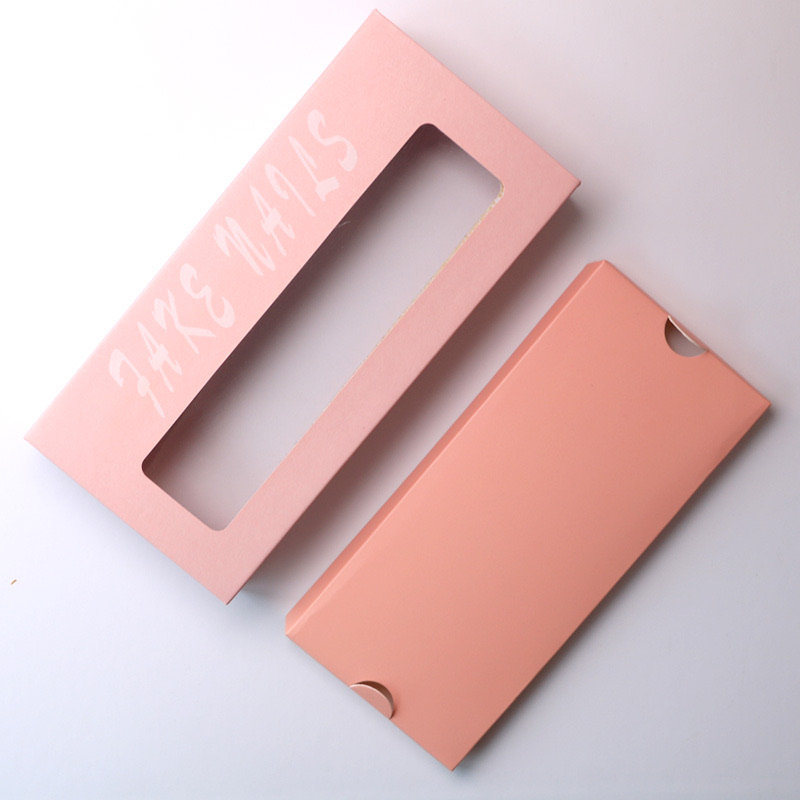
Custom magnetic book-style press-on nail box
A custom book-style box with a magnetic closure and window, listed at 171 × 82 × 26 mm in 1200 g greyboard with a displayed minimum of 100 pieces. Treat the dimensions as unconfirmed until the supplier states the internal cavity after inserts are fitted.
Card photos are the current marketplace listing images and may differ from the delivered product; confirm details on the live listing.
Both listings showed no item reviews for the specific format at the time checked, and supplier-side details such as who manufactures versus prints still need written confirmation. Ratings and sold counters describe accumulated orders, not whether a format survives your mailer.
Compare landed cost per sellable set, not just the box price
A low unit price can mislead if the pack takes longer to assemble or needs a second protective layer. Compare the cost per sellable order:
Retail package + insert and tape + assembly labour + allocated inbound freight and duties + outer mailer or carton + expected replacement cost for damaged or unusable packs.
Time one sample assembly instead of assuming a self-adhesive card takes no labour. Add the supplier's written freight quote, usable unit count, print, sample, and setup charges. A quote that omits these is not an all-in number.
Compare quantities you can realistically sell through. A custom box can lower unit cost at volume but tie up cash on a first run; stock bags may simplify testing several designs. Calculate both with your own quantities rather than assuming one is cheaper.
Use the same set, quantity, and destination in every quote. Request packaging price, included components, customization, samples, carton count, gross weight, and shipping separately. Compare one format per spreadsheet row.
A simple comparison illustrates why this matters. Suppose a box quote is lower per piece than a pouch kit, but requires a printed insert and takes longer to assemble. Add the insert and labour to the box line before judging it. If freight is quoted by carton weight or volume, allocate it across the usable units rather than comparing the supplier's factory price. For a first order, also count the cost of leftover stock if the design changes before the package is used up. The numbers should come from your quotes and packing trial, not a generic online estimate.
Build a brief that a supplier can actually quote
Send a reference photo and brief with package type, finished card size, set contents, dimensions, material, print, closure, insert, logo position, quantity by design, destination, and whether you need retail packs, master cartons, or both.
For bags, specify opening, usable size, card stock, hang tab, adhesive, and how the card is fixed. For boxes, request cavity dimensions after the insert is installed and a drawing that labels inside and outside measurements. Ask for a sample using your actual card.
Confirm minimums by design and colour, logo setup, sample and shipping fees, lead time after artwork approval, dimension and print tolerances, and how repeat orders will match the approved sample. "Custom supported" does not answer these terms.
Add the label and claims review to the brief before the print file is approved. Decide which product identifiers, care directions, business contact details, or market-specific statements belong on the package, then check the rules that apply in each destination market. Do not ask the printer to add claims such as recyclable, compostable, or plastic-free unless the material and disposal claim have been confirmed for the exact finished pack.
Supplier guides already cover box formats, inserts, sampling, and quote preparation, and advise starting from the product and shipping route. Your useful addition is to connect the brief to sell-through quantity, packing labour, and delivered cost, then save the approved sample for reorders.
Test the sample as a complete order
Assemble one set exactly as sold. Check that the shade, size range, and included adhesive are easy to identify. Open and close the package; look for nails that lift, slide, rub against a window, or disappear under an insert. Photograph the sample beside the approved artwork.
Place it in the actual mailer and pack it as your team normally would. Check for shifted contents, an opened closure, a bent card, or visible scuffing. This is an internal comparison, not a certified transit test. Fulfilment programs may have separate current rules.
Record the SKU, package version, supplier, date, and failures. Request a revised sample if anything changes before production; keep the approved sample as the reorder reference.
When the first production batch arrives, compare a small selection from different cartons with the approved sample. Check the print, dimensions, inserts, closure, and supplied quantity. Keep photos and a signed-off specification with the purchase record. If a supplier substitutes a board, window film, or adhesive, assess that as a change and approve it deliberately instead of assuming the package is unchanged because the product title stayed the same.
Choose the simplest format that does every required job
A bag and card suits a compact set and flexible design run. A rigid box earns its cost when presentation, organization, or protection matter. A reusable case belongs when buyers have a reason to keep it. All three still need a separate shipping check.
Choose one primary channel and standard set. Define what buyers must see, what must stay in place, and what the mailer must protect. Compare delivered cost at a sell-through quantity, then test the full pack before reordering. That gives you a system to improve instead of excess inventory.