A cosmetic bag is judged from the inside. The outside is what the customer sees in the photo, but the inside is where foundation leaks, lipstick melts against the lining and a brush with loose pigment ends up. If the lining stains for good, turns tacky or starts to flake after a few months, the bag is a failure however nice the outer fabric looked on day one.
"Wipe-clean PU lining" and "waterproof nylon lining" are very thin descriptions. They tell you what the supplier would like you to picture, not which fibre sits under the coating, which coating it is, how it was bonded, or what happens when it meets a leaking mascara tube in a warm bathroom cupboard.
This guide separates the vocabulary, explains the one failure mechanism coated linings are known for, and sets out a short stain, rub and zipper test you can run on samples.
What "PU lining" and "nylon lining" usually mean
Two different things get named in the same breath, and mixing them up is the most common source of confusion.
Nylon and polyester are fibres. Ripstop, taffeta and canvas describe how a fabric is woven. PU, TPU, PVC and silicone are coatings or laminates applied on top. A finished fabric can combine several of these at once, so a single label rarely tells you much.
- When a listing says "PU lining", it is usually naming the coating and saying nothing about the base.
- When it says "nylon lining", it is usually naming the base and saying nothing about whether it is coated at all.
- "Waterproof nylon" most likely means nylon taffeta with a PU or similar coating on one face. "Polyester taffeta" can carry exactly the same coating on a different fibre.
Before comparing any two bags, write down four facts for each:
- Base fibre and weight of the lining (nylon or polyester; denier or gsm).
- Coating type (PU, TPU, PVC, silicone, or none).
- Which side is coated — the coated face normally sits towards the bag's cavity, so it is the surface your products touch.
- Whether the lining is the coated fabric itself or a film laminated to it.
If a supplier cannot answer those four, treat everything else they say about the lining as unverified.
How the main lining options compare
This is a summary of how these materials are normally described, not a lab ranking — individual fabrics vary a great deal.
| Lining | What it is | Where it tends to be strong | Where to be careful |
|---|---|---|---|
| PU-coated polyester taffeta | Polyester weave with a polyurethane coating on one face | Common, smooth, easy to wipe; the usual bulk bag lining | PU can degrade with heat and humidity; face-to-face contact matters |
| PU-coated nylon | Nylon weave with PU coating | Strong and soft; widely used in travel bags | Nylon absorbs water; same PU ageing caveat |
| TPU-coated or laminated | Thermoplastic polyurethane film on a woven base | Often described as tougher and more water-resistant | More costly; check seams and heat-sealed edges |
| PVC-coated or vinyl | Polyvinyl chloride layer, often on a backing | Easy to wipe, stiff, robust | Stiffer, can smell on arrival; plasticiser migration is a known issue |
| Silicone-coated nylon | Silicone applied to or into the fabric | Good heat stability | Can be slippery to sew; less common in low-cost bags |
| Uncoated nylon or polyester | No waterproof layer | Soft, breathable, often machine washable | Absorbs liquids; stains stay in the fibres |
Polyester is often the more common base for PU and PVC coatings and resists hydrolysis better than nylon, which in turn gives the coating a longer life. Treat that as a manufacturer's statement rather than an independent finding, and ask your supplier what they use and why.
Why coated linings peel: hydrolysis in plain words
If there is one thing worth knowing about PU linings, it is this. Polyurethane coatings can break down when they sit in warm, humid conditions — a process called hydrolysis. The visible result is delamination, where the PU layer peels away from its textile backing. Scratches and breaks in the top film let moisture and harsh cleaners in, which speeds up peeling.
A cosmetic bag is a good candidate for exactly this kind of stress: it lives in bathrooms, is packed damp after a trip, travels in hot cars and gets wiped with water, micellar solutions or alcohol wipes. So the right question is not "is the lining PU?" but "has this specific PU been tested for hydrolysis, and by what method?"
What the test names mean
Supplier datasheets often mention ISO 1419, sometimes with "Jungle" or "Tropical" in the name. That standard family ages coated fabric in a heat and humidity chamber — one faux-leather maker describes holding material at about 70 °C (158 °F) and 95 per cent relative humidity for a set period, with hydrolysis resistance measured in weeks and a minimum of five weeks mentioned in that guide's framing.
Those figures come from suppliers and trade guides rather than independent testing of cosmetic bags, so do not turn them into promises on your listing. They are useful for one purpose: telling you what a reasonable request looks like. Ask for:
- The test method used (for example ISO 1419 or the equivalent they cite).
- The duration and conditions.
- A report from a named laboratory, or at least the supplier's own record with batch information.
- Whether the tested fabric is the same construction as the lining in your bag.
If the answer is "we use high-quality PU", that is not an answer. A hydrolysis report is a document; a reassurance is not.
The face-to-face problem
Another point that is easy to miss: avoid applications where the face of a PU-coated textile contacts itself, because that contact can cause the topcoat to peel. A cosmetic bag has this by design — fold the pouch and the lining touches the lining; stuff a flat pouch into a suitcase and the two inner faces press together for days. If the coating is tacky at the surface, or has started to degrade, that is where it shows first.
Owners of old stuff sacks describe the same thing informally: a coating that went sticky or began to peel after years of storage. Anecdotes are not data, but they match the mechanism. Test the lining face to face at the sample stage, not just the lining on its own.
Choosing a lining by what the bag has to hold
The best lining depends on what goes inside, not on a ranking of materials.
- Liquid-heavy kits (foundation, serum, skincare minis, setting spray): a coated or laminated lining you can wipe, and check the seams, because a perfect lining with open stitching lets liquid through the needle holes.
- Powder and brush kits: loose pigment travels. A smooth coated lining sheds powder with a dry wipe; a soft uncoated lining holds pigment in the weave, which is a stain waiting to be noticed.
- Lipsticks, balms, cream sticks: oil and wax are the hard stain case. Smooth coatings usually clean better than open weaves, but not all coatings behave the same with oils — this is where the stain test matters most.
- Skin-contact and clean-use kits: a pouch carrying sponges and brushes should dry out fully. A fully sealed coated lining can trap moisture, which is the problem covered in the sponge case ventilation test. If the bag also carries damp items, a separate wet compartment — as in the period wet bag test — is a better answer than asking one lining to do everything.
- Hot-climate or long-storage use: if bags sit in warm storage between orders or ship to humid destinations, put hydrolysis documentation higher on your list than softness or colour.
What "wipe-clean" should mean
"Wipe-clean" is a claim about a result, not a material. To make it testable, define three things up front.
- Which substances. Lipstick, liquid foundation, mascara, eyeliner, nail polish and a dark powder are a sensible starting set. Add a facial oil or sunscreen if your customers carry them.
- How long they sit. A spill wiped at once is not the same as a smear left overnight in a closed bag. Choose a contact time (say thirty minutes and twenty-four hours) and keep it fixed across samples.
- What cleaning method counts. A dry tissue, a damp cloth with water, a mild soap solution and an alcohol wipe are four different tests. State which one you mean, and make the care label name the same method.
Note also that no coated fabric is completely impervious to repeated chemical cleaners and disinfectants: prolonged use can change surface texture, dull gloss or crack the coating. A fresh-water rinse and wipe after any cleaning agent is the sensible habit, and the gentlest cleaner that works is the one to recommend.
A repeatable stain and wipe test
This is an in-house screening test, not a published standard. Its job is to compare candidate samples under the same conditions and document what you saw.
| Step | What to do | What to record |
|---|---|---|
| 1. Map the area | Mark four or five spots away from seams with removable tape | Photo with a ruler or label in frame |
| 2. Apply products | Swatch equal amounts of lipstick, foundation, mascara, eyeliner, dark powder, each in its own spot | Product names, shades, time of application |
| 3. Short contact | Thirty minutes at room temperature, then clean with the stated method | Wipes in one pass, three passes, or not at all |
| 4. Long contact | Twenty-four hours, part of it with the lining folded face to face | Residue, ghosting, texture change, tackiness |
| 5. Look again | Dry fully, check in raking light, press with a white tissue | Remaining shadow, shine change, fibre fuzz |
| 6. Repeat on a seam | One product at a stitched seam or binding edge, then clean | Whether product sinks into the stitch line |
Run the whole sequence on at least two samples of the same bag, and on a reference you already approved if you have one. Three observations carry special weight:
- Ghosting — a faint stain that survives cleaning. It is cosmetic, but customers read it as "dirty", so decide in advance what level you accept.
- A change in surface feel (tackiness, softening, dullness) matters more than a colour mark: it can mean the coating is reacting with oils or solvents.
- Edge wicking at seams is a construction problem, not a lining problem. Record it separately.
The humid-storage screen
A real hydrolysis test needs a chamber. You do not have one, and a home version does not prove an ageing standard. What you can do is a rough screen: fold a clean dry sample so the lining touches itself, put a modest weight on it, seal it in a bag with a piece of damp cloth that does not touch the lining, and keep it somewhere warm for a week. Then check for tackiness, changed smell, surface sticking or flaking at folds.
A pass tells you little about two-year durability. A failure tells you quite a lot. If a sample goes sticky after a week of mild storage, do not order the bulk run.
Colour transfer: the rub test
Dark linings and dark outer fabrics can leave colour on light products, and a light lining picks up pigment from the makeup it holds. Textile labs measure rubbing transfer with ISO 105-X12 or the American AATCC Test Method 8: rub the coloured fabric with white cotton cloth, dry and wet, and grade the staining, where five means no transfer and one means a high degree of transfer.
You do not need the apparatus to learn something:
- Take a clean white cotton cloth or a white cosmetic pad.
- Press and rub it along the inside lining, then the outer fabric, ten passes at the same light pressure.
- Repeat with a slightly damp cloth.
- Compare against a white reference and photograph.
If a dark lining leaves colour on a dry white cloth, it will do so on a white product box or a light cosmetic. If it does so when wet, expect it on a damp bathroom shelf. Ask whether the lining and the outer fabric have rubbing-fastness reports, but do not borrow upholstery minimums as if they applied to cosmetic bags — set your own pass level and write it down.
Smell, plasticiser and cosmetic contact
Open the sample bag in a closed room and note the smell. A strong chemical or "new vinyl" odour on arrival is a sign to ask what the coating and any adhesives are. It may fade; it may not.
PVC deserves a note in a cosmetic context: plasticiser migration is one of the main changes seen when PVC contacts a product, with effects including changes in flexibility, brittleness and odour, and the plasticiser can move into the product itself. That is a historical source and materials have moved on, so do not read it as a statement about every PVC bag today. It is a reason to ask which plasticiser is in the lining and whether the supplier can provide a compliance statement for your market.
Note also that there is no real reference standard for cosmetic container–content compatibility; the EU cosmetics regulation is often used as a reference point. A bag is general merchandise rather than primary packaging, and what applies depends on where you sell, what you claim and who it is for. If the bag is marketed for children, or carries loose open products in direct contact, ask a compliance specialist before listing it.
Seams, tape and raw edges inside
A lining can pass every stain test and the bag can still leak at the stitching. Turn the bag out and check:
- Needle holes along the lining seams — liquid does not go through the coating, it goes through the thread line.
- Seam tape or binding: is it firmly bonded along its length and does it lift at corners?
- Raw edges: cut lining edges that fray into the pouch catch on brushes and sponge fibres.
- Bottom corners: a boxed base has more seams and more places for product to collect.
- Where the lining meets the zipper tape: a loose flap here is the classic snag point.
If the bag claims to contain a spill, fill it with a small amount of coloured water in a sealed container, or a bag of damp tissue, and stand it on a white paper towel for an hour. Leaks show at once. If the intended claim is only "wipe-clean interior", skip the liquid test — and do not word the listing as if you had run it.
Pass, revise and fail: decide before the samples arrive
| Area | Pass | Revise | Fail |
|---|---|---|---|
| Lining spec | Fibre, weight, coating and coated side confirmed in writing | One detail unclear | Supplier will not specify |
| Stain, short contact | All products wipe clean in the stated method | Faint ghosting on one product | Permanent stain or surface change |
| Stain, long contact | Wipes clean, no tackiness | Faint ghosting, no texture change | Tackiness, softening or colour change |
| Humid screen | No tack, odour or flaking | Slight odour that fades | Tack, flaking or sticking |
| Rub transfer | No visible colour on dry cloth | Slight transfer wet only | Visible transfer dry |
| Seams and edges | Neat, bonded, no raw edges | Minor fray, easily fixed | Open seam, lifting tape |
| Zipper run | Smooth, no lining catch, slider holds | One minor fixable catch | Catches lining, slider opens |
| Loaded closing | Closes easily with margin | Closes with effort | Cannot close or distorts |
A single pass on a single sample is a first step, not a green light. The table separates "needs a fix before bulk" from "wrong supplier".
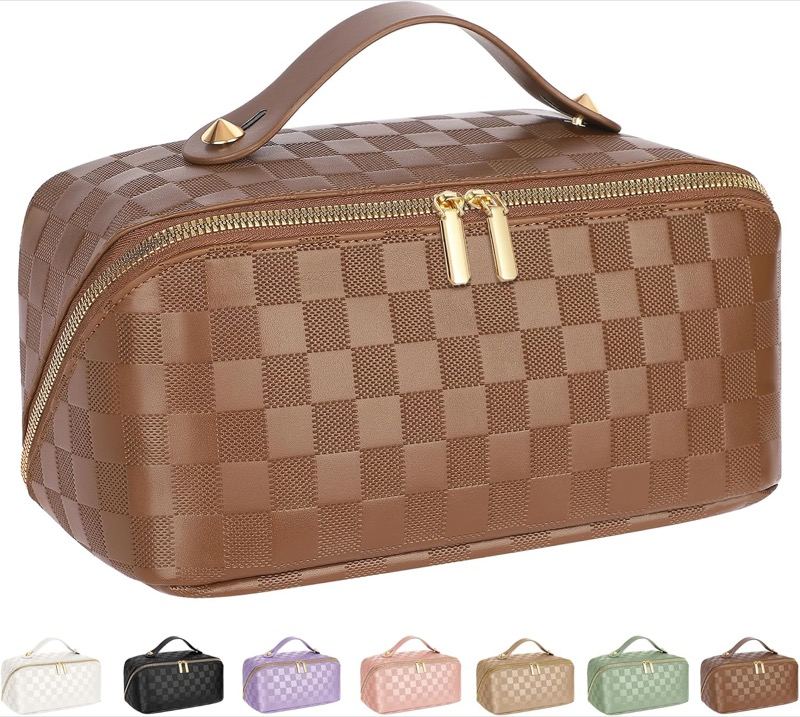
PU leather cosmetic bag with PU lining
A retail example of the format this article is about: PU outside and PU lining, which means the same coating family on both faces. Use it to see how a coated lining behaves in a real bag before you brief a factory.
The zipper is half the bag
Cosmetic bags live and die by their zippers: opened and closed more often than almost any other bag, packed to bursting, meeting bottles and lids with hard corners.
Chain type and size. There are three main chain types: coil, moulded plastic and metal. Coil suits curves and flexibility; moulded tooth suits straight, structured or weight-bearing installations. Size is stated by a number — a number 3 chain has a tooth width around 3 mm, a number 5 around 5 mm, with a bigger slider and thicker tape. A light flat pouch can use a smaller chain; a bag carrying bottles or stuffed to capacity needs more margin.
If a listing says only "YKK zipper" or "metal zipper", ask for chain size, chain type, slider type (auto-lock or non-lock) and whether the pull is metal or fabric. Because a listing photo may not show the hardware actually fitted, ask for a photograph of the slider stamp on the actual sample.
What the standards test. ASTM D2061 covers zipper strength: chain and element strength, stop holding strength, slider-lock holding strength, and resistance of the pull to being pulled off or twisted. The standard notes that no single test determines suitability for an end use. You probably will not run these on a first sample, but they give you vocabulary — ask about slider-lock holding strength rather than "is it strong?"
A hand test that tells you something. Run these with the bag loaded with your actual kit, because an empty bag proves little:
- Smooth run: open and close twenty times at normal speed; note stiffness, hesitation, grit.
- Corner pass: close slowly around the corners; the slider should not ride up or catch the lining.
- Overpacked test: add one more item than the standard kit, then close. A bag that closes only when you push and wiggle will do the same in a customer's hands.
- Lining catch: look for loose lining, tape or thread within reach of the slider.
- Slider hold: close, then lift the bag by the pull and shake lightly; the slider should not open.
- Pull strength: tug in line and sideways; it should not rotate off or bend.
- Stops: check end stops at both ends and the top.
- Reverse side: run a finger along the inside of the tape; rough or sharp areas will scratch the lining.
This is the same logic as the bra laundry bag zipper test, adapted to a bag whose hazard is sharp corners and heavy contents.
Pack-out: test with what customers actually carry
Build a reference kit and use it for every sample:
- The tallest and widest item customers will carry (a foundation bottle, a setting spray, a flat palette).
- A brush roll, if the bag claims to hold brushes.
- A few small items that move (lip products, a compact, a sharpener).
- One liquid item, in a bottle tested not to leak.
Then pack it the way a customer would on a bad day: quickly, heaviest first, zip it. Check that the bag closes without bowing the lining out of shape and that the lining does not crease against the zipper. Tip it on its side, carry it in a tote for an hour, open it again. If the bag is promoted for travel, drop it from table height with the kit inside and record exactly where it fails.
The supplier brief
Keep it short, specific and answerable:
- Product definition: bag type, internal dimensions, and the reference kit it must hold.
- Lining: base fibre, weight, coating type, coated side, and whether it is film-laminated.
- Documentation: hydrolysis report (method, duration, conditions), rubbing-fastness reports for lining and outer fabric, and any chemical compliance statements relevant to your region.
- Seams: taped, bound or open interior seams, and stitch density.
- Zipper: chain type and size, slider type, pull type, and a photograph of the slider stamp.
- Samples: two units of the final construction, plus a cutting of the lining fabric so you can run destructive stain and rub tests without damaging a bag.
- Change control: a commitment to tell you before changing lining supplier, coating or zipper.
If you source through a trade platform, keep the answers in the platform's messaging system. When a reply says "same as the picture", ask again specifically: "which side of the lining is coated, and with what?"
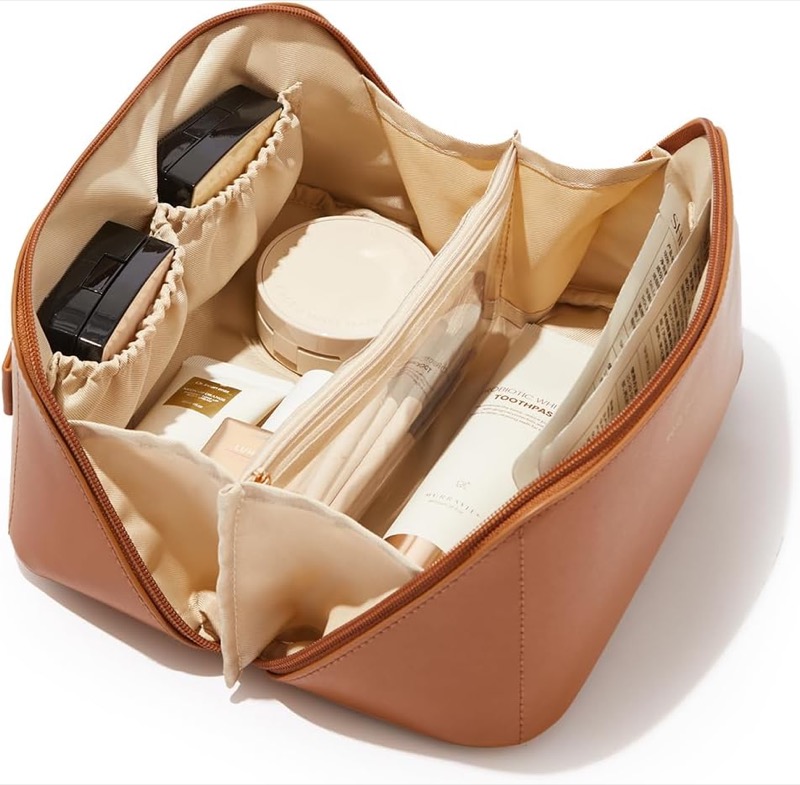
PU makeup bag with a clear TPU brush section
A second build worth comparing: a PU exterior with a separate clear TPU compartment, so two different surfaces sit inside one bag. Ask which of them touches the products and treat each on its own evidence.
Claims: how much your listing can say
Match the claim to the test you ran.
- If you tested only a wipe of a few products with water, say "wipe-clean lining" and name the cleaning method in the care notes. Do not say "stain-proof".
- If you did not leak-test the bag, do not say "waterproof". "Water-resistant lining" is still a claim; use it only if you can describe what you saw.
- If you have a hydrolysis report, you can say what the report supports, but do not translate it into a number of years of use.
- If the bag is not machine-washable, say so and give the cleaning method you tested.
- Avoid "non-toxic" and "safe for cosmetics" unless you hold specific compliance documents and understand what they cover.
A narrow claim that holds up is worth more than a broad one that attracts returns.
Care instructions that fit the lining
The best care note is the one you have tested:
- Wipe spills promptly with a damp cloth, then rinse and wipe again with fresh water.
- Let the bag dry fully, open, before storing; do not seal a damp bag away for days.
- Avoid folding the lining face to face while it is damp.
- Use harsh cleaners, solvents and alcohol wipes sparingly, if at all, and test them on a sample first.
- Keep bags out of hot cars and direct sun when empty — heat plus humidity is the combination associated with PU ageing.
Frequently asked questions
Is PU or nylon the better lining? They are not alternatives. Nylon is a base fibre; PU is a coating. The real choice is base fibre, coating type, and how that combination holds up in your use.
Will a PU lining peel? It can, particularly in warm, humid conditions and especially if the coating is scratched or sits face to face for long periods. A supplier should be able to tell you what hydrolysis testing the fabric passed. Peeling is a risk to manage, not a certainty.
Is an uncoated nylon lining a bad choice? Not necessarily. It is soft and often washable, but it is not wipe-clean, so it suits dry kits better than liquid-heavy ones.
Can I test hydrolysis myself? Not in the sense of the standard. A humid-storage screen can reveal an obvious problem; it cannot show a pass for a given lifetime.
Does a better zipper make up for a weak lining? No. They fail in different ways, and they are two separate approvals.