A press-on can sit neatly at the cuticle and still leave the natural nail visible at the free edge. Turn the same tip the other way, or choose the next size up, and the wider end may cover the nail while the cuticle area becomes too broad. For customers whose nails widen toward the fingertip, this is not a simple "size up or size down" problem.
Fan-shaped nail beds test whether a fit system is built around nail outlines rather than a single width. The product-development task is to identify the mismatch early, decide which tip families can accommodate it, and communicate the limits of a ready-made set without promising a universal fit.
Recognise the two-width problem before changing the size
Most sizing instructions ask a customer to measure the widest part of each nail. That is a sensible starting point, but it cannot describe every outline. A fan-shaped nail may be noticeably narrower near the cuticle and wider near the free edge. Two nails can share the same maximum width while asking for different press-on shapes.
The conflict is easy to see in a dry fit. A tip selected for the cuticle may look tidy at the base, then show slivers of natural nail along the upper sidewalls. A tip selected to cover the wider upper portion may overlap skin or look oversized at the base. If the customer has to push the tip down hard to make the sides reach, the set is not fitting; it is being forced into position.
Do not diagnose this as a curvature issue too quickly. Curvature describes the arch from one side of the nail to the other. The problem here is the changing width along the length of the nail. Some customers have both a flat or curved nail bed and a fan-shaped outline, but the two variables need separate records. A brand cannot improve its size range if every complaint is filed under the vague label "does not fit."
The first question for a sizing kit or sample review is therefore: where does the mismatch begin? Ask the wearer to place an unglued tip at the cuticle line, hold it in its natural position, and note the following.
- Is the tip correct at the base but too narrow near the free edge?
- Is it wide enough at the free edge but visibly too broad at the base?
- Does the same problem repeat on more than one finger, or only on a thumb?
- Does the tip cover the nail plate yet rise at the sides because its crosswise curve is wrong?
Those observations tell the product team whether it is dealing with an outline, a size increment, a back-edge contour, or a profile issue. They also prevent an unhelpful response such as "try a different number" when neither adjacent size follows the customer's nail shape.
Measure the base and the free edge, not only the widest point
A brand selling fixed-size press-ons does not need to turn every order into a custom service. It does, however, need enough information to see where its range stops working. Adding a second measurement to a size exercise is one of the simplest ways to obtain it.
Measure the nail in two locations: near the cuticle, where the press-on will begin, and farther forward at the point where the natural nail is widest before its free edge. The exact placement should be illustrated in the brand's sizing instructions and kept consistent from one customer to the next. The purpose is comparison, not the invention of a universal anatomical standard.
Record the two values against the same finger. The difference between them is the useful signal. A customer with a small difference may be able to use a conventional outline comfortably. A customer with a larger difference may need a different tip shape, selective reshaping, or a custom option. The raw pair of measurements is more useful to a product team than an unsupported rule such as "fan-shaped nails always need a size up."
For physical sizing kits, the same idea can be tested without asking every customer to use a ruler. Include enough try-on tips for the intended shapes, and ask the user to report whether each selected tip is narrow at the free edge, broad at the cuticle, or correct at both. If the kit only records a tip number, it captures the final choice but loses the reason an adjacent size failed.
For a brand's internal sample sheet, make the distinction visible. A simple line drawing of the tip with a base-width field and a forward-width field is clearer than a single "width" entry. Add the measured length, the shape name, and the tip family or mould identifier. This keeps an almond, square, and squoval tip from being treated as interchangeable simply because they share a number.
Shape is part of the size system
The outline of a press-on is set by more than its marketed shape name. "Almond," "oval," or "square" can describe the visible free edge while concealing meaningful changes in width through the lower half of the tip. A short squoval and a tapered almond can have the same nominal length but meet the sidewalls very differently.
For fan-shaped nail beds, the useful comparison is not which shape looks longest or most fashionable in a product photograph. It is which blank tip provides enough material along the upper sidewalls without creating a wide, heavy-looking base. The answer may vary by finger. A thumb may need a different compromise from an index or middle nail, and an index finger may not resemble its counterpart on the other hand.
That is why a finished collection should be sampled in the actual shape and length offered for sale. A brand may correctly approve a broad straight-sided blank tip, then transfer the same size chart to a strongly tapered long almond collection. The published size numbers will look consistent, but the customer's usable coverage has changed. Size charts should belong to a specific tip family or clearly disclose when a new shape uses a different base.
When a customer must reshape a slightly larger tip, the instructions should identify the trade-off. Filing the sidewalls can make a broad base fit more neatly, but it also changes the outline and can expose a raw edge or disrupt a finished design. It is a limited adjustment, not a promise that every fan-shaped nail can be converted to every press-on silhouette.
Build samples around the failure, not the average hand
A sample approval process often centres on whether a set looks good on a model hand. That is useful for colour, artwork, and overall proportion, but it will not reveal a fan-shaped fit problem if the model's nail outline happens to be close to the mould. The purpose of a fit sample is to look for the hands that make the size logic fail.
Create a small internal panel of nail-outline cases. It does not need to make claims about population prevalence. It should simply include the conditions the brand intends to serve: a relatively parallel outline, a wider thumb, a nail that widens toward the free edge, and, where relevant, a flatter or more curved profile. Keep photographs, selected tip sizes, and notes for each case.
During review, ask the tester to dry-fit first. A glued application can conceal a gap while pressure is being applied, then show the mismatch once the hand moves. Photograph each selected nail from above and at a shallow side angle. The upper sidewalls, cuticle zone, and free edge should all be visible. A styled close-up of the finished manicure is not sufficient evidence for size approval.
The sample record should answer practical questions:
- Which sizes covered both the base and the forward sidewalls without skin overlap?
- Where did the tip first become too narrow or too broad?
- Did a change in shape solve the outline issue, or only move it?
- Was the customer able to apply the tip without sustained pressure?
- Did the design survive any permitted reshaping?
This information gives a manufacturer or production partner something concrete to compare. "The sample does not suit fan-shaped nails" is too imprecise for a corrective request. "The index tip in size X fits at the base but is short of coverage at the forward sidewalls on the approved test outline" identifies the failing position and the reference sample.
Retail options
These Amazon retail references are included for readers who want to compare a clear full-cover tip set and a hand-file option for minor reshaping. Check the current listing before relying on availability, included components, or any manufacturer claim. Neither listing proves it will solve a fan-shaped nail fit problem.
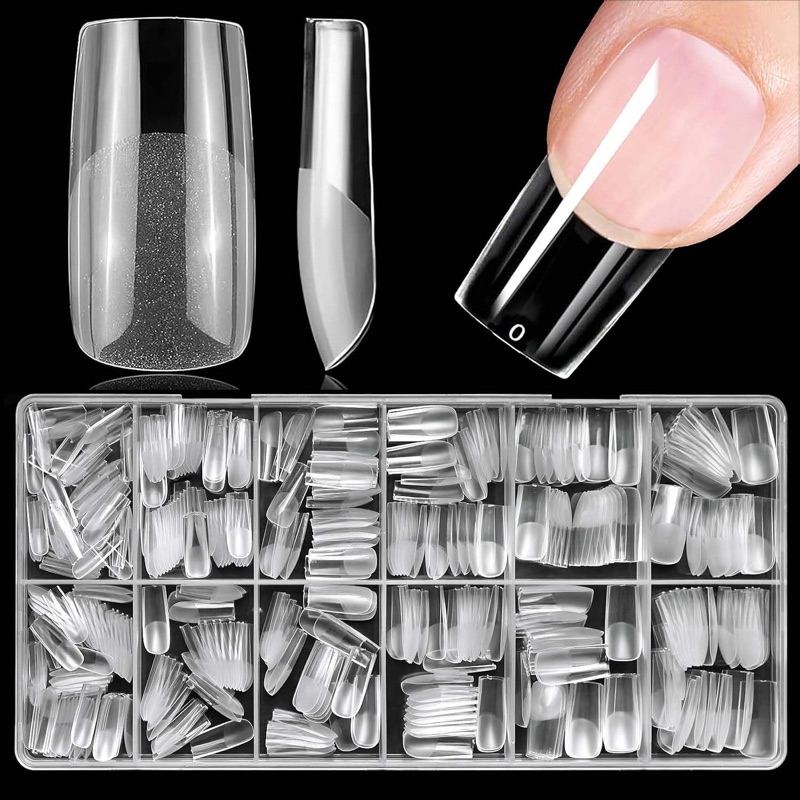
Medium square nail tips, clear full-cover, 360 pc, 15 sizes
A 360-piece clear full-cover square tip set in 15 sizes. Use it to check where a wider, more parallel outline starts to cover the upper sidewalls without overlapping the base on a fan-shaped nail.
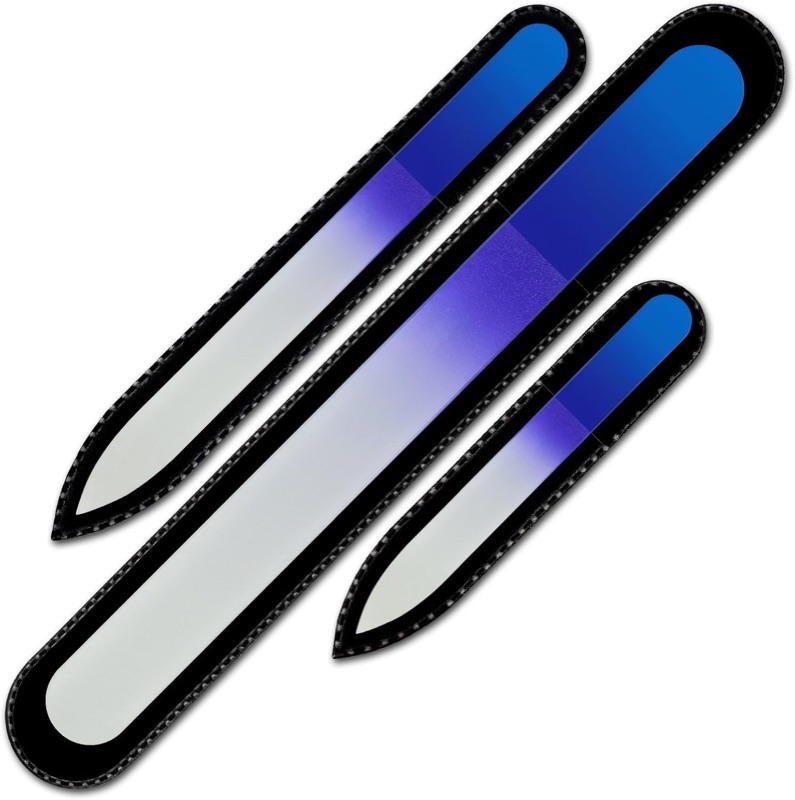
Glass nail file set of three, crystal
A set of three crystal glass files for the minor sidewall reshaping a slightly larger tip may need. Useful when you test how much of an outline mismatch can be corrected by filing without disturbing the finished design.
Do not let a ready-made set overpromise what it can cover
The consumer-facing guidance should make a distinction that beauty copy often avoids: a ready-made set is a range of shapes and sizes, not a guarantee that every nail outline will match every design. Clear guidance protects the customer from paying for a set that requires an unrealistic amount of alteration, and it makes the brand's fit claims more credible.
Show the customer how to dry-fit a tip at the cuticle before using glue. Explain that a good candidate covers the nail plate without sitting on skin and does not require the wearer to press the sidewalls inward. Then give a useful next step for the two-width conflict: compare an adjacent size, compare another offered shape, or choose a custom or made-to-measure service if the brand provides one. Do not imply that a custom option exists unless it actually does.
Photographs can help, provided they show the decision rather than just a polished manicure. One image can show a tip that is correct at the base but too narrow farther forward; another can show a tip that is wide enough at the top but overlaps at the base. The goal is to help a buyer recognise a mismatch before adhesive makes correction difficult.
Avoid one-size slogans such as "always choose the bigger nail" or "always choose the smaller nail." A too-small tip may leave exposed natural nail at the sidewalls; a too-large one may touch skin. The better choice depends on whether a modest amount of reshaping can resolve the mismatch without compromising the intended design and whether the tip can sit comfortably on the nail plate. Where neither is true, the honest answer is that the specific ready-made shape is not a good match.
This is also a return-policy issue. If a brand offers sizing kits, a customer should be able to use the result before ordering a non-returnable bespoke set. If it sells ready-made designs, its FAQ can explain the difference between a normal adjustment and an outline mismatch. Those details reduce avoidable disappointment without claiming that a product can fit a nail shape it was not built to cover.
Use feedback to decide whether the range needs another outline
Fit feedback becomes valuable when it is structured. "Too narrow" should not be the final category. Ask which finger, which size, which shape and length, and whether the gap occurred at the cuticle, in the middle, or near the free edge. Add a voluntary photo field for customers who are willing to share one. A small number of well-described reports can reveal more than a large group of generic ratings.
Look for patterns across a tip family. If several customers report that the thumb or middle nail fits at the cuticle but fails near the free edge, a larger version of the same outline may not be the answer. The range may need a less tapered option, an additional width in a particular position, or a separate fit note for that collection. That choice should be based on retained samples and repeat feedback, not on a single comment.
Keep design feedback separate from outline feedback. A dark sidewall, a wide French line, or a raised decoration can make a correctly fitted nail appear broader than it is. Conversely, a bare strip of natural nail at the side can be mistaken for a design issue when the underlying tip is simply too narrow. A production record should allow the team to distinguish visual styling from physical coverage.
The same structure is useful when a brand changes supplier, material, or mould. A set with the same printed numbers can acquire a different outline during a production change. Retaining front-view comparison photographs and base/forward measurements makes that drift easier to spot before an old size chart is reused.
Treat fan-shaped fit as a product-architecture question
Customers with fan-shaped nails are not asking for a vague reassurance that press-ons "work for all nail shapes." They are asking whether a tip can cover a nail that changes width from base to free edge without looking wrong at either end. A professional answer begins with the outline, records the two relevant widths, and tests the exact tip family rather than relying on a generic size number.
For a brand, the practical outcome is a stronger fit system: measure more than one point, keep each shape family accountable to its own chart, sample the hands that expose the range's weak spots, and give customers an honest route when a ready-made outline is not suitable. That approach will not make every design universal. It does make the product decision clearer before a buyer uses glue, and before a brand commits to another production run.