Ball-of-foot cushions can reduce the pressure that makes heels hurt — but only if the pain really is pressure under the forefoot and the pad sits in the right place. Heel grips solve a different problem: a heel that slides up and rubs. Before buying either, work out which one is happening inside your shoe, because a cushion will not stop a slipping heel and a grip will not take load off the ball of the foot.
This guide separates the two, summarises what the pressure studies do and do not show, and ends with a checklist for reading a product page. It is general information, not medical advice.
For the skin problems these products are trying to prevent, see callus and hard-skin removal.
Why does the ball of your foot burn in heels?
Because a raised heel moves your weight forward. A laboratory study of women walking in shoes of different heel heights found that a higher heel increased peak pressure under the metatarsal heads — the knuckle-like ends of the long foot bones behind your toes. It also shortened the time taken to reach that peak and increased how fast the load arrived early in each step. The authors noted this could mean more stress on foot tissues.
A later study measured pressure and soft-tissue thickness in 21 healthy adults standing on blocks of 2, 3 and 4 centimetres. Pressure on the metatarsal heads rose as the heel went up, and the authors suggested keeping heel height to no more than about 2 cm. Few people who choose heels will go that low, which is why the useful question is what you can do inside the shoe.
Podiatry clinics describe the same mechanism in plainer terms: high heels sit alongside shoes that are too small, calluses and certain foot shapes as contributors to metatarsalgia, the general term for pain in the ball of the foot. Others add high arches, a long second metatarsal and age-related thinning of the fat pad. Heels are one cause among several, and your own foot shape decides how much a pad can help.
How long, and how high, before it really hurts?
There is no universal threshold, but one 2024 study tracked pain across body regions over six hours of wearing heels. Its summary reports pain rising significantly after about 3.5 hours, and a relationship with heel height that was not a straight line: overall body pain became significant around 7.5 cm. The authors present 3.5 hours and 7.5 cm as critical points for designers. Treat those figures as one study's findings, not a medical limit.
Pain is common without any threshold at all. A 2014 survey of 1,000 US adults, cited in a trade article, found that 71 per cent of heel wearers said heels hurt. A newer cross-sectional study of heel users found that age predicted pain and reduced function better than heel-wearing habits did — a reminder that your own history matters as much as the shoe.
For balance: a systematic review found no evidence that heels cause foot osteoarthritis, though they may push the big toe over time and contribute to bunions. The case against heels is about discomfort and forefoot load more than a proven path to arthritis.
Do ball-of-foot cushions actually reduce the pressure?
In the lab, yes — with a trade-off.
A 2014 study tested metatarsal pads made of bio-gel, polyurethane and EVA foam in high-heeled shoes. Every type reduced forefoot peak pressure, and every type also increased peak pressure at the heel. Polyurethane was the most effective, cutting forefoot peak pressure by about 35.5 per cent compared with no pad. Subjective comfort improved significantly with the bio-gel pad.
An older study of inserts in high heels found that a heel cup insert reduced heel pressure and impact force, and that an arch support insert reduced pressure on the inner forefoot. Its introduction noted that no earlier study had examined inserts in high-heeled shoes, so this research is young.
Two cautions. These are small laboratory studies measuring pressure, not long-term trials of pain in everyday use. And the pressure does not disappear — some of it moves backward to the heel. That is an acceptable trade for an evening, but it means a pad shares the load rather than removing it. A Japanese prototype of a padded metatarsal cup for heels reached a similar modest conclusion: soft material under the metatarsal region can reduce load on the inner forefoot.
Which type of cushion should you choose?
Think in three shapes.
- Dome or teardrop metatarsal pads. Small and adhesive, designed to lift and spread load behind the ball. The only option when a shoe is very snug, and the shape the placement advice refers to.
- Full ball-of-foot gel cushions. A flatter pad covering the whole forefoot, aimed at shock absorption. These suit pain that is diffuse and burning rather than at one point.
- Skid-resistant versions. Listings claim a textured surface stops the foot sliding forward into the toe box. That is a different complaint from ball pain, and the evidence is a manufacturer's claim plus buyer reviews — useful as a hint of what to look for, not as proof.
Material matters less than the pressure numbers suggest, because the studies tested a small set of specific pads. Still, the finding that polyurethane relieved the most pressure while bio-gel felt most comfortable shows that "least pressure" and "feels best" are not the same thing. If a pad is hard to stand on, you will take it out.
Is it a cushion problem or a slipping problem?
This is the question most buyers skip. Look at where the pain and rubbing happen.
| What you feel | What is happening | What helps |
|---|---|---|
| Burning under the ball, worse on hard floors | Pressure | Forefoot pad, placed behind the ball |
| Raw or blistered back of heel, shoe loose at the back | Friction from slipping | Heel grip |
| Toes jammed at the front, foot sliding forward | Forward slide | Skid-resistant insert or a different shoe |
One podiatry page says heel blisters in shoes that appear to fit are almost always caused by the heel lifting slightly with each step. The same practice says self-adhesive silicone heel grips work for most cases, adding both cushion and grip, but work best when the heel counter — the stiff cup at the back of the shoe — is soft. They do not overcome a rigid counter that is the wrong shape. An Australian foot clinic recommends fitting shoes to your longer foot, since the smaller foot will otherwise tend to rub at the back, and notes that mesh, coarse fabric and synthetic textiles are more likely to cause heel blisters than natural materials.
On thickness, a buyer's guide notes that heel grippers range from about 2 mm for minor slipping to around half an inch for real size gaps, and warns that too thick a pad crowds the heel. That fits the sense of the problem: if you need a thick pad to make a shoe fit, the shoe is probably the wrong size.
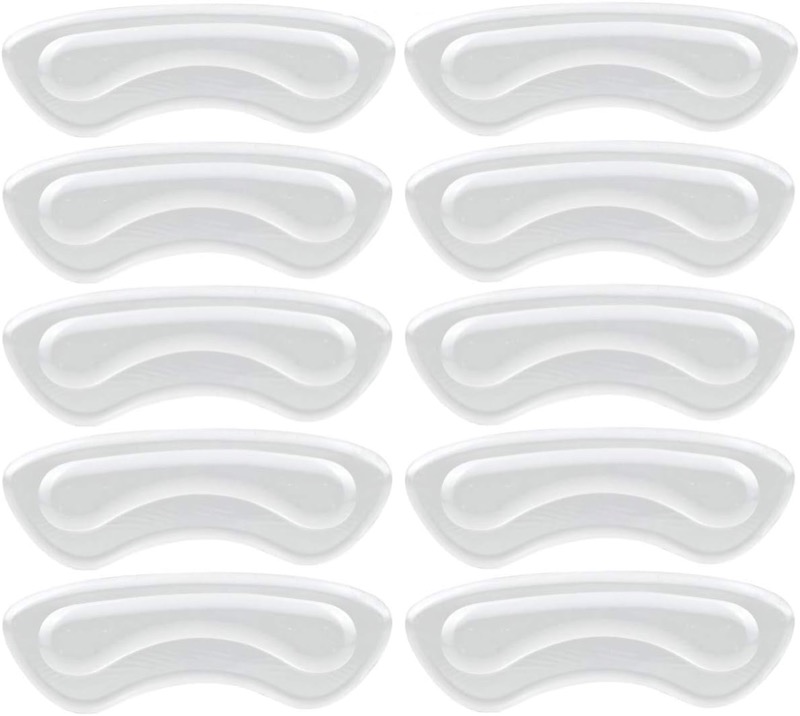
Clear gel heel grips, 5 pairs
The other half of the problem: a thin adhesive liner that fills the gap at the back of the shoe and adds friction so the heel stops lifting. Five pairs because they wear, lose tack, and get moved between shoes — the same reason the thickness advice says start thin.
What about space inside the shoe?
Every insert uses volume, and heels have little to spare. A forefoot pad pushes the foot upward and backward, a heel grip squeezes the heel, and together they can make a snug shoe tight across the toes. Shoes that are too small are themselves a listed cause of ball-of-foot pain, so a pad added to the wrong size can swap one problem for another.
Try one product at a time at home, on a hard floor, for at least ten minutes of standing and walking before wearing it out. If you add a heel grip and a forefoot pad together and the shoe feels tight, go back to one.
Do socks, straps and break-in matter?
Yes, and they are cheaper than any insert. A podiatrist quoted in a consumer piece advises against breaking in new shoes on your feet for the first time, because that is how you get cuts, blisters and pain. Another in the same article recommends heels with straps to hold the foot in place, and a thicker sole. A shoe brand advises moisture-wicking socks over cotton, and a clinic says thicker socks help only if they also wick moisture — commercial sources, consistent advice, but not strongly evidenced.
Where should the pad go?
Behind the ball, not under it. This is the most repeated instruction in the podiatry sources. One clinic says a metatarsal pad belongs behind the metatarsal heads and describes placing it directly under them as a common error that increases pressure. An insole retailer's guide says a pad that sits too far forward raises pressure at the painful spot instead of lowering it.
The practical test is simple. Stand in the shoe, find the spot that burns, and check that the thickest part of the pad is just behind it, toward the arch. If you cannot feel a difference, the pad is probably too far forward. Some products are a full-length gel sheet with a built-in raised zone, which removes the placement guesswork but takes more room in the shoe.
Note that those placement rules come from practices that also sell or recommend products, and some of their pages carry affiliate disclosures. The advice is consistent with the pressure logic, but read it as practical guidance rather than a trial result.
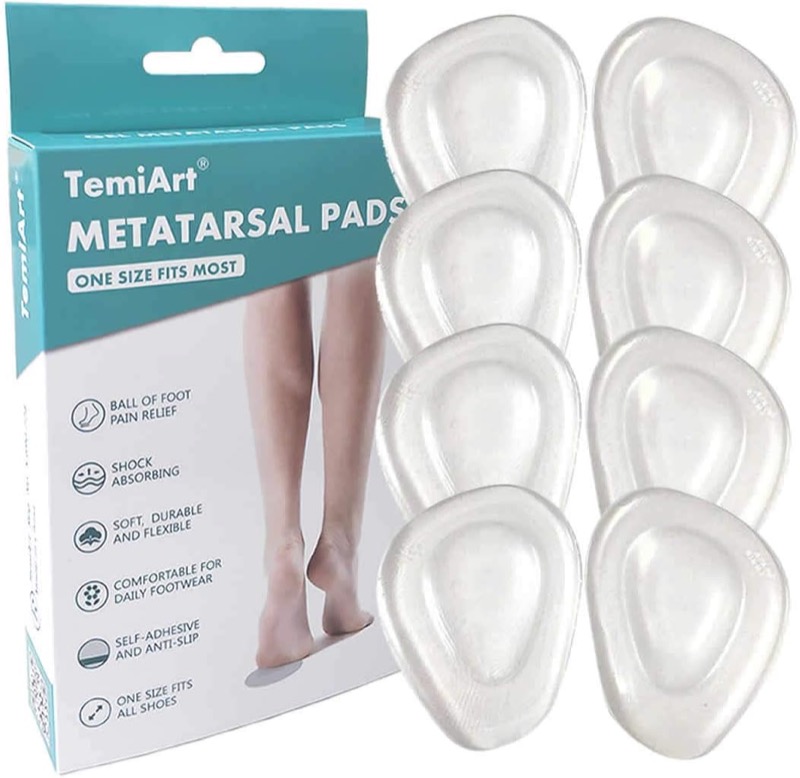
Ball-of-foot gel cushions, 4 pairs
A retail example of the forefoot option, and one that publishes the number that matters: 0.19 inches at the thickest point, with a reusable silicone adhesive. Thin enough for a snug heel, and repositionable — which is what you want, because the first placement is usually wrong.
When is the pain not a shopping problem?
Stop cushioning and get the foot looked at if pain is severe or persistent. Sources that sell insoles say severe metatarsal pain warrants a doctor or podiatrist, and a podiatry-advice site says persistent or severe pain may need a custom orthotic with a more pronounced dome. A clinic lists reasons to see a podiatrist for heel rubbing: an open sore or ulcer — especially with diabetes — a soft swollen lump at the back of the heel, or Achilles pain persisting beyond two to three weeks.
Pads cannot diagnose anything. If you are unsure what is wrong, ask. This guide is general information, not medical advice.
What should you check before you buy?
- The problem it targets. Forefoot pressure, heel slip and forward slide are three different products.
- Placement design. Is the thickest part meant to sit behind the ball? Does the listing say so?
- Thickness in millimetres. Compare it with the room in your shoe.
- Material named. Gel, polyurethane, EVA or foam — not just "advanced cushioning".
- Adhesive and reusability. Can you reposition it after a wrong first guess?
- "All-day" claims. The only duration data we found is the 3.5-hour pain finding, so treat bigger promises with scepticism.
- Return policy, since fit is personal.
What a listing should say
Print if true: thickness at the thickest point in millimetres or inches; the intended position relative to the metatarsal heads; material; whether the adhesive is reusable; how many pairs; the shoe types it fits (a pad designed for a closed pump is a poor fit for a strappy sandal).
Avoid: "cures metatarsalgia", "clinically proven to stop pain", "one size fits all shoes", "corrects your posture", and claims of all-day comfort with no test behind them. A pad is a load-sharing device; a listing that describes where it goes and how thick it is outperforms one making medical claims.
Frequently asked questions
Do ball-of-foot cushions work in stilettos? They reduced forefoot peak pressure in a laboratory study of high-heeled shoes, but that study measured pressure, not pain over a night out. Expect some relief, not a cure.
Can I wear a heel grip and a forefoot pad together? Yes, if the shoe has room. Try them one at a time first, because both take volume.
Will my shoes stretch to make room for an insert? Do not count on it. An Australian foot clinic warns not to expect shoes to stretch when you wear them in, so buy the pad that fits the room you have.
How long can I wear heels comfortably? It varies. One 2024 study found pain increased significantly after about 3.5 hours, but that is a single study with its own limits.
Do heels cause long-term damage? A systematic review found no evidence for osteoarthritis, though it suggested heels may contribute to bunions over time.
Which is better for a shoe that is half a size too big? A heel grip, not a forefoot cushion. Start with a thin one — 2 mm handles minor slipping, and anything approaching half an inch is compensating for a size error rather than fixing it.