An adhesive underarm pad has to do two things that pull against each other: stay put through a working day, and come off without leaving a mark on the blouse. A stronger adhesive resists movement and makes removal riskier. That is why "extra strong" is not the thing to shop for.
The pads that work for you are the ones that match your fabric, your blouse shape and how long you wear them. Here is what to check before you buy a pack, and how to apply one so it holds without ruining the shirt.
Why pads peel off
Most complaints about these pads are not about absorbency. They are about the pad lifting at a corner, sliding inside the sleeve, or leaving a sticky patch on the fabric.
Three causes cover most of it:
- The fabric fights the adhesive. Smooth finishes, satin, silk, linen and some stretch fabrics give a pressure-sensitive adhesive very little to grip. Cotton and cotton blends hold far better.
- The blouse shape works against it. A narrow sleeve with a seam, a dart or a lining changes how much flat surface the pad has to sit on.
- It was applied wrong. Oily skin, deodorant residue, body lotion or a wrinkle under the pad all reduce contact — and a pad that only partly touches is a pad that peels.
Knowing which one is yours tells you whether to change product or change technique.
Match the pad to the fabric you wear most
Before buying, look at the labels of the blouses you plan to wear pads with.
- Cotton and cotton blends, poplin, oxford, most workwear shirting — the easiest surfaces. Almost any adhesive pad will hold.
- Stretch jersey and soft knits — hold reasonably, but the fabric moves, so choose a pad with adhesive around the full edge rather than only in the middle.
- Linen, seersucker and loose weaves — the textured surface reduces contact. Expect to press firmly and to check after an hour.
- Satin, silk, and heavily finished or smooth synthetics — the hardest. Test on one blouse before buying a pack; these are also the fabrics most likely to show a residue mark.
If most of your wardrobe is the last group, a washable shield that pins or attaches differently may suit you better than an adhesive pad, even though it is more work.
Choose the shape and size for your blouse
Pads come as ovals, shields, teardrops and rectangles, and the pack size usually reflects the intended garment.
- A small oval suits a fitted blouse with a narrow underarm.
- A shield or teardrop follows the curve of a sleeve better and is the safer default for most tops.
- A larger rectangle covers more fabric but creases in a tight armhole, which is where peeling starts.
Look at the dimensions on the listing, not the picture. Compare the pad width with the flat width of your blouse's underarm: a pad that reaches into the sleeve seam will lift as soon as you raise your arm.
For sheer or light-coloured fabric, check that the pad is thin and skin-toned rather than white and thick. A white pad under a cream blouse is visible from the outside in daylight.
Apply it so it actually holds
A pad that is applied badly will lift even on cotton. The routine that works:
- Put the blouse on a flat surface, inside out, so the underarm is flat and the sleeve is not twisted.
- Make sure the fabric is dry and free of deodorant, perfume or lotion at that spot. If you have just applied deodorant, wait until it has dried.
- Peel the backing without touching the adhesive — finger grease is enough to weaken it.
- Place the pad centred on the underarm seam, then press from the middle outward for several seconds.
- Turn the blouse the right way and press the area again from the outside, with your hand inside the sleeve.
Smooth out any wrinkle before you press. A fold trapped under the pad becomes the place it starts to peel.
Do not add heat from an iron to "set" the adhesive. On most of these products that softens the backing and makes the pad slide.
Remove it without marking the blouse
Peel slowly, and hold the fabric flat just beside the adhesive so the blouse is not stretched as you pull. Pulling the garment taut is what distorts a finish and, on loose weaves, pulls yarns.
If the pad resists, warm the area slightly with your hand — body heat is usually enough — rather than tugging. Never scrape with a fingernail or a tool.
If a sticky patch is left behind, do not attack it with alcohol or stain remover straight away. Try a clean, dry cloth first; if that fails, a small amount of mild soapy water on a hidden area to check the fabric tolerates it. Aggressive solvents can lift the finish as well as the residue.
For blouses you care about, test one pad in an inconspicuous spot (inside the sleeve, near the hem) before wearing a full pack.
What to check on the product page
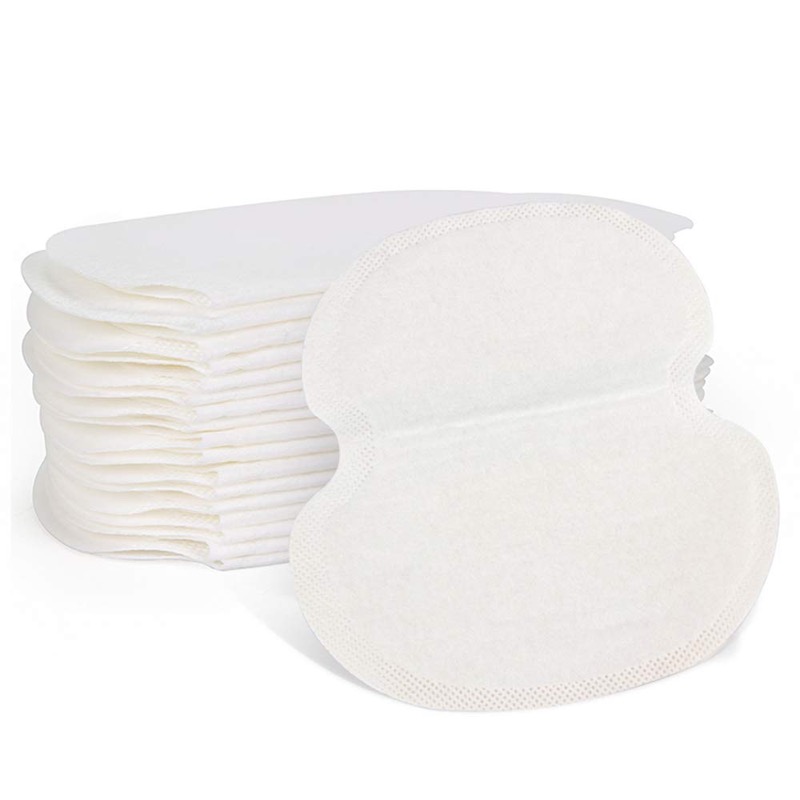
Disposable underarm sweat pads, adhesive backing
A thin adhesive shield that sticks inside the garment at the underarm. Check the dimensions against your blouse and whether the adhesive runs around the edge before committing to a multipack.
Pack photos show the pad flat; whether it holds is decided by your fabric and how you apply it.
Things worth confirming before you order:
| Check | Why it matters |
|---|---|
| Dimensions in cm or inches | A pad wider than the underarm will crease and lift |
| Adhesive coverage | Full-edge adhesive holds on stretch fabric |
| Thickness | Thick pads show through light fabric |
| Colour | Skin tone disappears under cream and white |
| Removal instructions | Tells you whether it is designed to peel cleanly |
| Pack count | You will use more than you expect per week |
Reviews are useful here in a specific way: search them for the fabric named — "silk", "linen", "chiffon". A pad that holds on cotton can fail on all three, and reviewers usually say so.
Do they show through?
A thin pad on a proper-sized underarm is usually invisible. Two things give it away: a pad larger than the underarm, and a pad that wrinkles when you raise your arm.
Check yourself in a mirror with your arm down and then raised. If the outline reads through the fabric, the pad is either too thick or too large for that blouse.
Under very sheer fabric, no adhesive pad is truly invisible. In that case a nude-toned pad is the best compromise, or accept a washable shield worn with a camisole.
How long one pad lasts
Most disposable pads are a single-wear item: they absorb what reaches them and lose adhesive tack once removed. Reusing one tends to leave residue, because the adhesive has already picked up fabric fibres.
If you need coverage for a long event, take a spare and change at a natural break rather than wearing one pad for twelve hours. Changing a pad in a bathroom takes under a minute.
When a washable shield is the better buy
If you wear pads daily, a washable underarm shield usually wins on cost and on residue risk: it does not rely on adhesive against a delicate finish and it can be washed with the blouse's own care cycle.
The trade-off is bulk and laundry. If you wear a blouse once a week and need a discreet fix for a presentation, disposables are simpler.
Quick checklist before you buy
| Question | What you want |
|---|---|
| What fabric will I wear these with? | Cotton blends are easy; silk and satin need a test |
| Does the pad fit my underarm? | Measure the flat underarm, not the sleeve |
| Will it show? | Thin, nude-toned, correctly sized |
| Can I remove it cleanly? | Instructions say peel slowly, no solvent |
| How many will I use? | A multipack beats repeat shipping |
Buy for the fabric you actually wear, apply it to a flat, dry, wrinkle-free underarm, and peel it slowly. Those three habits prevent most of the complaints these pads get.
If your problem is a bra strap or band that will not stay put rather than a blouse, see why bra straps keep slipping.