Heat is a reasonable first move for ordinary period cramps, and a heating pad is a cheap way to deliver it. The part most buying guides skip is how thin the evidence is for the pad itself. The trials behind "heat works" mostly tested wearable heat patches, not the plug-in pad on your sofa, so what you are really buying is a safe, controllable source of gentle warmth. That makes the safety features — not the wattage or the fabric — the main thing to compare.
This guide covers what the research actually shows, how the common types differ, the limits regulators set, and the signs that cramps need medical attention rather than a warmer pad. It is general information, not medical advice.
For other period-product decisions, see menstrual cup sizing and overnight period underwear coverage.
Does a heating pad actually help period cramps?
Probably yes for typical cramps, with caveats about how strong the proof is.
A 2018 systematic review in Scientific Reports pooled six randomised trials of heat for primary dysmenorrhoea — period pain without an underlying pelvic condition. It found that a heat patch had a more favourable effect on pain than analgesic medication in a pooled analysis of two studies. The authors still described the evidence as suggestive and said rigorous high-quality trials are needed. One detail matters if you already take ibuprofen: in one trial, a heat patch plus ibuprofen gave similar relief to an unheated patch plus ibuprofen. Heat did not clearly add to the medication.
A newer review, published in Frontiers in Medicine in January 2026, reached a similar conclusion: compared with no treatment heat is likely to reduce pain, and compared with NSAIDs it may achieve comparable relief with a better safety profile. It also notes NSAIDs fail to provide relief in 18 per cent of women, part of why a non-drug option is worth having.
Clinicians say much the same in plainer language. A hospital OB-GYN lists NSAIDs as first-line treatment and adds that one study found heat more effective than paracetamol. The Merck Manual's consumer pages suggest moist heat on the abdomen may help, alongside sleep, rest and regular exercise. A German health-information institute puts heat, relaxation and exercise in the same everyday-relief group as painkillers.
The honest summary: heat is low-risk, probably useful, and not a replacement for medication when pain is strong.
Why does the "39 °C" detail matter when you shop?
Because the benefit shown in the research comes from mild, steady warmth. The BMJ Clinical Evidence review of dysmenorrhoea treatments states that topical heat at about 39 °C may be as effective as ibuprofen and more effective than paracetamol. That is roughly 102 °F — close to a warm bath, not the "high" setting of a plug-in pad.
We could not find independent measurements of the surface temperatures of the pads on sale, so we cannot tell you what any given "low" setting delivers. One shopping roundup mentions a moist pad with a range of 88 to 166 °F, which shows how wide the spread between lowest and highest can be. The practical lesson: start on the lowest setting and treat higher settings as something to approach cautiously, not a reward. A gynaecologist quoted by a health site makes the same point — more heat is not necessarily better and can cause skin discolouration and potentially burns.
Product listings do sometimes state their ranges. Two examples: one XL pad lists six settings from 105 °F to 140 °F with a two-hour auto shut-off; a digital pad lists four set points — 113, 130, 150 and 167 °F — with a timer of 15, 30, 45 or 60 minutes. Note what that means in practice: even the lowest setting on the second pad is above the 39 °C (102 °F) that the trials describe, and the first pad's lowest is close to it.
Which type of heating pad should you buy?
Four types are common. None is "best"; they trade convenience against control.
Electric plug-in pads. Steady heat for as long as you need, usually several settings. They need an outlet, so they tie you to one spot, and they are the type with the best-documented safety rules.
Cordless rechargeable pads and wearable belts. Closest to the heat patches in the trials, because you can wear them under clothing while you move. Check battery run time and whether the pad has temperature control and a timer; a cordless pad without either is just a small heater against your skin.
Microwavable pads. Filled with clay, grain or gel, no cord and no plug. The trade-off is that they start hot and cool down, so you cannot hold a temperature steady. Follow the heating times on the label exactly and test the surface before it goes on skin.
Hot water bottles. Cheap and familiar. One health-information site warns poor-quality bags can leak or burst and rubber ones degrade over time, so check for cracks and replace old ones. They are also a known cause of the skin marking described below.
If you are unsure, pick the type that lets you control temperature and remove it quickly. For most people that means an electric or rechargeable pad with a timer.
What does the FDA say about using one safely?
The FDA's safety communication was written in 2022 around a recall, but it includes advice for anyone using an electric pad. The recall involved a pad classed as a Class I recall — the most serious type — covering 544,212 units, with the FDA saying it knew of no deaths. The agency warned of skin burns, electric shock and other malfunctions. It is worth reading for what it teaches about buying, not to single out one brand: check recalls before you buy a pad, especially a bargain one from an unfamiliar seller.
The general advice in that communication:
- Follow the safety instructions that come with your pad.
- Never sleep with the heating pad on.
- If the pad has a fabric cover, keep it on.
- Do not use pins, nails or other metal items on the pad.
- Report problems to the FDA.
Session length is stated differently by different sources. A news summary of the FDA's tips says to use an electric pad for only 15 to 20 minutes at a time, and a shopping roundup quotes an OB-GYN recommending sessions of about 15 to 20 minutes repeated through the day. Treat that as the cautious default, then follow your pad's manual.
An older FDA and Consumer Product Safety Commission advisory, still cited by the FDA on an archived page, puts the scale in perspective: CPSC estimated more than 1,600 heating pad burns treated in hospital emergency rooms each year, with about 45 per cent of those injured over 65. Risk factors named include advanced age, diabetes, spinal cord injury and some medications. That data is old, so read it as an indication of the type of risk, not a current rate.
What is "toasted skin" and how do you avoid it?
Erythema ab igne is a net-like red or brown mottling that appears after repeated, prolonged exposure to moderate heat. It does not need a burn. One health article on heat therapy warns that prolonged or repeated use of concentrated heat sources, such as hot water bottles, can cause this rash, and suggests limiting sessions to 15 to 20 minutes. The shopping roundup says the same about falling asleep with an electric pad on.
Three habits cut the risk. Put a layer of cloth between pad and skin. Move the pad slightly during a long afternoon rather than parking it on one patch. And stop if the skin looks pink or patterned when you remove it. If a mottled mark appears and does not fade, see a doctor.
Is auto shut-off enough protection?
No, and this is a common misunderstanding. A health site's expert advice is to never sleep with a heating pad and to choose one with automatic shut-off as a backstop. One retailer's guide says most electric pads shut off after about two hours, but that is a seller's generalisation — and a two-hour timer is long compared with the 15 to 20 minutes suggested for a single session. The FDA says never sleep with the pad on, regardless of the timer. Use the shut-off as insurance for the day you forget, not as permission to doze.
For night-time cramps, a safer routine is to warm the area before bed, take any medication your doctor has advised, and use another approach to stay comfortable once you are lying down.
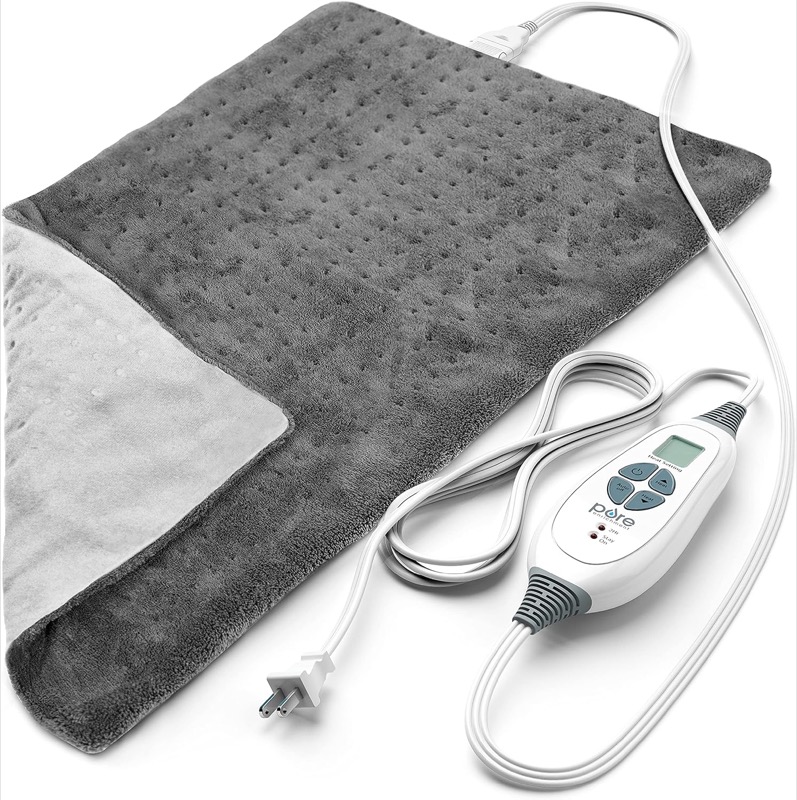
XL electric heating pad, six settings
A retail example that publishes its range (105–140 °F in six steps) and its cut-off (two hours). Both numbers are useful: the low end is close to the temperature the trials used, and two hours is far longer than a 15–20 minute session.
What should you check on the listing before you buy?
Use this as a filter.
- Adjustable temperature, with the lowest setting stated. Without it you cannot start gently.
- A timer or automatic shut-off. Useful as insurance; confirm the duration in the manual.
- A cover you can keep on and wash. The FDA's advice to keep the cover on only helps if the cover is part of the product.
- A size that matches your pain. If pain spreads to the back, choose something that covers both.
- Moist or dry heat. Some pads are marketed as moist heat. The Merck Manual mentions moist heat, but we found no head-to-head trial showing moist pads outperform dry ones for cramps, so treat it as a preference.
- Recall status. Search the model name with "recall" before you buy.
- Clear safety instructions in the box, including a folding warning. Retail guides note folding an electric pad can create hot spots.
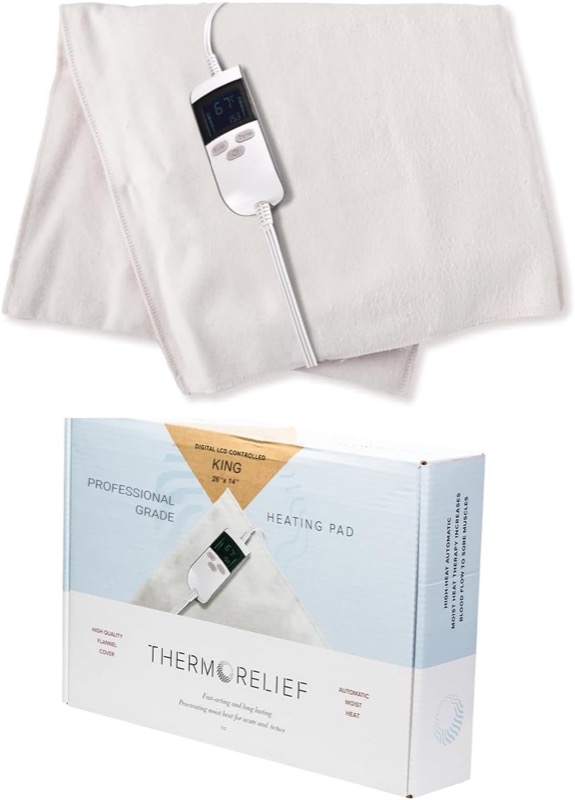
Moist heating pad with 15–60 minute timer
The other end of the control spectrum: four set temperatures and a timer in 15-minute steps. A 15-minute option is what makes the cautious session length practical rather than a manual instruction you have to police yourself.
If you sell heating pads, what should the listing say
Safe to print, if true:
- "Six settings from 105 °F to 140 °F" — the actual numbers, not "low / medium / high".
- "Auto shut-off after 2 hours" and, separately, "recommended session 15–20 minutes" — the second sentence is the useful one.
- "Machine-washable cover; keep it on in use."
- "Do not use while sleeping. Do not use on numb skin or over broken skin."
- "Test on the lowest setting first."
Avoid: "pain relief guaranteed", "safe to sleep with", "medical grade", "heats deeper than other pads", and any claim about relieving cramps by a specific percentage. The clinical evidence supports mild warmth, not a brand's output. A listing that explains session length, skin checks and who should not use it reads as more trustworthy than one that promises results.
Also worth noting for sellers: the FDA's advice to keep the cover on, avoid pins, never sleep with it on and report problems is boilerplate you can copy into your own instructions. It costs nothing and it is what a regulator expects to see.
When are cramps a reason to see a doctor instead?
Heat is for ordinary cramps. The Merck Manual lists warning signs that should prompt a same-day call, such as sharp abdominal pain that gets worse with a light touch or the slightest movement, and says people without warning signs who have worse cramps than usual, or pain lasting longer than usual, should see a doctor within a few days.
Hospital gynaecology guidance puts it plainly: if pain is disruptive, worsening, or comes with other symptoms, it is worth talking to a doctor. The Merck Manual notes more than half of women with dysmenorrhoea have the primary kind, but secondary causes such as endometriosis or fibroids exist. A changed cramp pattern, pain between periods, pain with sex, or pain that regularly keeps you off school or work are all reasons to book a visit. If heat and over-the-counter medication used as directed do not help, say so; hormonal treatments are among the next options doctors discuss.
If you take NSAIDs, the Merck Manual says they are usually started 24 to 48 hours before a period begins and continued for a day or two after it starts — a decision to make with your own doctor or pharmacist, especially if you have stomach, kidney or bleeding concerns.
Frequently asked questions
Should I put the pad on my stomach or my back? Either. Pain often reaches the back and thighs. One retailer's guide suggests the lower abdomen above the pubic bone, where the uterus sits, and a larger pad can cover both.
Can I use a heating pad and take ibuprofen at the same time? The Scientific Reports review found heat plus ibuprofen gave about the same relief as ibuprofen alone, so combining them is not harmful on that evidence, but it is not clearly better either. Check the medicine label for its own instructions.
Is a hot bath as good as a pad? We did not find a trial comparing baths with pads. Warm baths are mentioned alongside heating pads as a home measure by clinics, which makes them a reasonable alternative, and they avoid the stay-in-one-spot problem.
Can I use one if I have diabetes or reduced sensation? The FDA and CPSC advisory lists diabetes, spinal cord injury and some medications among risk factors for burns, because reduced sensation can hide overheating. Ask your doctor before using a pad and keep sessions short.
Does heat help if I also have a heavy flow? Heat does not change how much you bleed, so keep appropriate period protection. For comfort on heavy days, see the period underwear guides.
Do I need the highest setting for bad cramps? No. The evidence comes from warmth around 39 °C, and higher settings raise the risk of burns and mottled skin without evidence of better relief.
Is a microwavable pad safer than an electric one? It removes the electrical risk but not the burn risk: it starts hot and cools, so test the surface and follow the heating times on the label.