A customer says her satin bonnet slips off unless she ties it so tightly that the knot presses into her forehead. Recommending a tighter tie misses the useful information in the complaint. The bonnet has a range of settings, but the part of that range that feels comfortable may not keep the opening in place. For a brand ordering its own sleep caps, that is a sample-approval problem. It can arise from the opening, the band, the ties, the cap body, or the way the hair sits inside it.
This guide is for a small hair-accessory brand comparing adjustable tie bonnets before a purchase order. The aim is to define a wearable closure range on actual heads and hairstyles, then preserve that range in a supplier brief and a receiving check. It is not a claim that one band design prevents headaches, stays on every sleeper, or treats hair loss. If a covering causes pain or persistent irritation, stop using that fit. Dermatology guidance notes that repeated pulling and rubbing from hairstyles or coverings can damage hair; it does not give a universal bonnet circumference or knot position.
The complaint tells you where to start, not what to buy
In a discussion about tie bonnets, a wearer described the precise trade-off: a tie tight enough to hold caused a headache and ear discomfort, while a looser setting slid off. Another wearer with wavy hair said the wide band flattened hair at the forehead, yet loosening it let the bonnet move. These are individual accounts, not a measured failure rate. They do show why “adjustable” is incomplete as a product specification.
A bonnet that creeps upward may have a loose opening or a body too shallow for packed hair. A roomy body hanging to one side can pull the edge out of position. A knot may feel fine upright yet hurt against a pillow. Test the whole cap on the intended hairstyle and sleep posture.
Our long-braid fit guide covers length, volume and opening. This article takes the next decision: once the body can hold the hair, does its closure stay in a comfortable position? Do not use a closer-fitting band to conceal insufficient capacity. Record the capacity problem separately and change the body or size before changing the tie.
Why an adjustable label is not enough
Retail advice often distinguishes a cap that is too shallow from one with a loose opening. Adjustable ties, wider bands and moving the knot are common suggestions, but none defines a comfortable fit on its own. An adjustable oversized bonnet with a promise of adjustable ties is a useful example of mixed retail feedback: a review describes movement despite trying different knot positions. A review cannot tell a buyer the dimensions of the band or prove that all units behave alike.
The gap for a product brand is the space between those tips and a purchase order. A supplier can quote “wide elastic tie,” “adjustable” and “one size” without defining the usable opening, the amount of stretch, where a sewn-in elastic stops, or what happens after washing. Published custom-bonnet construction guidance discusses several closure types, but a category description cannot approve a particular factory sample. Your own fit observations and an identified reference sample are the evidence that lets you reject a later change.
A brand video demonstration shows a way to put on and tie a satin bonnet. It is useful for seeing how the wearer handles the ties and opening. It is a brand video, so it cannot establish overnight retention or comfort across users. If you use a demonstration during sampling, write down the exact tying method rather than assuming every customer will reproduce it.
Isolate the closure before testing an overnight claim
Start with samples that differ in one meaningful aspect: a fixed gathered elastic, a tie band over an elastic base, and a tie band without elastic. The two retail references below represent two closure formats, not verified solutions to pressure or slippage. A retail unit cannot prove a factory's proposed materials or stitching. Photograph each sample untied, laid flat, and worn. Identify which surface touches the forehead and which seam or label touches the nape.
Measure the relaxed opening along the contact edge without stretching it. Then record the opening at a comfortable worn setting on each test wearer. Do not reduce that setting to a single “head circumference” number: hair beneath the edge, the location of the band, tie overlap and crown shape all change what the wearer feels. Measure band width, usable tie length on both sides, and the distance from the edge to any fixed elastic. Note whether the band twists, rolls or forms a narrow cord after being tied. Use the same units and the same measuring route on every sample.
For the tie setting, mark the point where each tie crosses or meets on the sample with removable thread or a photograph. Record a plain description such as “crossed at nape, brought forward, flat bow off-centre.” The mark describes how the sample was worn; it is not an instruction to place a knot at that spot on every head. Ask the wearer where pressure occurs after sitting, lying supine, and lying on either side. A hard slider, metal adjuster, bulky knot or seam that feels harmless while standing may sit directly under the head on a pillow.
A useful sample sheet has separate columns for fit and retention. “Stayed on” cannot erase “caused pain.” “Comfortable” cannot erase “slipped by morning.” Mark a failure if the only setting that holds causes pressure the wearer would not tolerate through a normal night. That decision is more honest than stretching the adjective “snug” until it includes discomfort.
Choose test wearers for the product you intend to sell
A model wearing loose hair cannot represent a line advertised for long braids, locs, curls and short hair. Define the hairstyles in scope. A first release could target one braid length and head-size range. The supplier's “one size fits all” claim does not create universal fit.
For each wearer, record an approximate head measurement along the actual band route, hairstyle type, length and volume in the shape in which it will be worn, and whether braids or extensions add weight. Note if the wearer places an edge scarf beneath the cap, because that changes contact and grip. Avoid gathering private medical details for a simple accessory test. If a wearer reports pain, take the cap off; this is not an endurance exercise. Do not tell a wearer to keep a tight hairstyle in place for the test.
Have the wearer put the bonnet on without coaching once. Photograph the band at the front, temples and nape with consent. Ask what they changed to make it wearable. Then have them follow the short printed instructions proposed for customers and repeat. If only the product designer can make the closure work, the listing and the insert need revision even when the prototype itself is sound.
Test the same hairstyle with the hair arranged two ways if your intended instructions permit both: distributed loosely inside the body and gathered in the natural bedtime position. Record whether the band moves because the hair presses against the crown. Do not force a bulky style into a shallow cap to produce a favourable grip result. For a long braid bonnet, measure containment first, then compare closures on bodies of the same shape and size.
A short wear check should answer specific questions
An overnight test is valuable only after the basic fit works. Begin with a modest, documented sequence: put on the cap, turn the head while seated, lie in the usual sleep positions, and turn from one side to the other. The tester records where the edge started and where it moved, whether the tie loosened, whether the crown twisted, and any discomfort. There is no industry pass distance in this proposed check. Set your own acceptance criteria before testing, based on whether the wearer can keep the hair contained and the edge in the intended place without pain.
If a sample passes this short check, invite a normal overnight wear trial with the same tie arrangement. In the morning, record whether the cap remained on, whether hair escaped, whether the opening moved forward or backward, and whether a knot or band left discomfort. A photograph of the starting position and another in the morning is more informative than “worked great.” A single successful night is a screening result, not a retention percentage or an all-night guarantee. Different pillows, sleeping positions, head shapes and hair arrangements can change the outcome.
Compare the same wearer across more than one night if your claim hinges on overnight performance. Log sample ID, hairstyle, closure setting, morning outcome and comfort. Repeated removal due to discomfort is a fit failure. A bonnet found off the head does not by itself prove the elastic was too loose.
Clinical literature warrants restraint around safety language. A report on nocturnal traction discusses the potential contribution of tight nighttime wrapping in people with other traction risks, while explicitly noting the lack of evidence-based data on many silk-scarf and bonnet practices. Your fit log can guide product development. It cannot demonstrate that your cap prevents hair loss or improves scalp health.
Retail and sourcing references
The two links below show two closure formats — a tie band and an adjustable elastic band. We may earn a commission from qualifying purchases through these links. Neither has been tested for this article, and a review count does not establish overnight retention.
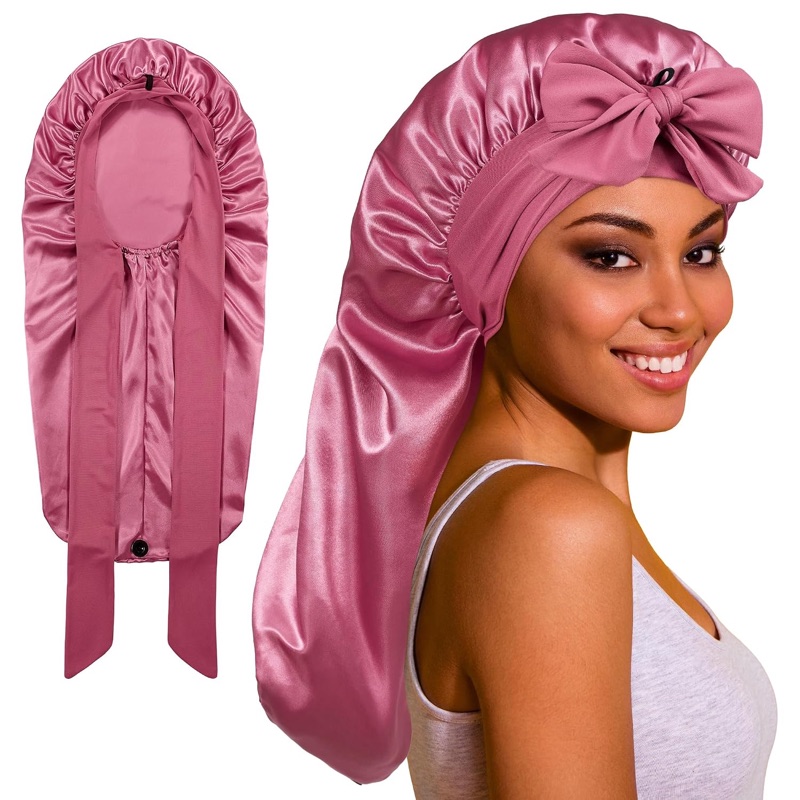
Long bonnet for braids and curls with satin tie
A long tie bonnet, the format where the wearer sets tension by hand — and therefore the one that can hold only by tying tight. Sample it on the braid length you sell, and record the band mark at the setting that is both comfortable and stable.
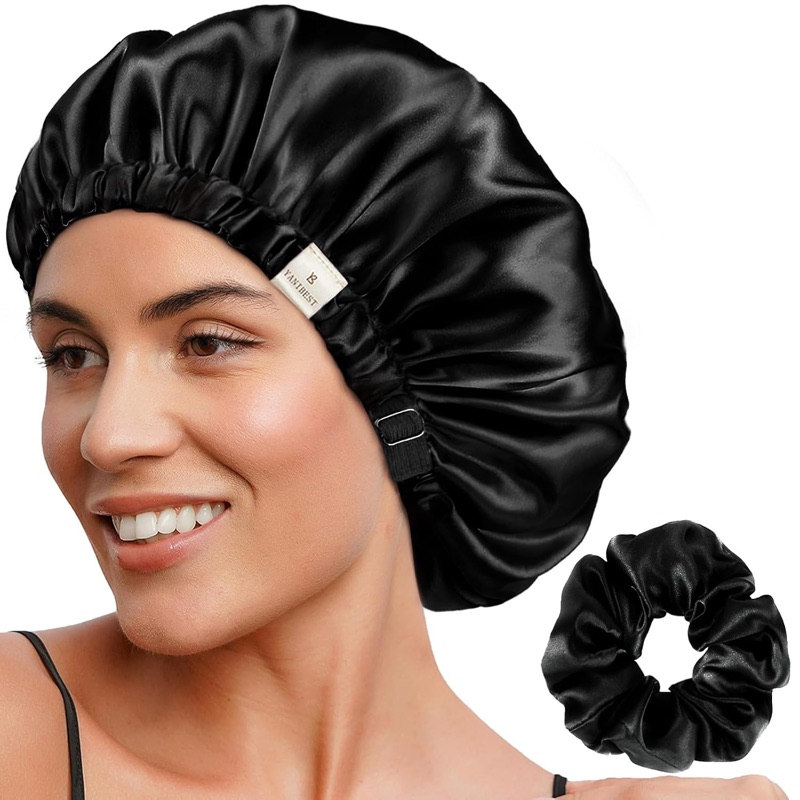
Adjustable satin bonnet with elastic band
An adjustable elastic-and-tie closure, included as the contrasting construction rather than the better one. Its band has a fixed stretch range, so test where that range lands on your reference heads before assuming an adjustable opening solves pressure.
Card photos are the current marketplace listing images and may differ from the delivered product; confirm details on the live listing.
A wholesale long-tie bonnet listing illustrates why the written brief matters: it lists satin, an adjustable circumference, a long braid shape, colours and logo options, but those labels do not establish your required closure range or comfort. Treat it as a possible supplier conversation, not an approved offer. Pricing, minimum quantities, customisation, samples, shipping and affiliate eligibility need live confirmation for the precise variant and destination country.
Match the closure to the adjustment the wearer needs
The three common closures solve different parts of the problem, so compare them by what the wearer has to adjust:
- A plain elastic edge is quick to put on and works when the opening already matches the head, but offers little adjustment. Adding pins or hauling on the elastic produces an uneven hold, and elastic changes with use and care — a new sample says nothing about how it feels after six washes.
- A wide soft band spreads contact over more skin than a narrow channel, which can feel less sharp, but width alone does not make a fit. A band that sits too low presses on the ears; one that is too tight still leaves a line.
- Long ties let the wearer change tension and knot position, which helps when head size or hairstyle varies night to night. Tying harder to compensate for a shallow crown only moves pressure to the hairline.
- Elastic plus a tie can hold the perimeter while the tie adds adjustment, but ask how the tie attaches, whether the seam is reinforced, how much tie length is usable, and whether the channel gathers smoothly.
One more rule outranks the closure choice: hair should sit loosely beneath the covering. Dermatology guidance warns that constant rubbing from a head covering, especially with hair pulled tightly under it, can contribute to traction-related hair loss. Pain or repeated pulling is a stop signal, not a fit target.
Translate a passing sample into an orderable brief
A supplier brief should identify an approved physical sample and the exact construction being quoted. Specify the finished body dimensions and the hair arrangement used to approve them, then describe the closure: relaxed opening, band width, ties and their attachment points, elastic placement if present, seam finish, adjuster material if any, and which side of the textile touches skin. Ask for a fibre-content statement for the actual shell and lining. “Silk-feel satin” is not a fibre specification; satin names a weave or surface, while the fibre must be stated separately.
Include the band photographs and tie method from the successful trial. Request a production-intent sample with the proposed colour, labels, care wording and packaging. A different colour or finish may alter hand feel; a revised seam can move a hard spot against the head. Compare the proposed sample with the dated reference before approving bulk production. A product page showing a long tie says little about whether the finished tie lengths match on both sides or whether the band twists after repeated use.
Ask the supplier how it will check the finished opening and band width, and which tolerances it can consistently meet. Do not invent a millimetre tolerance in the article and impose it on every textile construction. Agree a range against the approved sample and your actual test results. Define what counts as a visibly rolled band, exposed elastic, uneven ties, rough seam or loose stitch. If a factory substitutes elastic, tie fabric or adjuster hardware, require a new sample approval rather than accepting the product under the old reference code.
Check after care and again when the cartons arrive
Closure fit can change with laundering, handling and time. Follow the care method you intend to print, record the starting dimensions, and repeat the comfortable-setting and short movement check after a defined number of care cycles. Avoid a claim such as “machine washable” or “retains stretch” merely because a fresh sample feels durable. If the candidate cannot tolerate the care method customers will realistically use, revise the care label or the construction before ordering.
At receipt, identify cartons and production lots, then draw pieces from more than one carton where practical. Compare the fabric and label with the approved sample; measure the relaxed opening, band width and tie lengths; inspect attachments, seams and hardware; and repeat the documented fit routine on selected pieces. Record which lot and carton produced each result. A random handful cannot prove every bonnet is identical, but it can reveal a drift worth holding for review. If the first shipment feels tighter than the reference, do not ship it because the colour and logo look correct.
The approval question
The listing should say what you actually learned. Give dimensions with a clear measurement method, name the fibre, show the closure on a head, and explain the intended hairstyle range. If overnight tests were small and informal, do not advertise an “all-night stay-on guarantee.” Explain how a buyer can adjust the ties and what to do if comfort and retention cannot coexist: try a different size or construction, or stop using that cap. An honest exchange route is more useful than telling someone to pull the band tighter.
The approval question is simple: can the intended customer put the bonnet on, keep the hair inside, move naturally, and choose a setting that both stays put and feels acceptable? If the answer only appears after an uncomfortably tight knot, change the product. The return comment has already told you where the next sample should improve.