A bonnet described as "extra long" can still fail a person with long braids. The tail may have enough length while the crown is too shallow; a tie may hold at bedtime but press uncomfortably at the hairline; or a product may fit one braid arrangement and leave another exposed. For a small brand, the useful question is not simply which bonnet looks largest. It is whether a defined group of wearers can put it on, secure their hair, sleep in it, and take it off without the bonnet shifting or the braids being forced into a tight fold.
That makes the buying task measurable. Before ordering inventory, test three separate dimensions: usable length, volume through the crown and opening, and retention without excessive pressure. Record those results with the hairstyle and wearer rather than treating "one size" as a universal fit claim. The same process helps an individual shopper compare retail options and gives a new brand a practical sample brief for suppliers.
Why long braids expose fit problems
Long braids do not occupy space like loose hair. A set may be gathered into a ponytail, folded once, tucked into a pouch, or arranged in a loose loop. Each method changes the length and bulk the bonnet must contain. Braids can also have added hair, beads, cuffs, or thick ends, so a length measurement alone does not describe the full load inside the cap.
The complaints visible in social discussions are specific: a bonnet can slide off, squeeze the braids into an awkward shape, leave the ends outside, or feel too small for longer styles. Some users also report that a tie or elastic leaves a mark at the forehead. These posts are useful signals for product research, not a representative survey and not proof that every bonnet has the same problem. They tell a product developer what to test: coverage, movement, comfort, and whether different braid arrangements change the result.
Measure the hairstyle before comparing products
Use a soft tape measure and take the same measurements for each test wearer. Do not pull the tape tight. Record the style in its usual sleep arrangement, because a bonnet is fitted to the contained arrangement, not to hair length in the abstract.
- Contained length: from the point where the braid bundle will sit inside the opening to the longest end. If the wearer folds the braids, record both the uncompressed length and the planned folded arrangement.
- Bundle circumference: measure around the widest part of the gathered braids, including extensions and accessories that will remain in place overnight. This is a practical estimate of bulk, not a medical or hair-care measurement.
- Crown depth: mark how far the bundle extends from the wearer's hairline toward the back of the head when arranged comfortably. This helps distinguish a long pouch from a cap with enough crown volume.
- Opening position: note where a band or tie sits on that wearer: hairline, just behind it, or lower on the head. Do not assume every customer wants the same position.
- Style and length context: record braid type, approximate length category, whether the hair is gathered, and whether beads, cuffs, or a bun are present. Photos can help compare samples, but obtain permission and avoid collecting identifying details unnecessarily.
Test length, volume, and hold separately
A useful trial is a simple wear log over several nights. Ask participants to use their normal bedtime routine and their preferred way of arranging braids. Do not instruct them to tighten a tie until the bonnet stays on; that can hide a poor fit and create an uncomfortable experience.
At bedtime, check whether all braid ends fit inside without pushing them into a hard bend or compressing the bundle to close the cap. Ask the wearer to note the location of any pressure, slipping, or exposed hair. In the morning, record whether the opening moved, whether the ends remained covered, and whether the wearer had to readjust during the night. A product can pass one test and fail another: enough length does not guarantee enough crown room, and a secure band does not guarantee comfort.
Use a short rating scale, but keep the actual comments. For example, score coverage, ease of putting on, overnight hold, and comfort from one to five, then ask "Where did it move?" and "What felt tight?" Scores are helpful for comparing samples, while the written answer explains what a supplier might change. Avoid averaging away a serious recurring issue. If two testers report pressure at the same seam or the same braid arrangement repeatedly exposes the ends, investigate that pattern before ordering.
What to inspect on a retail bonnet
When shopping for one bonnet, start with the product's construction details rather than a broad promise about protecting hair. Look for a stated material, closure type, care instructions, and photos that show the pouch relative to a person or a common object. "Satin" describes a weave or finish, not necessarily silk fiber. If the listing does not say the fiber, do not infer it from a silky appearance.
A long bonnet with a tie band may offer more adjustment than a fixed elastic edge, but the word adjustable does not tell you whether the tie is long enough, whether the knot sits comfortably, or whether the pouch holds a thick braid bundle. Check the return policy and the current listing details before purchasing; stock, price, colors, and product specifications can change. Current search results include broad product roundups as well as long-bonnet guides. Those pages help shoppers compare retail options; this guide focuses on fit measurements and sample criteria a small brand can carry into a supplier conversation.
Two retail examples illustrate different roles in a comparison. The BONNET QUEEN listing is specifically presented as a foldable, extra-long wrap for braids, so it is a direct length-and-containment candidate. The YANIBEST listing describes a double-layer satin bonnet with an adjustable tie band and broad curly-hair positioning. Treat it as a closure and construction comparator, not proof that it accommodates very long braids. The pages do not provide a controlled fit test across braid lengths. A shopper should compare current dimensions, images, and policies, then test the item against their own arrangement.
Turn consumer fit questions into a supplier brief
A brand should send a supplier a brief that describes the user and the test, not just a request for "a large bonnet." Include a target braid arrangement, contained length range, bundle circumference range, desired opening style, fabric description, color, packaging, and the measurements the supplier must confirm. Ask for finished-product dimensions and tolerances, not only fabric cut dimensions. Request the same measurement method for every sample and production lot.
Keep fit and comfort as separate requirements. A sample might cover the braid ends but feel too tight at the opening. Another might be comfortable but slide during movement. Ask whether the supplier can adjust the pouch length, crown depth, opening circumference, tie width, or tie length individually. Do not assume every factory can customize each feature or that a listing's customization options apply to this product; request written confirmation and a revised sample before treating any change as available.
A practical sample comparison sheet can include:
| Check | Record |
|---|---|
| Product and sample date | Supplier, sample code, color, batch/date |
| Flat dimensions | Total length, usable pouch length, widest depth, opening width |
| Construction | Seam placement, lining, tie or elastic type, stitching finish |
| Wear test | Hair arrangement, coverage, movement, comfort, readjustments |
| Decision | Pass, revise, or reject; include a specific reason |
Take measurements in the same condition each time. If a soft pouch collapses when flat, specify whether the supplier should measure unstretched, gently spread, or under a defined load. Do not compare one sample stretched open with another left relaxed. Ask for the production tolerance in writing and verify that the finished size is the one shown in the approved sample.
Retail and sourcing references
The three links below cover two retail roles and one wholesale candidate. The Amazon items let a shopper compare a length-and-containment option against a closure-and-construction option; the Alibaba listing is for brands opening a supplier conversation. We may earn a commission from qualifying purchases through these links.
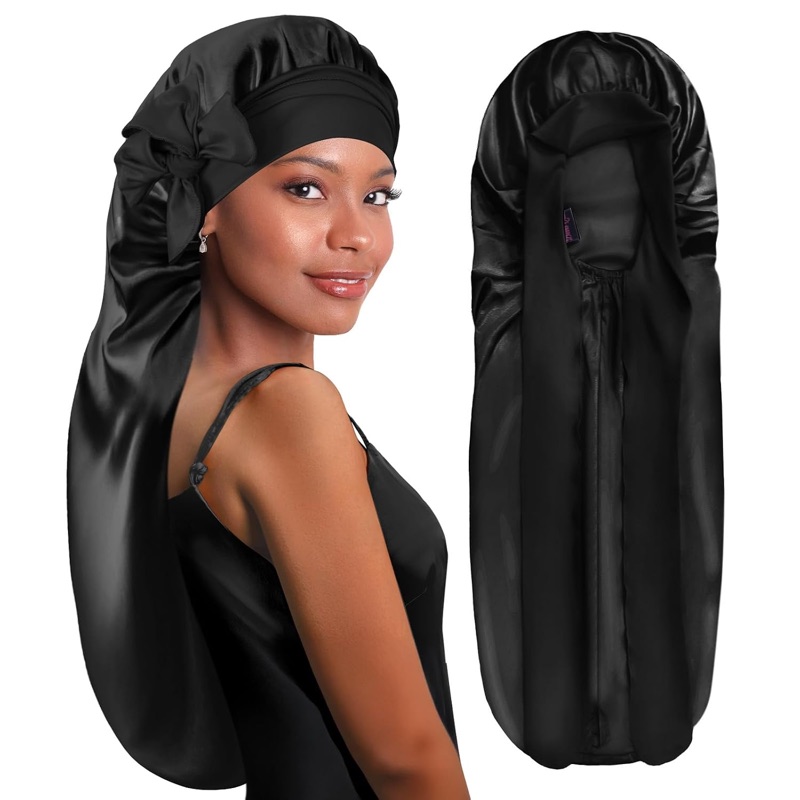
Foldable extra-long braid bonnet, satin
A bonnet presented specifically as a foldable, extra-long wrap for braids, which makes it the direct length-and-containment candidate in this comparison. Check the listed pouch dimensions and the return policy before relying on the word extra long.
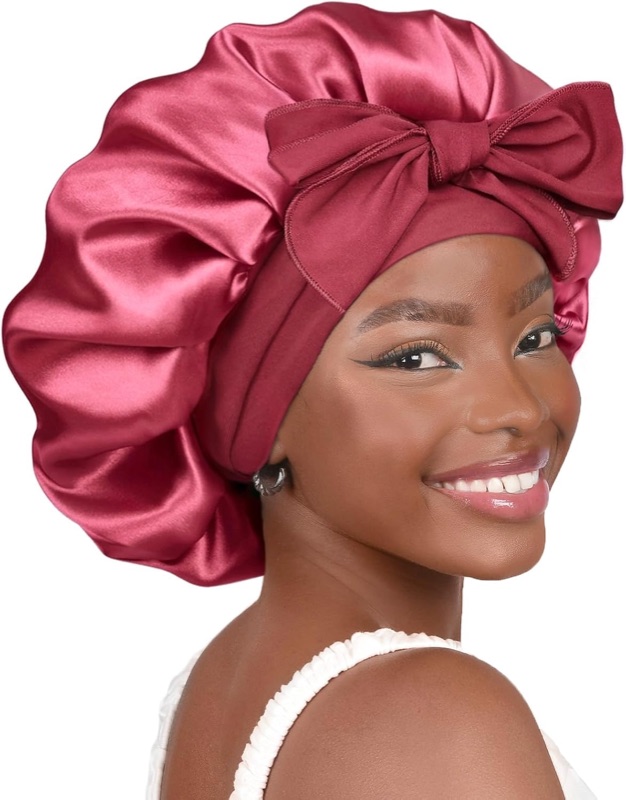
Adjustable double-layer satin bonnet with tie band
A double-layer satin bonnet with an adjustable tie band, positioned for curly hair. Compare its closure and band construction here — the listing is not evidence that it contains very long braids, so test the tie length and knot comfort against your own arrangement.
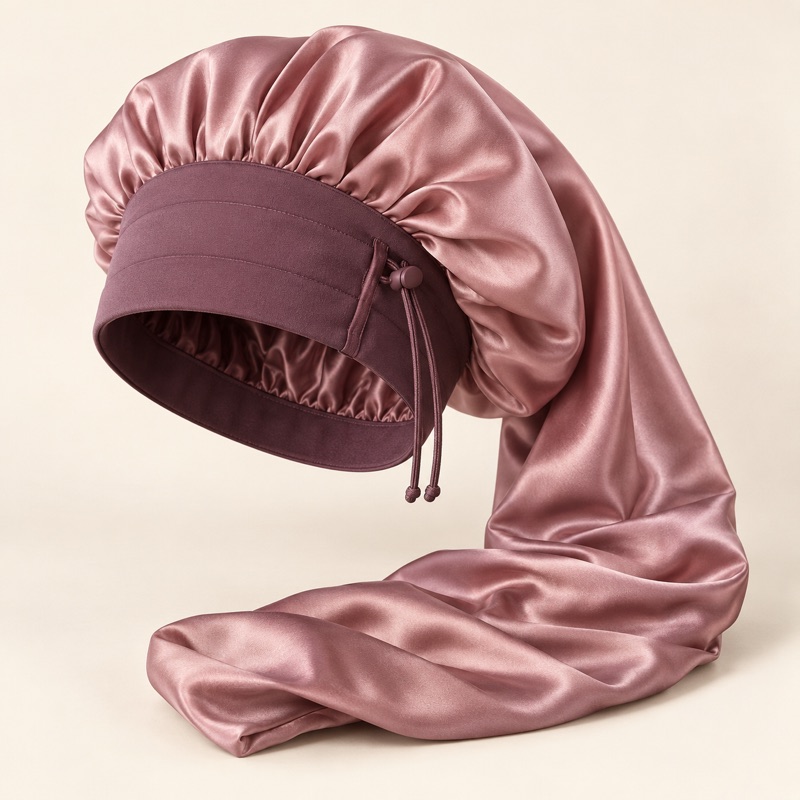
Long satin bonnet for braids with a tie band
A satin braid bonnet listing with a 10-piece minimum, sample options and customisation, and no product reviews. An early sample candidate rather than a pre-vetted recommendation — request a current quotation and fresh measurements before paying.
Card photos are the current marketplace listing images and may differ from the delivered product; confirm details on the live listing. The Alibaba card is the exception: that supplier page returned no usable product photo, so the card shows the site's own editorial visual for that listing.
Small wholesale orders and the Alibaba candidate
The Alibaba product link supplied for this article resolves to a satin braid bonnet listing from Guangzhou Hair I Need Trading Co., Ltd. The page currently shows a 10-piece minimum order, customization and sample options, a supplier profile with five years on the platform, a 4.7/5 store rating, and no product reviews on the listing. These are page-level details that can change. A store rating is not the same as a review of this specific bonnet, and "sample available" does not establish sample cost, shipping cost, lead time, or what can be customized.
For those reasons, treat it as an early sample candidate, not a pre-vetted recommendation. Its relatively low listed minimum may be useful for a first comparison, while the five-year platform history falls short of this project's preferred supplier-tenure target. Before paying, request a current quotation and verify the company identity, exact product specification, sample price, shipping, production lead time, payment terms, and any customization charge through Alibaba's current order process. Ask for fresh photos or a short video showing the product measured flat and worn over the target braid arrangement. The platform listing alone cannot confirm fit or production consistency.
Before approving a sample, request answers in writing to five points: What are the finished usable pouch dimensions? Is the stated fabric satin polyester, silk, or another fiber? Which closure components can change? What is the minimum quantity for each color and size? Will production units match the approved sample, and how will the supplier handle a dimensional deviation? These questions separate a product listing from an order specification. Save the reply with the sample photos and the final quotation. If the supplier cannot confirm a measurement, mark it as unverified in the internal product sheet rather than filling the gap with an assumption. The same records make later replenishment easier because the next order can refer to a sample code, dimensions, and agreed construction instead of a vague product name.
Check the sample against a repeatable protocol
A sample should pass a sequence that another person can repeat. First inspect the delivered item against the approved sample: compare color, seams, closure, lining, and key dimensions. Second, have each tester put it on without coaching. Record whether the opening is easy to manage and whether the wearer can position the pouch without pulling sharply on the braids. Third, ask each tester to wear it for a consistent number of nights and note movement and comfort. Finally, check the product after washing only if the care label allows it, following that label exactly. Record any change in dimensions, seams, or closure; do not make a general durability claim from one wash.
If a sample fails, give the supplier a specific correction request. "Make it bigger" is difficult to evaluate. "Increase usable pouch length by 5 cm while keeping the opening circumference unchanged" is testable, provided the brand has confirmed that 5 cm addresses the observed shortfall. If the issue is sliding, identify whether it came from a loose opening, a tie that was hard to secure, or movement of the pouch itself. These are different design problems and may require different changes.
For the first production order, define a receiving check before the cartons arrive. Measure a small, consistent sample from each lot using the same method; compare key dimensions with the approved specification; inspect stitching and closures; and test a few units with the target wearer group. The sample size for a formal quality plan depends on order size and risk, so do not present a casual spot check as statistical proof that every unit conforms. If the order is large or the product will carry a strong fit promise, consider a qualified third-party inspection and agree on acceptance criteria before production.
A simple go or no-go decision
Move toward a small order only when the sample passes the target length and volume tests, stays in place for the intended testers without uncomfortable pressure, and matches the approved dimensions. If it covers the ends but slides, revise the closure. If the opening holds but the braid bundle is compressed, revise the pouch or crown. If only one hair arrangement works, narrow the product claim or develop a second size rather than presenting the sample as universal.