A facial roller or gua sha stone is a small piece of polished mineral, glass or steel. It has no battery, no formula and no moving parts beyond a roller spindle, yet the listings carry some of the most ambitious language in beauty accessories: "Genuine jade." "Drains lymph and toxins." "Lifts and sculpts." "Boosts collagen." "Cooling therapy for puffiness." Every phrase sounds checkable, and on most listings none of it is.
That has consequences in two directions. A seller who calls dyed quartz or a glass bead "jade" has made a material claim a gemmologist can contradict in an afternoon. A seller who tells customers a stone "drains toxins" has made a health claim dermatology sources do not support. And a buyer who picks a stone on the strength of those claims may end up with something that chips, snags the skin or stains, or with a routine wrong for skin that bruises easily.
This guide separates the material claims, which can be tested, from the outcome claims, which mostly cannot; summarises what clinical sources say, including the one controlled trial we found; and sets out a repeatable material, edge, cooling and cleaning test. It recommends no product and makes no promise about anyone's skin.
What the evidence supports, and what it does not
Start with the cautious voices. The Cleveland Clinic says there is not enough high-quality research to confirm gua sha's benefits, notes that research does not address whether facial gua sha reduces puffiness, and says the idea that it triggers an anti-inflammatory response has not been scientifically validated. It does report that gua sha has been shown to increase microcirculation — blood flow in the smallest vessels — in the treated area. It also quotes an acupuncturist saying a small wooden spoon works just as well as a stone tool.
That last point is worth sitting with. If the practitioner quoted by a major hospital says the material is not the point, then "real jade" is a premium claim about the object, not an efficacy claim about the routine. A seller can charge for a better object but should not imply the stone does the work.
Now the studies that get cited most.
The microcirculation pilot. Nielsen and colleagues (2007) used laser Doppler imaging on 11 healthy people after traditional gua sha on the back and found roughly a fourfold increase in surface blood flow lasting about 25 minutes. A dermatology trade publication points out this is genuine, measured physiology — but from firm-pressure scraping of the back, intended to raise petechiae, in a small uncontrolled pilot. The figure is widely repeated in skincare marketing as if it validated gentle facial gua sha. It validates a different technique, on a different body part, at a different pressure.
The 2023 review. Hamp and colleagues reviewed gua sha, jade rollers and facial massage for dermatology in the Journal of Cosmetic Dermatology. As summarised by secondary sources, the conclusion was measured: some mechanistic plausibility, such as improved blood flow and potential lymphatic effects, but overall evidence insufficient for definitive anti-aging claims.
The 2025 randomised trial. Ahn and colleagues compared a facial roller with gua sha massage in a randomised controlled trial of 34 women aged 20 to 50 in South Korea, with 10-minute sessions about five times a week for eight weeks, using facial oil. The authors report both interventions improved facial contour through different mechanisms. Secondary summaries say the gua sha group showed changes in facial muscle tone, the roller group showed greater improvement in skin elasticity, and gua sha did not improve elasticity. It is a small trial with short follow-up, and it did not measure lymphatic flow. Still, it is the best facial-specific evidence we found, and it supports a narrower claim than most listings make: a small group of women showed measurable changes in some contour and tissue measures after eight weeks of regular use, with oil, to a protocol.
What no source we found supports. Not detoxifying, not stimulating collagen in the face, not permanent sculpting, and not the idea that one stone mineral outperforms another. Dermatology commentary says directly that a lasting change in bone structure or fat distribution is not what happens. Several articles dressed up as dermatologist interviews appear on retailer "insight" pages; some contain quotations we could not trace to a named, verifiable source, so we did not rely on them.
A reasonable summary for a seller: cooling and light massage can feel good and may produce a short-lived reduction in morning puffiness — sources describing this are mostly commentary — and lasting claims are unproven. Describe the tool and the routine, not a physiological result.
Safety points a listing should not leave out
Gua sha and facial rolling are low-risk when done lightly, but the risk is not zero, and the people most likely to be harmed are the ones beauty copy does not talk to.
The Cleveland Clinic says gua sha is generally safe but aggressive scraping can cause soreness, bruising or skin discoloration, and it should never be done on irritated or inflamed skin such as rashes, wounds or sunburn. It advises people with circulation problems or diabetes, people with skin conditions such as eczema or psoriasis, people on blood thinners (it names aspirin, warfarin and apixaban), people undergoing chemotherapy, and pregnant people to check with a provider first. Healthline says that on the face the tool should be swept gently upward and outward and that pressure should not be enough to leave petechiae — the tiny red or purple spots from broken capillaries. It adds that those with blood-clotting disorders or on blood thinners should consult a professional, and extends the caution to recent cosmetic procedures and active skin conditions. WebMD says to skip facial gua sha if you take blood thinners, and recommends cleaning a roller or stone with mild soap after each use. A GoodRx article quotes a clinician warning that if skin is broken and the tool is not cleaned, infection is possible.
One point is easy to miss. In traditional body practice, petechiae are expected. A brand selling the tool as "traditional gua sha" and a brand selling it as gentle facial massage are making different promises, and the instructions in the box must match the promise you make. A wellness-brand article we read says facial gua sha should never cause bruising, and a practitioner-run page says facial marks are almost always a technique problem. Those are brand or practitioner sources, but they match the dermatology advice on light pressure.
The takeaway is short: say the tool is for light use on intact skin, put the main cautions on the insert as well as the page, and avoid wording that encourages pressure ("deep", "intense", "break up").
Five terms the listing uses loosely
Jade. The word covers two different minerals. Gemmological sources explain that "jade" is a generic term for nephrite and jadeite, different in composition and structure: nephrite is a fibrous amphibole rock, jadeite a granular pyroxene rock. Telling them apart reliably needs laboratory tools. Common look-alikes include serpentine (sometimes sold as "new jade"), dyed quartzite, aventurine and glass. Appraisal and gem-trade sources agree on two points: the naked eye is a poor tool, and the usual advice is to ask for a report from an established gemmological laboratory.
Rose quartz, amethyst and other stones. These are mineral names with defined identities. A tool listed as one should be that mineral, not dyed glass or a composite. Ask for the species in writing. Beauty-blog claims that particular stones have anti-inflammatory or luck-bringing properties are not supported by anything we found, and we would not repeat them.
"Real", "natural", "genuine". The US Federal Trade Commission's Jewelry Guides (16 CFR Part 23) address misuse of words such as "real", "genuine" and "natural" for gemstones, and say treatments such as dyeing should be disclosed. A trade source notes dyed jade is common and polymer-impregnated jadeite is a distinct, lower-value category. Two cautions: the Guides are written for the jewellery industry, and the FTC states that industry guides are administrative interpretations that do not themselves have the force of law, so whether they apply to a facial tool is a question for your lawyer. And whatever the answer, a seller who uses the language of the gem trade invites the gem trade's standard. If you say "natural nephrite jade", someone will test it.
Cooling. A stone feels cold because it conducts heat away from the skin, and it warms up within minutes. Retail pages repeat the advice to keep the tool in the refrigerator. That is a care tip, not a performance claim. We would not suggest freezing: sudden temperature change may stress stone, glass and glued parts, and very cold stone on thin skin may be uncomfortable. We found no source testing this, so if you give storage advice, base it on your own test.
Lymphatic drainage. Manual lymphatic drainage is a clinical technique used by trained therapists, not the same thing as running a tool over the face. The Cleveland Clinic suggests facial gua sha strokes may help lymph move but says this is not well studied, and a summary article notes no peer-reviewed study has directly measured lymph flow changes from facial gua sha in humans. The word belongs in an explanation of tradition or theory, not in a benefit line.
What goes wrong with these products
Based on the material and safety sources above, and on what we see in sample requests, the problems fall into six groups.
- Wrong or mislabelled material. Glass or dyed stone sold as jade; a composite sold as a single mineral; "jade" used as a colour name.
- Poor finish. Rough edges, polishing marks, mould seams on glass or resin, pits where dye collects, sharp corners at the notches of a gua sha tool.
- Weak construction. A roller that wobbles, squeaks, loses a head, or has a metal frame that corrodes. Rollers have more parts than stones, and the spindle is where most failures start.
- Breakage. Stone and glass chip or crack when dropped on a bathroom floor, and a chipped edge can scratch skin. The Cleveland Clinic advises replacing a tool that chips or breaks.
- Hygiene. Porous or pitted stones hold residue; a roller with crevices around the spindle is hard to clean.
- Claims on the box. Health and permanence claims with no evidence behind them, and instructions that ignore the cautions above.
Reading the results: pass, revise or fail
| Result | Pass | Revise | Fail |
|---|---|---|---|
| Material report | Species named, treatments disclosed, report from a known lab | Species named but treatment unknown; get the report before listing "natural" | Claim cannot be supported, or supplier refuses to name the material |
| Density and dye screen | Density consistent across pieces and with the claimed mineral; no colour on pad | Density varies between pieces; ask about mixed batches | Density matches a simulant, or visible dye in cracks or on the pad |
| Surface and edge | No snags, smooth edges, no sharp notch | Minor mould seam that can be re-polished | Any snag or sharp point |
| Drop test | No chips in three drops from the stated height | Chips only on tile; add a warning and a pouch | Chips or cracks on the towel as well |
| Roller mechanics | Heads turn freely, no wobble, no rust after soak | Squeak that clears with lubrication | Heads detach, spindles seize or metal corrodes |
| Cooling | Cool for a time you can state | Cooling shorter than the copy implies; reword | Cooling claim with no measurable effect |
| Cleaning and ageing | No dulling, staining or residue after 20 washes | Dulling with a harsh cleaner; remove that cleaner from the instructions | Colour loss, pitting or rust |
| Volunteer panel | No marks, snagging or complaints | Mild redness fixed by lighter-pressure instructions | Petechiae, bruising or cuts |
Treat a failure on edge, drop or material as a stop. Treat the rest as a prompt to change the listing before changing the product.
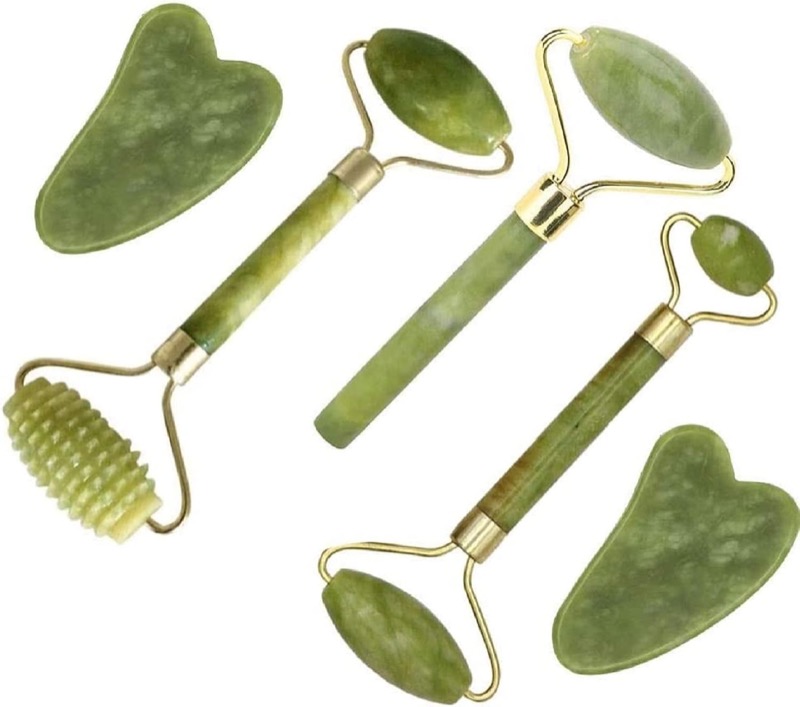
Five-piece stone roller and gua sha set
A larger set makes the material question harder, not easier: more pieces means more chances of mixed batches and of one glass or composite piece inside a stone set. Ask for a report that covers the set, not a single sample.
The sample test: eight steps in an afternoon
These are our own screening procedures, not a standard. They compare samples, check the claims you plan to make, and fail weak items early. Use at least three pieces of each model, because stone varies piece to piece, and photograph every defect with a ruler in frame. Wear gloves when handling anything that might have chipped.
1. Material documents and species. Ask the supplier, in writing, to name the species of each stone (nephrite, jadeite, rose quartz and so on), the origin if claimed, and whether it is dyed, bleached, polymer-treated or reconstituted. Ask for a laboratory report from an established gemmological or materials laboratory naming the method (Raman or infrared spectroscopy are the methods trade sources mention). A "certificate" from a dealer or unknown body is not a report. For your own screening, weigh the piece and measure volume by displacement to get density in g/cm³; appraisal sources say common simulants such as glass, serpentine and quartz are lighter than true jade minerals, so a density matching a simulant is a flag. Density cannot separate every look-alike and cannot find a dye, so treat it as a way to reject the obvious and compare batches, not as proof of identity.
2. Dye and colour transfer. Dyes concentrate in cracks, pits and pores, so inspect under a loupe and strong light for colour pooling along fractures. Then rub the stone for a minute with a damp white cotton pad, again with a pad wetted with your intended cleaning solution and with facial oil, and look for colour on the pad. Repeat after a day in a warm place. This is a screening hint; a stone can be dyed without transferring colour in a minute.
3. Surface and edge inspection. Inspect every surface under a lamp, then run an edge over a cotton pad or a sheer nylon stocking and watch for snags. A snag tells you there is a burr or chip you may not see. Check mould lines, seams, polishing marks, pits and any sharp point at the notch or corner of a gua sha. Measure the working edge thickness in millimetres and record it: a clinician quoted in a consumer-health article says edge thickness changes how intense the massage feels, and thinner edges are gentler, so thickness is a design variable you should state.
4. Drop and knock test. Drop each sample from a stated height (waist height is a sensible start) onto a tiled floor and onto a folded towel, three times each. Inspect for chips and cracks, and repeat the snag test. A glass or stone piece that chips from a counter fall is a risk to skin, and your instructions should say what to do with it. Record the pass rate, not just the best piece.
5. Roller mechanics. Spin each head by hand and listen for squeaks. Check for wobble, play in the spindle, and whether the head can be pulled off. Press a roller onto a flat surface with moderate force for a minute and check the head still turns freely. Look for metal in the frame and ask what it is, because a damp bathroom will find any weak plating. Soak the roller in warm soapy water for five minutes, dry it, and check whether water entered the head, a rust mark appeared or the spindle seized.
6. Cooling behaviour. Take surface temperature with a probe thermometer, chill samples together in a refrigerator for 30 minutes (not a freezer), and record surface temperature on removal. Then record it every minute while the piece sits in a room at a stated temperature, and while held against the inside of your forearm for 30 seconds. This tells you how long the cooling lasts, which is what a "cold therapy" claim implicitly promises. Compare against a steel tool and a plastic or wooden one if you can. We found no published comparison of materials, so you will be generating the numbers.
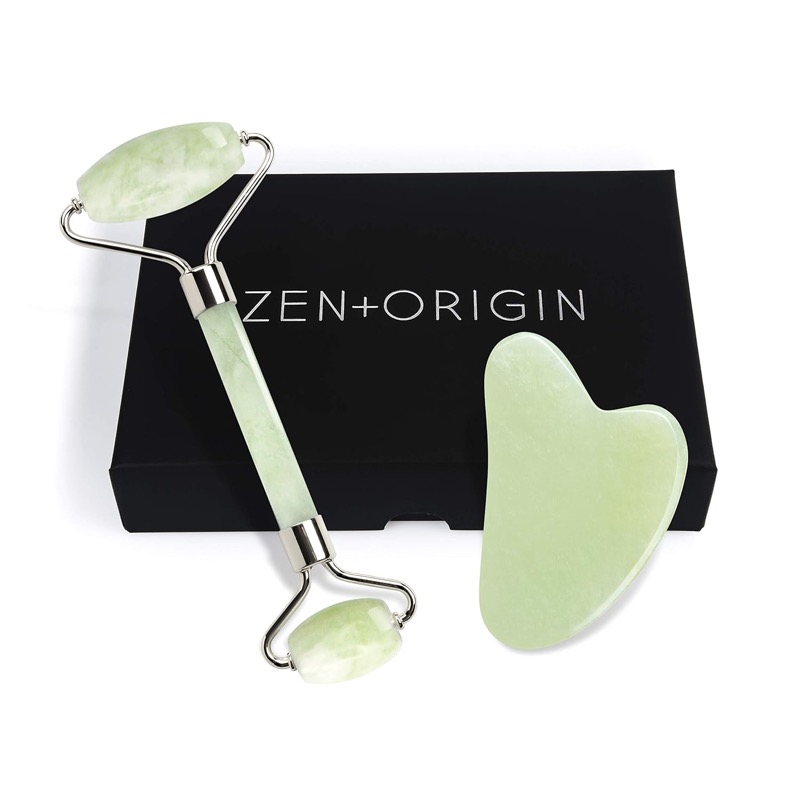
Jade roller and gua sha set with travel pouch
A retail example of the format, and of the wording this guide examines: 100% natural jade, stimulates blood flow, reduces signs of aging. The listing is the reason the sample test exists — the material claim is checkable, the outcome claims are not.
7. Cleaning and ageing. Wash with mild soap, which the WebMD article advises, then repeat with the cleaning method you plan to print. If you plan to recommend boiling water or dilute bleach, which a Cleveland Clinic source mentions for stone, test it on a spare piece first, because adhesives, metal frames, dyes and resin fills may not survive. After 20 wash cycles, inspect for dulling, colour change, surface pitting and roller rust. Wipe with oil, leave a day, wash again, and see whether residue lingers in pores.
8. Volunteer comfort panel. Recruit at least five adults with intact skin who do not have the conditions listed above and do not take blood thinners. Give each a protocol: clean skin, a drop of facial oil, light upward and outward strokes for a stated number of minutes, once a day for a week. Ask for a daily note on comfort, redness, snagging, any visible mark and how long it lasted. Stop anyone who sees petechiae or bruising and treat it as a failure of the product or its instructions. This is not a clinical study and cannot show benefit; it checks that ordinary users can handle the tool without harm and that the instructions are usable.
The supplier brief
- The mineral or material of every part, by name and not by colour, with origin if claimed, and a laboratory report for the stone.
- Disclosure of any dye, bleach, wax, resin or polymer treatment, and whether the piece is one stone or reconstituted.
- Dimensions, weight and working edge thickness for each piece.
- For rollers: the material and plating of the frame and spindle, the number of heads, how they are attached, and the bearing or axle design.
- The finishing process: polishing method, edge radius and inspection step.
- Packaging that protects against impact, with a drop-test result if the supplier has one.
- Care instructions the supplier has actually tested, including any approved cleaning agent.
- Whether the factory makes the stone or buys it in, and whether batches are mixed.
- Minimum order quantity, lead time, sample policy and replacement terms, on the quotation and not in chat.
What your listing can say
- Material: "Nephrite jade, laboratory report available on request" only if you have the report. Otherwise name what you know: "polished green aventurine" or "glass". If you cannot name it, do not use the word "jade" at all.
- Treatment: state whether the stone is natural colour or dyed. If you do not know, find out before you list.
- Finish: "Edges polished and checked for snags; thickness 3 mm", with your measured value.
- Cooling: "Keep in the refrigerator for a cool feel. Does not require freezing." Add the time you measured, and do not claim a treatment effect.
- Use: "For light, gentle strokes on clean, intact skin with a facial oil." Add the cautions: not on irritated, inflamed or broken skin; check with a healthcare professional first if you take blood thinners, have a bleeding or circulation problem, are pregnant, or have an active skin condition.
- Care: the cleaning method you tested, in plain words.
- Evidence: if you mention research, describe it as it was — a small randomised trial of 34 women over eight weeks found changes in some measures of facial contour and tissue, and the tool and routine in that study may differ from yours. Avoid "clinically proven".
Avoid "drains toxins", "detox", "lymphatic drainage" as a benefit, "boosts collagen", "lifts", "sculpts permanently", "anti-aging", "heals" and anything about energy or luck. Avoid instructing customers to press hard or aim for marks.
Frequently asked questions
Does a jade roller work better than a steel or quartz one? We found no controlled comparison of materials. The Cleveland Clinic's acupuncturist source says a small wooden spoon works as well as a stone. Material affects weight, temperature, cost and cleaning — legitimate reasons to prefer one, but not a basis for an efficacy claim.
Is "jade" ever a legitimate colour description? Not without a qualifier. If the item is dyed quartz or glass, "jade-green" or "jade-coloured" is clearer, but buyers searching for jade will still read the word as a material claim. Use the real material name in the title.
Can I tell real jade at home? Only roughly. Density, a loupe and a dye check can reject obvious simulants. Trade sources say distinguishing nephrite from jadeite, and detecting treatments, needs laboratory equipment such as spectroscopy. If the price depends on the answer, pay for a report.
Should I recommend keeping it in the freezer? We would not. Sudden temperature change may stress stone, glass and glued parts, and we found no source supporting the practice. A refrigerator is a milder suggestion; test your own pieces before you print it.
Is a facial roller safer than gua sha? WebMD describes a roller as a good choice for the face that is unlikely to worsen existing skin issues such as eczema, but we found no head-to-head safety data, and the cautions about irritated skin and hygiene apply to both. Neither is risk-free.
Can I mention the 2025 trial in my listing? Only if you describe it accurately, as above, and make clear it studied a specific protocol in 34 women. Do not present it as proof that your tool delivers those results.
What if a customer sends photos of bruising? Ask about pressure, technique, oil, medication and the condition of the skin, and refer them to a healthcare professional for anything beyond mild marks. Review your instructions for wording that encouraged pressure, and check the product's edge and snag results.
Are gemstone-energy claims acceptable? They are claims about properties we could not find evidence for. We would leave them off the listing.