The hairbrush aisle online is a wall of promises: "Gentle detangling." "Boar bristle for shine." "Ball-tipped, no pulling." "Reduces breakage." "Heat-resistant bristles." "Ionic, ceramic, tourmaline." "Wet and dry." Most are claims about how a tool treats hair, and hair is hard to test: it varies between people, between days and between wet and dry. That makes it tempting for a listing to say things nobody has measured.
This guide separates the claims that can be checked with a loupe, a ruler and a hairdryer from the ones that need laboratory or clinical evidence, explains where brushes actually fail — usually the tip, the seam and the cushion, not some mysterious property of the bristle — summarises what dermatology and trichology sources say about brushing, and sets out a repeatable screening test. It recommends no product and makes no claim about anyone's hair or scalp. For other hair-side products, see the spiral hair tie test and the microfibre hair towel wrap test.
What the hair-care sources agree on, and where they are only opinion
A few points recur across dermatologist and trichologist commentary in consumer media.
Wet hair is more fragile. Healthline's overview of brush types notes that the American Academy of Dermatology Association warns against brushing wet hair because it is more prone to breakage. A dermatologist quoted by a lifestyle site says wet hair is weaker and more susceptible to breakage than dry hair, and recommends a wide-toothed comb for damp hair. A trichologist quoted by Refinery29 says she generally avoids brushing wet hair because it can stretch and weaken the strand, while allowing that gentle post-shower detangling may help very thick hair. Retail explainers go further, saying the wrong tool on wet hair is a fast route to breakage. These are consistent, and they matter for any listing that says "wet and dry".
Over-brushing is possible. The same dermatologist describes over-brushing as both brushing too much and using too much pressure on the scalp.
Combs versus brushes. A men's-health retailer's article says a 2007 study found brushes cause more hair breakage than combs. We could not read the study and treat the claim as unverified. The practical point: a seller claiming a brush is "better than a comb" for breakage is making a comparative claim that needs its own evidence.
Bristle choice is mostly opinion. Consumer guides say boar bristle suits fine to medium hair and distributes oils, nylon suits thick or coarse hair and gives stronger detangling, and mixed brushes combine both. They also say rigid nylon can create tension and breakage on fine or damaged hair. A brand blog calls boar bristle the gold standard for anti-breakage — the view of a company that sells such brushes. We found no independent measurement behind any of these recommendations, so treat them as common advice, not evidence a listing can lean on.
What follows for a seller: you can describe the construction of your brush accurately, and say which hair types and conditions retailers commonly suggest it for, but you cannot say it prevents breakage unless you have evidence from a properly designed test.
How a hairbrush is built, and where it fails
Most brushes have the same parts. The bristles or pins do the work, whether natural boar hair, nylon, or a mix. The cushion pad is the flexible rubber or thermoplastic pad the bristles sit in; a reviewer site calls it the hair's shock absorber, noting a stiff pad resists pressure while a flexible one gives. The body or base holds the pad and may be vented. The handle is plastic, wood, or metal with a coating. Patents show a variety of constructions, including bristles moulded with the pad as one piece, bristles moulded separately and assembled into the pad with glue or fabric reinforcement to stop them being pushed through, and bristle anchors inserted into the pad.
Complaints from users and reviewers point at the same few places.
Tips. Many detangling brushes use ball tips: a small rounded cap on each pin. Buyer reviews of a popular ball-tipped brush describe the plastic tips coming off over time and exposing the metal, which makes brushing uncomfortable, and one reviewer says the adhesive holding the tips wears off. Another notes the jagged edges of the tips make the brush hard to clean. Marketplace reviews, not tests, but they describe a failure you can screen for.
Seams and mould lines. A review site says a one-piece moulded handle with no seams prevents hair getting trapped and yanked, calling it a common failure point on cheaper paddle brushes with glued-on pads. Another praises a smooth bristle bed with no rough edges or mould lines that could snag. Both are affiliate reviews, but they identify what to look at.
Pins that bend or splay. The reviewer site notes pins that are not replaceable if bent. Splayed or bent pins are a plausible cause of snagging, though we have not found a test that shows it.
Hot-air damage. Reviewers of vented brushes report cheap plastic brushes melting in a blow dryer's heat. Anecdotal, but it is why heat-resistance claims need testing.
If you remember one thing: brush complaints are overwhelmingly about construction defects that a handful of simple tests will catch.
Terms the listing uses loosely
- Boar bristle. It should mean hair from boars. Many "boar" brushes are a blend of boar and nylon, and some products use plant fibre or synthetic fibre as a vegan alternative. A hair-care brand describes one brush as blending agave fibre and nylon to imitate boar bristle with no animal ingredients. If you claim boar, ask for the fibre identified by a laboratory. If you claim vegan, make sure nothing else in the brush is animal-derived and be careful with wording, as the makeup brush set guide explains.
- Ball-tipped. A cap or melted bead on the end of a pin. It does not guarantee the tip is smooth, attached, or the right size. Inspect it.
- Gentle / no pulling. A feel claim. Tension depends on hair, technique and tangle, as well as the brush.
- Anti-breakage / reduces breakage. A health-adjacent outcome claim. A small seller cannot support a percentage reduction without a controlled test, and we found no independent source behind such figures. Leave it out.
- Heat resistant. Needs a temperature and a test. Brand pages give numbers, such as bristles resistant to 290 °C (550 °F), and consumer brands describe heat-resistant bristles that withstand blow-dryer heat. Brand specifications. Ask for the data behind yours.
- Ionic, ceramic, tourmaline. Materials and marketing terms. Brand and review sites say ionic and ceramic features reduce frizz or distribute heat. We found no independent evidence that they do what the listings say, so describe the material ("ceramic-coated barrel") and stop there.
- Wet and dry. See above: the authorities say wet hair is fragile, so a brush "for wet hair" should have flexible, widely spaced pins and a flexible cushion, and the listing should still tell people to start at the ends and be gentle.
- Massaging / stimulates circulation. One listing says soft plastic bristles stimulate circulation and support hair growth. We found no evidence and would not repeat it.
What goes wrong with these products
- Tips fall off. Caps loosen with water, heat or time, then the metal or sharp plastic is exposed.
- Sharp or rough tips. Moulding flash, uneven caps or burrs scratch the scalp or snag hair.
- Seams and gaps. Hair gets caught between pad and body, or at the handle join.
- Pins pull out or push through. The pad's anchors fail and pins disappear into the cushion or fall out.
- Pad splits or hardens. The rubber cracks or goes sticky.
- Heat damage. Bristles soften, fuse or bend with a dryer, or the body warps.
- Water trapped in the cushion. Vents block, the brush stays wet and smells.
- Handle coating problems. Soft-touch paint goes tacky or peels.
- Static. One comparison article says nylon can increase static in dry conditions. Treat as a customer-experience issue to watch.
- Mislabelled material. Nylon passed off as boar, or a blend sold as 100% natural.
Reading the results: pass, revise or fail
| Result | Pass | Revise | Fail |
|---|---|---|---|
| Contents and labels | Matches the listing | Wording mismatch; fix the listing | Missing parts or wrong materials stated |
| Material | Named in writing, lab report matches any boar or natural claim | Material named, no report; drop the claim until verified | Material is not what the listing says |
| Tips | Smooth, centred, attached | Minor flash; request better trimming | Missing, sharp or rough tips |
| Tip retention | Tips hold through soak and 100 strokes | A few tips move; improve adhesive or process | Tips detach in the test |
| Seams and edges | No catches anywhere | Minor catch on one edge; request deburring | Catches on surfaces that touch hair |
| Pull-out and pad | Pins hold, pad stays supple | Slight pad stiffness; check the material | Pins pull out or push through; pad cracks |
| Tress comparison | Clears the tress in similar strokes to the benchmark | Slower; adjust the pin pattern | Many broken hairs or heavy snagging |
| Heat and water | No deformation at tested conditions; dries reasonably | Warping at an extreme setting; state a limit | Bristles or tips soften or fuse in normal use |
| Cleaning and handle | No change after 20 cleans | Slight dulling | Peeling, tackiness or tip loss |
| Volunteers | Comfortable | Complaints fixed by instructions | Scratching, pain or tips coming off |
Treat a failure on tips, pull-out or seams as a stop. They are the defects customers notice first, and some — exposed metal under a missing cap — are safety issues.
Combs, travel brushes and children's brushes
The same logic applies to neighbouring products, with a few extra checks.
Wide-tooth combs. Dermatologists and retailers in the sources above recommend a wide-tooth comb for damp hair, so a comb is often the safer product to sell for that use. Failure modes differ from a brush's: check each tooth tip for flash and sharp corners, run a nylon stocking along the whole comb to find burrs and mould seams, and flex the comb to see whether teeth snap or the spine cracks. Teeth too close together defeat the purpose of a wide-tooth comb, so record the gap and put it on the listing. A comb too thin may bend under a thick tangle, so test it on a tangled tress and look for permanent bending.
Travel and folding brushes. Folding handles and mirrors add hinges, latches and a spring. Open and close the mechanism 500 times, check that bristles do not catch on the case or mirror, and test the latch in a bag that is shaken, because that is how it is carried. A brush that opens in a bag with its tips exposed will pick up lint and damage whatever is next to it.
Children's brushes. Small parts are the issue. Loose caps, pins and handle ends can be swallowed or inhaled, and rules for children's products differ from those for adult products and vary by market. We did not research those rules in detail. If you sell a brush marketed to children, ask a compliance adviser which requirements apply, and treat a tip that detaches in testing as more serious than it would be for an adult brush.
Scalp massage brushes. These overlap with the silicone scalp massager category, where the same caution about growth claims applies — see the silicone scalp massager guide.
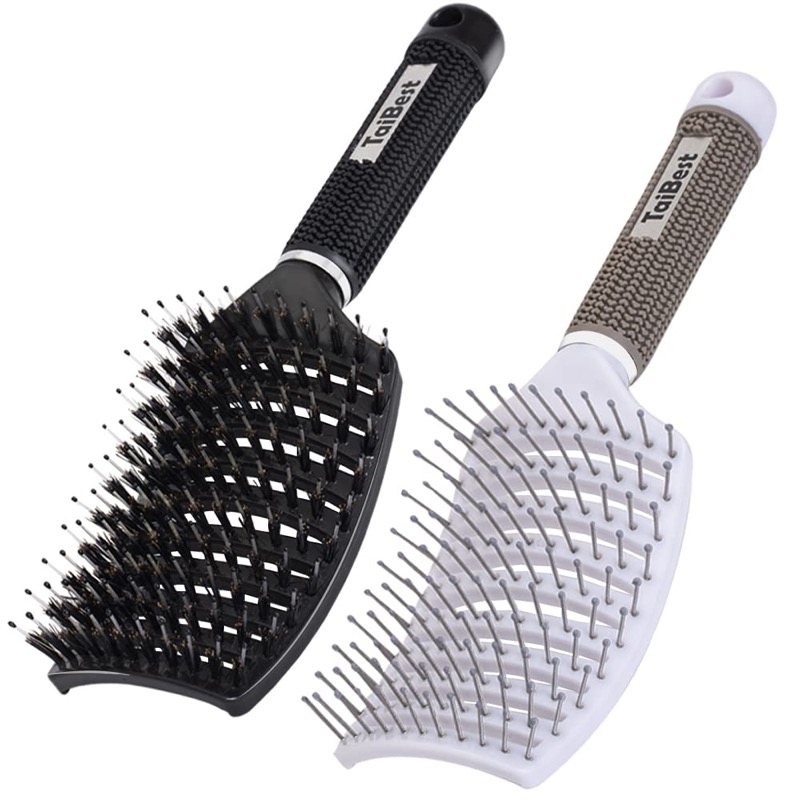
Vented boar and nylon brush set
A two-piece set makes the material question concrete: one brush is boar, the other all-nylon, so the listing's fibre claim has to be checked per piece. Vents also add the water-trapping check to the test plan.
The sample test: nine steps in an afternoon
These are our own screening procedures, not a standard. They compare samples with each other and check the claims you plan to make. Use at least three samples per model from different cartons, and record date, room temperature and humidity.
1. Contents, specification and labelling. Count what is in the box and check it against the listing. Measure overall length, head length and width, pin length and weight. Record the stated materials for pins, pad, body and handle. Note any markings and compare with the packaging.
2. Material identification. Ask the supplier to name the bristle material in writing. For any "boar" or "natural" claim, have a laboratory identify the fibre, with a report for your sample. Do not rely on burn tests or feel. If you plan to say vegan, ask in writing about adhesives, pad material and handle coatings too.
3. Tip and bristle inspection. Under a loupe, look at every pin tip on a sample brush, or a representative area of 30 pins. Record caps that are missing, off-centre, rough or flashed with excess plastic. Draw the tip of each pin lightly across the back of your hand and across a cotton pad; note scratchiness and fibres caught. Photograph defects against a ruler.
4. Tip retention. Pull on a sample of 30 tips with tweezers or a small gauge, recording the force at which a tip moves or comes off. Then soak the brush head in warm water for ten minutes, dry it and repeat on a different set of pins. Finish by running the brush through a standard tress or a nylon stocking 100 times and counting tips that detach. Record the numbers per brush as a comparison between samples and against your own pass level.
5. Snag test for seams and edges. Draw a tress of hair, or a length of long-pile cloth, along every seam, edge, vent and the handle join, and note anywhere it catches. Pass a clean nylon stocking over the same places, since stockings snag on burrs. Record the location and photograph it. A catch on any surface that touches hair is a defect.
6. Pull-out and cushion test. Pull a sample of pins in the direction of use and against it, with a gauge, recording the force at which they move or pull out. Press the pad with a thumb and look for pins pushing through the back or tilting. Flex the pad through its range 200 times and re-inspect for cracking, hardening or stickiness.
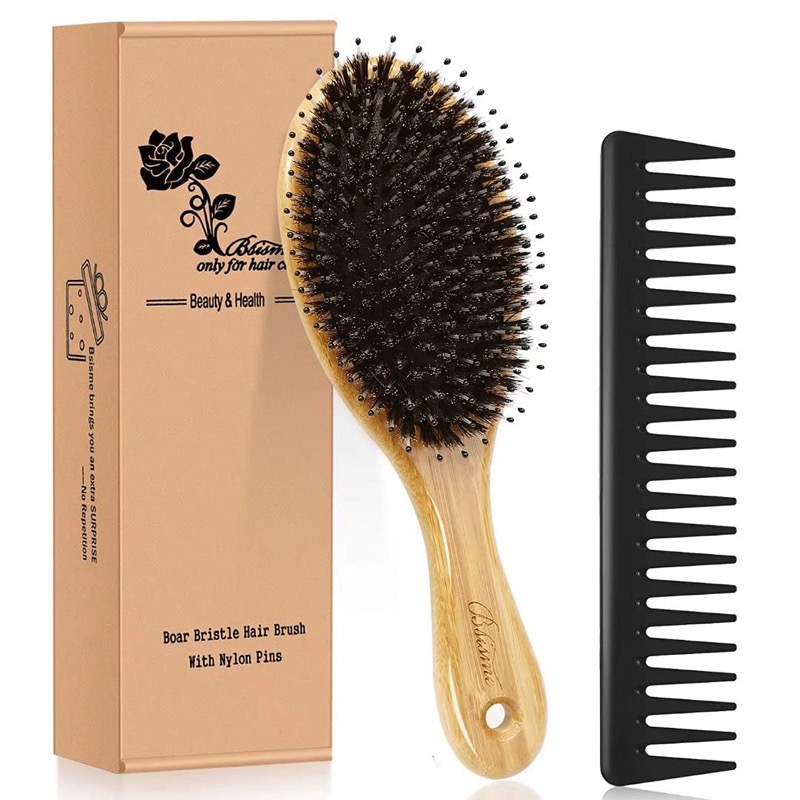
Boar and nylon paddle brush with comb
A retail example of the mixed-bristle construction this guide covers: long nylon pins with ball tips and shorter natural bristles. Both parts need separate checks — tips for retention, bristles for material identification.
7. Hair tress comparison. Use a standard tress of your own, ideally human hair swatches from a supplier, in the same condition each time. Detangle a pre-tangled tress with each brush in a fixed number of strokes and a fixed way; record strokes to clear it, broken hairs collected, and the force felt on the tress (a spring gauge on the tress end gives a number). This compares brushes on a swatch. It does not measure damage to a person's hair and must not be turned into a breakage claim.
8. Heat and water. If you claim heat resistance, find out what a typical hairdryer in your market does at the nozzle with a thermocouple, and write the number down. Hold the brush bristle area at a fixed distance from the nozzle for a fixed time (for example five minutes on the highest setting, repeated in cycles) and look for bristle softening, tip loss, warping and smell. If you claim wet use, soak the brush five minutes, shake it and let it dry on its side, noting how long water stays in the cushion and vents. Do not claim a temperature rating you did not test.
9. Cleaning, handle and volunteer panel. Clean as the instructions say: a comb or rake to pull out hair, a soap rinse, drying. Repeat 20 times and re-run steps 3, 4 and 6. Wipe the handle with a damp cloth and a sanitiser wipe and look for tackiness, peeling and transfer. Then give brushes to at least eight adult volunteers with different hair types for a week, asking about comfort, scalp scratchiness, snagging, static, how the brush holds up in the bathroom and whether any tips came off. Tell them to stop at any pain and see a professional for scalp problems. This checks usability, not hair health.
Record keeping that protects you later
A hairbrush rarely draws a safety recall, but loose tips, melted bristles and snagging draw reviews, returns and sometimes claims. A short paper trail makes each easier to handle.
- Keep a sample from every batch in a labelled bag with the date and carton number.
- Photograph the tip inspection for each batch, with a ruler, and keep the files with the batch record.
- Record the numbers, not just pass or fail: tip pull force, pin pull-out force, strokes to clear the tress, heat-test conditions. A batch that drifts slowly is easier to catch when you can compare figures.
- Save the supplier's reports for fibre identification, heat resistance and adhesive, with the date and lot they relate to.
- Log customer complaints by batch, with date, symptom and whether the customer sent a photo. A cluster of "tip came off" reports from one batch is a signal to check retention again.
- Write your care instructions at the same time as you test them, so the listing and the test agree.
- Decide in advance what you will do if a tip comes off in a customer's hands: who is told, what is replaced, whether the batch is held. It is much easier to follow a plan you wrote calmly.
None of this needs special software. A spreadsheet and a folder of photographs is enough, and it is the kind of evidence a marketplace or a compliance adviser will ask to see if a complaint escalates.
The supplier brief
- The material of the pins or bristles, with a laboratory report for any boar or natural claim, and the proportion for blends.
- The tip type, the cap material, the attachment method and the adhesive, with retention test data.
- The pad material, hardness and construction, and how pins are anchored.
- The body and handle material and coating, and any surface treatment.
- The mould tooling finish, the deburring process, and the inspection plan for seams and edges.
- Any heat-resistance rating, with test method and temperature, and any limit on use with hair dryers or hot tools.
- The venting design and a drying-time test, if you plan to say "wet use".
- A cleaning and care instruction they have tested.
- The packing list, carton drop test, and a defect-rate policy that covers loose tips.
- Minimum order quantity, lead time, sample policy and replacement terms, on the quotation and not in chat.
What your listing can say
- Material: "Nylon pins with ball tips; boar and nylon blend" and the proportions, only as verified. Use "boar" only with a report.
- Construction: the pad type, how the pins are attached, and any seam or tip detail you actually inspected.
- Hair type: "Commonly recommended for…" is a fair way to describe retailer advice, and you can add that you have not measured hair damage.
- Wet use: "Designed with widely spaced flexible pins. Brush gently from the ends, and consider a wide-tooth comb for very wet hair" fits the dermatology advice we found.
- Heat: a tested temperature and duration, or nothing.
- Care: how to remove hair, how to wash, and how to dry the brush.
Avoid "stimulates growth", "ionic" or "ceramic" as a benefit, "healthy hair" and "dermatologist approved" unless you hold evidence for each.
Frequently asked questions
Is boar bristle better than nylon? Retail and brand guides recommend boar for fine hair and shine, and nylon for thick or coarse hair. We found no independent measurement, so treat it as preference.
Should I brush wet hair? The American Academy of Dermatology Association, as relayed by Healthline, warns against it because wet hair is more prone to breakage. Dermatologists and trichologists in consumer articles suggest a wide-tooth comb or a wet-detangling brush, used gently.
Do brushes cause more breakage than combs? A retailer cites a 2007 study saying so. We could not read it. We would not make the comparison on a listing.
Can I say my brush is vegan? Only if every material is free of animal-derived ingredients, including adhesives and coatings, and you can say what that is based on. Otherwise name the fibre.
What does ball-tipped actually guarantee? Nothing by itself. Tips can be rough, off-centre or loose, which is why we test retention.
How heat resistant is "heat resistant"? It depends on the test. Brand pages quote numbers such as 290 °C for specific bristles. Ask for the method and test your own.
Do ionic or ceramic brushes reduce frizz? Brand and review sites say so. We found no independent evidence. Describe the material, not the benefit.
What if a tip comes off in use? Customers should stop using the brush if metal or a sharp edge is exposed. Keep the batch details and treat it as a defect.