A "lint-free" label is not a promise that a wipe releases zero fibers in every manicure. A wipe can shed at its cut edge, break down when wet, catch on a rough surface, or leave lint that was already on the table or the hand. And a pad that performs well for a quick cleanser pass can be frustratingly dry when used to remove polish.
When fibers keep appearing on gel nails, do not switch brands on the label alone. First find out when the lint arrives. Then test the wipe against the exact job, liquid and technique you use. That separates a wipe problem from dust, clothing fibers, a contaminated workstation, or a step your gel system does not require.
"Lint-free" is a claim to check, not a material name
The phrase appears on cotton, cellulose, paper-like and nonwoven products. It does not tell you the fiber blend, how the edges were finished, how the wipe behaves when saturated, or whether it was tested for your specific task. "Nonwoven" describes construction, not a guarantee of zero fiber transfer.
That matters because nail wipes get used for different jobs: cleaning the nail plate before product, removing dust, taking off a cured gel's dispersion layer, wiping a brush, or removing ordinary polish. Each exposes the wipe to different liquids, pressure and surface textures. A wipe can work in one step and disappoint in another without either result proving anything about the category.
Manufacturer instructions also differ by gel system. Some products call for a cleanser and a wipe to remove a tacky layer; no-cleanse top coats are designed to finish without that step. Follow the instructions for the exact gel and cleanser you use, and do not add a wiping step just because a tutorial does it.
Find the moment the fiber appears
Start with a clean, well-lit surface and a fresh sample. Before changing the product, note the stage where you first see a fiber: after dust removal, after cleanser, after wiping a cured layer, or only after the next gel coat. Photograph the nail or practice tip at that point. If the speck is visible before the wipe touches the nail, the wipe is not the original source.
Check the work area as carefully as the consumable. Fibers come from towels, sleeves, paper towels, clothing, hair, a reused brush, an open pack sitting near filing dust, or the dispenser itself. A black work mat or a dark practice tip makes pale fibers easier to spot; a light surface exposes dark lint. Both are inspection aids, not a substitute for the real application surface.
Lift a visible fiber from a practice tip with a clean tool and look at it. A long twisted strand suggests textile lint; a short tuft or cluster suggests a wipe or cotton product; a fine particle suggests dust. That is a clue, not a laboratory identification.
Change one variable at a time: new pack, clean table, different wipe, same liquid, same motion. If you switch the wipe, the solvent and the technique together, you will not know which change fixed it.
Nail forums carry reports of fibers on freshly applied gel even when the user bought wipes sold as lint-free, and other reports of changing wipe type or reserving lint-free wipes for prep helping. They show the question is real. They cannot establish a failure rate or name a universally reliable brand.
Run a small comparison you can repeat
A buyer test does not need laboratory equipment. It needs a fixed setup. Label the incumbent wipe and each sample with a code, and record the supplier, pack, stated material, size, lot or date code if provided, and the job being tested. Keep the cleanser or remover, practice tips, work surface, lighting and operator consistent, and compare wipes one at a time rather than opening several packs over the same dusty table.
Inspect the dry sample. Open a new pack and take a wipe out without dragging it over a rough dispenser edge. Look at cut edges, holes, loose strands, visible lint, odour, discolouration, and whether pieces separate cleanly. Record what you see — "fails lint test" is not an observation.
Test dry transfer. Place one wipe on a clean contrasting surface and make a fixed number of passes at the same light pressure, using a fresh area for each sample. Photograph any visible fibers. The pass count and pressure are your internal comparison conditions, not a published method; choose something close to how your technicians work and never change it mid-test.
Test wet behaviour for each intended liquid separately. Use the cleanser or remover approved for that step, apply the same measured amount to each wipe, and repeat the same pass on comparable practice tips. Record whether the wipe holds the liquid, drips, tears, pills, leaves a film, or transfers fibers. Acetone, cleanser and prep solution are different products and may behave differently on the same wipe.
Repeat with a second wipe from each sample and, if the order is meaningful, a second pack. One clean wipe cannot tell you whether a lot is consistent. If results differ, repeat before deciding whether the cause was a sample defect, handling, or a real performance difference. Keep photos, sample codes and notes with the written purchase specification.
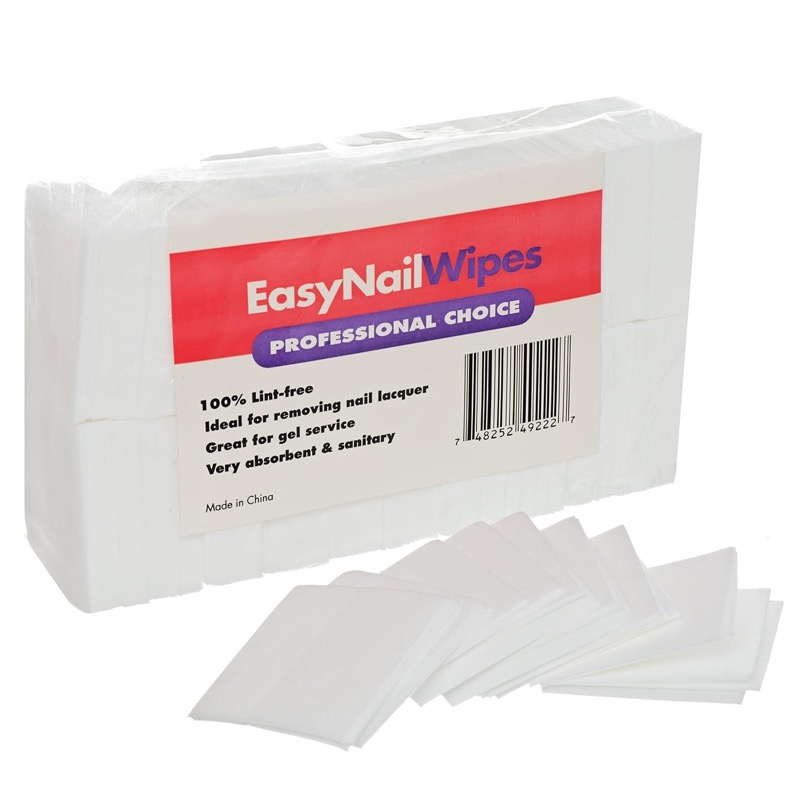
Lint-free nonwoven nail wipes, 2 x 2 inch, 1000 pack
A firmer nonwoven pad rather than a soft cotton type, positioned for professional gel services. Worth comparing against a soft pad when your fibers appear during prep rather than removal.
Choose the wipe for the job you actually sell
For professional use, a compact square may suit a nail plate or a brush, while a larger or thicker wipe is easier to hold during removal. Those are workflow questions, not universal size rules. Ask technicians to test the real dimensions with gloves if they wear them, and compare how much usable surface remains after folding and whether the pad can be held without touching the part that contacts the nail.
Describe absorbency relative to the job. For a quick controlled cleanser pass, a thinner wipe may be adequate. For polish removal you may need more liquid retention and a larger surface. "Super absorbent" is not a measurable result unless the seller provides a method, and a heavier wipe does not automatically shed less.
If you sell a press-on nail kit, the enclosed single-use prep pad is a separate component question from a salon's dry lint-free wipe for gel prep. Keep the kit pack count and the salon wipe specification apart in your catalogue and purchase orders.
Separate prep, tack-layer cleanup and polish removal
For prep, the goal is a clean surface using the liquid and sequence the gel manufacturer specifies. Use a fresh wipe for the intended pass. If the wipe leaves fibers on a clean practice surface, check the dry wipe first, then repeat with the specified cleanser and a fresh wipe. Do not add alcohol, acetone or another solvent unless the product instructions allow it; a cleanser that works with one system is not automatically right for another.
For a cured tacky or dispersion layer, verify that the step is required at all. Some top coats are no-wipe, some builder and colour systems need a finishing solution and a lint-free wipe. A no-wipe product should not be wiped as a troubleshooting ritual, and a wipe-finish product should be cleaned according to its own instructions. If the finish turns dull or streaked, check the cleanser and the timing before blaming the wipe.
Polish removal is a different demand. A thin wipe can be clean and low-lint yet hold too little remover for the time you need. That does not make it a bad prep wipe. Customers on manufacturer product pages report exactly this split — praise for low lint, complaint that the pad was too thin to absorb enough remover, with the brand recommending a more absorbent material for soak-off. "Lint-free" and "absorbent enough for removal" are separate questions.
Avoid testing a nail wipe on a person to settle a sourcing question. Use practice tips or another appropriate test surface, follow the product-system instructions, and keep client services for products already approved for the workflow.
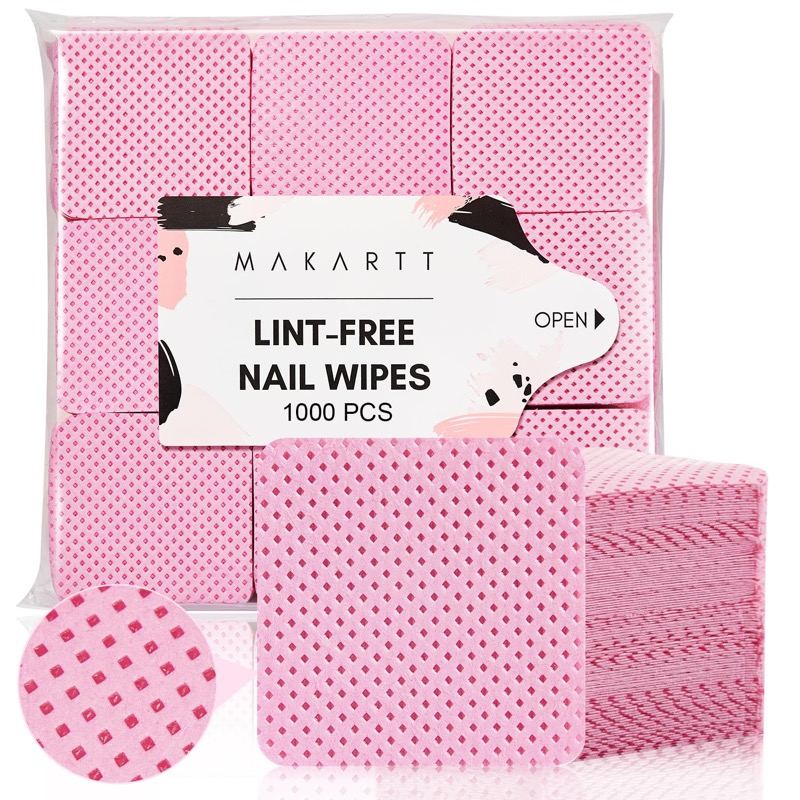
Lint-free nonwoven nail wipes, 1000 pcs
A three-layer nonwoven pad sold for prep and gel removal. Useful as a comparison sample against whatever you use now — judge it on your own cleanser and practice tips, not on the pack copy.
Turn a sample result into a supplier specification
A purchase order should identify more than "lint-free nail wipes". Ask for:
- Exact fiber composition or material declaration.
- Construction method and number of layers.
- Dimensions, and basis weight if the supplier measures it.
- Edge finish and colour.
- Pack count, and whether the count means individual wipes.
- Packaging that protects the stack from dust.
- Storage instructions.
If the supplier cannot provide a field, mark it unknown rather than filling it with a guess.
Describe the intended use: nail-plate prep with a named liquid, cured-layer cleanup in a specified system, brush cleaning, or polish removal. Ask what test supports the lint claim and whether the production item is the same material and process as the sample. Request a sample from the proposed production configuration, not a visually similar item from a different listing.
Set acceptance criteria before approving the sample. For example: no visible fibers on a clean practice tip after a defined number of passes, no tearing during the intended wipe, and enough liquid retention for the specified step. Those are buyer-defined checks, not industry standards. Avoid absolute or medical language such as "zero lint", "allergy-free" or "safe for every gel system" without substantiation.
Keep an approved reference sample, dated photos, the material declaration and the exact product code. On later orders, compare a received wipe with that record before releasing it to the salon or packing it into a kit. If material, dimensions, edge finish, packaging or supplier changes, ask why and repeat the relevant check. A repeated SKU name does not prove the production process stayed the same.
A sample candidate worth testing
One marketplace listing that fits this product role states a 5 × 5 cm wipe, 50 gsm, 100 pieces per bag and a minimum order of 100 bags, from a supplier profile showing a long trading history and a store-level rating. That rating is not the item's rating, and the product page showed no item-level reviews when checked.
Treat every detail as a claim to reconfirm in a sample quote — especially the exact fiber composition and what "cellulose cotton" means for that particular wipe. Ask for the current sample, confirmation that the stated size and weight are the offered item, composition and construction documents, liquid-retention details if available, packaging and count confirmation, and written notice of any production change. Compare it with the wipe already in use and approve it only if it performs for the job you actually need.
Common questions
If a wipe says lint-free, why do I still see fuzz?
The fiber may come from the wipe, its cut edge, the work area, a towel, clothing or another tool. The label alone does not identify the source. Test on a clean contrasting practice surface and change one variable at a time.
Can one nail wipe do prep, removal and the tacky layer?
Possibly, if the product and the gel-system instructions allow it and the sample works for each task. Do not assume a quick prep pass carries over to solvent-heavy removal.
Should every gel layer be wiped?
No universal answer applies across systems. Follow the instructions for the product in use; some require a wipe at a particular stage, and no-cleanse finishes are designed to skip it.
What is the most useful sample test?
Use the liquid, surface and motion that match your workflow, compare the current wipe with the sample under identical conditions, repeat with more than one wipe, and record visible lint, tearing and liquid handling. Keep the criteria internal and consistent, and do not present them as an industry certification.