A standard sleep bonnet can be adequate until hair changes shape. Longer braids, locs, extensions, a higher-volume curl pattern, or a style that needs to lie in one direction can turn an ordinary round cap into a poor match. The bonnet may technically close, but the hair ends can bunch, the opening can ride upward, or the wearer can end up sleeping on the part of the style they were trying to cover.
The answer is not simply to buy the largest bonnet available. Bigger capacity can solve one problem while creating another: extra fabric can shift, a wide body can pull on the opening, and a loose fit can make a closure work harder than intended. A useful choice begins by separating three measurements that are often collapsed into one vague word, “size”: length, volume, and opening.
For a consumer, this guide gives a way to compare long-hair and braid bonnets before buying. For a small brand, the same checks become a sourcing brief for product development, sample approval, packaging, and reorders. It does not promise a universal fit. Hair density, braid grouping, head shape, sleeping movement, and personal comfort vary too much for that.
First, decide how the hair needs to sit overnight
Before you measure the bonnet, look at the style you want to protect. Does the hair naturally hang down, form a compact bundle, sit in a pineapple, or need to be gathered without a sharp bend? Long braids and locs often need a different internal path from loose, shorter curls. A bonnet that makes sense for a high-volume round shape may be less suitable for hair that is more comfortable falling in a long direction.
This is why product photos can mislead. A model can fit a large amount of hair into a cap for a styled image, but the question is whether the same arrangement remains comfortable when lying down and moving. If hair ends are tightly folded, pressed toward the crown, or forced into a narrow opening, the product may be technically large but still not well matched to the use case.
For shoppers, describe your own hair in functional terms before opening a product listing:
-
How far does the style extend when it hangs naturally?
-
Is the main challenge length, bulk, or both?
-
Do you normally sleep on your back, side, or in several positions?
-
Do the ends need to hang downward, or can the hair sit comfortably in a round body?
For brands, turn the answer into a product scenario. “For long braids” is a broad market phrase. “Designed to contain a long, downward-hanging braid arrangement without requiring sharp end folding” is a sample-check instruction. You can test the second statement. You cannot properly test the first without deciding what “long” means for the product.
Measure the hair path, not just body height
Hair length is useful information, but it is not the same as the interior length a bonnet needs. A braid, loc, or extension can curve, layer, or group differently inside a cap. The usable path is the distance the hair needs when arranged as it would be for sleep—not a single number copied from a haircut chart.
To get a practical starting point, arrange the hair as you would before bedtime. Without pulling it tight, note where the longest part sits. If the style hangs down your back, a long or tube-shaped bonnet may be more relevant than a round cap. If the style can sit loosely on the crown without folding the ends, interior depth may matter more than length.
Use the product’s stated dimensions only as a comparison tool. Check whether the measurement describes the finished product lying flat, the usable interior, the opening, or a stretchable outer dimension. Those are not interchangeable. A length listed on a product page may not tell you how far hair can travel once the bonnet is gathered at the opening.
For brands, ask the supplier to identify exactly how each dimension is taken. A sample specification should separate:
| Dimension | What it should describe | Why it matters |
|---|---|---|
| Body length | Usable path from opening to end of the bonnet | Indicates whether long hair must fold |
| Body width or circumference | Interior room across the body | Helps assess grouped braids or dense styles |
| Opening measurement | Relaxed and intended working opening | Affects how the bonnet stays positioned |
| Closure length or range | Ties, elastic, or drawstring adjustment | Shows how fit is controlled |
Do not treat a flat product measurement as proof of capacity. It is a starting point. Capacity must be checked with an arrangement that resembles the intended use.
Estimate volume separately from length
Two people with hair at the same length can need different bonnet shapes. Individual braid thickness, the number of braids, loc diameter, curl density, extensions, and the way the hair is grouped all change the interior space required. This is why a blanket “long hair” label often disappoints both customers and brands.
For shoppers, think of volume as the amount of room the style occupies after it has been arranged for sleep. If your hair is thick or braided, do not assume that an extra-long tube alone solves the fit. Look for a product that shows the body shape, not only the length. A long, narrow style may suit hair that can stack neatly; another person may need more width or depth near the opening.
Avoid compressing the hair just to make a product work. If the first step of wearing a bonnet requires a tight bundle, a sharp fold, or force at the opening, the product may not be the right capacity. The goal is not to prove that the hair can fit once. The goal is to choose a repeatable bedtime arrangement.
For brands, use more than one sample scenario. Test a lower-volume arrangement and a fuller one within the target product category. Photograph the bonnet from the front, side, and back, noting whether the body pulls against the closure or whether hair ends bunch at a single point. This is not a claim that every customer will have the same result. It is a way to find the range your product page can describe honestly.
Check the opening before you judge the body
The opening is where capacity meets stability. A bonnet can have ample room in the body and still be a poor fit if the opening is too narrow for the intended hair arrangement, too loose to remain positioned, or adjusted in a way that creates unwanted pressure.
Look for an inside view of the opening. Identify the closure: continuous elastic, elastic panel, long ties, drawstring, toggle, wide wrap band, or another mechanism. Then ask whether that mechanism works with your hair volume and preferred orientation. A long bonnet with a small, unadjustable opening may be harder to put on over a fuller style than a different body with a more appropriate closure.
For shoppers, do not use “one size” as a measurement. Check whether the listing provides a head-circumference range, closure description, or clear instructions. If it does not, look at customer photos and questions, but keep in mind that another person’s braid density and sleep position may not match yours.
For brands, write the opening and body dimensions in the same sampling block. Do not approve an extra-long body independently of the band. Test the product filled with the intended hair volume, then note whether the closure twists, the edge rides up, or the body weight pulls the opening away from its intended position. A change in length can require a different closure placement or a different band construction.
Compare a long-bonnet listing with a standard-bonnet listing
The fastest way to understand the difference is to compare the information each listing gives you. Use this Amazon long-bonnet listing to inspect the current product images, stated dimensions, closure design, intended hair use, and shopper questions. Do not rely on the title alone; variants, dimensions, and materials can change.
Then use this second Amazon listing as a comparison point. Ask which design gives clearer evidence of usable length, room for grouped hair, and an opening that can be adjusted for the intended style. These are affiliate links, not promises that either item will fit every wearer. Check the live pages for the exact version before you purchase.
You are not looking for a universal winner. You are checking whether a product supplies enough information for your own decision. A detailed long-braid listing should show more than a label such as “XL.” Ideally, it makes the body shape, usable length, opening, and closure visible.
Practical routes
These links are starting points for comparison. Confirm current product details, dimensions, material, pack configuration, pricing, and affiliate terms on the live destination before relying on them.
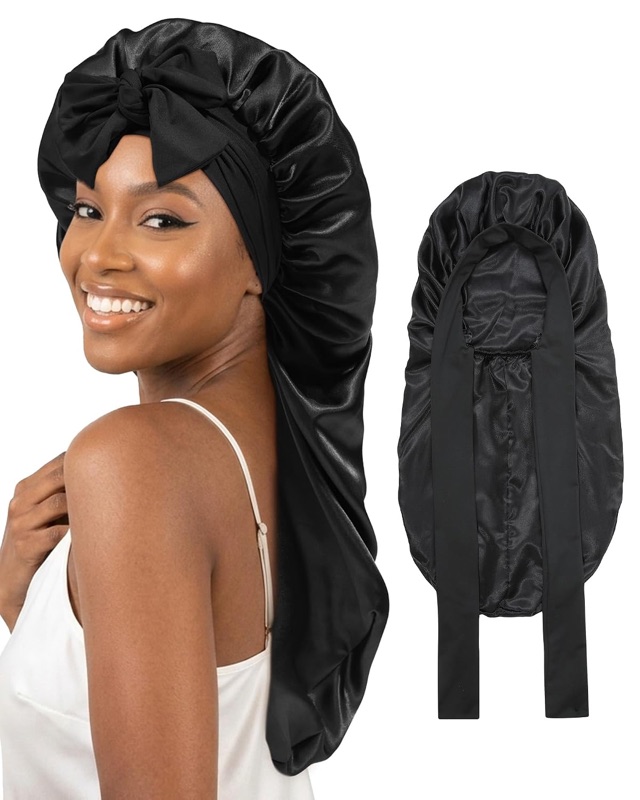
Long satin bonnet for braids with an adjustable tie band
A long double-layer satin bonnet for braids with an adjustable elastic tie band. This is the long-length reference for the guide: check the stated length and how much braid the opening is designed to take.
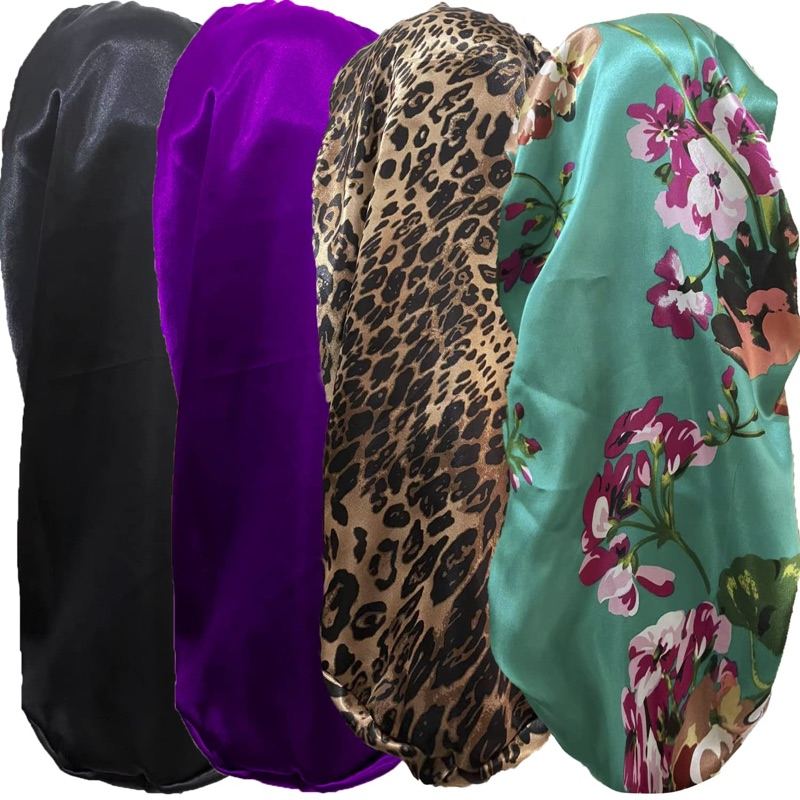
Long sleep bonnet four-pack in soft satin
A four-pack of long satin sleep bonnets, sold as a multi-item pack rather than a single cap. Useful as the second length reference when you compare opening size, usable length, and how the pack price changes the per-unit calculation.
Card photos are the current marketplace listing images and may differ from the delivered product; confirm details on the live listing.
Build a simple at-home fit check
Once a bonnet arrives, test it before treating it as part of your nightly routine. Arrange your hair in the intended position, put the bonnet on at a comfortable setting, and look for three signs.
First, check the ends. Are they forced into a hard fold, pressed into a corner, or left outside the intended body? Second, check the opening. Does it stay in place without forcing you to overtighten a tie or band? Third, check the body. Is there enough space for the style to settle without making the bonnet so loose that it shifts immediately?
Move your head as you normally would before bed. Sit, lean back, and change position. You do not need to simulate a whole night. Look for an obvious mismatch before the product becomes part of a longer routine.
If the fit is wrong, record what failed. “Too small” is less useful than “body length was adequate but the opening slid,” “ends needed sharp folding,” or “body was too wide for the closure.” These distinctions help with a return decision, the next purchase, or feedback to a seller.
Turn consumer feedback into a product specification
For a small brand, customer phrases such as “my braids do not fit,” “the bonnet is too short,” or “it slips when full” should not be treated as isolated complaints. They describe different product variables.
| Customer observation | Product question to investigate |
|---|---|
| Ends bunch at the crown | Is the usable body length too short? |
| Hair fits but the bonnet slides | Does the closure support the filled body weight? |
| Opening is difficult to use | Is the opening range too small for the target volume? |
| Body feels empty and shifts | Is the product too wide or too deep for the stated use? |
| Hair is compressed near the front | Does the internal shape or closure position need revision? |
Use this table in a sample review, not as a substitute for testing. Ask the supplier for the pattern dimensions, intended orientation, material statement, and closure construction. Then request a sample with the same body and opening dimensions planned for production. If the supplier changes the fabric, body length, band, tie length, or pattern after approval, treat it as a new revision.
The product page should reflect what the sample can support. Instead of claiming that a bonnet “fits all braids,” describe the body style, stated dimensions, closure type, and intended use. That makes the customer’s decision easier and reduces returns caused by a vague promise.
Plan packaging around the actual fit decision
Long-hair product packaging needs to explain the shape, not merely show a beauty image. A small insert can say how to orient the bonnet, where the hair should sit, and where the closure is adjusted. It should not tell customers to pull the product tighter simply to compensate for a capacity mismatch.
For brands, make sure the package image matches the approved sample. If the product is intended for downward-hanging braids, do not show a tight crown bundle as the only way to wear it. If it is a round, high-volume cap, do not market it as a long tube. The product’s functional shape should be clear before checkout.
This is also a sensible place to explain care-label location and variant differences. A customer choosing a standard, XL, and long version should be able to see what changes between them—body form, closure, intended volume, or all three—rather than guessing from colour names.
Choose a shape before choosing a size name
The most useful long-braid bonnet choice is based on shape and specification, not a broad size word. Measure how your hair needs to sit, consider the room it occupies, inspect the opening and closure, then compare the live listing with your own overnight routine.
For brands, do the equivalent in reverse: define the hair arrangement, set body and opening dimensions, sample with realistic capacity, and describe only what the sample supports. A long-braid bonnet does not need exaggerated claims to be useful. It needs a body shape that makes sense for the wearer and a product page that explains it clearly.
Affiliate disclosure: Some links in this guide are affiliate links. HerBrandKit may earn a commission at no extra cost to you.