Search for the right claw clip size for thick hair and you will find answers that cannot all be true. One guide says thick hair needs a jaw of two and a half to three inches. Another points to large jaws of four to five inches, or jumbos of five and above. A buyer who reads both ends up with two numbers and no way to choose.
The disagreement is not mainly about opinion. It is about what is being measured. "Size" on a claw clip listing can mean the overall length of the clip, the width of the jaw, how far the jaws open, or a marketing label such as "large" or "jumbo". Each is a different dimension, and none of them is the one that decides whether a particular head of hair stays up: the size of the hair bundle the clip has to hold, compared with the space the clip has to hold it in.
This guide is for small hair-accessory brands and sellers choosing or specifying a clip for thick hair, and for shoppers tired of clips that slide down by lunchtime. It separates the terms, explains how to measure the bundle, and sets out a repeatable slip test. It deliberately does not cover springs and hinges — those belong to the claw clip spring and hinge test. Sizing and mechanism are two different approvals, and a clip can pass one and fail the other.
Why the size guides disagree
Every sizing table we looked at is written by a seller, a retailer or a content site that sells clips. They are not independent measurements and they do not use a common standard. Read side by side, three problems show up.
They measure different dimensions. A French accessory brand's sizing page describes large jaws as about four to five inches and jumbo jaws as five inches and above, and calls both suitable for thick hair. A supplier-side buying guide gives a table with separate columns for clip width and jaw span, and the jaw span is smaller than the width in every row. Both can be sensible once you notice one is quoting the overall size of the clip and the other the jaw. The same physical clip can be "four inches" in one table and have a "two and a half inch jaw" in another.
They define thick hair differently. Thickness can mean density (how many strands grow per square centimetre of scalp), the diameter of each strand, or simply the volume that results from length or curl. A person with fine strands and high density can have as much bulk in a twist as someone with coarse strands and lower density. A table that only asks "thick or thin?" cannot tell them apart.
They do not say which hairstyle the size is for. A clip that holds a half-up section of thick hair comfortably may be hopeless for a full twist of the same hair. Same hair, very different shape.
Treat published size tables as a rough starting point for which clips to try, not as a rule. Then measure.
The four dimensions that matter
Before measuring anything, agree on terms. On a claw clip, these are the dimensions worth writing into a specification.
| Dimension | What it is | Why it matters |
|---|---|---|
| Overall length | Edge to edge along the long side of the closed clip | What most listings call "size"; sets how much hair the clip can span |
| Inner jaw width | The space between the jaws at rest, measured across the inside | Shows how much room the clip has before it must stretch around hair |
| Maximum opening | How far the jaws open at full stretch | Decides whether a thick bundle can be inserted at all |
| Basket depth | How deep the clip curves, front to back, where hair sits | Decides whether a thick twist sits inside the clip or perches on top of it |
Add the tooth pattern: number of teeth, one row or two, tooth depth, and whether upper and lower teeth interlock or only touch. A clip that is long enough but has few, shallow teeth grips a small amount of hair at a few points.
If a supplier cannot give you at least overall length, maximum opening and basket depth, you cannot compare two clips however good the photos are. Measure them yourself on the sample with a ruler and callipers, and record the values.
What "thick" means for this test
For a sizing test, ask which kind of thick the customer has, and write the answer down. This framing is ours, not a standard, but it keeps tests consistent.
- Dense hair. Many strands. The bundle is wide even when each strand is fine.
- Coarse hair. Each strand is thick. The bundle is firm and tends to spring back against the clip.
- Long hair. Length adds volume when it is folded up, and weight when the clip supports it.
- Curly or textured hair. The bundle can be wide and airy and compresses differently. A clip sized to a compressed curl may fail once the curl expands.
Most customers who describe their hair as thick have at least two of these. A brand that wants to say "for thick hair" should decide which of them its test volunteers represent.
Measure the bundle, not the clip
The most useful change you can make is to size the clip to the bundle it has to hold. Here is a method you can run in ten minutes with a few volunteers. It is a screening procedure, not a standard.
- Choose the styles. Pick the three styles your customer actually wears — for example a half-up section, a full twist and a low loop. Do not invent a style nobody wears.
- Gather the hair as the customer would. The volunteer gathers and twists or folds the hair into the style, holding it where the clip will go.
- Measure at the clip line. With a soft tape or callipers, measure the width (along the length of the clip) and the thickness (front to back) of the hair where the clip will sit. If the bundle is soft, measure with a light squeeze, not a firm one, and note which.
- Record the hair facts. Length, density as the volunteer describes it, strand texture, and whether hair was dry, damp or styled.
- Compare with the clip. Check bundle thickness against maximum opening and basket depth, and bundle width against inner jaw length.
Do this for each volunteer and style, and put the numbers in a table. After a handful of volunteers you will see patterns. Perhaps the full twist is always about as thick as the maximum opening of your large clip. Those numbers are far more useful than the word "large".
What the ratios tell you
When you compare bundle to clip, you are looking for a margin. A clip that can only just close on the bundle is working at its limit: the spring is stretched near maximum, the teeth meet at the edge of their travel, and there is no reserve when the hair shifts. A clip with a comfortable margin closes without strain and still holds when the hair moves.
There is no magic ratio — it depends on the clip's design and the hair. What you can do is define your own acceptance rule from your volunteers, for example "the closed clip must still have visible spring return when the largest bundle is in place", and apply it consistently. The point is that you measured, and wrote down what you accept.
Teeth, not just length
Length gets the attention, but thick hair is usually held by the teeth.
- Single or double row. A second row gives more contact points. Some sellers call double-row teeth essential for thick hair; treat that as a seller's view and test whether the extra row actually engages the hair in your volunteers' styles.
- Tooth depth and spacing. Deep, well-spaced teeth hold coarse hair. Fine teeth set close together can glide over a thick, smooth bundle.
- Interlocking. Close the empty clip and look through the gap: do the teeth interleave or just meet? Does the pattern line up end to end or is it offset?
- Tooth edges. Run a fingertip and a strand of hair over the teeth. Burrs and rough moulding seams snag hair.
- Tooth strength. End teeth take the most load on a heavy bundle. Press lightly on them with the clip closed; they should not flex or crack.
Seller blogs describe broken end teeth when a clip is overloaded. Those are anecdotes, not failure rates, but they tell you where to look.
A repeatable slip test
This is a proposed in-house test. It compares candidate clips under the same conditions and records what happened. It does not predict durability.
You need at least five volunteers with thick hair of different types, a timer, a camera and a measuring tape. Each volunteer wears each candidate clip in each agreed style.
| Step | What to do | What to record |
|---|---|---|
| 1. Insert | Clip the prepared bundle once, without readjusting | Whether it closes in one attempt, and how much effort it took |
| 2. Photograph | Photograph from the side and back against a fixed reference | Starting position and tilt |
| 3. Movement | Nod, turn the head left and right, bend forward, reach overhead — ten times each | Any shift, slip or loosening |
| 4. Rest hour | Wear the clip through an hour of normal activity | Distance moved, tilt, any readjustment |
| 5. Look again | Photograph again against the same reference | Position change in millimetres, or direction |
| 6. Comfort | Ask about pressure points and pulling | Comfort log with locations |
| 7. Release | Open the clip and release the hair | Whether strands are trapped, snagged or pulled |
Repeat on a second day, because the first insertion is always the best one. Run every volunteer through the same order so differences come from the clip, not the test.
Count a readjustment as a failure of that attempt. If someone has to re-clip, tuck in loose hair or push the clip back up, record it. A clip that needed one readjustment in an hour has not held as well as one that needed none, even if neither fell out.
Hold without squeezing: comfort and scalp tension
There is a trap in designing for thick hair: the easy way to make a clip hold more is to make it grip harder. A stronger spring holds a heavy bundle, but it can also pull on the scalp, particularly near the hairline or at the crown.
The American Academy of Dermatology notes that hairstyles that are too tight can lead to traction alopecia, hair loss caused by repeated pulling, lists tightly pulled buns, ponytails and updos among the styles that can do this, and offers a simple rule: if a hairstyle feels painful, it is too tight. Dermatology guidance also stresses varying styles and watching for early signs such as broken hairs at the hairline or scalp soreness. A claw clip is not a braid or a weave, and we are not aware of any study of claw clips specifically. The general principle still applies to anyone wearing a heavy bundle held up all day.
Two practical consequences for a brand:
- Do not specify "stronger" as the goal. Aim for geometry that spreads the load — enough jaw and tooth contact that the clip holds the bundle without extreme spring force.
- Record comfort as a result. Ask each volunteer about pulling and pressure at the end of the rest hour, and note where they felt it.
Avoid listing wording that suggests the clip prevents or reduces hair damage. That is a health-adjacent claim your test cannot support. Say what you built and what you tested.
Material claims: acetate, ABS and what you can verify
Claw clips for heavier hair are often sold on their material. Many sellers describe cellulose acetate as more flexible and more durable than the injection-moulded plastic in cheap clips, and describe cheaper clips as brittle. These statements recur across seller blogs and retailer pages, and some carry specific figures, such as the density of acetate compared with ABS. We could not trace them to independent testing of claw clips, so treat them as supplier claims.
What you can verify on the sample:
- Ask for the body material in writing. "Acetate", "acetate-like", "resin" and "plastic" are not the same statement.
- Weigh the sample. A scale shows whether a clip of a given size is heavier or lighter than a comparable one — a rough indicator of material and wall thickness.
- Inspect the moulding. Look for flash lines, rough tooth edges, thin walls near the hinge, and stress whitening when the clip is opened wide.
- Do not equate a material name with durability. The same material can be well or badly designed.
The mechanical checks belong in the spring and hinge guide, and the two approvals should stay separate in your records.
Special cases worth testing separately
Curly and textured hair. A curly bundle looks smaller pressed flat and larger when allowed to expand. Measure it compressed and you will pick a clip that closes on the day you measured and fails once the curls spring back. Measure the bundle the way the customer wears it, and note whether hair was stretched, scrunched or left to sit.
Very long hair. Length adds weight as well as volume, and the weight acts on the clip every time the head moves. Test long-haired volunteers in a style that folds the length up, and watch for the clip tilting backwards as the lower loop drags. A clip that holds a twist at rest can lose it once the wearer walks or turns.
Half-up versus full updo. A half-up section is smaller, sits at the crown and is partly supported by the hair underneath. A full twist is bigger, hangs from the clip and has no support but the clip. A clip that is perfect for one is often wrong for the other, so a listing that says "for thick hair" without naming the style says less than it seems to.
If you also sell elastics, the same fit-versus-volume reasoning applies in the silk scrunchie test for fine hair, and the bundle-to-capacity logic carries over to heatless curlers on long hair.
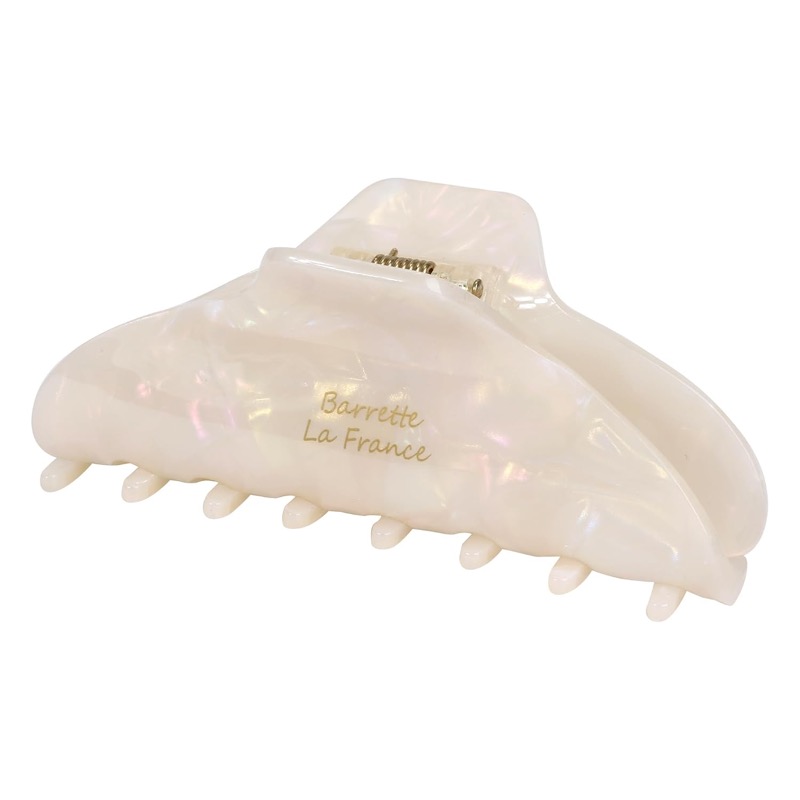
4-inch acetate claw clip for fine and thick hair
Useful as a comparison against the tortoiseshell clip above: same stated length, different tooth geometry and spring. Two clips can both be '4 inch' and behave nothing alike on the same twist.
Weight, balance and sliding
A clip that holds the hair can still slide down the head if the combined weight of hair and clip is not balanced.
- Drop in position. Mark the clip's starting position (a small piece of tape or a photo against a fixed reference) and record how far it moved after an hour of normal activity.
- Side-to-side tilt. A clip that tilts has uneven grip along its length, or the bundle is not centred.
- Pivot point. Heavy hair pulls the clip downward and outward. Check whether the hinge sits above the bundle's weight, or whether the weight acts to open the jaws.
- Clip weight. A heavy clip adds load of its own. One acetate brand says its material is denser than ABS and that this helps the clip stay anchored — a seller claim, and an equally plausible effect is that extra mass drags on a heavy bundle. Test it rather than assuming either way.
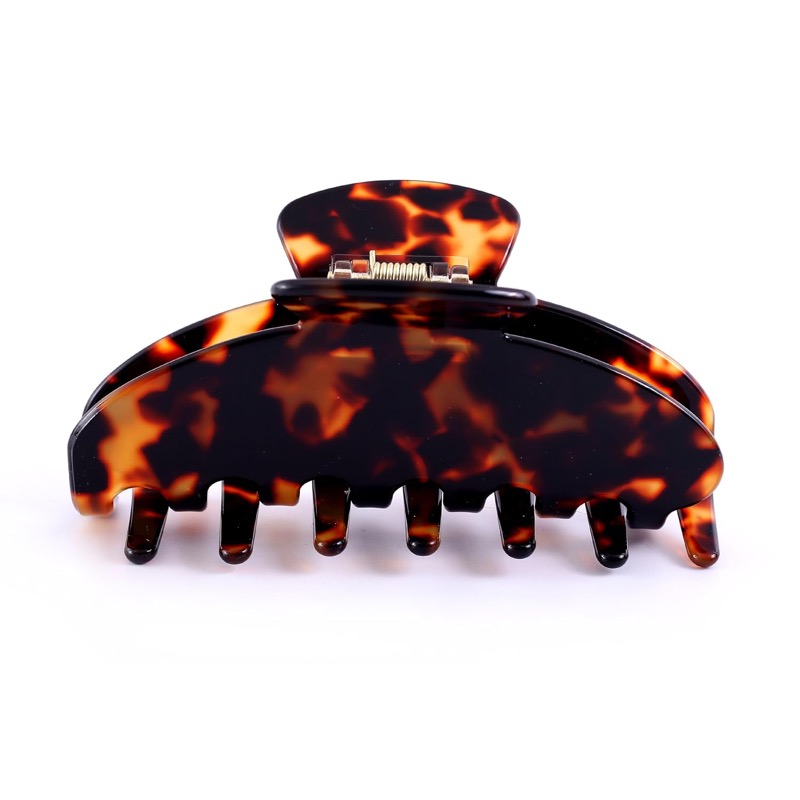
Large tortoiseshell acetate claw clip, 4 inch
A retail example of the size class this guide is about, with a stated 4 × 2 × 2 inches and 1.45 ounces. Those are the clip's outside dimensions — they say nothing about maximum opening or basket depth, which is the point.
Keeping a clean record
The numbers only help if you can find them again. For every trial, write down the clip's identifier, the date, the volunteer, the hair facts, the style, the bundle width and thickness, the result of each slip-test step, and a comfort note. Keep photographs in a folder named for the clip and the date. When a revised sample arrives, run the same volunteers through the same sequence and compare against the earlier results rather than starting fresh impressions.
It is also worth writing down what you did not test. If your volunteers all had straight hair, say so. If nobody tried a wet-hair session, say so. That list tells you which claims you cannot yet make, and stops a good result with five volunteers from quietly becoming "works for everyone".
Pass, revise and fail: decide first
Write the decision rules before the samples arrive. This table is a template.
| Area | Pass | Revise | Fail |
|---|---|---|---|
| Dimensions | Length, maximum opening, basket depth and tooth pattern supplied and confirmed by measurement | One value unclear | Supplier cannot say |
| Insertion | Largest volunteer bundle goes in without forcing the jaws | Fits but needs effort | Will not close, or needs the hair compressed hard |
| Closed margin | Jaws close with visible spring reserve on the largest bundle | Closes at the limit of travel | Teeth do not meet |
| Slip, rest hour | No readjustment on most volunteers | One readjustment for some | Slides or tilts on most |
| Tilt | Stays level | Slight tilt that corrects with one tug | Persistent tilt |
| Comfort | No pulling or pressure complaints | Mild complaints from some | Pulling complaints from most |
| Release | Hair releases cleanly | Occasional snag | Frequent snagging or trapped strands |
| Teeth | Smooth, aligned and sound under light pressure | Minor rough spots, fixable | Cracked or loose teeth |
| Documentation | Material and dimensions confirmed in writing | Pending | None |
A single volunteer is not enough to pass a clip, and a failure on one tester is worth recording but not necessarily a verdict. If the same failure shows on three or more people, the clip does not suit that hair type.
Building a size range for a brand
- Group volunteers by bundle size. If measurements cluster into two or three groups, those are your sizes. If they spread evenly, define the product around the largest bundle you will support.
- Do not label by adjective alone. "Large" and "jumbo" mean nothing across brands. Label by measured length and maximum opening, and say what you tested ("held a twist of up to a stated width on volunteers with thick, long hair").
- Offer a way to choose. A short instruction telling the buyer to measure their twisted bundle and compare it with the stated opening prevents more returns than another adjective.
- Be honest about what does not fit. If your largest clip does not reliably hold the heaviest hair, say what it is designed for. A clear limit builds more trust than "fits all hair".
The supplier brief
- Product definition: clip style, overall length, maximum opening, basket depth, tooth pattern and tooth count, hair types it must hold, with your measured bundle sizes attached.
- Materials: body material, spring material and type, pivot construction.
- Tolerances: the variation in length and opening you will accept between units.
- Samples: at least three units of the final construction per size, so you see variation and not one lucky piece.
- Documentation: material statement and any compliance statements relevant to your market, in writing.
- Change control: a commitment to tell you before changing the mould, material or spring.
If you source through a trade platform, keep answers in the platform's messages. When a reply says "large size, suitable for thick hair", ask for the numbers: "what is the maximum opening, and how deep is the basket?"
What your listing can say
- Give measured dimensions: overall length, maximum opening and basket depth.
- Describe what you tested in plain terms: "tested on five volunteers with thick hair in a twist and a half-up style".
- Avoid "fits all hair types" and "holds any amount of hair".
- Avoid claims about preventing damage, breakage or hair loss.
- If you say "acetate", be able to show the supplier's material statement.
- Give a simple way to size: how to measure a bundle and compare it with the stated opening.
Frequently asked questions
What size claw clip do I need for thick hair? There is no single answer, because published guides measure different things and define thick hair differently. Measure your twisted bundle, compare it with a clip's maximum opening and basket depth, and choose one that closes with a margin rather than at its limit.
Is a longer clip always better? No. Length spreads the hold along a wide bundle, but a long clip with shallow teeth or a weak spring can still slide. Teeth, opening and balance matter as much as length.
Why does my clip slide down by midday? Usually a mismatch between bundle and clip, uneven grip along the length, or a clip too heavy for its spring. Check whether it closes with room to spare and whether the teeth engage the hair.
Are acetate clips better for thick hair? Sellers say so and market them that way. We did not find independent testing comparing claw clips by material, so ask for the material in writing and run the same size and slip tests on any clip you consider.
Can a claw clip damage hair? Any hairstyle that pulls tightly can contribute to traction alopecia over time, per dermatology guidance, and discomfort is a sign a style is too tight. We have no data on claw clips specifically. If a style hurts, loosen it, and see a dermatologist if you notice thinning or scalp soreness.
How many samples should I test? At least three units per size to see unit-to-unit variation, and at least five volunteers with different thick-hair types.
Should I test with wet or product-treated hair? If customers will use the clip on damp or styled hair, include at least one session that way and record it separately. Do not combine it with dry-hair results.
Does a double row of teeth help? Sellers say so. Test it on your own volunteers, since the benefit depends on whether the second row actually meets the hair.