A makeup brush set is one of the most crowded corners of any beauty marketplace: twelve, eighteen or twenty-four brushes in a roll-up case, in rose gold or black, at a price that makes the arithmetic look impossible. The listings use a handful of phrases again and again: "Vegan." "Cruelty-free." "Premium synthetic Taklon." "Real goat hair." "Soft as silk." "No shedding." "Professional quality." Each is a material or construction claim, and each can be checked with tweezers, a tub of warm water and a pull gauge.
That matters because the failures are visible and, in one case, a health issue. A brush that sheds bristles into foundation or, worse, near the eye gets a one-star review within a week. A handle coating that peels in the wash looks cheap after one use. A set sold as vegan that turns out to mix animal and synthetic fibres draws a different kind of complaint, because it touches a belief the customer holds. And brushes that are never cleaned are a hygiene problem in their own right, which dermatology sources take seriously enough to publish cleaning schedules.
This guide separates the claims that can be tested from the ones that depend on paperwork, explains how brushes are built and where they fail, summarises what dermatology sources say about keeping brushes clean, and sets out a repeatable fibre, pull, wash and handle test. It recommends no product and makes no promise about anyone's skin. For the sponge side of the kit, see the sponge case ventilation test.
How a brush is built, and where it fails
Makeup artists' guides describe the same three parts. The bristles are the working end: the toe is at the tip, the heel is the end held in the ferrule. The ferrule is the metal band — usually nickel-plated brass or aluminium, less often plastic — that holds the bristles together and attaches them to the handle. Bristles are held by the top of the ferrule, sometimes pinched flat, and by a generous amount of glue. The handle may be wood, plastic or metal, with a paint, lacquer or rubberised coating.
Beauty-trade writers agree on where brushes fail. One brush-care guide says the most delicate parts are the bristles and the area just under the heel where the glue sits, and that excessive pressure either breaks bristles or weakens the glue, after which the brush sheds. A buying guide says that if the glue loosens or the ferrule is not crimped tightly enough, a brush quickly becomes unusable, and that a double-crimped ferrule helps bristles stay attached through regular cleaning. A reviewer roundup notes users of one natural-hair set reported shedding after several washes and suggested the ferrule crimping could be tighter. Another cleaning guide advises against soaking the ferrule so the glue does not break down.
Put those together and you have the shedding story. Shedding comes from three places: loose fibres left from manufacturing, bristles that break from rough handling or wear, and bristles that pull out because glue or crimp failed. Only the third is a construction defect, and it is the one a pull test catches. The first is quality control, the second durability. "No shedding" is not a property; it is a result, and it has to be measured.
Natural, synthetic and what the words mean
Natural brushes use animal hair. Industry guides name sable (often weasel), squirrel, goat, pony (horse), badger and others, and note that "camel hair" brushes are usually not camel hair but a blend of horse, goat, squirrel and other hairs, chosen for softness and cost. Natural hair has a cuticle structure that retail guides say helps it pick up and distribute powder, which is why it is used for blush, bronzer and powder. Synthetic brushes use man-made fibres such as nylon, polyester or "Taklon". Guides describe synthetics as non-porous, less absorbent of liquids and creams, and therefore suited to foundation and concealer. Some pro-grade sets blend natural hair with a small share of synthetic fibre to firm the brush and reduce shedding, according to one review site.
Three cautions apply to the vocabulary.
"Taklon" is a trade term, not a polymer. Sellers use it for synthetic fibre, and we found it described as premium in brand copy. It does not tell you the polymer, the filament diameter or whether tips are tapered. Ask for the polymer by name and a laboratory identification report.
"Real goat hair" can hide a blend. A set labelled "natural goat hair" may include other hairs, dyed hair or synthetic fibre. Hair names are used loosely in the trade ("sable", for example). If you claim a species, ask for the species in writing and have the fibre identified by a laboratory.
Softness is not specified. Soft is a feel. Filament diameter, taper and tip shape decide it, and they can be measured. "Soft as silk" tells you nothing a customer can check.
What "vegan" and "cruelty-free" do and do not mean
These two terms carry the highest risk because customers treat them as values claims.
A skincare writer notes "cruelty-free" and "vegan" are not legally defined or regulated by a distinct body nationally or internationally, not even by the US Food and Drug Administration. A beauty-trade article on the subject quotes a lawyer saying misleading vegan claims could expose a brand to consumer claims and possibly action by the Federal Trade Commission under its general rules on deceptive advertising, and notes an FTC representative saying vegan claims have traditionally been handled by the FDA. Read those as signs of a grey area, not a statement of law, and ask your own adviser.
The terms mean different things. Cruelty-free is generally taken to mean no animal testing. Vegan means no animal-derived materials. A consumer organisation's cosmetics check found a product with a PETA (Beauty Without Bunnies) certification that confirmed it was not tested on animals but did not establish it was vegan — and a vegan claim with no certification behind it. The Leaping Bunny programme, run with Cruelty Free International, certifies companies rather than individual products, according to a cosmetics trade article, and requires supplier declarations and audits. A comparison article says PETA's programme relies more on brand self-declaration. These come from advocacy and trade sources, but they agree that the logo you show tells customers something specific, and a logo you do not hold tells them something false.
For a brush set the questions are practical. Is every fibre synthetic? What is in the adhesive? Is there leather, suede or animal-derived material in the roll-up case, trim or dyes? Does the supplier use any animal-derived finishing material? Does the brand hold a certification, and does it cover your product or only the brand? Some brush brands say plainly their brushes use a custom blend of synthetic and vegan fibres with FSC-certified wood handles. That is a brand statement, but it shows the level of detail customers expect. If you cannot answer every question, do not use the word vegan. "Synthetic fibres" is a statement you can prove.
What dermatology sources say about brush hygiene
Cleaning is half of what makes a brush last and a large part of why customers care. Cleveland Clinic's dermatologist guidance gives a schedule: brushes used with wet products such as foundation and concealer about weekly, most brushes used for dry products such as powder and blush about monthly, and any brush used around the eyes about every two weeks. It describes warm water, a drop of mild soap, rinsing until clean and leaving the brush to dry overnight, and says to call a doctor about a very red eye, drainage or pain after applying makeup. Other dermatologists quoted in consumer articles recommend weekly washing if you use heavy makeup daily, or every two weeks for light makeup, and warn that dirty brushes near the eye can pass on infections.
You will also find headlines saying makeup brushes hold more bacteria than a toilet seat. Those come from small swab surveys run by cosmetic and clinic brands, described in press coverage, without peer-reviewed methods we could read. A 2019 paper in the Journal of Applied Microbiology, as summarised in a health article, found beauty blenders to be the most contaminated tools it studied, with many never cleaned. We would not repeat the toilet-seat comparison on a listing, and we would not claim your brushes reduce bacteria. We would say how to clean them and show that your brushes survive the cleaning.
That last point is the product opportunity. A set that loses bristles, flakes paint or swells at the handle after a few washes cannot be cleaned as dermatologists advise. So the wash test below is not a durability extra; it is the test of whether the product can be used the way the health guidance assumes.
Seven terms the listing uses loosely
- Professional. No standard. Treat it as decoration.
- Premium synthetic. A description of price positioning. Ask for polymer, filament diameter and tip treatment.
- Non-shedding. Test it.
- Antibacterial. Some listings say bristles or handle are antibacterial. We found no independent test behind such wording. Leave it out unless you have a laboratory report with method and organisms, and check how your market regulates such claims.
- Hypoallergenic. Applied to fibres, but with no agreed definition. Do not use it without evidence. Ferrules are commonly nickel-plated brass according to trade guides, and nickel is a known contact allergen, so ask what the plating is and whether it is nickel-free before writing anything about allergies. We did not research regulatory limits.
- Eco-friendly / bamboo. A bamboo handle is a handle. Ask what coating it has and what the glue is.
- Set of 24. Count the pieces. A listing may count the case, the sponge, the cleaning pad or duplicate sizes.
What goes wrong with these products
- Shedding. Loose fibres on arrival; bristles that pull out in use or wash.
- Ferrule loosening. The ferrule twists or slides on the handle, or the crimp opens, so the head wobbles.
- Glue failure. Water or soap weakens adhesive at the heel and the head separates.
- Splayed or lost shape. Bristles fan out after a wash and do not recover.
- Dye bleed. Coloured fibres or handles that stain water, hand or a white cloth.
- Handle coating problems. Paint or rubberised coating that peels, goes tacky or flakes.
- Odour. A chemical smell from glue or lacquer when new, which may fade or may not.
- Mislabelled fibre or count. Natural hair in a "vegan" set, a different species from the one claimed, or fewer brushes than listed.
The sample test: ten steps in an afternoon
These are our own screening procedures, not a standard. They compare samples, check the claims you plan to make and fail weak items early. Use at least three sets per model from different cartons, and test several brushes from each set, including the smallest and largest. Record room temperature and photograph every defect against a ruler.
1. Count, sizes and labelling. Count pieces and compare with the listing. Measure overall length, head width and bristle length of each brush. Check that markings or labels on the case match the contents. Weigh each brush; weight differences within a style point to batch or construction variation.
2. Fibre identification. Ask the supplier to name the fibre for each brush, and for natural hair the species. Look at fibre samples under a microscope: animal hair shows a scale pattern on the surface, synthetic fibres are smooth and uniform. That catches an obvious mismatch, such as a "vegan" set with natural hair. For any species claim, or a claim that a set contains no animal fibre, commission a laboratory identification. Do not rely on burn tests or feel.
3. Bristle size, shape and tip. Measure filaments for diameter if you can, or ask for diameter and taper. Inspect tips under a loupe: tapered tips, blunt cut ends and bent filaments all matter. Run the brush across the back of your hand and across a cotton pad and note scratchiness and loose fibres.
4. Dry shedding test. Count loose fibres on arrival by tapping each head over white paper and sweeping the back of your hand ten times. Then run each brush through a standard motion on a clean cotton pad or nylon stocking 50 times and count fibres on the pad and paper. Record numbers per brush. A few stray fibres on a new brush are expected; consistent loss is not. A brand selling on "no shedding" should know its own count.
5. Pull test on the ferrule and heel. Clamp the handle and pull the head, or pull a pinch of bristles in a standard way, with a spring gauge or luggage scale. Record the force at which bristles come out or the ferrule moves. Twist the ferrule on the handle and note any slip — a head that can be rotated by hand will wobble in use. Check the crimp, looking for a single pinch or a double crimp. Cut open one spare brush per batch to examine the glue plug and bristle bundle.
6. Wash test. Wash as dermatologist guidance describes: rinse the tip under warm water, work mild soap through the bristles, rinse until clear, lay it to dry. Do not soak the ferrule. Repeat 20 times, and after every fifth wash re-run the shedding and pull tests. Record fibres lost, any change in shape and any looseness at the ferrule. Photograph brushes against a white background after the first, tenth and twentieth wash.
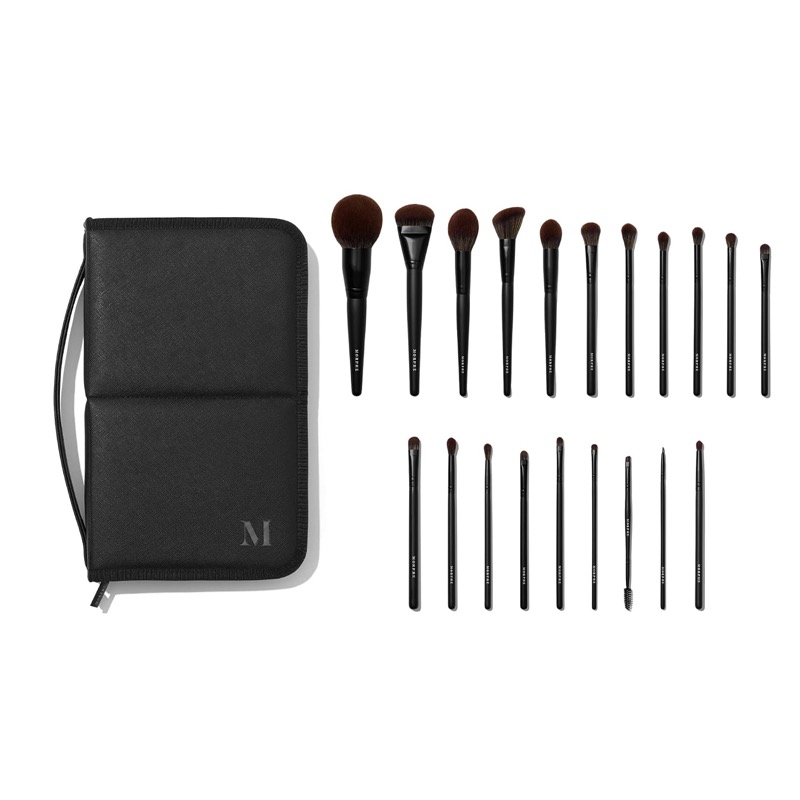
Twenty-piece makeup brush set with case
A retail example of the format, and of the claim stack this guide examines: synthetic bristles, a count in the title, a carrying case. The count and the fibre are checkable; 'no shedding' is not, which is why the wash test exists.
7. Dye and odour. Rub wet bristles over a white cotton pad and a white towel, and check wash water for colour. Smell each brush when new, after 24 hours in a sealed bag, and after drying from the first wash. A glue or lacquer smell that remains is a reason to reject a batch. Do the same with the case and any sponge or cleaning pad in the set.
8. Handle and coating. Rub the handle with a damp pad and with a pad wetted with alcohol-based sanitiser, which customers do use, and look for coating transfer or dulling. Scratch lightly with a fingernail and check adhesion. Soak the handle end (not the ferrule) in warm water for ten minutes, dry it and check for swelling or cracking, especially with wood. Drop each brush from counter height onto a hard floor three times and inspect.
9. Pickup and application. Compare brushes for the job they are named for. For a powder brush, tap it in loose powder and weigh the product picked up; for a foundation brush, compare liquid take-up. Apply to a flat surface or a volunteer's hand and compare streaking. This is a bench comparison only: it lets you say a brush picks up less liquid than another, not that it gives a better finish.
10. Volunteer panel. Recruit at least eight adults across skin types with no active skin conditions around eyes or face, and give each a kit and a protocol: use for a week, wash once, report comfort, scratchiness, shedding on skin, smell and any irritation. Remind them of the eye advice: a very red eye, drainage or pain after using makeup is a reason to stop and see a doctor, and treat such a report as a serious complaint. This is not a clinical study and cannot show any skin benefit.
Reading the results: pass, revise or fail
| Result | Pass | Revise | Fail |
|---|---|---|---|
| Count and labelling | Matches the listing exactly | Count includes accessories; change the title | Fewer brushes than listed or mislabelled sizes |
| Fibre identification | Fibre named, report in hand, matches the claim | Fibre named but no report; hold the claim | Natural hair in a "vegan" set, or species not as claimed |
| Tip and softness | Even taper, no scratchiness | Slightly stiff on one style; re-spec | Scratchy tips or broken filaments |
| Dry shedding | Few loose fibres, no ongoing loss | Fibres on arrival but none after first wash | Continuing loss in the 50-stroke test |
| Pull and ferrule | Bristles hold at the force you set; ferrule does not slip | Single crimp with tight glue; request double crimp | Ferrule twists or bristles pull out easily |
| Wash test | Little loss and no loosening after 20 washes | Slight splay that recovers | Heads loosen, bristles fall out or shape is lost |
| Dye and odour | No colour in water or on pad, no lingering smell | Mild smell that fades after washing | Dye transfer or persistent smell |
| Handle | Coating adheres, no swelling | Minor dulling with sanitiser; add a care note | Peeling, tackiness or swelling |
| Volunteer panel | Comfortable, no irritation | Complaints fixed by instructions | Irritation, eye problems or scratching |
Treat a failure on fibre identification, pull or wash as a stop. Treat the rest as a prompt to change the instructions or the listing.
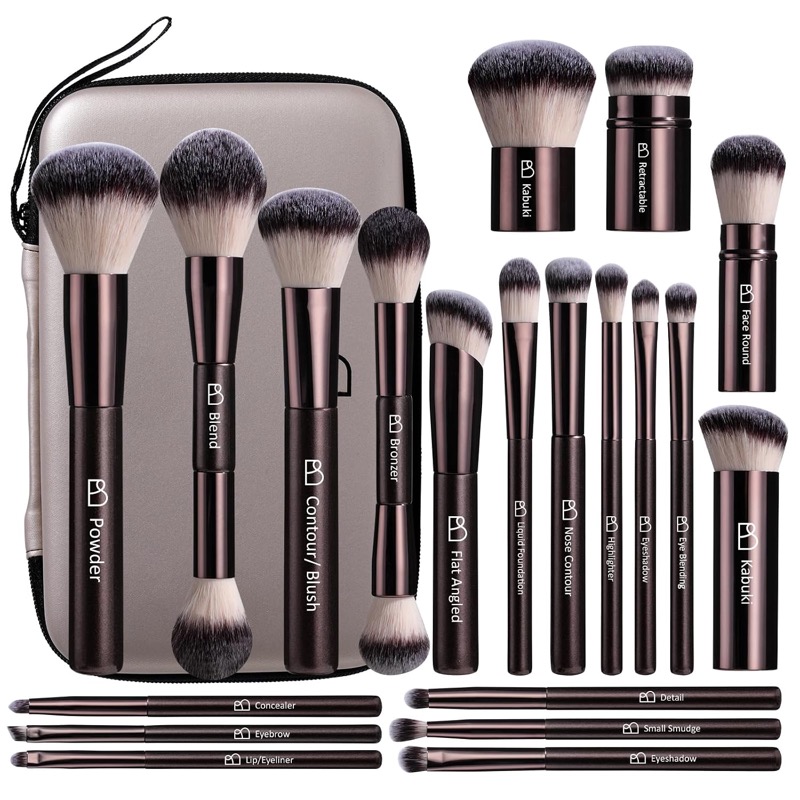
Labelled twenty-piece synthetic brush set
A second set to compare: each brush is labelled for its intended use, which is a construction decision you can verify on the bench — count the labels against the count in the title before you test anything else.
The supplier brief
- The fibre for each brush by polymer or species, filament diameter, taper and lot, with a laboratory identification report.
- A written statement of whether any component contains animal-derived material — adhesives, handle coatings, dyes, case trim — and any certification, plus what it covers.
- The ferrule material and plating, whether nickel-free, the crimp style and the adhesive type.
- The handle material, coating, curing process, and the test it passed for adhesion and wash.
- The supplier's own shedding and pull-out data, with method, force and sample size.
- Colourfastness data for dyed fibres and coloured handles.
- A packing list that counts each brush, case and accessory.
- Care instructions they have tested, including wash method and drying position.
- Minimum order quantity, lead time, sample policy and replacement terms, on the quotation and not in chat.
What your listing can say
- Fibres: "Synthetic fibres (polymer named), laboratory report on request" only if the report exists. For natural hair, name the species as identified.
- Vegan: only if you can state that every material — including adhesive, coatings and case trim — is free of animal-derived ingredients, and say what that is based on. Otherwise say "synthetic bristles".
- Cruelty-free: only if the brand holds a certification you can show, or you can state the policy precisely. Do not use a logo you do not hold, and do not imply a company certification covers materials it does not.
- Construction: "Double-crimped ferrule, bristles tested to a pull force of your measured value", with your numbers.
- Shedding: "Expect a few loose fibres on first use. Tested through 20 washes with the results you recorded." Do not say "no shedding".
- Care: the wash method you tested, a note not to soak the ferrule, and to dry brushes flat or head-down.
- Hygiene: "Wash brushes used with liquid products weekly and brushes used around the eyes every two weeks", consistent with the dermatologist schedule. Do not claim your brushes reduce bacteria.
Avoid "no shedding", "hypoallergenic", "antibacterial", "dermatologist tested" and "professional" unless you have evidence for each.
Frequently asked questions
Is synthetic always vegan? Not necessarily. The fibres may be synthetic but the adhesive, handle coating, dyes or case trim might not be. Ask about each, or limit the claim to "synthetic bristles".
Is cruelty-free the same as vegan? No. One refers to animal testing, the other to animal-derived materials. A consumer organisation found a certification confirming no animal testing did not establish a product was vegan.
Do natural-hair brushes pick up more powder? Retail guides say the cuticle of natural hair helps with powder and that synthetic fibres suit liquids and creams. These are widely repeated statements; test your own brushes if you want to claim a difference.
How often should brushes be washed? Cleveland Clinic's dermatologist guidance gives about weekly for wet-product brushes, monthly for dry-product brushes and every two weeks for eye brushes. Customers who wear heavy makeup daily may need to wash more often.
Are dirty brushes really worse than a toilet seat? That claim comes from small swab surveys by cosmetic and clinic brands, reported in the press. We could not read a peer-reviewed method, and we would not repeat it.
Can I say the set is hypoallergenic? We would not. Trade guides say ferrules are commonly nickel-plated brass, and nickel is a known contact allergen. Ask about plating, test with volunteers, and claim only what you can show.
What if a customer reports an eye problem? Cleveland Clinic advises calling a doctor about a very red eye, drainage or pain after applying makeup. Ask the customer to stop using the product, and record the batch and the product used.
How many washes should a set survive? We found no standard. Pick a number from your wash test, such as 20, and state it.