A hair towel wrap looks like the easiest product in the category: a rectangle of fabric with a loop or a button, sold to people tired of balancing a wet bath towel on their head. The listings, though, carry some of the boldest claims in personal care. "Dries hair up to 50 per cent faster." "Reduces frizz and breakage." "Gentler than cotton." "Cuts blow-drying time." Each sounds measurable, and almost none comes with a method.
That gap matters twice. A seller who repeats a supplier's claim without testing it is exposed if a customer or regulator asks for evidence. And a buyer who picks a wrap on the strength of a claim may end up with a heavy, slow-drying turban that slips off, pulls at the hairline or leaves lint in clean hair.
This guide is for small brands about to approve a hair towel wrap, and for buyers who want to know what the listing really says. It separates what independent guidance supports from what is marketing, explains the fabric terms, and sets out a repeatable absorbency, wet-weight, fit and lint test. It recommends no product and makes no promise about anyone's hair health.
What is actually supported, and what is not
Start with the one thing independent guidance does say. The American Academy of Dermatology's tips for healthy hair advise wrapping hair in a towel or a t-shirt to gently absorb moisture, because roughly rubbing hair dry can cause damage. Other mainstream hair-care guidance says the same in different words: wet hair is fragile, so blot and squeeze rather than rub.
Notice what that advice does not say. It does not say microfibre beats cotton. It names a towel or a t-shirt — a plain cotton jersey — and puts the weight on behaviour: gentle absorption, no rough rubbing. The damage mechanism described is the rubbing.
Now the claims on the other side. Many hair-towel brands and retailers say a regular cotton bath towel has thick looped fibres that rough up the hair's outer layer and cause frizz and breakage, and that microfibre is smooth and avoids this. Some say microfibre dries hair up to 50 per cent faster than a cotton towel. A few describe microfibre as finer than a single denier, or "one hundred times thinner than a human hair". These circulate widely on brand pages, retailer pages and beauty editorials. What we did not find, in sources we could reach, was an independent controlled study comparing microfibre and cotton towels for hair breakage, or a test method behind the 50 per cent figure.
That does not make the claims false. A looped terry towel is a plausible source of friction, and a thin dense fabric may hold less water against the hair than a thick one. It means a seller should treat them as hypotheses about their own product. The rest of this guide is about turning them into something you can show.
Four terms the listing uses loosely
Microfibre. Very fine synthetic fibres, usually polyester or a polyester-polyamide blend. It is a fibre description, not a performance guarantee, and says nothing about the weave. One brand describes its wrap as a polyester and polyamide blend; others give no composition at all.
Terry. A fabric with loops of yarn standing up from a flat base. Cotton bath towels are terry. A microfibre towel can also be terry, which is one reason the "microfibre versus cotton" framing misleads: a looped microfibre towel and a flat-knit cotton jersey can behave the opposite way from what the labels suggest.
GSM. Grams per square metre — the weight of one square metre. Towel suppliers describe it as density, and say that for looped fabrics a higher GSM generally means more fibre and more absorbency. They also say, correctly, that GSM measures weight and density, not fibre quality, loop construction or finishing. For a hair wrap it cuts both ways: a heavier fabric may hold more water but is heavier on the head and slower to dry. One supplier guide cautions that extremely heavy microfibre towels take a long time to dry and can lead to mildew.
"Absorbent". An unmeasured adjective. It can describe how fast a droplet sinks in, how much water the fabric holds when soaked, how much it takes from hair in use, or simply how it feels. Those are different properties, and a fabric can do well on one and badly on another.
For each sample, write down the fibre content with percentages, the construction (loop, flat knit, waffle), the GSM (ask the supplier, then weigh a cutting yourself) and the finished size. If a supplier cannot say whether the surface is looped or flat, you cannot compare two wraps.
Why the "50 per cent faster" claim needs a method
Claims of the form "dries hair X per cent faster" are comparisons, and a comparison needs three things: what was compared, how it was measured, and on what hair. We could not find these behind the figures we saw. That does not stop a seller making their own comparison, which is the better course.
The honest version is narrow. For example: "In our test with six volunteers with shoulder-length hair, hair wrapped for ten minutes was lighter by an average of X grams than hair wrapped in a standard cotton bath towel." That sentence contains a duration, a group, a measurement and a comparator. It also invites the reader to ask whether their hair is like your volunteers' — exactly the right question.
What standard absorbency tests measure
Textile laboratories have several established ways of measuring absorbency, and knowing the main ones helps when a supplier sends a report.
- AATCC Test Method 79 measures the time for a water droplet to be absorbed by a fabric — a drop-penetration (sinking time) test applicable to yarns, fabrics and garments of any fibre content or construction. Test-equipment commentary describes it as a screening and trend-control method rather than a predictor of comfort in wear.
- ASTM D4772 measures how much water a specimen absorbs when held in a hoop at an angle while water flows over it — a surface wetting method. A patent filing describing towel fabric cites it alongside AATCC 79.
- Soaking methods immerse a sample, let it drip, weigh it, and express the result as a percentage of dry weight.
- Chinese national towel standards (GB/T 22799) describe a sinking test in which small cuttings are dropped onto water and timed until fully wetted, with a sixty-second cut-off, plus an absorption-rate method on a dedicated tester.
The point is that "absorbent" has at least three quantifiable meanings: how fast the surface takes a drop, how much the fabric holds, and how much it takes from a surface in realistic use. A report that says "absorbency: pass" without naming the method is not useful. Ask for the method, specimen size, water temperature and the result in numbers.
An in-house absorbency and wet-weight test
This is a proposed screening test for comparing candidate wraps with each other and with a reference. It is not a standard and does not replace a laboratory report. Use a cotton bath towel and, if you can, a plain cotton t-shirt as references, because the dermatology guidance names both.
Step one: drop test. Place a clean dry cutting flat over the rim of a beaker or cup. Release a single drop of room-temperature water from a fixed height onto the surface and time how long it takes to lose its shine. Repeat at five points on each fabric and record the average. This is a simple version of the sinking-time idea behind the standard methods, and it compares fabrics with each other under the same conditions.
Step two: holding capacity. Weigh a dry cutting, soak it for a fixed time, let it drip for a fixed time, weigh again. Express the gain as a multiple of dry weight. Do the same on a full wrap if you can.
Step three: wet weight on a head. This is the one that matters to a customer. Each volunteer washes their hair, squeezes out the excess the same way, and puts on the wrap as they normally would. Weigh the wrap before it goes on and again after a fixed interval, such as ten minutes. The difference is the water it removed in that time. Repeat with each wrap and the reference towel in randomised order, on different days, so the hair is in the same state each time.
Step four: dryness check. After the same interval, ask the volunteer to rate how damp the hair feels on a scale you define in advance, and photograph it. This is subjective and should be reported as such.
Record everything: hair length, thickness, density as the volunteer describes it, whether conditioner or a leave-in was used, room temperature and time of day. If your volunteers' hair is all similar, say so, because the result will not carry across.
What you can then say is limited and true. "In our test, the wrap removed more water than the cotton towel in ten minutes on four of five volunteers" is a statement about your test. Whether the hair is healthier is a different question this test cannot answer.
The friction question: what you can and cannot measure
A seller can run two simple checks, and neither proves anything about breakage.
- Hand feel. Volunteers run a hand through a lock of damp hair wrapped in each fabric and rate how much it drags. Subjective, and one way to catch a rough or stiff finish.
- Surface inspection. Look at the fabric under a magnifier or a macro photograph. A tightly knitted surface and a looped surface present very different contact to a hair strand, and a photo of each is a fair way to show customers what you mean.
What a bench check cannot do is show that a fabric prevents breakage. Breakage depends on how a person handles their hair, the condition of the hair and many other factors, and "reduces breakage" is an outcome claim needing real evidence. The safer wording is about design: "smooth, tightly knit surface", "designed to be used by blotting, not rubbing", plus a description of what you tested.
It also helps to repeat the advice the dermatology guidance emphasises. A wrap is a tool for gentle absorption. Include a short note telling customers to squeeze and blot rather than rub. That is consistent with independent guidance, and protects your claim better than a promise about the fabric.
Fit, weight and tension
A hair towel wrap fails in ways a flat towel does not: it slides off, feels heavy, pulls at the hairline, or will not close over a large volume of hair. These are fit problems, and you can test them.
The load. Hair volume is the main variable. Long, thick or curly hair needs a larger wrap or a different shape, and a wrap that works for chin-length hair may not close around a thick braid or twist. For a wrap, measure the hair gathered on top of the head and the distance around it, and compare that with the wrap's usable length and width. The same bundle-versus-capacity logic applies to claw clip sizing for thick hair and to heatless curlers on long hair.
The closure. Each type has its own failure mode:
- Button and loop. Secure when it fits, but the loop can stretch, the button can pull off, and the button position decides whether the wrap fits a small or large head.
- Elastic band. Flexible, but a tight band leaves marks and a worn one lets the wrap slip. Composition matters, including whether it contains latex — the same question as for sleep eye mask straps.
- Twist and tuck. No hardware, so nothing to break, but it stays on only if the fabric grips itself. A slippery finish will not.
- Clip or snap. Quick to use; check for sharp edges and hair catching.
Test the closure the way a customer uses it: wet hair, a bent head, a quick walk across the room, reaching for something on a shelf. Record whether the wrap shifts, slides or comes undone, and how many volunteers had to readjust.
Weight and the hairline. A wet wrap adds weight, and that weight hangs from the scalp and hairline. The American Academy of Dermatology warns that tight hairstyles can lead to traction alopecia, hair loss caused by repeated pulling, with a simple rule: if a style is painful, it is too tight. The AAD also notes that constant rubbing of a hat, head scarf or other covering can contribute, especially if hair is pulled back tightly beforehand. A towel wrap worn briefly after a shower is a different situation from a hairstyle worn for months, and we are not aware of research on wraps specifically. The principle still applies to design: a wrap should hold hair without needing to be pulled tight, and without a closure that digs in.
For a sample test:
- Weigh the wrap wet. Use the wet-weight figure from the absorbency test. A wrap that weighs a lot once it has done its job will feel heavy.
- Ask about pulling. After ten minutes, ask where, if anywhere, each volunteer feels pulling or pressure.
- Look at the marks. Check forehead, temples and behind the ears after the wrap comes off.
- Do not engineer for tightness. If the only way a sample stays on is by tightening the closure, it is a poor fit, not a secure one.
Avoid wording suggesting a wrap prevents hair loss or promotes growth. Those are health claims a sample test cannot support.
Washing and absorbency over time
A wrap that absorbs well on day one and badly after a month is a poor product, and the usual culprit is care. Towel suppliers say fabric conditioner coats the fibres and reduces absorbency, that overloading the machine can leave detergent in the pile, and that heavy towels need room to wash. Those are supplier statements, not tests of hair wraps, but they point to what to check.
- Wash as the label will say. The temperature and cycle you plan to print, in the same machine and detergent for every sample.
- Test absorbency at intervals. Repeat the drop test and holding-capacity test after the first wash, then after five, ten and twenty.
- Check the structure. Measure shrinkage in both directions, check the closure for wear, look for pilling, fraying and colour loss.
- Run one cycle with fabric softener if customers are likely to use it, and see what it does to the drop test. If the result is poor, say so in the care instructions.
- Dry as the label will say. Check how long the wrap takes to dry fully the way you recommend. A wrap that stays damp is more likely to smell, and the drying method is part of the care label.
Do not put a wash-life number on the listing unless you tested it, and the same applies to any hygiene claim. A home wash test is not a microbiological test.
Lint, shedding and what comes off in the wash
Hair towels shed two ways: lint onto hair and face in use, and fibres into the wash.
Lint in use. Run a new wrap over a black glossy card, dry then damp, and photograph in raking light. Compare with the wrap after one wash and after five, since many fabrics shed most in the first wash. The lint-free nail wipe test and the reusable makeup pad guide use the same approach for their products.
Fibre release in the wash. A 2021 PLOS ONE study tested 37 consumer textiles over five domestic wash cycles and found a very wide range. Polyester fleeces and jerseys released several times more than woven nylon, shedding rose with fabric thickness for nylon and polyester, and cotton and wool also shed large amounts. It concerned apparel, not hair wraps, so it gives no numbers for your product. What it supports is a rule for claims: do not call a microfibre wrap "plastic-free", and do not call a cotton one "shed-free". If a supplier calls the wrap low-shedding, ask what that is based on.
Colour transfer. Rub a white cloth over the wrap, dry and damp, and see whether colour comes off. Dark or bright wraps can stain light hair or a pale bathroom. The rub test in the cosmetic bag lining guide works here too, and ISO 105-X12 and AATCC Test Method 8 apply the same idea in a laboratory.
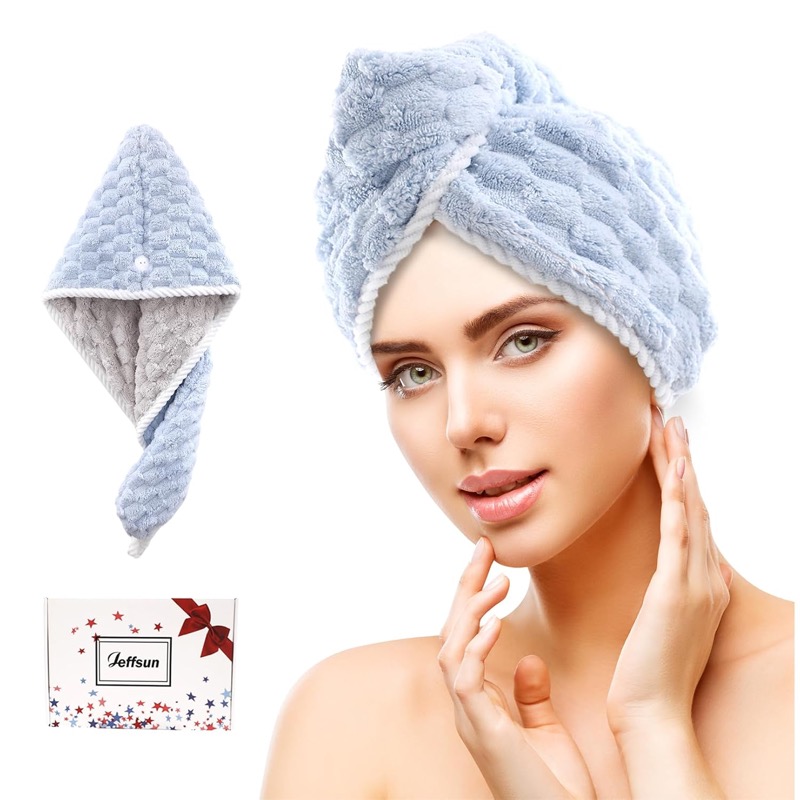
Two-layer reversible microfiber hair turban
A retail example with the closure design this guide asks about: two buttons and a secured loop, so the fit has two positions. Two positions is not a fit range — ask the supplier for the head sizes each button is meant to cover.
Hair types, scalp and the claims to avoid
Listings often say "for all hair types", "for curly hair", "gentle on sensitive scalps" or "salon-recommended". Each is a claim with a hidden test behind it.
- "All hair types". Your volunteers cannot represent all hair. Say which lengths and volumes you tested.
- "For curly hair". Curly and coily hair has particular handling needs, including how it is wrapped to preserve shape. If you make this claim, include volunteers with curly hair and describe what you did.
- "Sensitive scalp", "hypoallergenic", "dermatologist-approved". Claims about biological response. Do not use them without documentation you understand.
- "Reduces frizz" and "reduces breakage". Outcome claims. We did not find independent evidence supporting them for microfibre specifically.
- "Heatless" and "no heat damage". A wrap that shortens hairdryer time is not a guarantee of no heat damage. Describe what it does.
- "Salon-recommended". Only if you can name who recommended it and when.
If the wrap is designed for children, product-safety rules may be stricter. Ask a compliance specialist before listing.
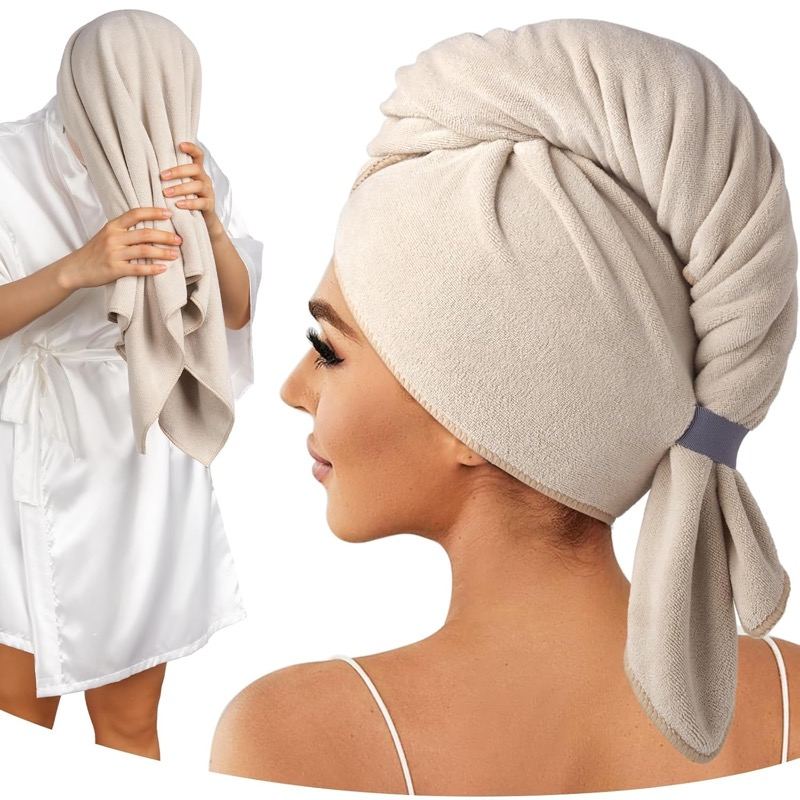
41 × 22 in three-layer microfiber hair towel
A larger wrap with a stated size, which is the number that actually lets you compare capacity. Ask for the usable length and width rather than the flat cut size, and test it against the largest hair in your volunteer group.
Pass, revise and fail: decide the rules first
| Area | Pass | Revise | Fail |
|---|---|---|---|
| Fibre and construction | Fibre percentages, construction and GSM confirmed in writing | One detail unclear | Supplier will not specify |
| Drop test | Time within the range you set, and no worse than the reference | Slower than reference but acceptable | Water beads on the surface |
| Holding capacity | Holds enough for your volunteers' hair | Holds less than expected | Barely absorbs |
| Wet weight on head | Removes more water than the reference in the stated time on most volunteers | Similar to reference | Removes less than the reference |
| Wet wrap weight | Comfortable to wear for ten minutes | Noticeably heavy | Pulls at the hairline |
| Closure | Stays on through the movement test | Needs one readjustment | Slips off or comes undone |
| Pressure and marks | No pulling or marks on most volunteers | Mild marks on some | Marks or complaints on most |
| Capacity | Closes over the largest volunteer's hair | Closes with effort | Does not close |
| Lint | No visible lint after the agreed washes | Fades by the fifth wash | Keeps shedding |
| Colour transfer | None on a dry white cloth | Slight transfer when damp | Visible transfer dry |
| Wash durability | Absorbency, shape and closure intact at the tested count | Slight decline | Marked loss of absorbency or closure failure |
| Documentation | Fibre, care and test statements in writing | Pending | None |
One sample passing is a first step, not a green light. Test at least three units of each wrap and at least five volunteers with different hair lengths and volumes.
The supplier brief
- Product definition: shape, finished size, closure type and position, hair lengths and volumes it must cover, with measured volunteer data attached.
- Materials: fibre content with percentages, construction (flat, loop, waffle), weight in GSM, and the same for the closure elastic or loop.
- Absorbency documentation: test method, specimen size, water temperature and numerical result, with a report from a named laboratory if available.
- Colour fastness: rubbing fastness for the fabric, dry and wet.
- Care instructions: wash temperature and method the supplier has tested, in writing, and whether fabric softener is allowed.
- Closure details: button, loop and elastic specification, with tolerance on position.
- Samples: at least three units of the final construction, plus a loose cutting for destructive tests.
- Change control: a commitment to tell you before changing the fabric, dye or closure.
If you source through a trade platform, keep answers in the platform's messages. If a reply says "super absorbent microfibre", ask again: "what is the fibre content, weight in GSM, and the result of the absorbency test, by which method?"
What your listing can say
- State fibre content with percentages, the construction and the finished size.
- Describe your absorbency test in plain terms: number of volunteers, interval, comparison, and what you measured.
- Say how to use it: blot and squeeze, do not rub.
- Describe the closure and how it fits different head sizes, with the range you tested.
- State the care method and the number of washes you tested through.
- Avoid unmeasured speed claims, outcome claims about frizz and breakage, and any claim about hair loss, growth or scalp health.
- Avoid "plastic-free", "shed-free", "chemical-free" and "all hair types" unless you can support the exact claim.
Frequently asked questions
Is a microfibre towel better for hair than cotton? The guidance we found from dermatology sources is to wrap hair in a towel or t-shirt and avoid rough rubbing. Many brands say microfibre is gentler and faster, but we did not find independent comparisons, so treat those as a seller's view and test your own samples.
Does a hair towel wrap really cut drying time by half? A figure like that is a brand's claim. Ask for the method, the hair and the comparison behind it, or run your own test and report what you measured.
What does GSM mean for a hair towel? The fabric's weight per square metre. Higher GSM usually means more fibre, and often more water held, but also a heavier wrap that dries more slowly. It does not tell you about fibre quality or loop construction.
How long should I leave a wrap on? Online sources give figures from ten to thirty minutes, but we did not find authoritative guidance for a specific time. For a listing, say how you tested and leave the choice to the customer.
Can a wrap cause hair loss? Tight hairstyles and coverings that pull on the hair can contribute to traction alopecia, per dermatology guidance, and a style that hurts is too tight. We are not aware of research on towel wraps. Design the closure so it does not need to be tight, and avoid claims about hair health.
Why does my wrap stop absorbing well? Suppliers say fabric softener coats the fibres and reduces absorbency, and that detergent left in a crowded wash can leave a stiff pile. Test your own fabric with and without softener before you put it in the care instructions.
Should I offer a different wrap for long or thick hair? If your volunteers show one size does not close over the largest hair, yes. Measure the gathered hair, compare it with the wrap's usable dimensions, and state the range on the listing.
Can I say the wrap is eco-friendly? Be careful. Microfibre and cotton both shed fibres in the wash, and broad environmental claims are easily challenged. Describe specific features you can support.