A collapsible silicone container looks like a solved product problem: it folds flat, holds a cup, and can go in a microwave. The part that needs checking is everything the listing does not say — whether the cup actually fits inside without forcing the rim against the wall, whether the lid has a stable partial-open position, and whether the material documents cover the parts that touch hot water.
"Sterilizer" is also a stronger word than most listings can support. Published reviews of cup-cleaning guidance have found that manufacturers use sterilization, disinfection and sanitization loosely, and that the evidence behind many recommendations is thin. A brand repeating a supplier's percentage claim without a method is taking on a risk it cannot defend.
This guide is the sample workflow for the container itself: dimensions, lid behaviour, fold durability, documentation, and the claim you are willing to print.
What the container is and is not
Four products get sold under similar names: a microwave steam container, a rinse or soaking cup, a plain carry case, and a storage pouch. Electric steamers and UV devices are different categories again and should not share a checklist.
Write the intended use in one sentence and name the cup or disc model alongside it. A rinse vessel, a steam container and a travel case need different tests, and a product marketed for both care and travel needs both.
Be careful with storage. Short-term carrying does not establish that an airtight case suits dry storage between cycles; cup makers commonly advise drying the cup fully and using a breathable pouch. If your container is sold for storage, that instruction has to be reconciled with the case design, not ignored.
And do not let the word sterilizer imply a level of microbial control the maker has not demonstrated. Describe the method you actually tested and its limits.
Measure the usable cavity
Listings quote outside height or capacity, which tells a buyer nothing about whether a cup fits. Ask for the inside diameter and the usable depth with the container fully expanded. If the lid projects into the chamber, measure from the base to the lowest obstruction.
Record for each sample: open height, usable depth, narrowest internal width, any marked fill level and the volume it represents, and the folded footprint according to the supplier's collapsing method.
Then test with the actual cup or disc — including the largest model in the bundle or compatibility claim. Place it as directed and close the lid to its stated position without forcing anything. A disc that can be pressed into a cup-shaped chamber is not thereby compatible; check the disc maker's guidance and the container's intended-use statement.
That single test catches most of the fit complaints that reach the customer, and it takes ten minutes.
Use the written procedure, never an improvised one
Do not run an ad-hoc microwave test. First obtain the container's written instructions: allowed microwave conditions, fill level, heating duration, cooling period and warnings. Then confirm that the cup maker permits the proposed method for that cup material.
A heating time quoted for one microwave does not transfer to another. Wattage, water volume, container geometry and local supply differ, and the failure modes are not trivial — unstable containers, sealed lids that should vent, or hot water ejected when the lid is opened too early.
Where a documented procedure exists, have a competent reviewer follow it exactly and record: unit and settings, water amount, starting temperature if relevant, time, lid position, visible steam release, spills, deformation, odour and cooling behaviour.
Stop the test and reject or revise the sample if the container becomes unstable, seals when it should vent, deforms, or ejects hot water. Never put a cup back into personal use after an experimental run.
Cycle the collapsible body
Folding is the feature and also the wear point. Every collapse puts stress on the same walls and creases, and a single open-and-close demonstration says nothing about months of handling.
Photograph the sample fully expanded and fully collapsed. Note whether the walls stand evenly, the base sits flat and the rim stays round. Collapse and reopen it using the supplier's method for a defined number of cycles, chosen from the intended use and written down.
Then inspect for whitening, tackiness, tearing, permanent creases, thin spots, separation at the base, and any change in lid fit. Re-measure open height and the narrowest internal width with the same method, and compare against the approved sample and the agreed tolerance.
A visual check cannot establish silicone grade or temperature resistance. Those need documentation and, where the claim depends on them, laboratory testing.
Also test handling at the marked fill level: lift the container by its intended grip points and set it down. Watch for spills or base buckling. That is a usability check, not proof of leak resistance; if carrying water is an advertised use, ask for a separate method.
Separate cleaning, cooling and storage
Product pages blur three jobs: washing during a period, heating between cycles, and storing the cup when dry. Your instructions should keep them apart.
A steam container can be convenient for a between-cycle method, but it does not replace cleaning as directed, and the word sterilizer does not establish that a cup is safe to handle immediately after heating. Put the cooling warning before the opening step, where the customer will read it.
If the container is also sold for storage, say when it must be dry and whether the storage position allows airflow. Encouraging a damp cup in a sealed case is a customer-service problem you will own.
If the product team wants a microbial-reduction claim, the evidence has to cover the exact container, cup material, load, water volume, temperature profile, exposure time and organisms named. Without that, keep percentages and absolute statements off the page.
Check the lid and the vent position
The lid is a safety feature, not packaging. Many microwave procedures require the lid to sit loosely or partly open so steam can escape, and the instructions usually pair that with a water limit and a heating duration.
So ask: does the lid have a defined operating position? A stop, notch, vent or marked orientation? Can a user tell whether it is open far enough? Does it fall shut when the container is moved?
If the instructions say "do not close fully" and the lid has no stable partial-open position, that is a design defect to resolve before production — not an instruction-writing problem. Customers will close it.
Check the same for any latch or clip: if the design can be closed against instruction, some customers will do it, and the warning needs to be visible on the product, not buried in a leaflet.
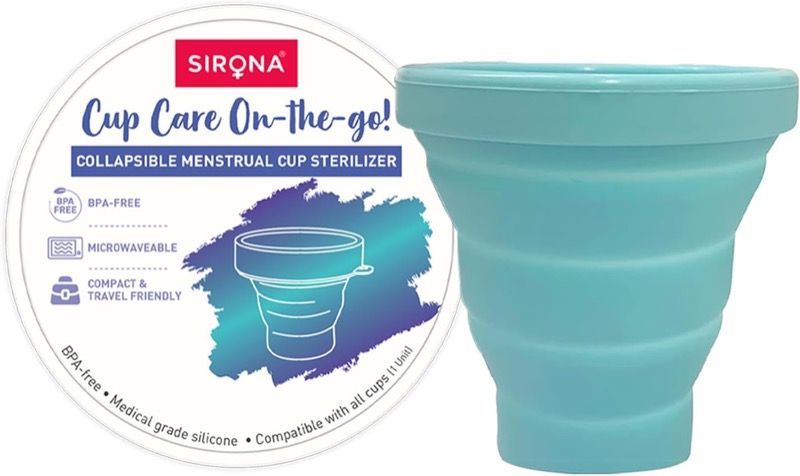
Sirona collapsible menstrual cup sterilizer
A retail example of the format: a ribbed collapsible silicone container sold for cup care between cycles. Check the usable depth, lid position and the conditions in the brand's own instructions rather than the pack claims.
Pack images show the collapsed and expanded states; internal depth and lid behaviour have to be measured on a physical unit.
Ask for documents before repeating a material claim
"Silicone", "food grade" and "medical grade" are not interchangeable proof packages, and a certificate for another item does not cover the product you are buying.
Request the exact material identification with documents that apply to the offered product and colour, the stated operating limits for hot water or microwave use, and confirmation of which parts those limits cover — pigmented body, printed marks, lid, any adhesive.
Ask for a dimensioned drawing with measurement points, material declaration, care instructions, warning text, colour options, packaging specification and written tolerances.
If the supplier says the sample is microwave safe, ask which parts that covers and what lid position, fill amount, time and power conditions the instruction assumes. "Microwave safe" alone tells the customer nothing about how to use it.
The approval sequence, and when to hold
| Step | Record | Hold the order if |
|---|---|---|
| Intended use | Cup or disc model, method, travel or storage | The claim is broader than the test |
| Cavity | Usable depth and narrowest width | The named cup must be forced in |
| Lid | Operating position, vent, stability | No stable partial-open position exists |
| Heat test | Written procedure, settings, observations | Instructions conflict or are absent |
| Fold cycles | Count, method, measurements before and after | It deforms or the lid fit changes |
| Documents | Material, limits, warnings, drawing | The material claim cannot be evidenced |
| Substitutions | Written approval required | A part changes without a new sample |
Do not accept "same as sample" as a production control. Record model, colour, material, drawing revision, insert and critical measurements, and reapprove a pre-production unit after any change.
Questions buyers ask
Does it need to fit every cup? No. The requirement is that the exact cup or disc named as compatible fits under the stated conditions. A universal claim needs a tested range and a definition of that range.
Can any silicone container go in a microwave? No. Confirm that the exact container and the exact cup instructions permit the method, with the stated water level, lid position, heating range and cooling steps. Never transfer another brand's time or wattage.
Is the case also the right place to store the cup? Not necessarily. Cleaning, heating, carrying and long-term storage are separate tasks; follow the cup maker's drying and storage instructions.
What should arrive with the sample? Model and variant, dimensional drawing, material declaration, use and care instructions, warnings, packaging insert, and the written limits behind any microwave or microbial claim. Commercial terms are a separate conversation.
A container that is easy to match to a real cup, unambiguous to use without guessing, and specific about its limits is worth approving. If those three pieces do not line up, a lower unit price will not fix the customer problem.