Match the bra's construction to your cup size and your activity, then confirm the fit with a five-point check rather than trusting the size on the label. For running and other high-impact work, or for fuller cups, research from the University of Portsmouth points toward encapsulation or combination designs with padded cups, an adjustable band and a higher neckline. For yoga, walking or a smaller cup, compression is often enough. Either way, a sports bra that is the "right size" on paper but fails the fit check is the wrong bra.
This guide covers why support matters, how to run the check at home, and where the often-quoted statistics are shakier than they sound. It is general information, not medical advice.
For strap and band problems that persist after sizing, see straps that keep slipping, strap cushions and washing without folding the cups.
Why does a sports bra matter more than an everyday bra?
Because the breast has no muscle to hold it in place, and it moves in more than one direction. Professor Joanna Scurr of Portsmouth, quoted by a beauty publication, describes the breast as fatty and glandular tissue with no muscle — a weak structure for holding itself still. Earlier Portsmouth work, reported in 2007, found that breasts move forward and back as well as up and down, while many bras are designed mainly to resist vertical motion. Infrared-camera work from the same group found the breasts do not simply bounce up and down but follow a more complex path.
The consequences show up as discomfort. Scurr told the same publication that pain during or after exercise is reported by up to 72 per cent of women. The Portsmouth group's own page reports that 51.5 per cent of 1,659 women surveyed experienced breast pain, and that those women tended to be larger-breasted and less active. The same page is candid that the exact source of exercise-related breast pain is still unknown, although it is proposed to relate to stretch of the breast's skin and supporting tissue.
Support also affects whether people exercise at all. One roundup cites a study in which 17 per cent of women avoided working out because they could not find a sports bra that worked. Treat that as indicative; it comes from one sample.
Compression, encapsulation or combination?
The three types differ in how they hold the breast.
Compression bras, typically a single piece of strong elastic pulled over the head, press the breasts against the chest. Encapsulation bras give each breast its own cup, closer to an everyday bra in appearance. Combination bras blend the two. Portsmouth researcher Nichola Renwick, speaking to a coaching publication, says an encapsulation bra limits each breast individually while compression pushes both down together.
Guidance on who should use which is consistent across the sources, with one difference in how firmly it is phrased.
| Source | Recommendation |
|---|---|
| A UK police college guide summarising the research | Compression below a D cup, encapsulation for fuller sizes |
| A rugby coaching article quoting a St Mary's University researcher | The same split |
| A running magazine's guide | Smaller-chested women may feel most comfortable in compression, but research suggests a structured encapsulation bra is more likely to give good support |
The cautious reading: compression is a reasonable choice for smaller cups and lower-impact activity, and encapsulation or a combination is the safer default as cup size and impact rise. We did not find a source endorsing compression-only for high-impact sport at larger sizes.
Does the impact level of your workout change the choice?
Yes. Breast discomfort tracks how fast the breasts move, so a bra that suits pilates may be inadequate for running. One retailer's guide groups activities as walking and hiking at low to medium, cycling at medium, and running or HIIT at high, where it recommends a combination bra. A retailer's classification, not a standard, but it matches the general logic in the research.
Two practical corollaries. You may need more than one sports bra: a high-support one for running and a lighter one for yoga. And age matters — one summary cites a study finding that in women over 45 the breasts move more side to side and in and out than up and down. Treat that as a reason to test, not a style rule.
What features show up in higher-support bras?
Portsmouth tested real products rather than relying on marketing labels. The group reports that over a third of sports bra performance could be explained by five characteristics, each adding to the support provided:
- Encapsulation style
- Padded cups
- Adjustable underband
- Nylon as the main fibre
- High neckline
A Portsmouth article republished by The Conversation adds that each additional centimetre of neckline height was linked to about 1 per cent less breast bounce. Renwick makes the same point about nylon rather than polyester.
Be careful with this list. The research found associations in tested bras, and over a third of performance leaves most of it unexplained. A bra with all five features that fits badly will still perform badly.
How common is wearing the wrong size, really?
You will see numbers from 70 to 90 per cent. The Portsmouth research page says over 80 per cent of women have been reported to be wearing the wrong size bra, and its video narration says over 70 per cent. A rugby coaching article quotes about 85 per cent. A brand spokesperson quoted by a coaching publication said that globally 90 per cent of women wear the wrong size — a company statement.
These figures differ because "wrong size" depends on how the fit was assessed, and they mostly describe everyday bras rather than sports bras. The sturdier point is a direction, not a number: most people who have never been fitted tend to wear a band that is too big and cups that are too small. One fitness site describes that pattern for women who have not been fitted, and the Portsmouth tape-measure finding says the same. If you have never checked, assume your current size is a guess.
How can you check a sports bra's fit at home?
Portsmouth's advice is to search for your fit, not your size. The group says tape-measure sizing is unreliable, and one summary of the research states that the traditional tape method underestimated cup size 84 per cent of the time and overestimated band size 76 per cent of the time. Instead, run the five-part check Renwick describes and Portsmouth teaches in its own video.
1. Underband. It should sit level all the way around, not ride up at the back. A band that is too tight can affect breathing and make flesh bulge over it.
2. Cups. The breast should sit fully inside the cup with no bulging at the top or sides and no gaping.
3. Middle panel (centre front). In an underwired or encapsulation bra it should sit flat against the chest. If it lifts away, Portsmouth suggests going up a cup size.
4. Underwire, if present. It should follow the natural crease of the breast and not rest on breast tissue, particularly under the arm.
5. Straps. No more than about 5 cm, or roughly two fingers, of give. If there is more, shorten them; if that does not fix it, the size may be wrong. A police-college summary adds that only about 20 per cent of the support should come from the shoulder straps.
Then test it the way you will use it. Jump, jog on the spot, twist and raise your arms. One brand, quoting Scurr, says the band should not shift when you raise your arms or twist — a brand's paraphrase of the research. Renwick adds a useful behavioural cue: if you notice yourself restricting your movement to keep your breasts feeling secure, the bra probably is not supportive enough.
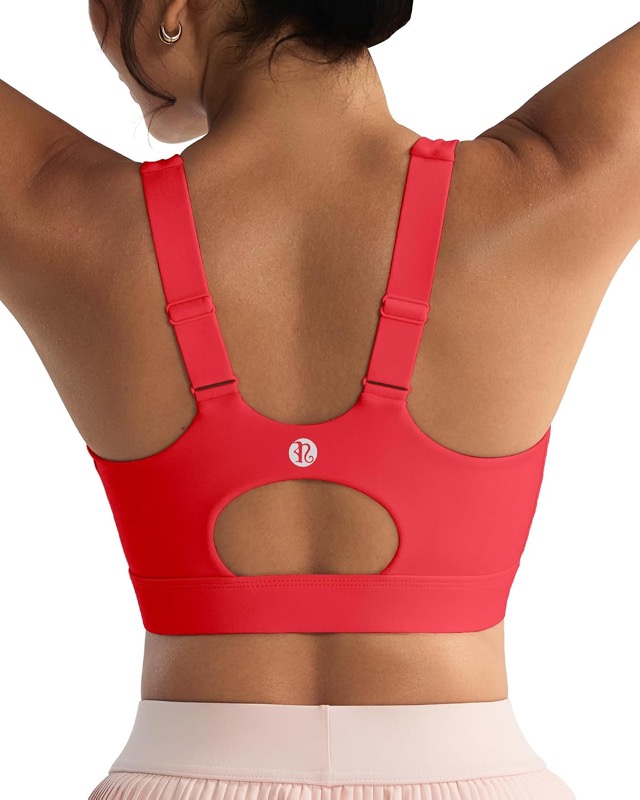
High-impact sports bra with moulded cups
A retail example of the combination build the research favours at high impact: moulded cups, adjustable straps and a high front. The listing states 75% nylon, which is the fibre point Portsmouth's testing links to better support — and one of the few such claims a buyer can check.
What about larger busts?
The advice here is more specific and, in the sources we read, consistent. Renwick calls encapsulation the best style for a larger bust. A retailer specialising in larger cups argues that a bra without individual cups is relying on compression alone, which is a problem from a D cup upward. Another retailer lists encapsulated cups, side support panels, wider underbands and wider straps as common features for fuller busts.
The retailers have something to sell; the Portsmouth and police-college sources are the more independent confirmation. Straps can become the pain point: a rugby coaching piece mentions that pressure sores or shoulder and neck pain from straps can occur, especially for larger-breasted women. That is another reason to ask the band to do most of the work, as the 80-20 split implies.
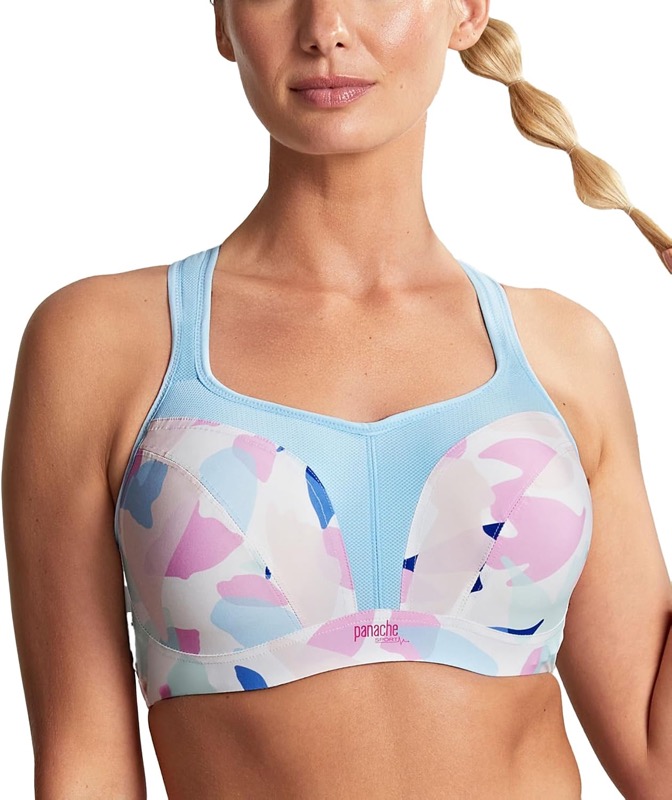
Underwired encapsulation sports bra
The encapsulation route the research favours for fuller cups and running: separate cups, a firm underband and wide padded straps. Note the listing states a cup-and-band size range rather than S/M/L, which is the only way that construction can be checked.
When should you replace a sports bra?
There is no firm rule, and the sources say so. Renwick suggests changing a sports bra about as often as you change running shoes — a rule of thumb rather than a finding. A brand spokesperson told a coaching publication the industry recommendation is every six to 12 months, depending on use and care. A scientist quoted in a roundup said that if you wash and wear one three or four times a week, you may need to replace it after about six months because it will have lost support. The police-college guide notes that laundering affects the mechanical properties of some sports bra materials.
Instead of counting months, look for signs: reduced support, stretched elastic, more bounce than before, persistent chafing, or a band that no longer sits firmly. One running retailer suggests a quick jog-or-jump test and replacing the bra if it feels less secure than when new.
Care changes how long a bra keeps its shape. Washing in a mesh bag helps protect cups and elastic.
What should you check before buying?
- Impact rating and activity named by the maker, not just "supportive". Compare it against the classifications above.
- Construction, not marketing. Separate cups, padding, an adjustable band, a high neckline and fabric content. If the listing never states fibre content, you cannot check the nylon point.
- Adjustability at both band and straps. Fuller busts benefit from both.
- Sizing information beyond a single letter. Brands vary, and Portsmouth's video narration says you might need a different size depending on where you shop.
- Return policy. The fit check only works if you can try the bra with movement and swap it if the band rides up.
- Care label. A bra you cannot wash easily will not last.
If you sell sports bras, what should the listing say
Safe to print, if true:
- "Combination sports bra: encapsulation panels, padded cups, adjustable underband, high neckline" — the construction, item by item.
- "Main fibre: nylon [x]%, elastane [y]%" — the fibre point only works if you state it.
- "Designed for running and HIIT; lighter support version for yoga" — activity, not "maximum support".
- "Band and straps both adjustable; strap width [x] mm."
- "Size range in cup and band" — if you make it in S/M/L, say what that maps to.
Avoid: "maximum support" as a universal good, "reduces bounce by X per cent" unless you have your own test, "prevents breast pain", "one bra for every workout", and any claim that a size letter removes the need to try it on. The research is explicit that the fit check beats the label, and a listing that gives measurements and a returns window sells into that reality.
Frequently asked questions
Do I need a sports bra if I have small breasts? Scurr says small-breasted women often think they do not need a special bra but that this is wrong, since breast pain can be linked to hormonal changes through the monthly cycle and good support helps every size. Whether you need encapsulation is a separate question; compression is often adequate for smaller cups.
Does a tighter bra mean better support? Not necessarily. One retailer says a sports bra should feel firmer than an everyday bra but never painful or make breathing difficult, and a too-tight band can affect breathing.
Is "maximum support" always the goal? Not for every activity. A computer-simulation study from Portsmouth, as described by a retailer, suggested that trying to eliminate all breast motion could raise estimated loading within the spine. We did not read the study itself, so treat this as a signal to match support to activity, not an established finding.
What if I still have pain in a well-fitted bra? Renwick says breast pain during exercise could be a sign you are not wearing a supportive enough bra, and Scurr says pain can almost always be fixed by a well-fitted bra. If pain persists after you have checked fit and support level, or you notice a lump or other change, speak to a clinician.
Can I use the same bra for pregnancy or breastfeeding? Breasts change in those periods, and the sources did not give specific sizing guidance. A maternity fitting from a qualified fitter, or advice from your midwife or doctor, is the better route.
How do I know if the band is doing its job? Raise your arms and twist: the band should not shift, and only about 20 per cent of support should come from the straps.