Choose a menstrual cup by length first, diameter second and firmness third, and treat the age-and-childbirth rule printed on most size charts as a tiebreaker rather than the answer. Length depends on how high your cervix sits. Diameter is how wide the cup is. Firmness affects how readily it opens and how well it holds its shape when you move. Flow volume matters too, but a cup that does not fit tends to leak long before it is full, so fit comes before capacity.
Most listings do not present it in that order. This guide takes each factor in the sequence that narrows the choice, shows where sources disagree, and ends with a checklist for product pages. It is general information, not medical advice, and individual anatomy varies — if something hurts, stop and ask a clinician.
For the cleaning side, see sterilising a cup; for backup on heavy days, the period underwear fit test; for the alternative product type, disc versus cup.
Key takeaways
- "Small" and "large" are not standardised. Healthline notes that diameters vary by brand.
- Cleveland Clinic says someone who has given birth vaginally is usually better served by a large cup, even under 30.
- Measure cervix height at the start of your period, when the cervix sits lowest.
- If the first cup fails, Cleveland Clinic suggests trying the next size or another brand.
- Capacity is smaller than most people assume, and a cup that fits badly will leak before it fills.
Why is menstrual cup size so confusing?
Because "size" bundles three measurements under one word. Healthline explains that size on a box usually means diameter, while length and capacity are separate properties. A cup can be wide and short, or narrow and long.
Brands then add their own logic. One brand's guide uses age, flow and cervix height. Another works from cervix height, vaginal birth history and a body-volume table, pairing a medium cervix with no vaginal birth with its smallest size and pointing a high cervix to its largest. A pelvic-floor brand argues strength matters as much as age. These are brand pages steering you toward their own range, not neutral standards, so when they conflict, your own measurements break the tie.
How do you check cervix height?
Do this on or just before the first day of your period. Healthline points out that the cervix moves during the cycle, and the lowest position is the one to plan around.
Wash your hands, then insert your longest finger and feel for the cervix. Healthline describes a smooth raised area with a dimple in the middle. Read the result by how much finger it took: around the first knuckle is low, fully inserted or unreachable is high, anything between is average.
This is a rough tool. Treat it as three bands, not a number.
Sources agree on the consequence. A shorter cup suits a low cervix. A cup retailer adds that a low cervix often dips into the cup, so a shorter body with a somewhat wider diameter can work better than a narrow one. A high cervix is where longer cups and ones with a removal stem or loop become useful, because you may need something to reach.
Should you start with a small or a large cup?
If you want one rule: pick the size that matches your cervix height and birth history, and only then check it against flow.
No vaginal birth. Small is the common starting point in clinical guidance. Cleveland Clinic says small suits lighter flow and large suits heavier flow, and that without a vaginal birth the usual split is small under 30, large over 30. Healthline reports the same pattern but notes some brands do not base sizing on age at all.
Vaginal birth. Cleveland Clinic's guidance is that a large cup is generally the better fit even if you are under 30. One manufacturer adds a caveat worth keeping: recovery and muscle tone vary, so its own guide describes a 34-year-old who gave birth in her twenties and trains regularly as someone who may still do well with the smaller model. A manufacturer's example, not a study, but it shows why the age rule is only an approximation.
Pelvic floor strength is hard to measure at home. A doctor quoted by a news site and one brand's guide both suggest regular pelvic muscle training can make a smaller size work better.
Two cautions about flow. Capacity is smaller than people assume: Healthline gives typical figures of roughly 25 to 30 millilitres, and one brand says its medium and large sizes hold the same amount, with the larger differing in fit, not volume. And on community forums, people on heavy days still report needing a pad or period underwear as backup. That is anecdotal, but it matches the sources: capacity helps only once the cup sits properly.
Does firmness matter more than size?
Often as much, and retailers explain it least. Firmness changes how easily a cup unfolds after insertion and how well it resists being squeezed.
A silicone manufacturer and an online pharmacy describe the usual trade-off: softer cups are easier to fold and insert but may leak, while firmer cups open more reliably and hold up during movement but can be harder to insert. Healthline suggests a firmer cup may suit active days, and one brand says high-cervix users often do well with firmer cups. These are seller-reported tendencies; we found no independent firmness comparison.
Manufacturers' troubleshooting pages are consistent on the failure modes. One brand says a cup that is too small or too firm may not open fully, while one that is too large can fold and break the seal. If you have a sensitive bladder, a low cervix or insertion anxiety, a softer cup is a reasonable first try. If you are active or the cup keeps collapsing, try firmer next. Change one variable at a time.
How can you tell a cup is too small or too big?
Healthline lists the signs.
| Problem | What it looks like |
|---|---|
| Cup too small | Leaks, hard to reach for removal, may suction onto the cervix, which makes removal painful |
| Cup too big | Uncomfortable, may not go in far enough, may press on nearby tissue and affect urine flow |
Two retailers add that discomfort continuing beyond the second or third use may mean the wrong size, and that a correctly inserted cup that still feels too big usually means moving down a size. Both sellers benefit from a second purchase, but they match Healthline.
Placement is the other half. A gynaecologist quoted by a lifestyle site says the cup should sit horizontally toward the tailbone at the base of the vaginal canal. A cup that is tilted or too high can leak, and one that is too large may not sit flat. One brand's troubleshooting page goes further and calls a misplaced cup the single most common cause of leaks, ahead of size.
Before blaming size, check whether the cup has fully opened and whether the rim holes are clear. One brand notes blocked holes are an overlooked reason a cup will not seal.
How long can a cup stay in?
The FDA says a cup may be left in up to 12 hours and tells users to follow the label; Cleveland Clinic gives the same figure against 4 to 8 hours for tampons. One brand's listing on a US retailer notes local rules can differ and cites France, where it says guidance is 6 to 8 hours with no overnight use. Check the instructions shipped in your market. For buying, wear time affects the capacity you need more than the diameter.
Why does a correctly sized cup still leak?
A quick list of the causes sources agree on, in the order worth checking.
- It has not opened. Folds behave differently on different cups. Try another fold before changing size.
- It is placed too high or tilted. See the horizontal-position point above.
- The rim holes are blocked. Rinse and clear them.
- It is full. Heavy-flow days can need emptying sooner than the maximum wear time; Cleveland Clinic notes heavy days may require more frequent changes.
- Your body changed. One brand points out leaks can follow changes after pregnancy, and some forum users report a swollen cervix on the heaviest day makes the same cup behave differently.
If all of that checks out and it still leaks, try a different shape or firmness before buying a larger size. One forum user who bought small and medium found the same slight leakage in both — a single anecdote, but a reminder not to buy a third size of the same cup.
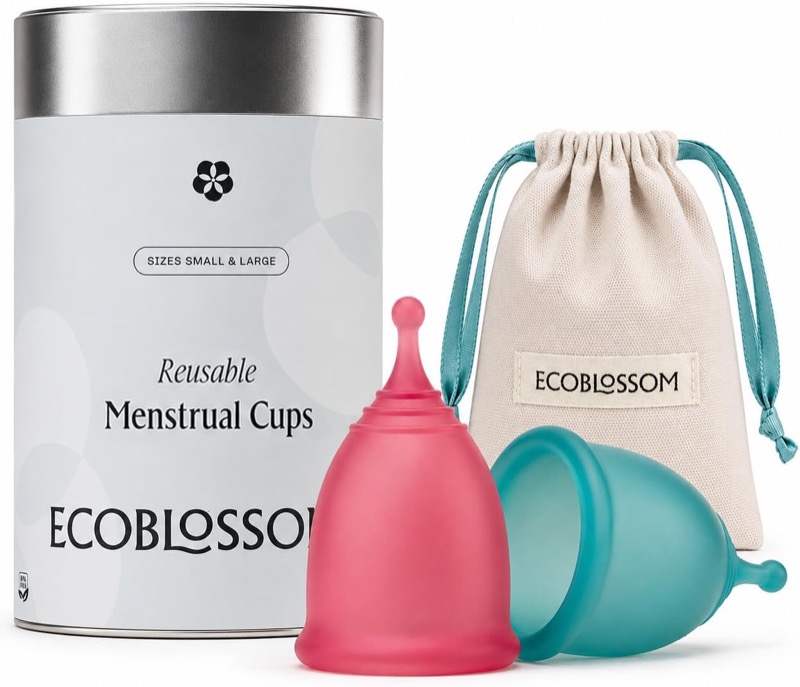
Two-cup set, small and large
A retail example of the format that makes sizing testable: two sizes in one box, so a first-time buyer can compare length and diameter against her own cervix height rather than guessing from a chart.
When should you skip the cup or see a clinician first?
The FDA's consumer page is the most reliable short list.
- Cups are not intended for vaginal drainage or bleeding that is not a period, such as drainage from an infection or bleeding after recent pregnancy or childbirth.
- Anyone with an IUD should talk to a gynaecologist first, because a cup can interfere with the strings and placement. Cleveland Clinic adds that some evidence suggests cups may raise the risk of dislodging an IUD, though more research is needed.
- Stop using a cup and contact a healthcare provider if you have itching, rash, pain, swelling or discomfort.
On materials, both the FDA and Cleveland Clinic say someone sensitive to latex should choose silicone. Cleveland Clinic lists irritation, allergic reaction and urinary tract infection among reported problems, and describes serious problems as uncommon.
Toxic shock syndrome deserves a sentence of honesty. Neither the FDA consumer page nor the Cleveland Clinic article discusses it. One cup maker states plainly that any internal vaginal product carries some risk, cups included. The shared advice is to wash your hands, clean the cup as directed and stay within the labelled wear time.
Conditions such as prolapse change fit; Cleveland Clinic recommends consulting a provider. One brand's FAQ says its cups suit stage 1 or 2 prolapse but not stages 3 or 4 — a brand statement rather than a medical standard.
For removal, Cleveland Clinic says to pinch the base to break the seal and not pull the stem.
What should you check on a product page before you buy?
A listing that cannot answer these is asking you to guess.
- Dimensions in numbers. Length, rim diameter and capacity, not just "small" or "large". With only a size letter you cannot compare across brands.
- A sizing chart that uses cervix height. A chart based on age alone is the weakest guide.
- Firmness stated or compared. Some retailers publish firmness charts. A brand that never mentions firmness is hiding a variable that decides your experience.
- Material named. The FDA says cups are generally silicone or rubber. If you have a latex sensitivity you want silicone, and the listing should say which it is.
- Exchange policy. Finding the right size can take more than one try, and a brand that lets you swap size or firmness reduces the cost of being wrong.
- Care instructions, in the product's own language and matching the wear and cleaning limits above.
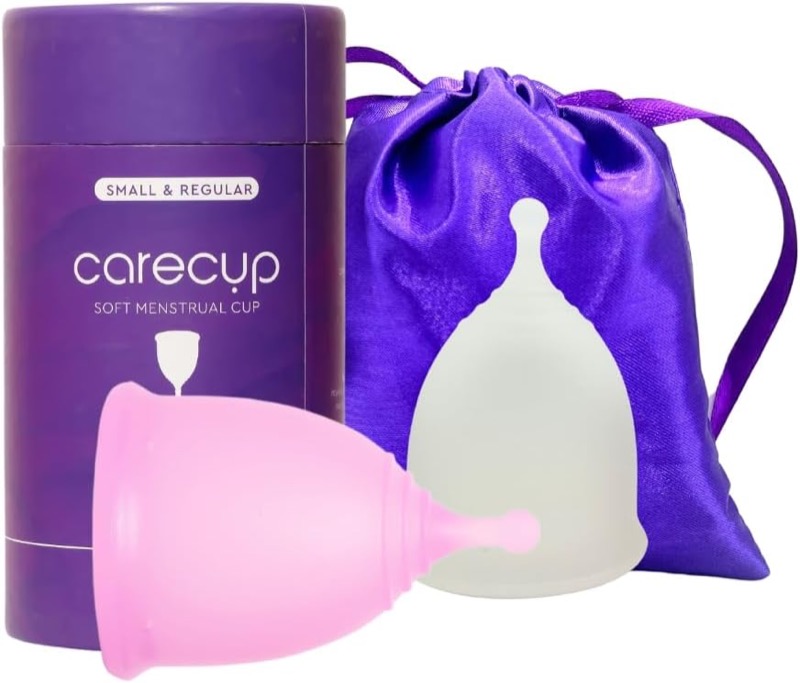
Small and large cup set with case
A second two-size set to compare on the same criteria: stated diameter, stem type, and whether the brand publishes a cervix-height chart or only an age chart. Those three decide whether the size number means anything.
If you sell cups, what should the listing say
The useful content is measurement, not adjectives.
Safe to print, if true:
- "Cup length 62 mm, rim diameter 40 mm, capacity 25 ml" — numbers a buyer can compare across brands.
- "Firmness: soft / medium / firm, compared on our chart" — if you actually rate it against your own range.
- "Recommended for a low / average / high cervix" — with the measured ranges behind it.
- "Medical-grade silicone; latex-free" — with the supplier's material statement behind it.
- "Wear up to 12 hours, or per local guidance" — and note where local guidance is shorter.
- "Sizing exchange within [x] days" — the policy that removes the fear of buying wrong.
Avoid: "one size fits all", "no leaks guaranteed", "hypoallergenic", "prevents infections", any suggestion that a cup is safe for non-period bleeding, and any age-only sizing chart presented as clinical advice. The FDA and Cleveland Clinic both treat fitting as a trial-and-error process, and a listing that admits that sells better than one that promises a first-time fit.
Frequently asked questions
Is it normal to buy more than one cup? Yes. The FDA lists difficulty finding the right size as a disadvantage of cups, and Cleveland Clinic says the next size or another brand may do what the first could not. Prefer a seller with an exchange option.
Can I use a bigger cup until I get used to it? Healthline says a cup that is too large is more likely to cause discomfort and may not insert far enough, so cervix height is a better guide than sizing up for capacity.
Does a cup stretch you out? One brand says the fear of "looseness" is widespread. We did not find an independent study that settles it, so we would not repeat a reassurance as fact. If you are worried about pelvic floor changes, a pelvic health clinician is the right person to ask.
Can teens or virgins use a cup? One pharmacy guide says virginity does not affect the ability to use a cup and suggests a smaller size and lubricant at first. That is educational content, not a trial; if insertion hurts, stop and ask a clinician.
How do I know if my cervix is low, average or high? By how much finger it takes to reach it on the first day of your period: around the first knuckle is low, fully inserted or unreachable is high.
Should I buy a soft or firm cup first? Softer if you have a sensitive bladder, a low cervix or insertion anxiety; firmer if you are active or the cup keeps collapsing. Change one variable at a time.