The file tucked beneath a press-on set is usually the least photographed item in the box. It may be the first thing a customer reaches for. One nail has a sharp edge; another needs a tiny change at the side; the natural free edge catches on the underside of the tip. If the included file is too wide to reach the point, sheds abrasive at once, or offers an unmarked coarse face, the customer's next move is guesswork.
In a recent discussion, a press-on user said small sanding blocks were still too big for the inside of a tip. Another user looking at her first set was advised to make small fit adjustments with a fine file. Those are individual accounts, not a survey. They expose a narrower buyer question than "which nail file is best?": can the one disposable file you pack handle the specific edge adjustments your instructions invite, while making it clear where its use should stop?
Retail kits already normalise the accessory. Some retail sets list a mini nail file, and marketplace sellers list mini files alongside sizing tips, wipes and application cards. That tells a small brand the component is familiar, not that any unlabelled mini board is suitable. A factory can deliver the correct count of files and still deliver the wrong tool for the finished tip and card.
Start with the two surfaces the customer may touch
A press-on tip is a manufactured product. Its outer free edge may need a small smoothing pass after sizing or application; its sidewall may need a cautious adjustment, if the maker permits it. The natural nail plate lies over a sensitive nail bed. A customer should not be encouraged to grind down its top surface merely because a file is included. The American Academy of Dermatology warns that filing the surface of natural nails for artificial nails can thin and weaken them, and recommends using a file to smooth rough edges with controlled motion.
For a kit that includes a file, define the permitted job in plain language: "Smooth a rough natural free edge" and, if your finished design allows it, "Refine a small rough edge on the press-on tip." These are different operations. A finished design with paint, chrome or embellishment extending over the edge may not tolerate any filing without visible damage. Check the actual decorated set, not an unpainted blank.
Don't tell shoppers to file a tip narrower until it fits if that would remove a large part of the sidewall or alter the cuticle line. A significant mismatch calls for another size, shape or mould. A file is an edge-finishing tool, not a way to rescue an unsuitable size range. If the tip feels tight, pinches, or leaves a gap during a dry fit, stop the filing experiment and revisit the fit.
Why the printed grit number isn't the whole specification
Grit numbers identify an abrasive grade: the higher number denotes a finer face. An 180/240 board therefore presents two different working faces. But the label alone does not tell you which face is which when the file is unprinted, whether the abrasive is evenly bonded, how much usable length the customer can hold, or how the edge of the board feels near skin. Treat "180/240" as the start of a sample comparison, not a guarantee of safe technique or equal quality between suppliers.
Retail guidance varies because it serves different products. A retail press-on prep-file set may include several grit combinations for distinct shaping, smoothing and refining steps, and a supplier's custom-manufacturing page lists 180/240 among common pairings with mini shapes available. That confirms format choice is possible; it does not establish one universal press-on-kit requirement. Even professional commentary differs on when a 180 face belongs near a natural nail. For a consumer pack, make the finer side the default for natural free-edge touch-ups, and avoid instructing repetitive abrasion of the nail plate.
There are cases where neither face should be used on the natural nail surface. The customer may have thin, peeling or injured nails. She may already have shaped her own nails and need no filing at all. Adhesive-tab and glue systems can have different prep directions. Do not transfer a salon technique from a different enhancement system into a retail press-on card without checking the adhesive instructions and the risks of repeated use.
Sample the actual file inside the finished kit
Get two or three candidate files and place each, in turn, inside the real retail package. Test with the finished nail set and the final draft of the instructions. Have a person unfamiliar with the product open the kit and identify the finer face without coaching. If she cannot, a tiny "fine side" mark or a clearer card may matter more than changing the nominal grit.
Use three tasks, not a vague impression of "good quality." First, lightly smooth a deliberately rough artificial free edge on a spare finished tip; inspect whether the colour, seal or decoration changes. Second, see whether a small side-edge refinement can be made while holding the board securely, without catching the neighbouring surface. Third, ask the tester to identify how she would smooth a snag on her natural free edge, then observe her grip and intended movement on a practice tip. Do not ask anyone to abrade a healthy nail plate for a marketing photograph.
Log the outcome for each face separately. Does the board flex or delaminate? Is the abrasive patchy? Does the cut edge of the backing feel sharp? Can the user grip it with short nails? Does the abrasive leave visible debris in the finished pack? Does a larger foam buffer reach the same location as a thin board? The answer may be no even if the buffer feels gentler on a flat surface. Record these observations against the exact sample lot and decorated nail SKU.
A video of a creator filing a press-on edge can show hand position, but it cannot prove a file's grit, durability, or compatibility with your finish. Marketplace listings establish that mini-file kit components are being sold; their descriptions and demonstrations are seller claims. Run the pack-specific task yourself and keep the sample, rather than presenting a platform clip as a laboratory test.
Write a spec a second packer can follow
After the use trial, put the file in the bill of materials as more than "1 mini nail file." Name the shape and backing, measured length, width and thickness, grit on each face, colour, face markings, printed artwork if any, acceptable edge finish, sleeve or individual wrap, and the orientation in the kit. Keep an approved physical sample with its revision date. Ask whether the grit marking survives handling and whether the same construction can be supplied for the next run.
If a factory offers a substitute because the printed colour is unavailable, the substitution is not automatically cosmetic. A different backing thickness may keep the file from fitting a tray; a different abrasive or edge cut may change the task. Require buyer approval for changes to grade, dimensions, construction, marking, packaging, or manufacturing source. Public custom-manufacturing pages show the options a manufacturer may quote, including mini sizes, grit combinations and printing — one supplier's offering, not proof that a marketplace seller provides those services.
For a first delivery, inspect a spread of files from different cartons. Compare dimensions and both faces with the retained sample. Rub a test piece on spare tips to see whether the abrasive sheds unusually or scores the finish. Check the board edges with bare fingers before placing it near the user's skin. Verify the pack count and that the file does not sit against a glue cap, sharpened decoration or unprotected adhesive tab. Record the lot or purchase order that went into each kit batch.
Do not call a paper-backed emery board "sterile" or reusable for salon clients because a listing uses "washable" or "professional." If the file is intended for one user's home kit, describe that use accurately. A salon's client-to-client sanitation policy is a separate matter, governed by its local rules and the actual file construction.
Thin board or foam buffer?
The physical form changes the job. A thin, narrow emery board can reach a small edge and may pack flat behind the display card. Its backing may be stiff, and its raw perimeter needs inspection. A foam-backed mini buffer gives more surface and hand contact, but the thickness can keep it out of a narrow sidewall or the underside of a deeply curved tip. "Mini" is a marketing word; ask for the actual length, width and thickness of the sample you are buying.
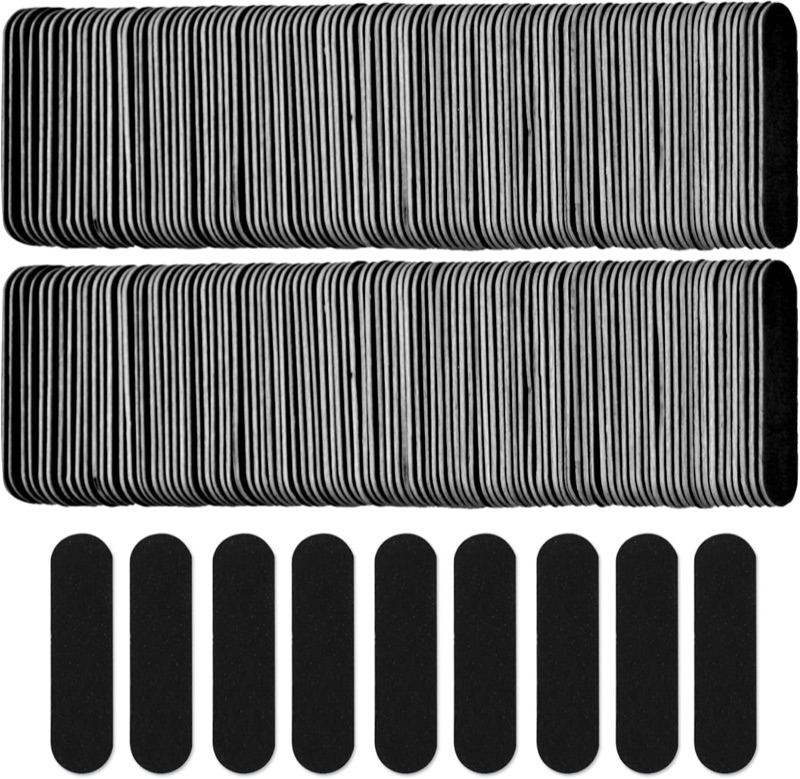
Mini nail files, 300 pack, 180/240 grit
A thin disposable emery board in a bulk pack, with 4.3 stars from 589 reviews on the selected variant when checked. The thin format reaches a small edge and packs flat — confirm the received count, side labelling and dimensions before using one in a retail kit.
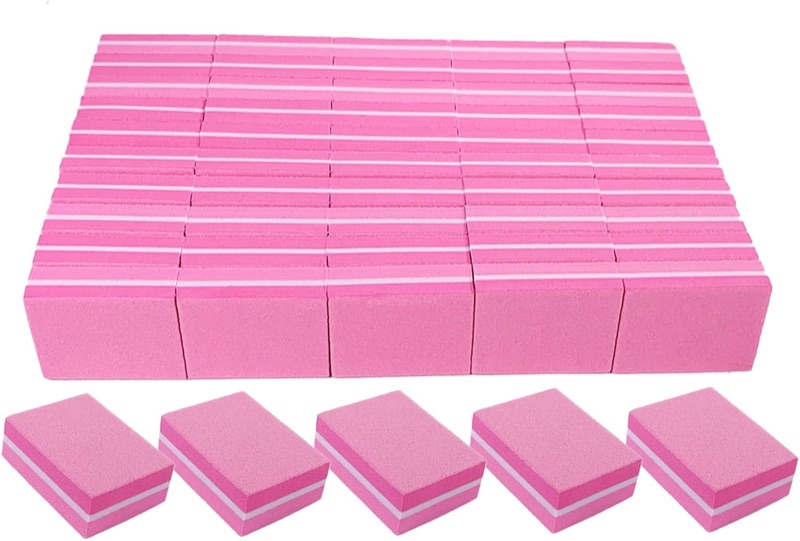
Mini buffer blocks, 50 pack, 180/240 grit
A foam-backed buffer block in a 50-piece pack, listed at 4.6 stars with 731 reviews. The thickness gives more hand contact and may not reach the inside of a narrow tip, so run the same fit and finish tasks — and check the selected variant, since the page also offers a 100-piece option.
Card photos are the current marketplace listing images and may differ from the delivered product; confirm details on the live listing.
Ratings, review totals, purchase badges and availability are changing marketplace signals, not verified performance tests. The two links are candidate samples for different formats, not approved components for every press-on set.
Reorder by accepted pieces, not just carton count
For 1,000 kits at one file each, the build requires 1,000 accepted files. If inspection or packing damages 25, you need 1,025 inputs to deliver that build, before any retained samples or customer-service stock. The 25 is an example, not an expected defect rate. Your purchase quantity should come from a trial run's rejects and the supplier's case multiples. If the packer uses one file per kit plus a standalone refill pack, forecast those separately.
Look beyond the unit price. Count damaged abrasives, time to pick and orient a marked face, wrapping, freight volume, and the cost of a file that scratches a premium finished nail. A 300-count box may look cheap per piece yet be wrong if its usable working edge or labelling fails the task. Equally, a soft buffer may be a poor inclusion if it cannot reach the edge the card tells people to smooth. Make a landed cost per accepted kit, then compare it with the use-trial outcome.
There is a plausible repeat-purchase path without pretending the file lasts forever. A press-on brand selling reusable sets can offer fresh mini files with reapplication supplies, or sell a small accessory refill for a returning customer. Keep the refill's file format and instructions aligned with the current finished nail design. If the design's sealed edge changes, retest filing before carrying the old accessory across seasons. Track reorder demand rather than assuming every new set needs a large extra bundle.
The card should describe the limit, not just the technique
An instruction such as "File nails to fit" is too broad. A more useful card might say: "Choose a tip that fits without pressure. Use the fine side of the included file only to smooth a small rough free edge. Check that filing will not disturb the design. Do not force a narrow tip to fit by removing a substantial sidewall." Adapt the wording to your actual product, adhesive and tested file. If the file is supplied solely for a natural free-edge snag, say that; do not invent a second use to justify its presence.
Before approval, hand someone the packed set and card. Ask which face she would use, which edge she would touch, and when she would stop. If her interpretation differs from your intended use, edit the card or the component. That short observation is more actionable than a generic five-star verdict on a loose file.
The decision is small and repeatable: identify the permitted edge jobs, compare a thin board and a foam format on your finished tips, select and mark the working face, approve a physical sample, and buy against that revision. A mini file earns its place in a kit when a customer can use it without being asked to repair a bad fit or sacrifice her natural nail to an unclear instruction.