A press-on set can look beautiful in its box and still frustrate a customer at removal. She may not know whether to soak, add oil, use remover, or keep waiting. If the nail does not loosen, the temptation is to pry. A small kit-design choice has become a product-experience problem.
Should every press-on kit include a remover? No. Every kit should include a removal route that matches the adhesive supplied, in language a first-time buyer can follow. A remover belongs in the box only when the brand has checked that it works with that exact adhesive and does not compromise the nail set or its intended reuse. For some tab-only sets, a clear care card and a suitable non-metal tool may be more useful than another liquid. For a glue set, a compatible remover may be worth sampling. The answer is a product decision, not a universal rule.
Consumers describe very different removal experiences. Community discussions mention long soaking, worries about peeling after pulling, and confusion about combining glue with tabs. Those posts flag customer questions; they are not controlled tests of product safety or effectiveness.
Start with the adhesive the customer actually receives
Before choosing a remover SKU, write down the exact attachment method in the retail kit. "Press-on glue" is too broad for a product brief. Adhesive tabs, air-dry nail glue, semi-solid adhesive and a light-curing gel do not necessarily soften in the same way. Even two products sold under the same general label may have different instructions. The manufacturer's directions for the supplied adhesive should be the starting point; a third-party tutorial is not a substitute for them.
Removal advice can seem contradictory: some guides describe warm water or oil for temporary tabs, others acetone-based soaking for stronger bonds. The American Academy of Dermatology notes artificial nails may require acetone soaking or filing. These are general explanations, not guarantees for a branded adhesive or decorated tip.
| Adhesive route | What to verify | Pack-out decision |
|---|---|---|
| Adhesive tabs | Does the card identify the exact tab system and explain what to do if an edge resists? | A clear method card may be enough; test any tool or liquid before adding it. |
| Air-dry nail glue | Is the remover named by the glue supplier and tested with this tip finish? | Include a compatible remover only when the directions and sample support it. |
| Semi-solid adhesive | Is it no-light or lamp-cured? What formula and directions apply? | Name the exact system; never infer cure method from "gel" alone. |
| Tabs plus glue | Is the combination intentional, and are both application and removal steps validated? | Use separate instructions for each route or explain a tested sequence. |
What the kit should contain
Keep the pack-out simple. For tabs, consider a named system card and a validated tool, with instructions to stop rather than force a resistant nail. For glue, consider a compatible remover, an applicator that reaches the edge, and separate directions for residue on the nail and reusable press-on. A universal bundle of files, pushers, cotton, foil, oil and liquids can confuse buyers when none is tied to the adhesive.
Give each component a job: the card identifies the system, the tool supports the stated method, and any liquid has a defined compatibility role. Aftercare copy must not imply a cosmetic product treats injury or prevents damage. Dermatology guidance warns improper removal can damage nails; it does not endorse a commercial remover.
If your design team wants to keep the press-ons reusable, test the set after removal as well as the natural-nail side of the process. An acetone-containing product may affect some plastic tips, coatings or decorations, and some dedicated removers may also change the finish. These are sample questions, not assumptions to put in marketing copy. Photograph the same tip before and after each trial, note visible residue or finish changes, and record whether a second application is still part of the intended product promise.
Write a removal card that cannot be mistaken for another brand's instructions
Put the adhesive name or kit version near the top. A customer should not need to infer whether the card belongs to the tabs, glue or sample in her hand. Use numbered steps only where the order matters, and describe the action in ordinary language. If there are two methods, label them by the package component: "For the included tabs" and "For the included glue." Do not compress two procedures into a single paragraph with a vague instruction to use whichever method feels right.
Keep the safety boundary visible. Tell the reader not to force or tear a nail off if the product resists, and to stop using the product and seek appropriate professional advice if she experiences unexpected pain, swelling, redness or another concerning reaction. Avoid claims such as "damage-free," "safe for all nails," "non-toxic," "hypoallergenic," "instant" or "works on every adhesive" unless you have the evidence and regulatory review to support the exact claim. A popular claim on a supplier page is not substantiation.
If the kit contains a liquid, the front label, bottle, insert and online listing should use the same product name and directions. Include an easy way for the customer to identify the formula and lot. This also helps the brand investigate a complaint without trying to reconstruct which version was shipped.
Build a sample test around decisions, not slogans
A practical sample check does not need a laboratory-style score invented for the article. It does need a repeatable record. Keep the press-on style, adhesive amount, preparation, wear period and removal instructions the same when comparing samples. Change one variable at a time: for example, compare the included remover with the supplier's stated alternative while holding the glue and application constant. If the adhesive instructions specify a different test method, follow those directions and record them.
For each trial, note the date, adhesive batch or product code, tip style, how the remover was applied, how long the user followed the directions, whether the nail released without force, what residue remained, and whether the press-on's surface changed. Record an incomplete release as an incomplete release; do not keep extending the procedure until the result looks favorable. A small internal trial can uncover packaging and instruction problems, but it cannot support broad safety claims or predict every customer's experience.
Ask two or three people unfamiliar with the product to read the card before they try the sample. Watch where they pause. Do they know which bottle to open? Can they tell if the instructions apply to tabs or glue? Do they interpret "lift" as a cue to pry? Those observations often expose an insert problem earlier than another round of polishing the brand language. If there is a liquid, check that its cap closes, that the applicator reaches the seam as intended, and that the bottle arrives without leakage after the supplier's agreed packing test. The actual tests and results belong in your records; do not describe them as completed until you have done them.
What the current product examples do and do not show
The two links below cover a consumer remover and a supplier adhesive-and-remover set. Neither is a controlled compatibility test, and a list price or sales counter cannot establish that a formula suits your tip finish. We may earn a commission from qualifying purchases through these links.
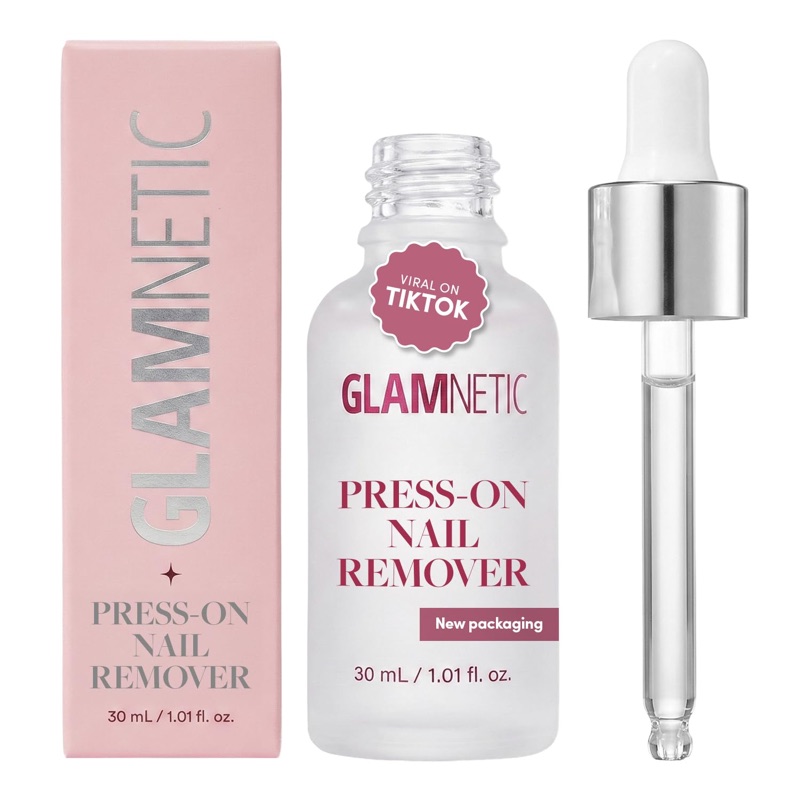
Press-on nail remover serum, 30 ml
An odourless remover serum sold for press-on sets, with a listed 4.2 stars from 4,556 reviews and 10K+ bought in the past month. A consumer reference — read its directions and recent reviews before assuming it suits your adhesive or preserves a reusable set.
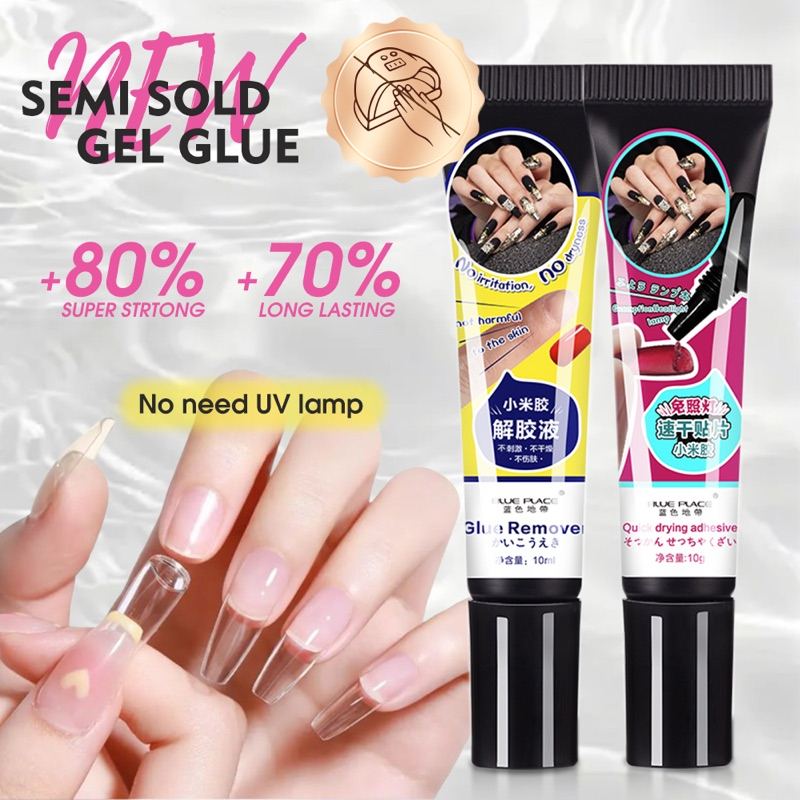
Semi-solid nail adhesive with remover, 10 ml + 10 ml
A two-bottle set pairing a semi-solid adhesive with a matching remover, showing 182 sold and no product reviews, from a supplier with six years on the platform. A sample-inquiry candidate — request the formula documents, compatibility check and current export quote.
Card photos are the current marketplace listing images and may differ from the delivered product; confirm details on the live listing.
The remover's page is a changing marketplace signal, not proof that the serum works with every adhesive or preserves every nail set. The supplier's listing shows no product reviews, and its ratings differed between the product page and the company profile, so verify the current company and product records directly before treating it as a sourcing choice.
For a separate removal-kit repeat purchase, assess the two channels differently. A consumer may need one bottle; a brand buyer needs stable formula, compatible packaging, clear directions, repeatable lots and viable shipping. Their listings answer different questions and are not interchangeable evidence.
Questions to put in the supplier brief
Ask the supplier for the exact adhesive and remover names, ingredient declarations, current safety data sheets where applicable, and the complete written directions. Confirm whether the remover is intended for tabs, air-dry glue, semi-solid glue or a cured gel; ask which press-on materials and finishes were used in the supplier's own compatibility checks. Request samples of the adhesive, remover, bottle, applicator, retail insert and proposed carton together. A loose bottle sample does not tell you whether the complete kit is clear or packable.
Clarify standard versus private-label options, minimums for custom labels and boxes, sample fees, approved-sample and bulk lead times, production controls, and liquid shipping method. A listed low minimum may apply only to a plain sample. Use the written quote and specification, not a thumbnail price, to estimate landed cost.
For a United States launch, a nail liquid may be regulated as a cosmetic depending on its intended use and claims. FDA guidance says the responsible business is accountable for safety and proper labelling; retail cosmetics have ingredient-label requirements, and MoCRA creates additional duties with exemptions that depend on the business and product. The FDA does not pre-approve ordinary cosmetic labels. Ask a qualified regulatory professional to review the exact formula, claims, label and import plan. A supplier's compliance fields do not, by themselves, answer U.S. cosmetic-labelling questions.
Because formula and concentration are not established from a listing headline, ask the supplier to confirm the correct shipping classification and packaging requirements for your route. Do not assume every remover is hazardous cargo, and do not assume every liquid can be sent by the cheapest parcel method. Confirm the destination country, carrier acceptance, documentation, storage instructions and any restrictions before placing a bulk order.
A useful go or no-go rule
Include a remover when the adhesive in the box has a clearly identified, compatible route and the brand can support the formula, directions, packaging and market requirements. Leave it out when the tabs or adhesive can be removed according to validated instructions without an extra liquid, or when the sample has not established compatibility. In either case, include removal instructions that name the attachment system and tell customers what to do when the nail does not release easily.
Before approving artwork, run one final pack-out check with the production-intent adhesive, remover, applicator, insert and nail design. The approval sample should match what the customer will receive. Keep the approved combination, lot identifiers, photos and written directions together; if the supplier changes a formula, bottle or adhesive, repeat the relevant checks. The insert is part of the product, and a better insert can prevent a confusing removal experience without pretending that one bottle solves every bond.
The useful question is whether customers can identify the method for their kit and whether the brand has checked that the included pieces work together.