A sizing kit is a reference sample, not a universal answer
A customer may carefully record 0 4 3 4 8 from a sizing kit and still receive a set that feels wrong. That does not automatically mean she measured badly. It can mean the blank tips in the kit and the tips used for the final set were not the same physical system.
In this category, numbers look more stable than they are. A number is only an identifier within a particular tip family. It does not carry a universal width, curve, cuticle profile, or free-edge shape from one supplier, product line, shape, or length to another. The consumer consequence is familiar: a size that worked in one set is too narrow in the next, leaves exposed sidewall, or looks too wide even though the number on the underside is the same.
That uncertainty is visible in the market. Community threads include buyers reporting different measurements between shapes and brands, and one recent discussion reduced the practical rule to this: a sizing kit is useful only when it comes from the same exact brand and shape. Marketplace listings also commonly describe a kit by a specified shape and length rather than as a generic size tool. A tutorial for press-on businesses groups sizing kits with shape and size-chart work.
For a brand, the useful question is: what final SKU does this kit prove fit for? A good answer ties it to a defined tip family, shape, length range, and production version. That turns the kit into a controlled reference sample.
This guide explains how to build that link before you sell a custom or fixed-size range. It does not claim that one kit will fit every nail bed or that a supplier will keep a mold unchanged. Verify both in your sample and reorder process.
Why the same number can feel different
Numbers on the underside of a press-on tip help a customer repeat a choice within the relevant system. They are not a measurement standard. A 4 is meaningful only alongside the tip family it came from.
Four changes can break the relationship between a kit and a selling set.
The shape changes the usable fit
An almond, oval, square, coffin, and stiletto can have different sidewall lines and different room around the widest part of the natural nail. Even when a manufacturer labels both tips with the same number, the customer is not evaluating the same edge geometry. Retail sizing pages frequently tell buyers to choose a kit in the shape they intend to order; that is a useful market practice, but it is not proof that two different product lines are identical.
The length may change more than the free edge
A long version may use a different mold or carry its apex and side profile differently from a short version. The issue is not simply whether a customer likes the extra length. The tip can settle against the nail bed differently when pressed into place. A sizing kit labelled only "almond" leaves too much unknown if the buyer later chooses short almond, medium almond, or long almond.
The curve changes the contact pattern
Two tips can have a similar width on a flat ruler but a different C-curve. One may sit comfortably over a flatter nail bed while another can touch at the centre and rise at the sides. Width remains a useful measurement, but it should not be the only piece of evidence in a brand's approval record.
The source or mold version changes
Brands sometimes change suppliers, move from an off-the-shelf line to a custom line, add a new finish, or receive a replacement batch without treating it as a product change. Any of those changes can make an old sizing-kit record unreliable. A community thread about a buyer's inconsistent online sizes captures the operational lesson well: keep millimetre notes, but do not transfer a kit result blindly across systems.
The point is to identify what a customer has actually tested. If the kit represents one physical tip family, say so and keep the final set connected to it.
Decide what the kit is allowed to certify
Before ordering cards, envelopes, or printed instructions, write one sentence that defines the kit's scope. For example:
This kit is valid for the 2026 Classic Almond tip family in extra-short and short lengths. It is not a fit reference for Square, Coffin, or Medium Almond sets.
That sentence is a product-control decision. It prevents a common mistake: treating every blank sample as a universal sizing coupon.
There are three practical models. A small or highly shaped range may need one kit for one final SKU: the exact base family, shape, and length that will be decorated and sold. A broader range can share a kit only after the brand has sampled the proposed variants and defined a narrow family — supplier line, mold reference, shape, and permitted lengths, not simply "almond." A ready-to-wear range can pair a millimetre chart with a physical confirmation option, provided it identifies the final shapes that chart represents. In every model, the selling page, kit page, production sheet, and reorder record must use the same definition.
Build a kit specification before you ask for samples
"Ten blank tips, numbered 0 to 9" is not yet a useful supplier brief. It describes a format, not the product relationship the kit must preserve.
Your internal specification should include the following fields.
| Field | What to record | Why it matters |
|---|---|---|
| Tip family | Supplier line, internal family name, or mold reference | Keeps the kit tied to a defined base tip |
| Shape | Exact commercial and supplier name | Avoids treating similar-looking shapes as identical |
| Length | The approved length name and an internal sample reference | Shows what the customer tested |
| Size range | Every supplied tip number and its measured width | Lets the brand compare later lots |
| Curve note | A short description plus side and front photographs | Adds evidence beyond a flat width figure |
| Kit version | A dated version code | Makes old kits traceable after a change |
| Final SKU scope | The products for which the kit is valid | Prevents false transfer to another set |
Measure each blank tip in the kit as received. Record width at the intended widest contact area, not only the supplier's listed number. Keep a photo of the numbered tip beside the measurement and save the source and sample date. This compares the physical reference you approved with the tip you receive later.
The Press-On Nail Size System Builder can hold the brand's own millimetre measurements, preset size groupings, and sampling notes. It should use data from your physical tips; it should not be used to promise a universal customer size.
Test the kit beside the finished set
The most useful approval exercise is simple: place the blank kit tip beside the decorated final sample from the same named size. Do it before artwork, before a large order, and after any meaningful supply change.
Check these five points.
- Number and width. Confirm the number on both tips and compare the recorded widths. A different number is an immediate stop. A width difference is a question to investigate, not something to hide under a generic tolerance claim.
- Cuticle outline. Put both tips over the same reference nail form or a clean, unpolished nail. Does the cuticle-side outline begin and end in a comparable place? A pretty design can conceal a mismatch until the customer applies it.
- Sidewall contact. View from above and from each side. Note whether either tip pinches, rocks, or leaves a visible gap. A small difference may be workable for a broad ready-to-wear assortment; it is a bigger issue when the kit is sold as the proof for a custom ten-piece set.
- Length and handling. Check that a length stated on the kit matches the experience customers will receive. The purpose is not to demand that every decorated tip be visually identical; it is to ensure that a "short almond" reference has not quietly become a different line.
- Customer record. Make sure the number sequence and finger labels shown on the kit can be used unchanged at checkout. If the final set's thumb size begins at a different number, the customer needs a new reference, not a conversion guess.
Ask a second person to follow the customer instructions. If they cannot tell which set the kit applies to, revise the page and card.
Retail and sourcing references
The following links are retail and sourcing references for building and measuring a sizing kit. We may earn a commission from qualifying purchases through these links. The linked products do not prove that a kit or tip line matches your approved tip family, shape, length, curve or numbering. Recheck current product details, size availability, minimum order requirements, and CPS eligibility before ordering.
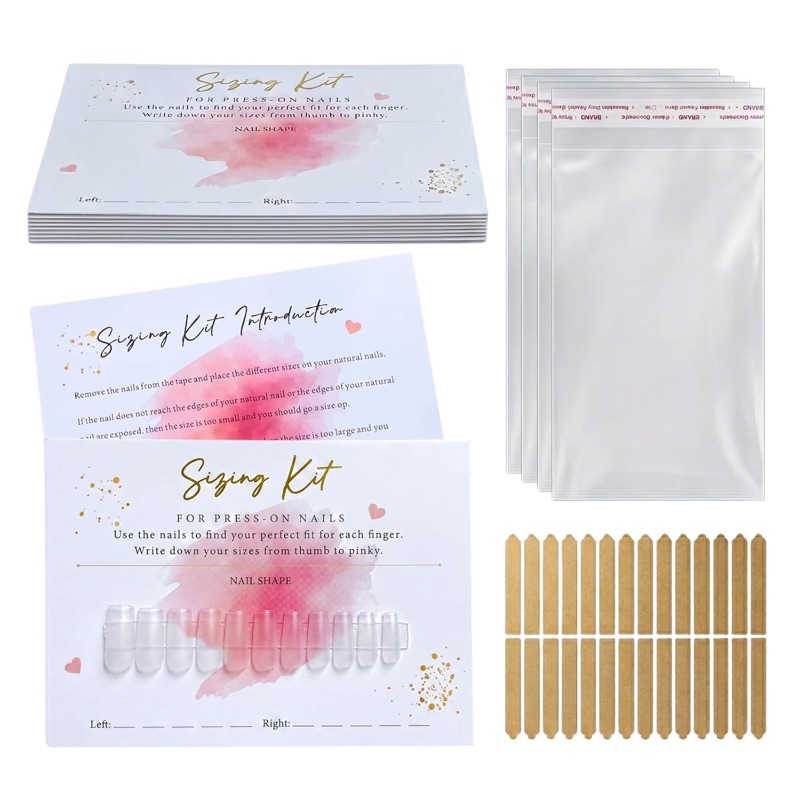
Press-on nail sizing kit cards with clear sample tips
A sizing-kit set of printed cards with clear sample tips for recording repeatable tip numbers. A retail reference for the kit format itself — confirm the included tip sizes against your own approved family before mailing a kit to a customer.
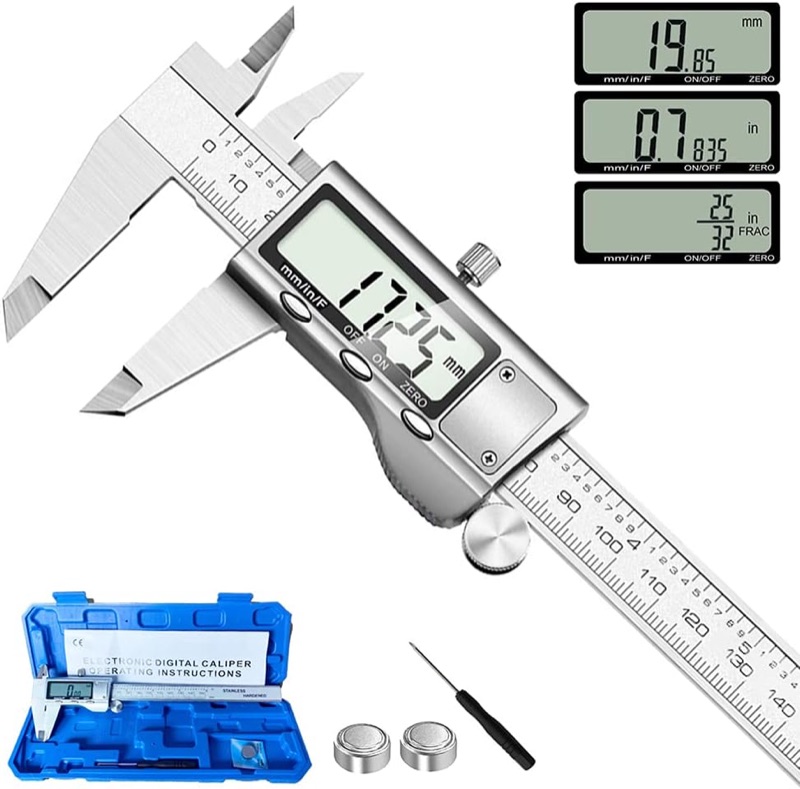
Digital caliper for tip width and curve checks
A stainless steel digital caliper with an LCD readout, for recording the width of each numbered blank tip as received. The numbers only mean something if the same measuring point is used every time.
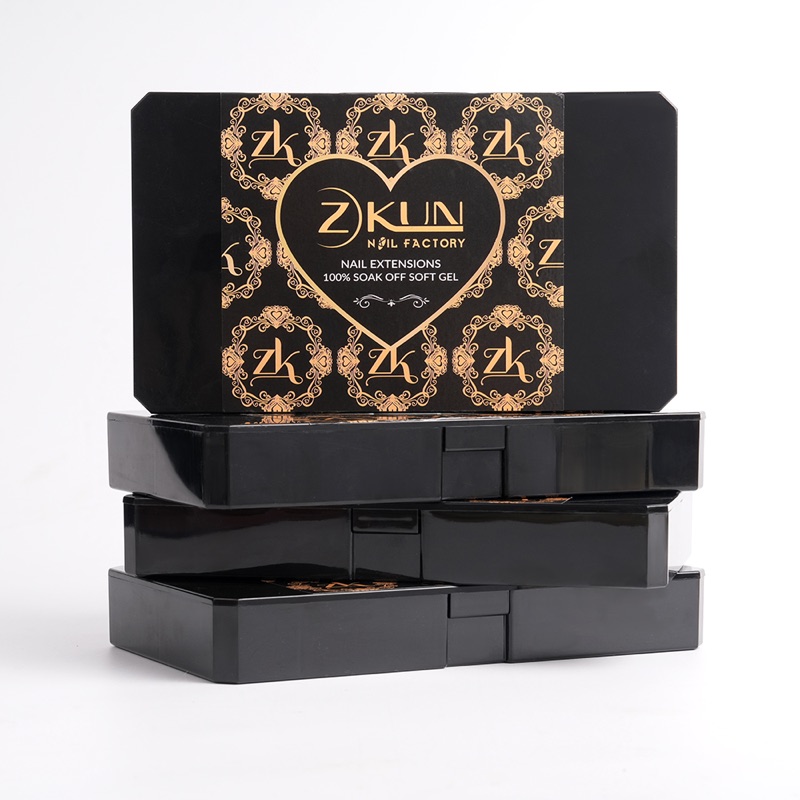
14 Sizes HEMA-Free Full Cover Soft Gel Nail Tips — Almond / Medium, Clear
A wholesale 14-size full-cover soft-gel line with a private-label option. A sourcing route for asking whether the blank kit tips and the decorated set come from one mold family — the listing alone does not confirm the numbering or the measurements.
Card photos are the current marketplace listing images and may differ from the delivered product; confirm details on the live listing.
Use version control when a supplier or line changes
Fit problems often appear at the point of change: a new mold, a restock from a different line, a new length, or a revised tip finish. This is where a simple version system earns its place.
Give every approved kit a code such as CA-SA-01: Classic Almond, Short Almond, version 01. Put it in the internal sample folder and production brief. Your team needs to know whether a reorder still corresponds to the kit a returning buyer used.
When the source changes, request relevant blank tips and compare them against the retained sample. Document one of three decisions:
- Same system: the new sample remains within the brand's approved comparison record, so the existing kit may continue to apply.
- New system: the new tips require a separate kit, chart, or checkout instruction.
- Unresolved: the sample does not provide enough evidence; do not expand the old kit's claimed scope.
This process also protects customer support. A previous record may be valid for an old set but not for a new shape or line. Explain the change and offer the relevant sizing route.
Write instructions that reduce the wrong kind of confidence
Most sizing instructions explain how to place a blank tip over the nail. A brand should also state the limits of the result in plain language.
Useful kit copy might say:
Choose the kit that matches the shape and length of the set you plan to order. Record the number that sits sidewall to sidewall without pressing into skin. Your kit applies only to the listed tip family and shape.
That is clearer than "use this size for all future orders." It also avoids forcing customers to discover the distinction after they have paid for a custom set.
On the product page, show the kit name next to each eligible shape and length. If a design comes in three shapes, do not use one generic "sizing kit" button. If using a millimetre chart, state that it is brand-specific and display the measurement method and current version date.
Avoid making performance promises a sizing kit cannot prove. "Guaranteed fit," "fits every nail type," and "universal size numbers" all claim more than a blank sample can establish. Customer feedback can guide a future range expansion, but individual comments do not validate every size or mold.
Questions to send before approving a supplier sample
Ask suppliers questions that produce a comparison sample rather than a reassuring answer:
- What tip family, mold reference, shape, and length will be used for the blank sizing kit?
- Will the finished decorated set use that same base tip family? If not, what changes physically?
- Can you send unprinted blank samples for each proposed kit version before the card artwork is final?
- What numbering appears on the underside, and does it remain consistent within this line?
- Which dimensions can you provide, and which must the brand measure from the delivered sample?
- If the source, mold, or line changes for a reorder, how will that change be communicated before production?
An Alibaba or any other supplier listing can start this conversation, but it cannot answer it by itself. Confirm current sample availability, minimum order quantities, customisation options, shipping terms, and the actual product identity before you place an order. Do not treat a generic product photo as evidence that a supplier can reproduce your approved system.
The finished decision
A press-on nail sizing kit earns its place when it removes a specific uncertainty: it shows a customer the same base tip system that her final set will use. Approve it only after the physical blank tips, final samples, instructions, and checkout choices agree.
The customer gets a clearer route to a made-to-order set, the brand has a reorder record, and a future supplier change becomes a managed product decision instead of a surprise inside the same familiar number.