Most press-on nail sellers do not run out of tips evenly. A few sizes disappear first: usually wider thumbs, common middle-finger sizes, or a label used in more than one fit profile. A single-size refill seems efficient. It can be, but only when the replacement belongs to the same tip system as the inventory already in your kits.
That condition matters. A number printed inside a tip is not a universal measurement. Across mould families, “size 5” can have a different width, contact area, arch, sidewall, length, material thickness, or label convention. A refill that merely looks close in a listing image can create a mixed kit. Customers may receive a different fit from the one described in your size guide, and future quality checks lose their baseline.
A full box can feel wasteful when one compartment is low. Yet it is often lower risk if you have changed factory, shape, or production run. The useful question is not refill versus bulk. It is whether you can preserve a consistent system. Use the following questions before discussing price.
1. Which exact tip system are you replenishing?
Begin with product identity, not the missing number. “Short almond press-on tips” is useful for a shopper, but it is not a sourcing specification. Create a record for the system you sell: full-cover or half-cover construction; shape and stated length; material and finish; curve profile if known; mould or product code; number of sizes in the set; supplier, order date, and batch reference; and markings printed inside the tips.
Photograph two or three original tips from the front, side, and underside. Put a ruler in at least one image. The front view documents width and outline. The side view captures arch and apex. The underside shows the contact area and internal number. Send all three views rather than relying on a supplier’s listing photo.
This avoids a common mistake: treating a shape name as a complete specification. Two medium-almond lines can have visibly different sidewalls and curves. One may suit flatter natural nails; another may be more arched. Either could be a good product on its own. The question is whether it continues the fit experience your customer expects from the existing kit.
If the original factory can identify the original mould, a one-size order may be low risk. If the mould cannot be identified, treat the proposed refill as a new candidate until a physical sample proves compatibility. This mindset prevents accidental mixed-kit purchases.
2. Does the printed size represent the same physical dimensions?
Ask for a measurement table before you discuss a label. At minimum, request the maximum internal width in millimetres, measured at the widest usable point. For a stronger comparison, measure your original sample at three points: near the cuticle, at the widest point, and near the free edge. Record length as well.
Do not assume an outer-width measurement answers a fit question. The inside contact surface is what determines fit, and suppliers do not always measure at the same location. Tell them exactly how you measured, and ask them to use the same convention. If that cannot be confirmed, request a sample instead of treating a spreadsheet as proof.
Size-system design matters too. One line may contain ten numbered sizes and another twelve or fourteen. A larger range can use smaller steps between widths. Their labels cannot be translated one-for-one: a “0” in one system may be narrower than a “1” in another.
Build a comparison sheet. Put the original label, internal widths, length, and curve note in one column. Put the proposed tip’s data beside it, with a pass/fail result for each feature. This turns an ambiguous supplier conversation into a purchasing record you can reuse later.
Set an acceptable tolerance before you sample. The threshold depends on your positioning, but the principle is clear: if the difference changes a buyer’s fit recommendation, it is not a compatible replacement. Do not rely on “close enough” simply because the number matches.
3. Will the refill match the curve, sidewalls, and thickness?
Width is necessary, but it is not sufficient. A refill can have the same maximum width as your original sample and still feel wrong. Curve, sidewall angle, apex placement, and thickness affect both application and appearance.
Place an original tip and a proposed sample side by side on a flat surface, then view them from the front and side. Nest one over the other without forcing it. A mismatch becomes easier to see: the refill may sit higher at the centre, flare at the sides, or stop short at the cuticle. Repeat the comparison on a nail stand or practice finger. You are not deciding which tip is better; you are deciding whether both can coexist in one kit without changing the fit experience.
Thickness matters as well. A heavier tip may look more structured but require different pressure during application. A thinner tip may flex differently with adhesive tabs. If your instructions tell buyers to choose a tip that lies flat from sidewall to sidewall, the refill must support that promise. Otherwise, customer service is managing two products behind one product name.
Ask whether the sample and production refill use the same mould and material reference. Save the answer with the order record. A written code is not proof, but it gives you a specific point to query if the delivered tips differ. Where your product uses clear, tinted, or coloured tips, compare transparency and surface finish too; an otherwise compatible size can look noticeably inconsistent under polish, chrome, or a sheer design.
4. Is the demand pattern stable enough to justify a refill?
Before optimising the purchase, establish why the size is missing. Count tips used or sold by size over a defined period. Separate normal customer demand from sample-making, content production, packing errors, and damaged pieces. If one wide size is depleted repeatedly through customer orders, that is useful forecasting data. If it vanished because it was used for internal testing, the right answer may be a separate sample stock rather than a retail refill.
A basic reorder point is enough. Take average use of the size per month, multiply by lead time in months, then add a buffer for uncertainty. If you use 45 size-0 tips monthly, delivery and receiving take two months, and you want a 30-tip buffer, you should reorder at 120 tips. You do not need complex software to stop discovering shortages while packing orders.
Your records may also expose a flaw in the original assortment. Standard boxes often contain equal quantities of each label, but buyer demand is not equal. Common thumbs and middle sizes can disappear faster. That may justify an adjusted future pack, a top-up product, or clearer pre-purchase sizing instructions.
Keep the time window long enough to be meaningful. A single promotion or a small run of custom orders can make one size look unusually popular. Compare at least two replenishment cycles when possible, and keep notes on any campaign, bundle, or design that changed the mix. This prevents one exceptional month becoming a permanent inventory rule.
A single-size refill is most sensible when demand is repeatable, the original mould is traceable, and the refill quantity aligns with your consumption. If usage is erratic or you are revising your fit system, a full box often gives more testing flexibility and less risk.
The decision, simplified
Choose the option that preserves the same physical tip system and gives you a repeatable way to verify the next batch—not simply the option with the lower unit price.
Supplier route: a single-size refill option on Alibaba before requesting a sample and confirming mould compatibility.
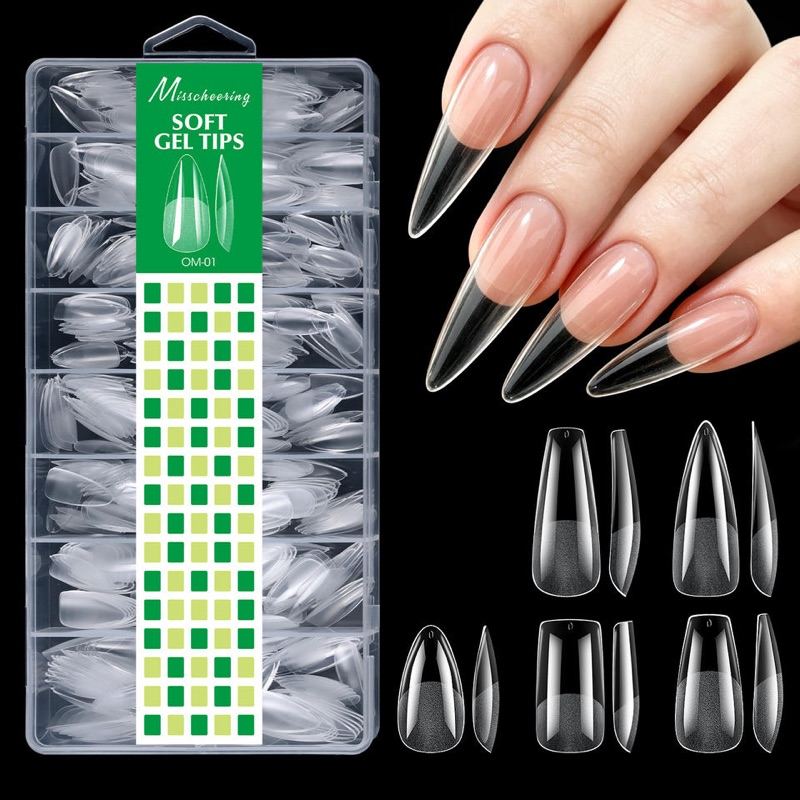
480 pcs Single-Size Nail Tips Refill Pack — Press-on False Nails, Handmade Extension Tips
A 480-piece single-size refill box with a compartment layout, sold as bulk refill stock for press-on and salon use. Useful as the ordering route to start the mould-compatibility conversation.
- Supplier
- Misscheering (listing supplier, verify current store before ordering)
Prices, minimum order quantities and pack configurations are set by the supplier and were not confirmed for this guide. Check the live listing and request a sample before you commit.
Choose a single-size refill when you know the original mould or hold a physical control sample; the new tip matches the required dimensions and curve; demand is repeatable; MOQ and packing work economically; and the sample passes your written check.
Choose a full box when compatibility is uncertain, several sizes are low, or you are changing factory, shape, or positioning. The apparent excess can be cheaper than the customer-service cost of an inconsistent kit. A complete box is especially useful when your product team needs a fresh control set for the new production version.
Before issuing a purchase order, keep four items together: original-tip photos, the measurement comparison sheet, the sample acceptance result, and the supplier or mould reference. Add the quantity used in your reorder calculation. This small record lets someone else on your team understand why the decision was made, and it reduces the chance that the next order is placed from a remembered number or a screenshot.
The supplier conversation should end with evidence, not a promise. When a common size runs out again, you will not need to source from a product photo or an assumption that matching numbers fit alike. You will have a replenishment system that protects fit, packing accuracy, inventory discipline, and the customer experience your brand is building.
5. What are the MOQ, pack format, and landed-cost trade-offs?
“Available by single size” does not mean “economical by single size.” A supplier may offer one-size cartons but impose a minimum order quantity larger than you can use. Tips may arrive loose, in bags, in trays, or in preset counts. Those formats change sorting time, damage risk, and the accuracy of inbound counting.
Ask for a quote with the minimum per size, pieces per inner bag or box, price at relevant quantities, sample charge, production time, shipping options, and whether mixed sizes may meet the minimum. Confirm whether the stated count includes spare pieces. Compare more than the item price.
Calculate landed cost per usable tip: product, shipping, tax or duty where applicable, payment charges, expected waste, and labour to count and pack. A loose low-price pack can cost more once your team sorts hundreds of tips. A full box may have a lower unit price but leave you holding sizes you will not use. The right choice is the one that provides enough verified, usable inventory at an acceptable total cost.
Packing must also suit your product. Long, thin, or decorated tips can deform or scratch when compressed. The refill should arrive in a format that your receiving process can inspect quickly. If you must empty every bag onto a table to identify the tips, it may be cheap only on paper.
6. Can you test a sample against a written acceptance checklist?
Do not move straight from a supplier’s table to a production refill when compatibility risk is meaningful. Obtain the actual size and line as a sample. Your checklist should be short enough to repeat and specific enough to catch the reasons refills fail.
Use your original tip as the control. Verify the internal label, maximum internal width, length, contact-area shape, curve, sidewall profile, thickness feel, colour or transparency, finish, and visible defects. Put the original and proposed tip in the same size compartment. If a team member can spot the difference without a label, it deserves a deliberate product decision, not a quiet substitution.
Make a small test assortment containing the refill and neighbouring sizes. Ask representative fit testers to apply them normally. Record whether the refill makes them choose a different size, alters their view of the set, or lifts at the sidewalls. This is a practical product check, not a clinical test, and it should happen before you commit to inventory.
Also observe how the tips behave in the actual kit workflow. Can they be picked, counted, labelled, and placed into the correct compartment without slowing fulfilment? Do their edges catch on protective film or on the insert card? Do they stay recognisable after a staff member handles them? Product compatibility includes the work needed to prepare the product, not merely the moment it is placed on a nail.
Write pass/fail criteria into your order record. Examples include: same internal width within the agreed tolerance; visually consistent curve when nested; no burrs, warping, or sharp edges; and no visible finish difference under normal photography. Avoid phrases such as “good quality” or “similar to sample.” Specific checks make future approvals consistent and make any supplier conversation more concrete.
7. Does a full box solve a larger system problem?
A full box is not a failure to optimise. It is often the correct reset when you cannot verify the mould, when material or sizing has changed, when a new shape is launching, or when several sizes are low. It can also be the better route when a new factory’s sample performs better and you are prepared to update the size chart, instructions, and fit-test record together.
Treat this as a version change. Assign the new tip system an internal code. Do not quietly mix it with leftover stock. If both versions will be sold, separate them in fulfilment and make sure the sizing information for each is clear. The goal is not to eliminate old inventory immediately; it is to avoid a kit whose components have no dependable shared specification.
For many small brands, the strongest approach is hybrid. Keep complete boxes as approved baseline inventory, then add verified one-size top-ups for predictable fast-moving sizes. That preserves continuity without forcing a full reset every time a compartment is empty. It works only if the refill is traceable to the same system and your demand data supports it.