A mixed box is often the right first purchase: it lets a maker test a tip family without guessing which sizes customers will request. The trouble starts when the same few sizes disappear and the rest of the box remains untouched. A single-size refill can reduce that mismatch, but it is not automatically the cheaper or safer reorder. The decision depends on actual size use, the product specification behind each number, minimum quantities, shipping, and whether the refill truly matches the tip line already in production.
This guide is for small press-on brands and independent makers who decorate blank full-cover tips in repeatable styles. It focuses on deciding what to reorder and what to confirm with a supplier. It does not assume that every factory offers individual-size refills, or that two bags marked “size 5” contain interchangeable tips. For the separate job of making and labelling a sizing kit, see our press-on sizing-kit guide, and for the supplier-question checklist that pairs with this decision, read single-size refill or a full box.
Start by separating three products that get called “nail tips”
A search for nail tips can lead to several different products: half-cover salon tips, full-cover soft-gel extension tips, and finished press-on nails sold as a wearable set. They do not have the same buying job. A refill pack for a salon extension system may not be a suitable blank for a hand-painted press-on collection, even if both listings use the words “full cover.”
Before comparing a box with a refill, write down what the blank tip is for: a finished customer set, a salon extension service, a sizing sample, or practice. Record the material stated by the supplier, whether the tip covers the full nail plate, the shape and length, the surface finish, and any profile or curve line. If the product is intended to become a press-on set, also note whether it will be painted, decorated, filed or pre-etched before sale.
Those details define the product family. The number printed under a tip is only a label inside that family. It is not a universal measurement. A size 5 from one mould, supplier, shape or curve line should not be assumed to match a size 5 from another.
Use the first box to learn what your customers actually consume
A full assortment has value beyond the tip count. It gives a new seller a chance to test the supplier’s range, fit samples to different hands, and collect early order data before committing to a narrower stock profile. If you have only sold a few sets, the “popular sizes” you expect may not be the ones that move in practice.
Keep a simple usage record for each exact tip family. For every completed set or sample, record the style, tip line, shape, length, size number used on each finger, and whether the tip was accepted, filed or rejected. Do not combine numbers from different moulds or profiles into one report. If the product changes from Natural to Sculpted, or from short almond to long stiletto, start a separate record.
A spreadsheet does not need complex inventory software. One row per order is enough to begin. Count the number of tips consumed by size, not just the number of sets sold. A ten-nail set can use the same number twice or use ten different numbers, and that affects the stock mix. Record replacements and samples separately from retail orders so they do not distort customer demand.
Treat early patterns as provisional; update the record as orders accumulate and keep the date range beside the totals.
Compare the packs using usable demand, not the headline piece count
A full box can advertise the lowest cost per tip while leaving a seller short of one frequently used size. A refill bag can have a higher per-piece price and still tie up less cash if it buys only the size currently needed. Neither comparison is complete until you account for what will be used and what remains in inventory.
For each option, calculate:
Landed cost per usable tip = (item cost + shipping + duties or fees attributable to the order) ÷ the number of tips you reasonably expect to use before the specification changes.
For a mixed box, do not divide the full cost by every tip if you already know that several sizes are unlikely to be used. Estimate the usable quantity by size from your own records. The leftover tips are not automatically waste: they may support new customers, samples, replacements, or a future product if the mould remains the same. Count them only when you have a plausible use for them.
For a refill, include the minimum quantity and the cost of placing the order. A supplier may sell one bag in one size, require several bags per size, or require a larger combined order. Shipping one small bag by itself can make the per-tip cost unattractive; combining several sizes may improve the landed cost but also increases inventory. Request the price break at the quantities you could actually order, rather than using a displayed “from” price as your budget.
Use a reorder comparison that includes:
- the exact size and tip family you need;
- pieces per box or bag;
- quantity you expect to consume before reordering;
- minimum order and pack multiple;
- item price at that quantity;
- shipping, taxes, duties and other fees;
- expected leftover inventory by size;
- the risk that the supplier changes the mould or retires the style.
An illustrative calculation can help explain the method without pretending to be a market quote. Suppose a mixed pack contains ten sizes, but a maker’s recent order records show regular demand for only four of them. Compare the next mixed pack’s landed cost against the refill quantities for those four sizes, then value the other six sizes only if there is a realistic use for them. Put your own supplier quote and usage counts into the calculation; the result is only as good as those two inputs.
Ask the supplier questions that protect the specification
Before you rely on a refill as a repeat purchase, confirm that the supplier can identify the exact product and that the same setup will be used in a later batch. Ask for written answers against the specific item code or sample you have approved.
-
Can this exact tip be reordered by size? Give the item code, shape, length, curve or profile, finish and size numbers. Ask which sizes are available and whether the supplier can quote each one separately.
-
What does the pack contain? Confirm pieces per bag, whether pieces are identical in size, how they are counted, and whether the quoted unit refers to a bag, a pair, a tray or a larger carton.
-
Is the refill from the same mould and specification as the approved box? Ask the supplier to identify the mould or product code and state what changes would trigger a new sample approval. Do not rely on the number printed beneath the tip alone.
-
How is size measured and identified? Request the supplier’s measurement method, a current size chart for that exact family, and a photo of the size labels. Compare physical width and profile against your retained reference sample.
-
What is the minimum for each size and for the whole order? Ask about per-size MOQ, mixed-size MOQ, pack multiples, custom packaging requirements and any minimum order value.
-
What sample can be sent before a repeat order? Request the same sizes and finish you plan to buy, not a visually similar substitute. If a sample fee or shipping charge applies, include it in the comparison.
-
What will the order record show? Ask that the purchase order or invoice list the product code, shape, length, profile, size, pack quantity, material description and approved sample reference. Agree how you will handle a size that does not match the sample.
These questions are a buyer checklist, not a promise that a supplier will agree to every condition. If the supplier cannot identify the product beyond a broad name or an image, mark the offer as unverified and do not treat it as a dependable refill source.
Check the sample before replenishing a size
Keep one approved sample from the original assortment in a labelled reference tray or bag. Mark its supplier, item code, shape, length, profile, size number, order date and the way you measured it. Store it away from dust and bending pressure. The point is not to create a laboratory standard; it is to preserve a clear “this is what we approved” comparison.
When the refill arrives, inspect the outside label before opening several bags. Confirm that the item code and size match the order record. Then compare representative tips against the reference sample using the same method every time. Measure the widest point across the tip and record length or other dimensions you use to distinguish that family. Place the new tip beside the retained sample under the same light, and compare the sidewalls and profile. A width match alone may not reveal a curve or length difference.
If the tip is intended for a finished press-on product, test the decoration and finishing workflow too. A blank that fits the same finger may still behave differently during filing, painting, curing or packaging. Make one test piece before using the replenishment lot in paid orders. Keep photographs and a short note with the lot date. This creates traceability for your own process; it does not certify the material or replace a supplier quality document.
If samples vary, pause the reorder and send the supplier the item code, reference sample details, measurements and clear photos. Ask whether the difference reflects a substitute mould, a new production revision or a packing mistake. Do not quietly mix the two versions in a customer set. If the seller cannot establish what changed, treat the refill as a different product and recheck fit before using it.
Reorder options in practice
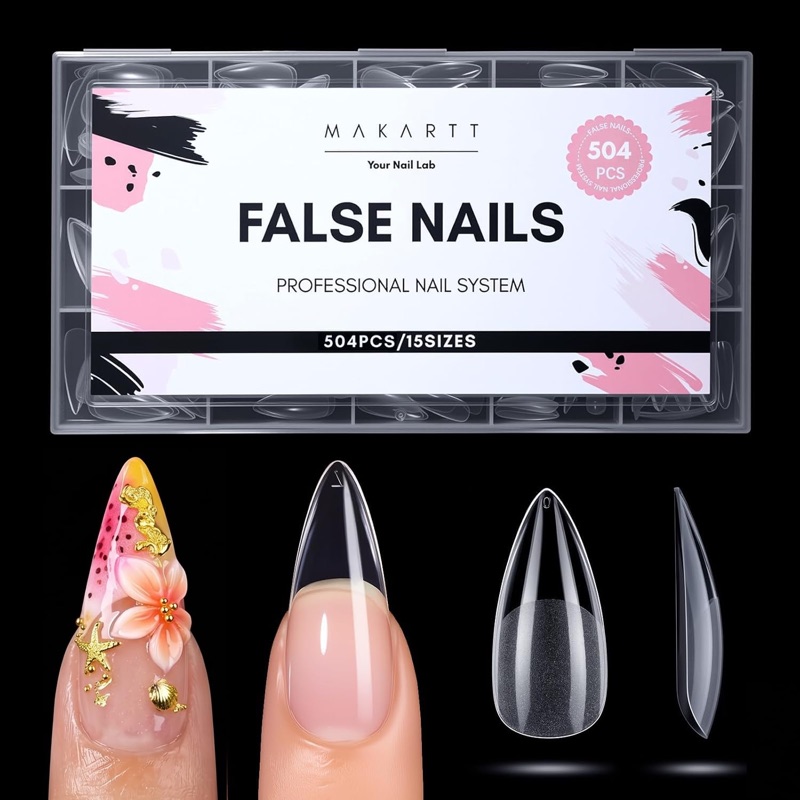
Medium sharp almond nail tips, 15 sizes, 504 pieces
A full assortment to use as the baseline before you narrow to refills. Check the size sequence and whether the mould is stated, since the printed numbers only mean something inside one tip family.
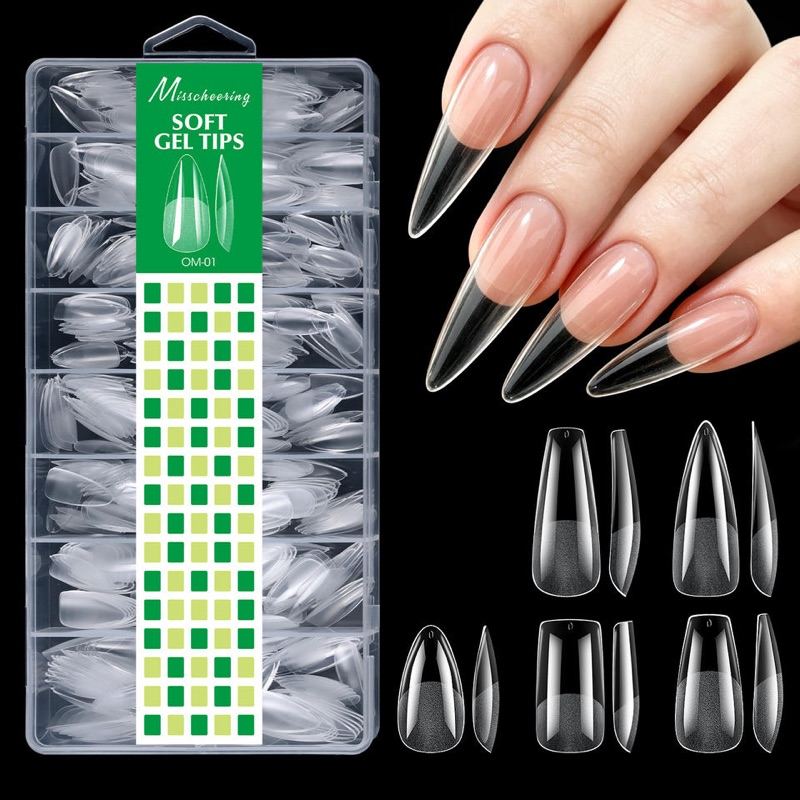
480-piece single-size nail tip refill pack, wholesale
A per-size refill format rather than a mixed box, which is the point of this decision. Confirm the tip family, size numbering and per-size minimum with the supplier before comparing landed cost.
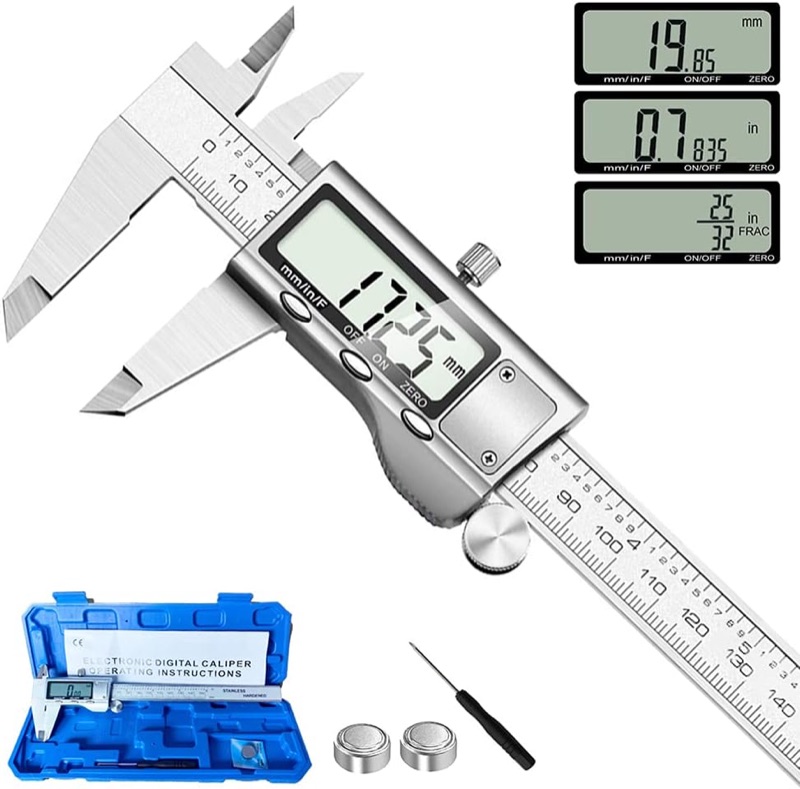
Digital caliper for tip width and curve checks
Used to measure the widest point of an incoming tip against your retained sample, so a refill can be compared numerically instead of by eye. Record the same measurement point every time.
Card photos are the current marketplace listing images and may differ from the delivered product; confirm details on the live listing.
Know when another mixed box is the better purchase
A mixed box can still be the sensible choice when you are starting a new product family, switching from one shape or length to another, testing a new supplier, serving customers whose sizes are not yet understood, or finding a refill minimum that is too large. It can also be more practical if you routinely use most of the included sizes or if several sizes are needed for a new collection.
A refill is more compelling when you have repeat demand for a small number of sizes, those sizes map to an approved tip family, and the refill quantity fits your rate of use. It is less compelling when demand is sporadic, the supplier has a high MOQ, shipping dominates the order, or the mould is likely to change before you use the bag. A lower item price is not useful if it leaves you holding a size that no longer matches the design or fit system you sell.
There is also a hybrid path: buy an assortment while you are testing, then replenish only the sizes with recorded demand. Do not let the mere availability of refill bags force a split-size inventory too early. Keep one untouched sample or a small reserve from the mixed box if it helps you compare later batches.
A refill example, and what it does not prove
Some professional tip brands sell refill bags of around 50 tips in a selected size, alongside style variants. That is evidence for those named product lines only; it does not show that a private-label factory or marketplace seller offers matching refills or uses the same mould. Check the current product variant before ordering.
Confirm available sizes, MOQ, price, lead time, packaging and sample terms in writing. A custom request may change them; one product family’s refill options do not guarantee another’s.
A marketplace listing, with a key difference
Wholesale listings make the same point from the other direction: a refill can be sold as a single size in a large pack, with a minimum order measured in bags rather than pieces. Those offers sometimes describe a half-cover salon tip rather than a full-cover soft-gel blank, and the two are not interchangeable for a press-on line even when the size number matches.
Treat any such listing as a candidate, not a confirmation. Confirm the exact SKU, size and shape, order a sample, and check shipping before comparing landed cost against the mixed box you already use.
Make the reorder decision from evidence you can reuse
A good refill process turns a one-off purchase into a record you can use next time. Keep the approved sample, size map, recent use by size, landed quote, MOQ, supplier response and incoming check together under one product-family code. When you request a reorder, send that record rather than saying only “same size as last time.”
Choose a mixed box when you still need the range or cannot validate a dependable refill. Choose size-specific packs when repeat use is documented, the offer matches the approved product, and the full landed order makes sense. If any one of those conditions is missing, wait for a sample or buy the smallest practical test quantity.
Choose by measured demand for the approved tip family; compare full landed cost and expected leftovers. Reorder records are more useful than a generic promise of single-size availability.