A cover that held all winter starts peeling the moment the temperature climbs. Nothing about the product changed — what changed is the surface it sticks to.
Heat, sweat and sunscreen all work against the adhesive at the same time, and together they can defeat a cover that is otherwise perfectly fine. Most of what fixes it happens before you leave the house.
Heat changes three things at once
- Your skin gets oily faster. Sebum and sweat form a film within an hour of being outside, and adhesive does not grip a film.
- Sunscreen and lotion migrate. Body products travel upward with heat and sweat, and they land exactly where the cover sits.
- Fabric moves more. Thin summer fabrics slide against skin, and a loose top tugs at the edge of a cover with every step.
That combination is why a cover can work in a fitted dress in April and fail under a linen shirt in July. The adhesive has not degraded; the conditions have.
Put sunscreen and lotion on first, then wait
This single change fixes more summer slipping than any product swap.
Order of operations:
- Apply body lotion and sunscreen as normal.
- Wait until they are fully absorbed — usually five to ten minutes.
- Blot the area with a clean tissue if it still feels tacky.
- Only then apply the cover.
Applying a cover over a fresh layer of sunscreen is the most common cause of a cover that slides within an hour. The sunscreen is doing its job: it is designed to sit on top of the skin and stay there.
Avoid putting powder, oil or shimmer products on the area you intend to cover. Powder in particular leaves a film that adhesive cannot grip.
Prep the skin, not just the cover
Before application, the skin should be clean, dry and free of product. A quick wipe with a plain tissue is enough; a toner or astringent can leave residue of its own.
Do not apply straight out of a hot shower. Skin that is still warm and slightly damp will trap moisture under the cover, and that moisture has nowhere to go.
If you are reapplying during the day, wipe the area first. Reapplying onto the old spot without cleaning pushes sweat and residue back under the adhesive.
Apply with pressure, and hold it
Technique matters more in heat than in cool weather.
- Centre the cover, then press from the middle outward with the flat of your fingers.
- Hold for a full 10–15 seconds. A quick tap is not enough to activate full contact.
- Smooth out any wrinkle at the edge — a wrinkle becomes the place where peeling starts.
- Give it a minute before dressing, so the adhesive has settled against the skin.
Avoid stretching the cover when you apply it. A cover applied under tension pulls back at the edges as it warms up, and that is exactly when it lifts.
Match the cover to the outfit
Summer clothing is harder on a cover than winter layers.
- Loose linen or a flowy top: fabric movement tugs the edge. A larger cover with a thin tapered edge resists this better than a small one.
- Backless or low-cut: an adhesive cover is the only option that works, but it must be applied to clean dry skin with nothing underneath.
- Thin light fabric: a matte skin-toned cover disappears; a glossy one catches light.
- Under a fitted dress: a standard round cover is usually enough, because the fabric holds it in place.
If you are choosing between two sizes, take the one that covers the area with a small margin rather than one that fits exactly. A cover smaller than the area it sits on has an edge that rubs.
When it is the product, not the heat
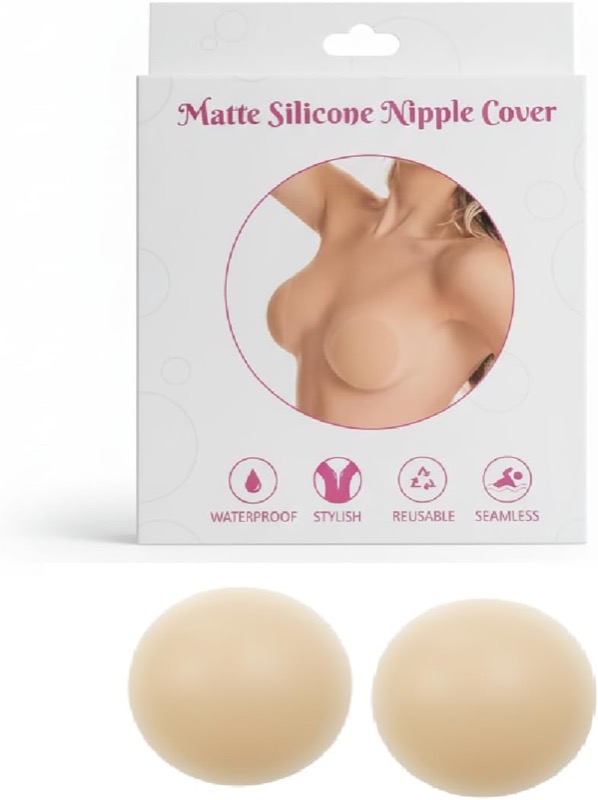
Matte reusable silicone nipple covers
A matte-finish adhesive cover with a low sheen that disappears under thin summer fabric. Check the diameter and edge profile for the tops you plan to wear it with, and follow the pack's own cleaning routine.
A matte surface reads better under thin fabric than a glossy one, which catches daylight.
If a cover slips even with clean, dry, product-free skin, correct application and the right size, the adhesive has probably reached the end of its life. Summer accelerates that: more wear, more washing, more handling.
Signs it is time to replace rather than adjust:
- The edge lifts within 20 minutes even on cool dry skin.
- The surface feels smooth instead of slightly tacky when dry.
- Cleaning no longer restores grip.
- The cover has stretched or changed shape.
For the full cleaning and storage routine that gets the most wear out of a pair, see how to clean reusable nipple covers.
What to carry for a midday fix
You do not need a spare pair for most days, but a small kit helps:
- One spare cover, kept on its film in a case.
- A couple of tissues to dry the skin before reapplying.
- A small mirror if you will be reapplying somewhere without one.
Reapplying works best after blotting the area dry and letting it air for a minute. If the skin is damp and hot, no adhesive will hold well — that is a moment to change into the outfit that gives more coverage rather than fight it.
What not to do
- Do not tape over a lifting cover. Fashion tape on top of silicone creates a worse edge and often takes skin with it on removal.
- Do not use hairspray, glue or powder to make it stick. Hairspray dries the adhesive surface and leaves a film; glue damages it permanently; powder defeats adhesion by design.
- Do not apply to damp or sunburnt skin. Neither will hold, and both can irritate.
Do not leave a cover on all day in heat if it has already started lifting. A cover that has partly detached collects sweat and lint underneath, and it will not recover by pressing it back down.
Heat plus a heavy day
If you are out in the heat for hours, a single cover is working against real conditions: sweat production is high and fabric is moving.
Practical adjustments for those days:
- Apply the cover to skin that has been clean and dry for at least ten minutes.
- Choose the larger size rather than the smaller.
- Skip body products on that area entirely — sunscreen goes everywhere else.
- Carry a spare and reapply once, mid-day, rather than hoping one application lasts.
Quick checklist
| Situation | What to do |
|---|---|
| Applying after sunscreen | Wait 5–10 minutes, blot, then apply |
| Skin feels warm or damp | Let it cool and dry before applying |
| Loose summer top | Use a larger, thin-edged cover |
| Cover lifts mid-day | Blot dry, reapply a spare; do not tape it down |
| Slips even on clean dry skin | The adhesive is worn out — replace |
| Storing between wears | On the film, in the case, away from heat |
Most summer slipping is a preparation problem, not a product problem. Sunscreen first, wait, blot, apply with pressure — and a cover that felt useless in July often holds fine in August.