A reusable cover holds perfectly on the first wear and starts lifting at one edge by the fourth. The silicone looks unchanged, so it feels like the product failed — but in most cases the adhesive face has picked up something: lotion, lint, residue from a rinse that was not thorough, or moisture trapped in the case.
Understanding what actually shortens the life of a pair is the difference between replacing them every month and getting the wear count the pack promised. Here is what to expect, how to clean them, and when to stop trying.
What "reusable" means on the box
It means the cover is designed to be worn more than once. It does not mean a fixed number of wears, and the number varies a lot between products.
Brands in this category publish everything from "up to 25 wears with proper care" to a maximum wear time per application of about six hours. Reviews and round-ups tend to land somewhere between 20 and 30 wears for well-cared-for pairs. Those figures describe specific products under specific care, not a guarantee for yours.
Two things to take from that:
- "Reusable" is a construction, not a lifespan. The pack should tell you the care routine and often a wear limit.
- Wear time per application matters as much as the number of wears. A cover worn for a fourteen-hour day is not the same as one worn for four hours, even if both count as one wear.
If your pack gives no care instructions at all, use the routine below and treat the cover as a short-life item.
How many wears you can realistically expect
A sensible expectation for a well-cared-for adhesive pair worn a few hours at a time: somewhere in the region of 15 to 30 wears. Heavy use in heat, oily skin, or a careless cleaning routine will land much lower.
What pulls you toward the low end:
- Applying over body lotion, oil, sunscreen, powder or fragrance.
- Wearing them for long, hot days or to the gym.
- Washing with hot water, harsh soap or a cloth that leaves lint.
- Storing them loose in a bag instead of on the film or in the case.
- Peeling them off quickly instead of easing them away from the skin.
None of these is a manufacturing defect. They accelerate the same wear that eventually ends every adhesive cover.
Why the grip fades
The adhesive works by contact. Anything between the silicone and your skin reduces that contact, and the effect compounds each time the cover is handled.
- Body products. Lotion, oil, sunscreen and powder transfer onto the adhesive face and stay there. This is the single most common cause of a cover that stops holding in week two.
- Residue from cleaning. A rinse that leaves soap film is as bad as no cleaning at all. Soap residue is slippery and attracts dust.
- Lint and fibres. Stored loose in a makeup bag or a drawer, the adhesive face becomes a lint trap. Once fibres are embedded, they do not rinse out easily.
- Moisture in storage. Sealing a damp cover in a case traps water against the adhesive and the film. It should be fully dry before it goes back.
- Physical wear. Edges thin out, the surface dulls, and eventually the tack is simply gone. That is the end of the pair, not a cleaning problem.
The cleaning routine that works
Follow your pack's instructions first — they are written for that exact adhesive. If the pack says nothing useful, this is the routine that works for most adhesive silicone covers:
- Rinse the adhesive face with lukewarm water as soon as you take the cover off, before anything dries on it.
- Use a small amount of mild soap — hand soap or a gentle cleanser. No alcohol, no oil-based cleanser, no scrubbing.
- Rub gently with your fingertips, not a cloth or a sponge. Both leave lint or abrasion marks.
- Rinse thoroughly until the surface feels squeaky rather than slippery. This step is where most people stop too early.
- Shake off the water and air dry, adhesive side up, on a clean surface. No towel, no hairdryer, no radiator.
- Reapply the protective film once the surface is completely dry, then put it in the case.
Wash after every wear, not every few wears. Residue that sits for a week bonds to the surface and no longer rinses off.
Store them so they stay tacky
The film and the case are part of the product, not packaging. A cover stored without its film will pick up dust and lose tack within days.
- Keep the original film. If you lose it, a clean piece of non-stick baking parchment works better than cling film.
- Store flat in the case, not folded or stacked face to face.
- Keep them out of a hot car or a sunny windowsill; heat softens the adhesive and can distort the shape.
- Do not store them in a bathroom where steam and dust are constant.
Choosing the size and edge
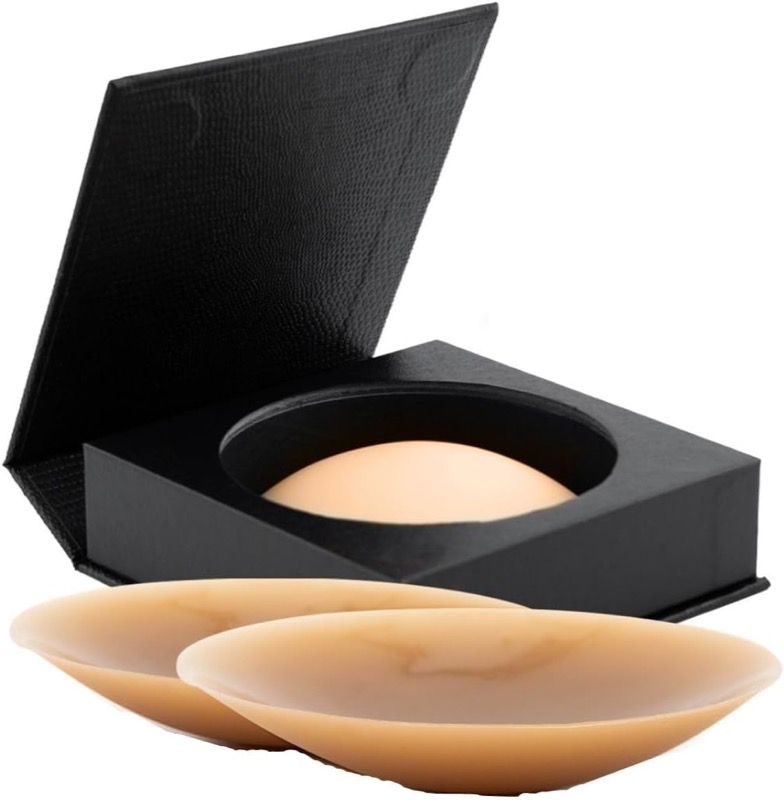
coverme reusable adhesive silicone nipple covers
Round adhesive silicone covers with a protective film and storage case. Check the diameter and edge profile for the tops you plan to wear them with, and follow the pack's own cleaning routine.
Keep the film and the case — they are what protect the adhesive between wears.
Most covers are sold as a nominal diameter, usually somewhere between 7 and 10 cm. Bigger is not automatically better: a cover wider than the area it sits on will wrinkle at the edge, and a wrinkle is where lifting starts.
- Under a fitted top or dress: a standard round cover is usually enough.
- Under a loose or low-cut top: a larger cover with a thin tapered edge stays flatter.
- Under sheer or light fabric: choose a matte, skin-toned cover; a glossy white one reflects light and shows.
Check the edge profile in the listing photos. A tapered edge blends into the skin; a thick blunt edge creates a visible ridge under thin fabric.
When it is time to replace
Cleaning restores grip when the problem is residue. It does not restore a worn surface.
Replace the pair when:
- The edge curls, lifts within minutes, or no longer sits flat even after cleaning.
- The surface feels smooth rather than slightly tacky when dry.
- Fibres are visibly embedded and will not rinse out.
- The cover has changed shape, stretched, or the colour has yellowed.
- Removal has become uncomfortable, or it leaves residue on the skin.
If a cover still sticks but needs careful handling and a long press to stay on, it is finished in practice even if it technically adheres.
Where the failure shows up tells you something. A whole cover that slides suggests lotion, sweat or a garment that does not press against it. A single edge that peels points to placement, a folded edge, or pressure from a seam. A surface that feels slick, tacky in patches, cracked or stretched is at the end of its life. Clean it once by the maker's routine, dry it fully, and try it on clean dry skin in a low-stakes setting: if it holds better, residue was part of the problem; if it does not, stop trying to rescue it.
Do not try to revive it with hairspray, glue, powder or alcohol. Those either damage the silicone or irritate skin, and they are never in the maker's instructions.
Adhesive or non-adhesive: buy the right type
Two products get sold as "reusable nipple covers" and they behave completely differently.
- Adhesive covers attach to skin and stay put under almost any garment, including loose tops and backless dresses. They need the care routine above and have a finite life.
- Non-adhesive covers rely on the shape of the cover and pressure from a close-fitting garment. They last far longer because there is no adhesive to wear out, but they shift under loose clothing and are the wrong choice for a backless top.
If a non-adhesive cover slides, that is not a failed adhesive — it is the wrong product for that outfit. Washing it until it becomes sticky will not help.
Wear time and skin care
Adhesive covers are not designed for continuous multi-day wear. Several brands cap a single application at around six hours, which is a sensible guide for anything worn against skin.
- Take them off at the end of the day rather than sleeping in them.
- Do not wear them on broken, irritated or sunburnt skin.
- If you feel itching or a rash, remove the cover and leave the area alone for a few days.
- Clean the skin, not just the cover, before reapplying.
Quick checklist
| Question | What to do |
|---|---|
| How often should I clean them? | After every wear, mild soap, thorough rinse |
| How do I dry them? | Air dry, adhesive side up, no towel or heat |
| Where do I store them? | On the film, in the case, flat, away from heat |
| How many wears? | 15–30 typical with good care; fewer in heat or heavy use |
| When do I replace them? | Edge lifts, surface feels smooth, fibres embedded |
| What if they slip anyway? | Check body products and storage before assuming a defect |
A pair that is cleaned properly, dried fully and stored on its film will last far longer than the same pair treated casually. That routine costs about a minute a day, and it is most of what "reusable" actually depends on.