A shower cap looks like the simplest product a hair-accessory brand could sell: a thin plastic circle with an elastic edge. Yet listings for shower caps and their thicker cousins, deep-conditioning and heat caps, carry a surprising amount of language: "Waterproof." "PEVA, non-toxic and PVC-free." "Reusable and durable." "Satin-lined to protect hair." "Microwave safe." "Locks in moisture." "Fits all hair, including braids and locs." Each phrase is a promise a customer can check in thirty seconds, in a shower, with wet hair — and two of them, "non-toxic" and "microwave safe", are safety claims rather than comfort claims. They need a document or a test, not an adjective.
The failure is visible and immediate. A cap that lets water run down the neck, rips at the seam on the first stretch, smells of chemicals in the steam or leaves a hot spot on the scalp does not get a second chance.
This guide separates the material claims, which can be tested, from the benefit claims, which mostly cannot; summarises what dermatology sources say about covering the scalp and leaving products on; and sets out a repeatable water, fit, steam and heat test. It recommends no product and makes no promise about anyone's hair or scalp. For the towel that follows a treatment, see the microfibre hair towel wrap test.
What the material claims really mean
PEVA and EVA. Most plastic shower caps are made from a thin film described as PEVA (polyethylene vinyl acetate) or EVA (ethylene vinyl acetate). Several consumer-information sites say these are the same copolymer under two labels, that vinyl acetate content makes the film softer and more flexible, and that the material is chlorine-free. They contrast it with PVC (polyvinyl chloride, "vinyl"), which contains chlorine and usually relies on added plasticizers such as phthalates to stay flexible. The same sites say PEVA does not need those plasticizers and is usually phthalate-free, which is why it is sold as a PVC alternative for shower curtain liners, food bags and baby products.
Read that carefully. It is a description of the polymer family, not a guarantee about your sample. "Typically phthalate-free" is not the same as "tested and found free". One health-and-home blog goes further, saying PEVA is less toxic than PVC but still contains volatile organic compounds and that more research is needed. Treat that as a reminder of how little independent testing sits behind these pages, not as a finding. Several of the pages we read are commercial or advocacy sites, and the figures on vinyl acetate content differ between them (10 to 40 per cent on one, 10 to 50 per cent on another). The practical point: the word "PEVA" tells you the polymer family the supplier says it used. It tells you nothing about thickness, odour, additives or compliance.
Phthalates and the law. In the United States, the Consumer Product Safety Commission enforces limits on certain phthalates, at no more than 0.1 per cent by weight, in children's toys and child care articles under 16 CFR Part 1307. That rule concerns children's toys and child care articles, and the CPSC says manufacturers are responsible for ensuring children's products do not contain hazardous substances. A legal commentary notes other children's products, such as rainwear and school supplies, fall outside that particular phthalate prohibition, though some states have their own, sometimes broader, restrictions. We have not mapped every rule for an adult shower cap, and the position differs by country and by whether the cap is aimed at children. If you want to write "phthalate-free" or "non-toxic", get a laboratory report naming the substances tested, the method and the date, and ask a compliance adviser what applies in each market.
Waterproof. A thin film is waterproof as a sheet. The cap is not, because water finds seams, the elastic channel, tiny holes from stitching or heat-sealing, and the gap where the cap meets neck and ears. The only honest way to describe a cap as waterproof is to test the finished cap, not the film.
Thickness. Listings state it in "mil" or microns, or not at all. Thicker film tends to feel more durable and is harder to tear, but is warmer and less pliable. Ask for the gauge in microns, measure with a micrometer, and record the spread across the cap.
Lined or satin-lined caps. Some caps add a fabric inner layer. If you claim satin, check the fibre; if you claim it protects hair, say what you tested. The AAD notes a covering made of silk or satin is gentler on hair than other materials when hair is pulled back loosely beneath it, but that is advice about covers worn for long periods, not evidence about a shower cap. See how to check a satin claim.
What dermatology sources say about covering the scalp
There is no body of research on shower caps as such. What exists is guidance about the two practices caps are used for.
Leaving a treatment on under a cap. Mayo Clinic's self-care advice for seborrheic dermatitis says to soften and remove scales by applying mineral, peanut or olive oil to the scalp, leaving it in for one to three hours, then combing or brushing the hair and washing it. The cap is not mentioned, and the time is a range from a clinical source. A clinician-run skincare site, which is a commercial source, suggests covering a scalp treatment with a shower cap for eight hours and repeating daily. We would not print that on a listing. If a customer has flaking, itching or scaling, AAD advice is to treat mild dandruff with a medicated shampoo and see a dermatologist if that does not help, because flaking can be a sign of seborrheic dermatitis, psoriasis, a fungal infection or eczema. A cap that holds a treatment against the scalp for hours is a self-treatment decision, not an accessory feature. Hair-mask brands meanwhile advise leaving most masks on for 10 to 20 minutes, and one warns against overnight use because the longer time can have adverse effects. Those are brand statements, but they point the same way: the time on the box should come from the treatment, not from the cap.
Heat. A well-known beauty brand explains a deep-conditioning cap is thicker than a shower cap, is meant to be heated, often in a microwave for the time in the cap's instructions, and is worn over a shower cap. The claim that heat helps hair absorb a treatment is repeated in brand copy. We did not find independent evidence for how much, if at all, heat improves the result, and the burn risk of a microwaved cap on the head is real. The safe reading: heat is a feature of a particular cap with a particular filling, and the temperature has to be measured and the instructions written from the measurement.
Covered scalps and sweat. A dandruff-shampoo maker's advice for people who cover their hair says that when hair is covered for long periods the scalp tends to retain heat and moisture, which can build up sweat and oil. Another consumer article quotes a dermatologist saying sweat is not inherently bad, but that when it sits on the scalp for a long time the combination of moisture, salt, oil and heat can cause buildup, itching and irritation. Both are indirect sources — a brand and a shopping guide — but they match common sense. A cap that traps steam against the scalp is not a cap to sleep in without evidence.
The AAD also advises people with hair loss to avoid tight styles and, when covering hair, to pull it back loosely. An elastic edge that digs in is a comfort problem and may be more than that for people prone to tension damage. The rule of thumb: pain means too tight.
Six terms the listing uses loosely
Reusable. This should mean the cap survives a stated number of uses, folds and washes. Thin film can crack at fold lines and elastic can lose its grip. State the number you tested.
Waterproof / leak-proof. A property of the finished cap, tested on a head or form in a shower.
One size fits all. Caps are measured by opening and by the volume they must hold. A cap that covers short hair will not cover long hair, thick hair, braids, locs or a bun. Print dimensions and the hair range you tested.
Non-toxic. There is no standard meaning. Treat it as a claim requiring documents.
Microwave safe. For a cap with a gel, grain or other filling, the claim needs a test of surface temperature, hot spots and seam integrity after heating per the instructions. For a plain film cap the answer is no: do not put a thin plastic film cap in a microwave, and say so.
Breathable. A thin plastic film is not breathable. If a listing says breathable, ask what it means. A cap with vents or mesh may allow air, but it will also let water in.
What goes wrong with these products
- Leaks. Water runs in at the neck or ears, through seams or the elastic channel.
- Tearing. Film rips at the elastic channel or a heat-sealed seam on the first stretch, especially over thick or braided hair.
- Elastic failure. The elastic loses grip after a few uses, or digs in and leaves a mark.
- Odour. A chemical smell that can strengthen in warm steam. Sellers describe PEVA as nearly odourless, but batches vary.
- Mould and mildew. A cap that stays damp inside, especially a lined cap stored wet.
- Heat problems. A heat cap that is too hot in places, leaks gel, or splits at a seam after microwaving.
- Claims on the box. Safety and benefit claims that cannot be supported.
Reading the results: pass, revise or fail
| Result | Pass | Revise | Fail |
|---|---|---|---|
| Material and thickness | Film named, gauge measured and consistent | Gauge varies a lot; ask for tighter control | Film cannot be identified or claims are unsupported |
| Odour | No odour after 24 hours and in steam | Mild odour that fades; add a note | Strong odour that persists or worsens in steam |
| Capacity and fit | Closes without strain over the stated hair range | Fits shorter hair only; state a range or add a larger size | Strains or splits on a typical bundle |
| Seam and elastic | No tears or splits; little relaxation after 100 stretches | Elastic relaxes; change elastic | Tears, splits or elastic failure |
| Water on form | No wet spots on paper towel or hair | Wetness only at the neck edge; adjust design or instructions | Wet spots at seams or in the crown |
| Steam and hot water | No warping or stickiness | Slight curl at high temperature; add a care note | Warping, fusing or tacky surface |
| Fold and storage | No cracks after 50 folds, no mould after a week | Cracks only at a hard crease; add folding advice | Cracks along the usual fold, or mould |
| Heat cap | Even temperature below your limit, no leaks | Hot spots; adjust filling or time | Hot spots, leaks or seam damage |
| Volunteer panel | Comfortable, dry, easy to remove | Complaints fixed by size or instructions | Pain, burns, tenderness or repeated leaks |
Treat a failure on water, heat or material identification as a stop. Treat the rest as a prompt to change the instructions or the listing.
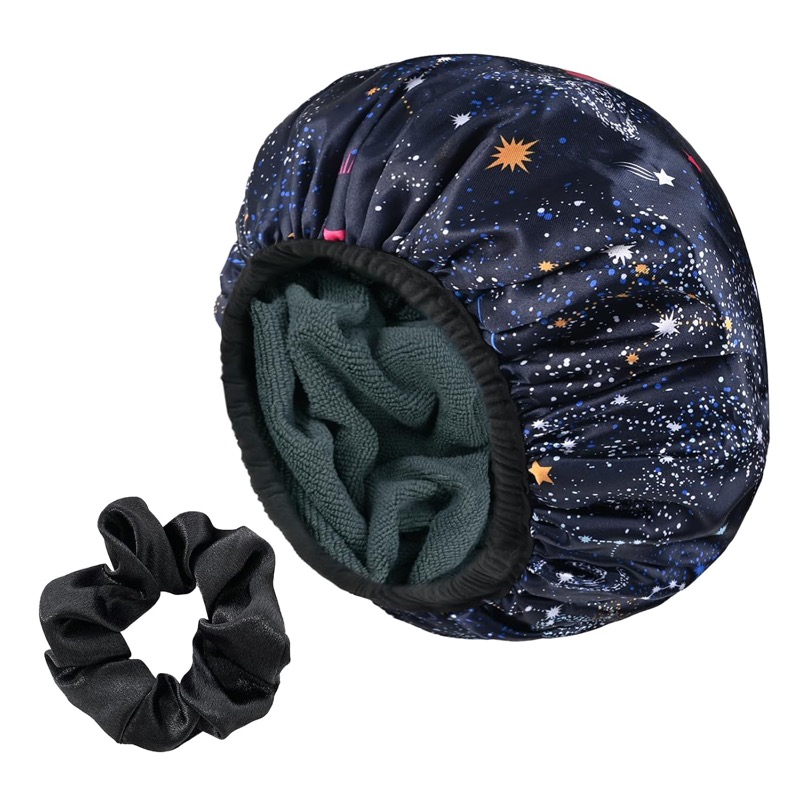
Satin-lined shower cap, large
A second build worth comparing: a lined cap, which adds a fibre claim to a film claim. Two materials means two things to verify — the film's gauge and identification, and the lining's actual fibre content.
The sample test: nine steps in an afternoon
These are our own screening procedures, not a standard. They compare samples, check the claims you plan to make, and fail weak items early. Use at least five pieces per model from different packs. Record room and water temperature, and photograph every defect with a ruler in frame. If you test microwave or hot-water exposure, use the precautions you would for any hot item, and never test on a person until the item has passed on a form.
1. Material, thickness and odour. Ask for the film name (PEVA, EVA, PVC, polyethylene, other), gauge in microns, any lining, and elastic type, with a laboratory identification report for the film. Measure thickness with a micrometer at several points on each cap and record the range. Smell a freshly opened pack, again after 24 hours in a sealed bag, and again after five minutes in a warm steamy bathroom. Record any odour and its strength.
2. Dimensions and capacity. Lay the cap flat and measure diameter. Stretch the elastic opening gently around a tape measure and record circumference at rest and at a stated stretch. Then measure what it holds: stuff the cap with a standard bundle of hair (or a soft form) of increasing volume — a short loose bundle, a long bundle in a bun, a large bundle of braids — and record whether the cap closes without strain. The AAD advises against tight styles; a cap that must be forced over the hair is a poor fit.
3. Seam and elastic stress. Pull the opening to a stated multiple of its relaxed size for 30 seconds, ten times, and look for tears, white stress marks and seam splits. Repeat 100 times and measure how much the elastic relaxed by comparing resting circumference before and after. Pull sharply at the seam and the elastic channel with moderate force to see whether a heat-sealed seam gives way.
4. Water test on a form. Put the cap on a head form or a bundle of hair on a stand, with a paper towel inside against the hair. Spray with a shower head or watering can for five minutes at a stated flow and angle, including spray directed at neck and ears. Remove and check the paper towel and hair for wet spots. Run a second test with the cap over hair of a different volume. Photograph any wet spot against a seam or edge. This is the real meaning of "waterproof".
5. Steam and hot-water exposure. Hold each cap over a bowl of hot water, or in a closed steamy bathroom, for ten minutes, then check for warping, stickiness and smell. If your listing mentions hot showers, test the temperature a customer might actually use and record it. A thin film that curls or fuses at shower temperature will fail with customers.
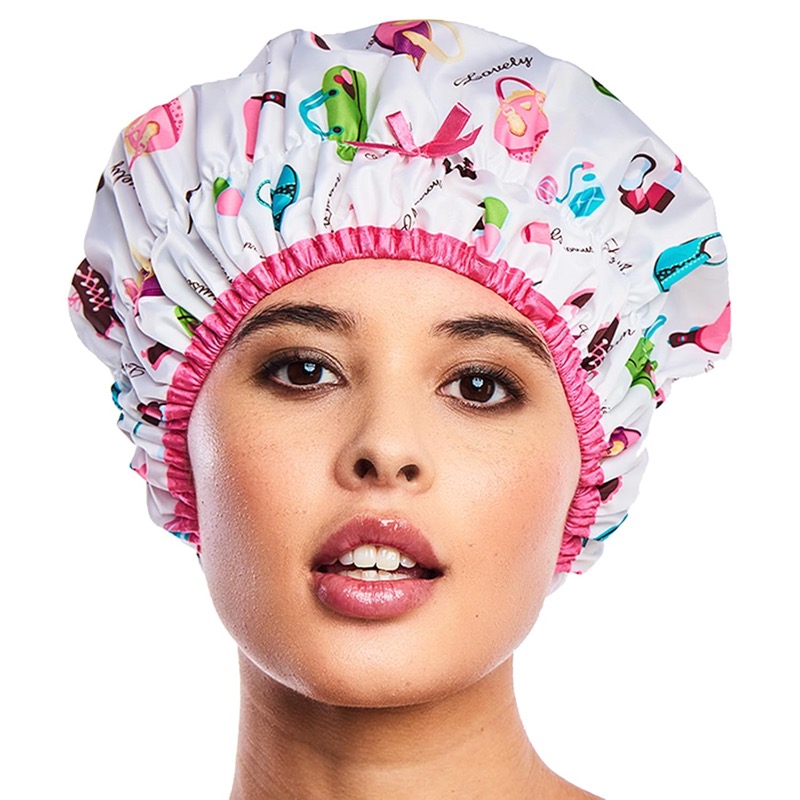
Oversized lined shower cap for long and thick hair
A retail example of the format this guide covers: an oversized cap with a lining and an elastic hem. The size claim is the one to check against your own hair bundles — a cap can be waterproof and still too small to close over braids.
6. Fold, store and dry. Fold and unfold the cap 50 times along the same line and inspect for cracks. Wash it as the instructions say, hang it to dry, and weigh a lined cap before and after to see how much water it holds. Seal a damp lined cap in a bag for a week and look for mould. Compare with a cap dried properly.
7. Heat cap test (only if you sell one). Do not start with a human. Heat the cap exactly as your instructions say — a stated time at a stated microwave power. Measure surface temperature at several points with an infrared thermometer immediately and after one, three and five minutes, and record hot spots. Open the cap and check the filling for leaks or damage. Repeat with a longer heat time to see what happens if a customer overheats it. Write the instructions from the numbers, and do not claim "safe" without a stated maximum temperature and time. If the cap is not tested for this, say it is not for microwave or oven use.
8. Lining and fabric (only if lined). Check fibre content, wash colourfastness and lint release, and whether the lining separates from the film after washing. The satin claim guide describes how to check the fibre. A lining that claims to protect hair should be tested for snagging with a nylon stocking or a hair tress.
9. Volunteer panel. Recruit at least eight adults across hair lengths and textures — including long, thick, curly and braided hair — with intact, non-irritated scalps. Protocol: wear the cap in the shower for five minutes, then on a second day wear it with a rinse-off conditioning treatment for the time on the product label, noting leaks, comfort, elastic marks, steam or heat, and ease of removal. For heat caps, give them a cap that has already passed step 7, and ask them to stop at any heat discomfort. Ask whether the cap would be comfortable for the time on the treatment label. This is not a clinical study and cannot show any hair or scalp benefit; it checks that ordinary users can use the cap comfortably and safely.
The supplier brief
- The film material by name, gauge in microns with tolerance, elastic type and any lining, with a laboratory identification report for the film.
- A test report for any "phthalate-free", "non-toxic", "BPA-free" or "PVC-free" statement, naming substances, method, date and laboratory.
- Flat diameter, relaxed and stretched opening circumference, and the hair volume the cap was designed for.
- How the seam and elastic channel are made (heat-sealed, stitched, folded), and any strength testing done.
- For heat caps: filling material, the heating instructions they tested, measured surface temperatures and the leak test.
- Odour control: whether the film is aired or washed before packing.
- Packing: whether caps are folded, how they are stacked, and whether anything is stored under pressure.
- Care instructions they have actually tested, including drying.
- Minimum order quantity, lead time, sample policy and replacement terms, on the quotation and not in chat.
What your listing can say
- Material: "PEVA film, 40 microns" only if the supplier's report and your micrometer agree. If you cannot name the film, say "plastic film".
- Water: "Tested on a head form under a shower for five minutes with no leaks at the crown or seams. Water may reach the neck edge on long hair", with your finding.
- Fit: "Fits hair that gathers into a bundle up to the size you tested. Not for large braids or locs — see our larger cap", as your testing shows.
- Odour: "May have a slight smell when new; air it before use", if true.
- Care: the washing and drying method you tested, with a note not to store the cap damp.
- Heat: "Not for microwave use" for film caps. For a heat cap, give the tested time, power and maximum surface temperature, with a warning to test on the back of the hand before wearing if your test supports it.
- Treatments: "Use the time on your treatment's label. If you have flaking, itching or scaling that does not improve, see a dermatologist."
Avoid "non-toxic", "PVC-free", "phthalate-free", "BPA-free", "hypoallergenic", "locks in moisture" and "microwave safe" unless you have evidence and the regulatory position for each. Do not suggest sleeping in a cap or leaving a treatment on for hours.
Frequently asked questions
Is PEVA safe? Sites that promote it describe it as chlorine-free and typically phthalate-free, and as a safer alternative to PVC. At least one source cautions it may still release volatile organic compounds and that more research is needed. We would not use "safe" on a listing. Describe the film and, if you have it, the laboratory report.
Are shower caps regulated? The phthalate rules we found apply to children's toys and child care articles in the US. Other rules and state laws may apply depending on who the cap is for and where you sell. Ask a compliance adviser rather than relying on this guide.
Can a shower cap help a deep-conditioning treatment work better? Brands say a cap and heat help treatments absorb. We found no independent evidence on how much. Product labels give 10 to 20 minutes for many masks, and one brand warns against overnight use.
Can I recommend wearing a shower cap overnight? We would not. Sources on covered scalps describe heat and moisture building up, and we found no support for sleeping in a plastic cap. A satin bonnet is a different product.
Is a satin-lined cap better for hair? The AAD says silk or satin coverings are gentler than other materials when hair is loosely pulled back under them. We found no evidence about lined shower caps. Test the lining and claim only what you measured.
Why does my cap smell? Plastic films can hold manufacturing odours, and warm steam brings them out. Airing helps. A strong, persistent smell is a reason to reject a batch.
Can I microwave my shower cap? No. A plain film cap is not designed for heat. A heat cap is a different product, and its instructions must come from a temperature test.
What if a customer reports a burn or a rash? Ask them to stop using the cap and see a healthcare professional. Record the batch, the heating method, the treatment used and the time. Then repeat your heat test on retained stock.