If your period underwear leaks at the back while you sleep, buying a pair labelled "overnight" may not fix it. In most cases the absorbent panel stops short of where your flow lands when you are lying down, or the pair shifts as you roll and the panel moves off the wet area.
Those are different problems from "not enough capacity", and they need different products. Before you spend on another pair, look at what actually happened — then shop for the layer position, not the boldest number on the box.
Start with where the leak is
The garment itself tells you more than any product page. Look at the pair after a night that leaked.
- Wet through to the rear edge of the panel? You are at or near capacity. You need more absorbency, or a change during the night on your heaviest days.
- Stain beyond the back edge while most of the panel is still dry? That is coverage. The panel does not reach far enough back for how you sleep, and a longer or higher-reaching panel is the fix.
- Leak at the leg opening instead? That is fit, not length. The pair is not sitting close enough at the leg, so fluid travels around the panel rather than into it.
One more thing worth noticing: whether it happens on your first night or the fourth. If only your heaviest night fails, capacity is the issue; if every night fails in the same place, it is coverage or fit.
Rise is not coverage
A high waist feels more secure and looks that way in photos, but waist height and absorbent length are separate things. A pair can sit at your natural waist and still have a short panel that stops well below the back waistband.
This is the single most common buying mistake in this category, and it is not your fault: listings sell "high rise" and rarely show the inside.
What you want to see before buying:
- A photo of the inside back of the garment, ideally with a ruler or a diagram.
- Wording about the absorbent layer extending up the back — not just the fabric rising higher.
- The same information for the size you are buying, since some ranges grade the panel unevenly.
If the page shows only the outside, message the seller: "Does the absorbent layer extend to the back waistband, and how far above the crotch seam does it stop?" A clear answer separates a genuinely long panel from a high waistband over a short liner.
Check the panel, not the cut name
Full briefs and high-rise briefs generally give more rear coverage than a bikini cut, and a boyshort can cover more across the seat. But the cut name is not a measurement: two high-rise pairs can have very different panel lengths, and a boyshort with a loose leg opening will still shift.
Compare the actual layout:
| What to look at | Why it matters at night |
|---|---|
| Absorbent layer length at the back | The main cause of rear leaks |
| Barrier layer extent | Where liquid stops before the fabric |
| Leg opening fit | Fluid can escape around the panel |
| Waistband height | Keeps the pair in place as you move |
| Fabric at the back | Stretch can let the panel migrate |
If your leaks are at the front rather than the back, apply the same reasoning in that direction — do not pay extra for a long back panel when your problem is at the front edge.
Get a close fit, not a tight one
Period underwear works when the absorbent area stays in contact with your body. A gap lets fluid run around the panel; too tight pulls the gusset out of position and feels awful at 3am.
Measure your hips and waist where the brand tells you to, then use that brand's chart. Sizes do not transfer between labels. If you fall between two sizes, read the fit notes and the return policy before ordering.
Fit also depends on the cut. A pair that fits well in the waist but gaps at the leg will leak sideways no matter how good the panel is — that is a cut problem, not an absorbency problem.
Read capacity claims carefully
"Holds up to X tampons" is a brand's own comparison, made with its own method, and it does not convert to another brand's number. Independent bench testing of period products has found wide variation, and lab conditions are not the same as a night's wear.
Use the number as a way to compare styles within one brand, not as a promise. If a listing gives a capacity figure without saying how it was measured, treat it as marketing.
Practical rule: a pair with a modest capacity number and a panel that reaches where you leak will serve you better than a higher number on a short liner.
Try a new pair on a manageable night
Do not test a new pair on your heaviest night of the month. Try it on a lighter night, or use it alongside the protection you already trust, and see how it behaves.
Check in the morning:
- Where the wet area is, relative to the panel edges.
- Whether the pair has shifted down or sideways.
- Whether the leg openings have gaped.
Two or three cycles of notes will tell you whether the problem is capacity, coverage or fit — and that is what you need to know before buying again.
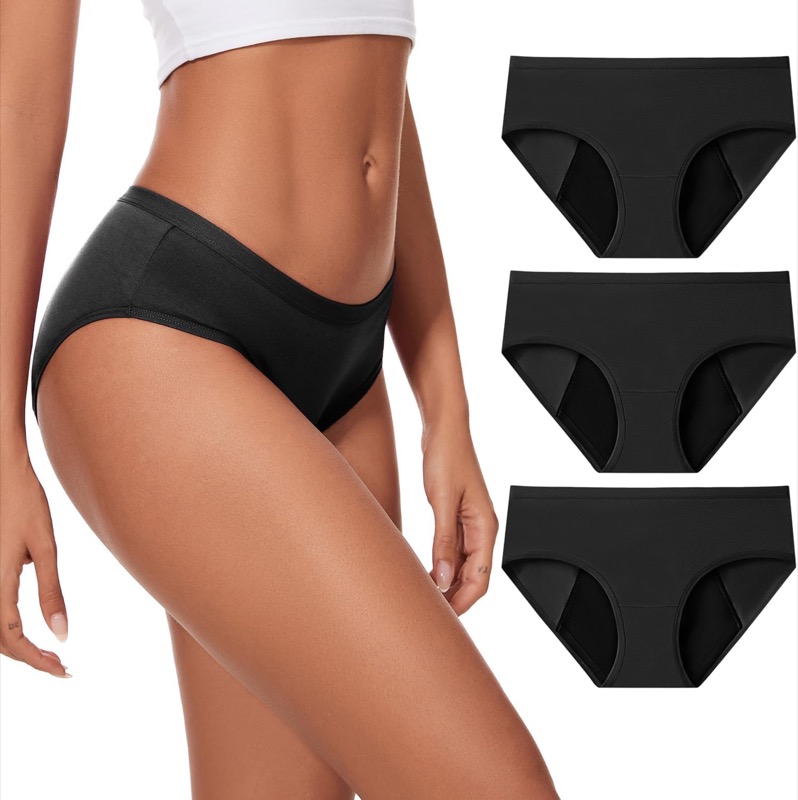
ALLBASE heavy flow period underwear, high waist
A high-waisted brief sold for heavy flow with side-leak claims. Check the inside back photo and the sizing chart before buying — waist height alone does not tell you where the absorbent layer ends.
Listing photos usually show the outside; ask for the inside back view before assuming coverage.
Care: keep the coverage you paid for
Coverage changes after washing if the panel shrinks, the seam puckers or the pair twists. If the care label allows tumble drying, know that heat is the usual cause of a panel that creeps down over a few months.
Wash as the label says, dry flat or on a line where possible, and re-check the fit after the first few washes. A pair that only covers correctly when new will start leaking in month two, and it will feel like a product failure rather than shrinkage.
When period underwear is the backup, not the plan
For very heavy flow, clotting, or nights when you are leaking through a pair plus protection, period underwear works best as backup rather than as the only thing you rely on. That is not a failure of the product; it is the wrong tool for that night.
A workable overnight setup usually combines a pair with the protection you already trust, keeps a spare pair ready for a change, and uses a small wet bag for the used one. If you are travelling, see how to test a wet bag for period underwear for what actually keeps a used pair contained.
Quick buying checklist
| Question | Good answer |
|---|---|
| Does the panel reach the back? | Inside-back photo or a stated measurement |
| Is the rise the same across sizes? | Size-specific panel length, not just "high rise" |
| Does the leg opening stay close? | Fit notes or reviews mentioning the leg |
| Is the capacity number explained? | Method stated, or treat it as marketing |
| Can you return it unworn? | Clear policy before you order |
Buy for where you leak, confirm the layer length before you pay, and test on a lighter night. That is a far better use of money than another "overnight" label that turns out to mean a higher waistband.
For the side-leak version of this problem, see testing gusset fit before a side leak.