A press-on nail set is not automatically reusable because it survived one wear. The real question is whether it is clean, structurally sound, comfortable to reapply, and still correctly matched to the wearer’s nails.
That distinction matters to both sides of the sale. A customer wants to know whether a handmade or purchased set is worth keeping. A press-on nail brand needs to decide what “reusable” means on its product page, what the customer should receive in the box, and when support should say “do not reapply.” Unlimited-rewear claims create the wrong expectation. A rewear checklist gives the customer a decision.
This guide covers the decision after removal, rather than treating reuse as a guaranteed result. It is not a medical protocol and it does not replace an adhesive maker’s directions. Do not apply press-ons over broken, painful, irritated, or visibly damaged nails or skin. If a customer reports persistent discomfort or a possible reaction, the right next step is to stop using the product and seek appropriate professional advice.
Reusable is a condition, not a permanent product feature
Many product pages use “reusable” as shorthand for a set that may be worn again. That wording can be reasonable only if it has limits. A tip may survive removal but still be a poor rewear candidate because it is bent, cracked, rough underneath, covered in residue, or no longer fits.
For a brand, the claim should describe a possibility, not a fixed number of uses. Avoid statements such as “wear this set forever” or “guaranteed to rewear ten times” unless you have defined the test conditions and can support the statement for that exact product. A clearer product-page line is: “Rewear may be possible when the tips are removed gently, remain undamaged, and are cleaned and stored according to the supplied care guidance.”
It tells the customer that removal and storage are part of the product. Raised charms, thin edges, unusual curvature, and long shapes need an extra visual check before reapplication.
Start with the removal route you chose
The likelihood of a clean rewear begins before a nail comes off. A customer who chose adhesive tabs for a brief occasion may have a different removal and residue situation from one who used liquid glue for a longer-wear plan. Neither route is automatically “reusable” or “not reusable.” They create different trade-offs.
Make these choices explicit before checkout. Tabs may suit a quicker change or fit test; liquid glue follows its own directions and removal considerations. Do not say that a glue-and-tab combination will preserve every set.
Every card needs one principle: do not force an attached tip off. Follow the adhesive’s directions; if removal hurts or resists them, stop.
The goal of removal is not merely to get the set off quickly. It is to assess whether the wearer and the tips can safely move to the next step. That makes removal guidance a customer-support system, not just a tiny line on a package insert.
The five checks before a set goes back in the box
After the set is removed, use the same checklist every time. It can appear on a care card, a QR-linked guide, or a post-purchase email.
1. Check the wearer’s natural nails first
Do not let the condition of the artificial tips distract from the natural nails. The customer should not plan another application if there is pain, tenderness, irritation, peeling, damage, or another concerning change. A retail brand should avoid diagnosing the cause. Its role is to tell the customer to stop and seek appropriate professional guidance where needed.
Natural nails change. A set that fit before may later have gaps or pressure points. Rewear begins with a dry fit.
2. Check every press-on for cracks, bends, and loose decoration
Lay the ten tips out in order. Compare the left and right pairs and inspect the underside as well as the visible surface. Look for hairline splits, warped curvature, sharp edges, lifted topcoat, loose gems, and damage near the cuticle edge. A crack or shape change can affect fit and comfort.
Do not disguise a warped or cracked tip with extra adhesive. It can complicate removal and conceal the cause of lifting. If only one tip is damaged, a well-organized brand can use this information to decide whether it needs a single-size replacement or a clearer spare-tip policy.
3. Check the underside for old adhesive residue
Residue is one of the main reasons that a set feels different on the second application. A raised lump can prevent close contact. It can also change where the tip sits and make a size that was previously comfortable feel bulky or unstable.
The customer should use only a cleaning approach that is compatible with the adhesive and tip material, and should follow the relevant product directions. Do not publish a universal chemical or tool recommendation just because one user reported good results. Different adhesives, coatings, and decorations can respond differently. Your brand can safely say: inspect the underside, remove only what your tested care method addresses, and do not scrape aggressively enough to gouge or thin the tip.
If a brand cannot validate a cleaning method across its own designs, it should not make a strong “easy to clean” claim. Instead, it can sell the set as a design that may be rewearable when removed and maintained carefully, then use customer feedback to improve the protocol.
4. Dry-fit the set again
A second application needs a second dry fit. Place each cleaned tip on the corresponding natural nail without adhesive. The tip should not press into the sidewalls, leave an obvious unsupported gap at the cuticle, or rock dramatically when touched lightly. If it does, the correct action is to stop and revisit the size or shape selection.
This matters especially for long, decorated, or strongly curved tips. Reuse does not remove leverage, so do not promise equal performance across shapes.
5. Confirm that the next wear plan still makes sense
The final check is not physical; it is practical. Is the customer reapplying for photos, a weekend event, a few days of normal activity, or a longer experiment? Is preserving the art more important than maximum attachment? The answers help select an adhesive route and prevent the customer from treating a reused set as identical to a fresh one.
For a customer who wants a short rewear or a fit trial, an adhesive-tab option can be a reasonable product category to compare: adhesive tabs for press-on nails. This is an affiliate link. Review the live listing, directions, quantity, and suitability before purchasing. The link is not a performance guarantee or a claim that tabs will preserve every design.
Store a set as a matched system, not a pile of tips
A set becomes difficult to reuse when the customer cannot identify which tip belongs to which finger. A good storage system preserves both the physical tips and the information around them.
For a small brand, include or recommend a labelled place for each finger. It may be the original display card, a compartment case, a numbered tray, or a reusable card-and-sleeve system. What matters is that the tips do not rub against one another and that the original size order can be restored. A loose pouch filled with mixed tips makes the next dry fit slower and increases the chance that the customer applies two similar but different sizes.
Add a small record to the storage method:
-
Set name or SKU.
-
Shape and length.
-
The customer’s chosen size sequence.
-
First application date, if the customer wants to track it.
-
Adhesive route used.
-
A note if a particular finger needs a spare or alternative size.
This turns the next rewear into a controlled repeat and creates useful brand feedback. If an SKU regularly needs a replacement thumb, the size assortment may be the issue.
Keep instructions modest. Do not promise that a storage case prevents all scratches, breakage, dust, moisture, or residue. Say what the packaging is designed to do: keep the set organized and reduce avoidable contact while it is stored.
Write a rewear claim that customers can actually use
“Reusable” should never be the only care instruction. Put a short definition next to it. A helpful claim has three parts:
First, the condition: the tips may be reworn when they remain intact, clean, and comfortable to dry-fit.
Second, the process: rewear follows gentle removal, component-specific care, and a new dry fit before each application.
Third, the exception: do not reapply a tip that is cracked, warped, uncomfortable, or carrying unresolved residue.
This format gives a customer permission to make a cautious decision. It also helps a small seller handle support conversations without making accidental promises about durability, allergy risk, or adhesive behavior.
The claim should match the product. A minimalist short set with no raised decoration may have a simpler rewear path than a long sculpted set covered in charms. That does not mean one is “better.” It means the customer needs a more specific expectation. If you sell both, use care cards tailored to each product family rather than one generic insert.
Practical routes
These links are starting points for comparison. Confirm current product details, dimensions, material, pack configuration, pricing, and affiliate terms on the live destination before relying on them.
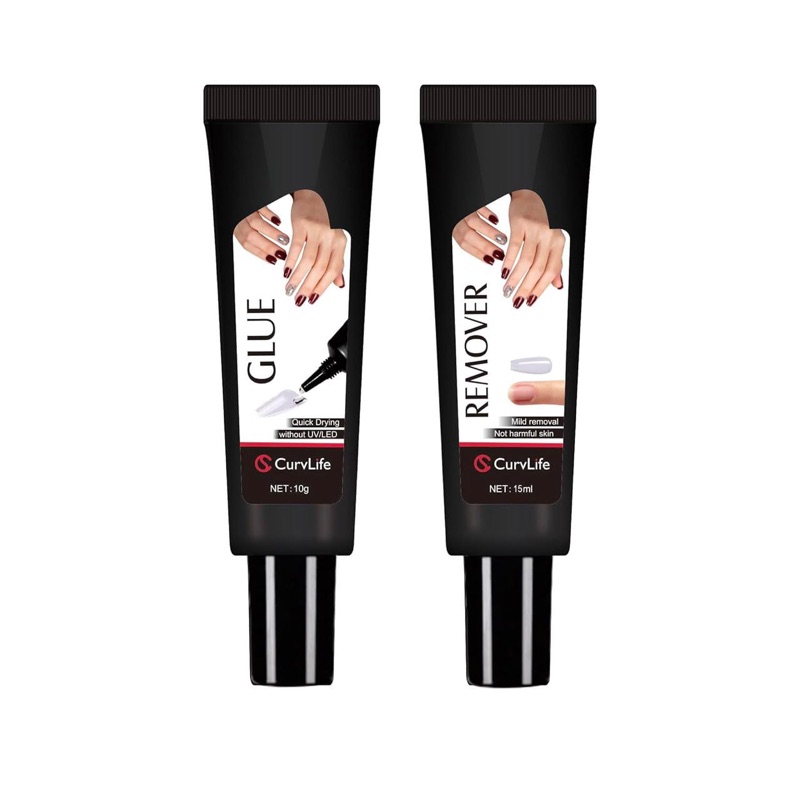
Semi-solid nail glue with remover, for removal and rewear
A semi-solid nail glue supplied with a remover — the pair that decides whether a set can be taken off and worn again. Check the removal method against your own rewear inspection steps.
Card photos are the current marketplace listing images and may differ from the delivered product; confirm details on the live listing.
Turn rewear questions into product-development signals
Questions about reuse are not only customer-service issues. They reveal where the product system fails.
When customers say, “I cannot get the glue off the back,” record the adhesive route, the set material, the design finish, the removal sequence described, and whether the residue is on one or many tips. When they say, “I do not know which nail goes where,” record whether the set included a labelled storage method and a saved size map. When they say, “It cracked when I took it off,” do not automatically blame removal. Inspect the shape, thickness, decoration, and the point at which it failed.
A simple support form can collect useful information without asking the customer to become a lab tester:
-
Order or set SKU.
-
Shape, length, and size map.
-
Adhesive route selected.
-
Whether the issue occurred during wear, removal, cleaning, or storage.
-
Which finger or tip was involved.
-
A photo, only if the customer is comfortable sharing one.
Review patterns by configuration. A repeated problem in one design deserves a sample check. A repeated misunderstanding may require a better instruction card. A problem tied to a certain accessory may mean the kit needs a different component or clearer separation between application and rewear tools.
Set an honest rewear policy before you need one
A rewear claim has commercial consequences, especially for premium hand-painted sets. Decide in advance what your brand will do when a tip arrives damaged, when a set has a confirmed production issue, or when the customer needs a replacement size after a fit mistake.
Your policy does not need to guarantee successful rewear. It needs to distinguish between a defect, a fit decision, an application outcome, and a normal wear-and-care limitation. Keep the language practical:
A set may be eligible for support when it arrives damaged or has a verified production issue.
A set may not be suitable for rewear if removal, residue, handling, or wear has changed its condition.
A replacement decision should consider the individual tip, the size map, the original pack condition, and available evidence.
This policy protects customers from false confidence and protects the business from making improvised promises in direct messages.
Reuse should feel intentional, not experimental
The strongest “reusable press-on” product is not the one with the boldest durability statement. It is the one that helps the customer decide before reapplying: are my natural nails ready, are the tips intact, is the underside clean enough, does the fit still work, and does the next wear plan match the chosen adhesive route?
For a press-on nail brand, that decision becomes a product-development loop. Build the care card around the five checks. Preserve the size map in storage. Track the support patterns. Test the exact tip, decoration, adhesive route, and packaging you intend to sell together.
Then “reusable” is a bounded promise: the brand gives the customer a clear way to evaluate the next wear.
Affiliate disclosure: This guide may contain affiliate links. If you use one, HerBrandKit may earn a commission at no extra cost to you.