A size 0 is not a universal product specification. It is a position inside one supplier’s mould set. Treating it as a universal size is one of the fastest ways for a new press-on nail brand to create avoidable returns, customer-service threads, and leftover inventory.
The problem becomes obvious when a customer says, “I always wear a 0, but this thumb does not fit.” The number may be correct in that customer’s usual brand and still be wrong in yours. A tip can be labelled 0 because it is the largest tip in a ten-size assortment; another factory can use the same label for a mould with a different width, inner curve, cuticle line, sidewall angle, or length. The label travels easily. The geometry does not.
For a buyer, the right question before placing an order is therefore not “Do you have sizes 0–9?” It is “What physical dimensions and profile does each labelled size represent in this exact shape and mould?” This article gives you a sourcing process for answering that question before you commit to decorated stock, packaging, or a full production run.
Why “the same size” is not the same product
A press-on tip has several dimensions, and each changes the fit experience. Width is the first: the tip needs to cover the natural nail from sidewall to sidewall without sitting on skin. But width alone does not explain the result. The crosswise arch—often called the C-curve—determines how much of the tip actually touches a flatter or more curved nail. A highly arched 14 mm tip can feel narrow on a flat nail because its edges lift away; a flatter 14 mm tip can feel too wide or look bulky on a deeply curved nail.
Length and shape change the usable area too. A long coffin, medium almond, and short square can carry the same nominal width at one point while narrowing at different rates toward the free edge. The cuticle end may be rounder, squarer, wider, or more tapered. Material and wall thickness affect whether a tip flexes enough to settle over the nail plate. Even two moulds sold by one supplier may not share a chart if one is a soft-gel full-cover line and the other is a rigid ABS line.
This is why a customer’s previous ten-number code is useful only as a clue. It can help you identify likely outliers—often thumbs, index fingers, and one hand versus the other—but it cannot replace a measurement for your own product. Search results and customer discussions repeatedly surface the same pattern: people with wider thumbs or flatter nail beds can find that the largest labelled tip differs substantially between brands. That is product-development evidence, not a reason to promise a “universal” fit.
Start with a fit brief, not a catalogue search
Write a one-page fit brief before looking at listings. Its job is to stop the first attractive photo or low unit price from deciding the mould for you. State what you are launching, who it should serve, and which fit problem you intend to solve.
For example: “Full-cover blank tips for a handmade press-on brand; medium-length almond and short square; ten-number size system plus a physical sizing kit; priority is reliable coverage for average-to-wider thumbs; initial market is U.S. English-speaking customers.” This is much more useful than “500 clear nail tips.” It tells you to compare mould families, not just pack counts.
Your fit brief should also name the records you need from a supplier:
- The shape, material, and coverage type, whether full cover or half cover;
- The count of distinct widths in the box, not just the total number of tips;
- A width table in millimetres for each label;
- Centre length for the largest, mid-range, and smallest tips;
- A clear side photo or profile description of the inner curve;
- The date/version of the mould or size chart; and
- Whether the sample, sizing kit, and bulk order use the same mould.
If a seller gives only “0–9, 500 pieces” and a lifestyle image, it has not yet answered the buying question. Keep it in discovery, not in the recommended shortlist.
Create a measurement table that survives supplier changes
Your brand should maintain its own tip record. Do not copy a supplier’s chart into a product description and call that your size system. Build a table for every shape–length–mould combination. The row key can be simple: “Soft gel / short square / mould A / revision 2026-10.” The columns should let someone on your team compare a replacement batch without relying on memory.
For each numbered tip, record the maximum inside width in millimetres, centre length, and a curve note such as flat, medium, or deep. Add a photo from above and a side profile photo with a ruler or a consistent background. Then add a field for “usable fit note”: for example, “size 0 covers a 15.0 mm flat thumb only with light side filing,” or “size 4 is the better starting point for a strongly curved 11 mm middle nail.” The fit note is not a medical claim; it is your observed product guidance.
A ten-number system can still work well. The point is not to replace numbers with an intimidating spreadsheet for shoppers. The point is to ensure that the clean consumer-facing code is backed by measurements your team can compare. You can publish a simple size chart later while keeping the full sourcing record internal.
Treat the thumb as a deliberate test case
The thumb is where generic size systems most often fail commercially. It tends to be the widest nail, but its curve can also be flatter or more pronounced than the other nails. A ten-tip sample can look perfect on eight fingers and still create a poor first impression if the two thumbs pinch, lift at the sidewalls, or leave visible gaps.
Ask for the physical largest sizes early. Do not approve from a generic 0–9 chart alone. Put size 0, size 1, and any extra-wide option on a sizing card or test hand. Check both hands; many people do not have mirror-image measurements. Ask your tester to distinguish between “the tip is too narrow,” “the curve is too deep,” and “the cuticle line feels wrong.” Each points to a different sourcing decision. Going up one label may solve a width problem, while changing to a flatter mould is more appropriate for an arch problem.
If your chosen mould consistently fails the largest common nail, describe the limitation honestly, add an alternate mould, or postpone the claim of broad fit.
Separate the sizing kit from the selling set—but keep the mould identical
A sizing kit is a product-development tool as well as a customer convenience. Its purpose is to let a buyer determine a ten-number combination before ordering an artistic set. It only works when the tips in the kit represent the final product. A translucent short square sample cannot reliably size a long almond retail set if the two shapes use different cuticle widths or curves.
For each collection, decide whether the sizing kit is shape-specific, mould-specific, or both. The clearest approach is usually a kit labelled with the exact shape and length family, plus a printed instruction card. The card should tell the customer to choose the smallest tip that covers the nail without pressure, record left and right hands separately, and photograph the result if an outlier remains. Avoid language that implies every purchaser will use one standard S, M, or L set.
For sourcing, order the kit components and production tips together when possible. Compare their labels, profile, material, and size-by-size measurements. When they arrive, pull random pieces from more than one inner bag. A kit that uses a prior mould version is worse than no kit: it creates confidence, then causes a mismatch in the purchased product.
Run a sample comparison before decorating inventory
A sample order should answer decisions, not merely prove that a package can arrive. Start with two or three plausible moulds rather than one “winner.” Give every sample a code that does not rely on the supplier name alone. Then compare it against your fit brief.
First, lay out the tips by label and check the sequence. Do widths generally step down as labels change? Any duplicate, skipped, or out-of-order value deserves investigation. A number sequence is a packing convention, not proof of quality control. Second, measure five to ten pieces of the high-risk labels—usually 0, 1, 2, 4, and 8—rather than measuring a single perfect piece. Third, compare the profile and sidewall contact on testers with different nail shapes. Finally, inspect finish quality: cuticle edge, flash, clarity, thickness consistency, and whether the tip flexes or cracks under ordinary hand pressure.
Keep the decision record simple: pass, conditional pass, or reject. A conditional pass might be a mould that works for a narrow-thumb collection but not for your general sizing kit. A reject is not a failure; it saves you from paying to decorate, pack, photograph, and support a product that does not match its promise.
Sample comparison routes
These supplier links are starting points for sampling, not one-size-fits-all recommendations. Before ordering, compare each listing’s current chart with the mould record you build.
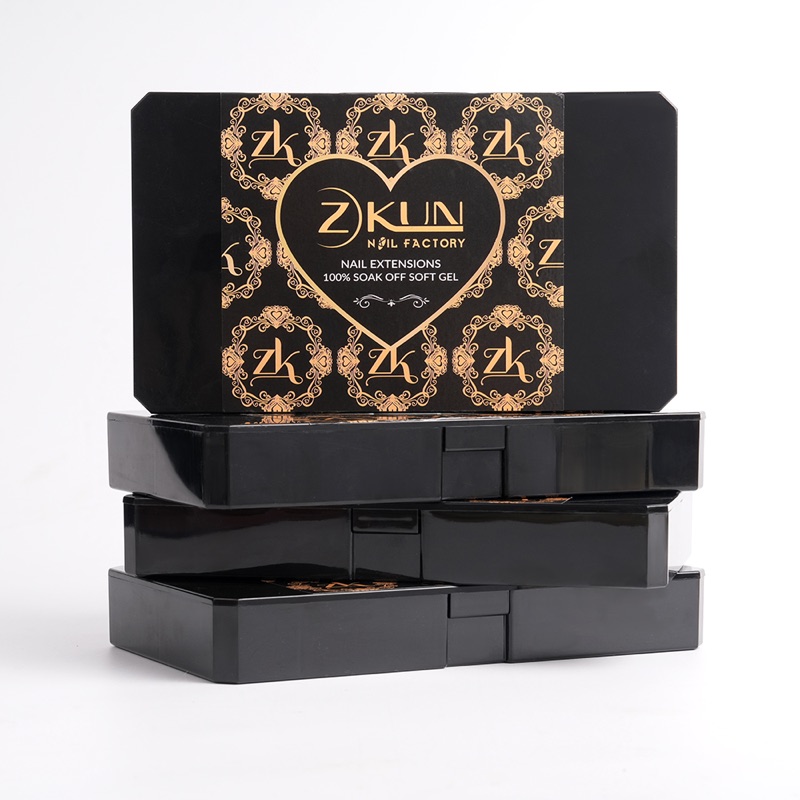
14 Sizes HEMA-Free Full Cover Soft Gel Nail Tips — Almond / Medium, Clear
Full-cover soft-gel blank tips listed in 14 sizes for professional salon and private-label use. Useful as a medium-almond comparison route when you are building a ten-number fit record.
- Supplier
- Jiangxi Zekun Trading Co., Ltd.
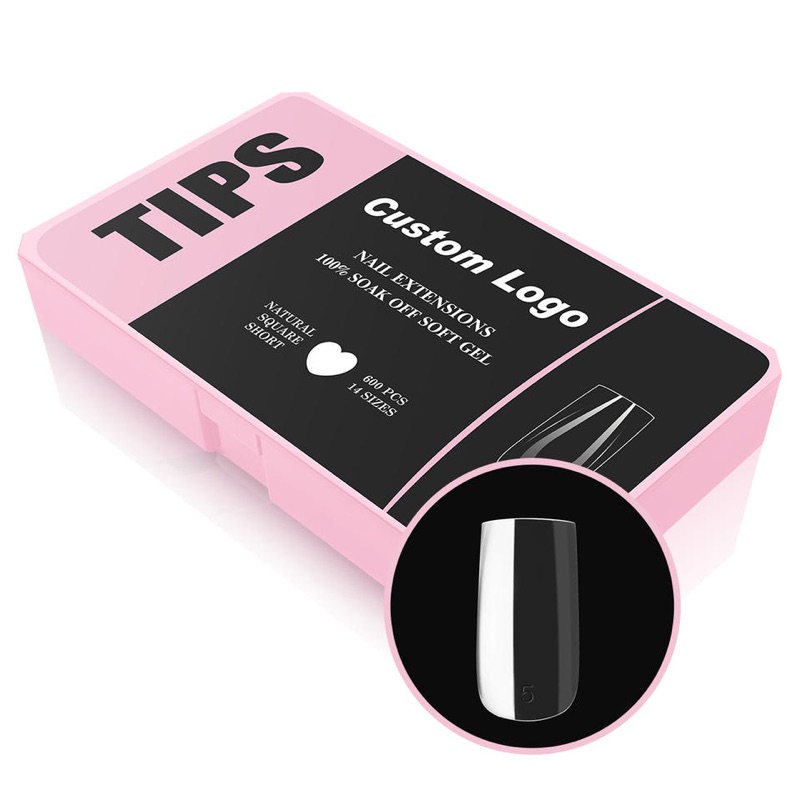
14 Sizes 602 pcs Factory-OEM Premium Soft Gel Nail Tips — Natural Clear, Square, Full Cover
A 602-piece, 14-size full-cover soft-gel pack with a custom-logo option, positioned as a high-count comparison route for the same shape family.
- Supplier
- Jiangxi Zekun Trading Co., Ltd.
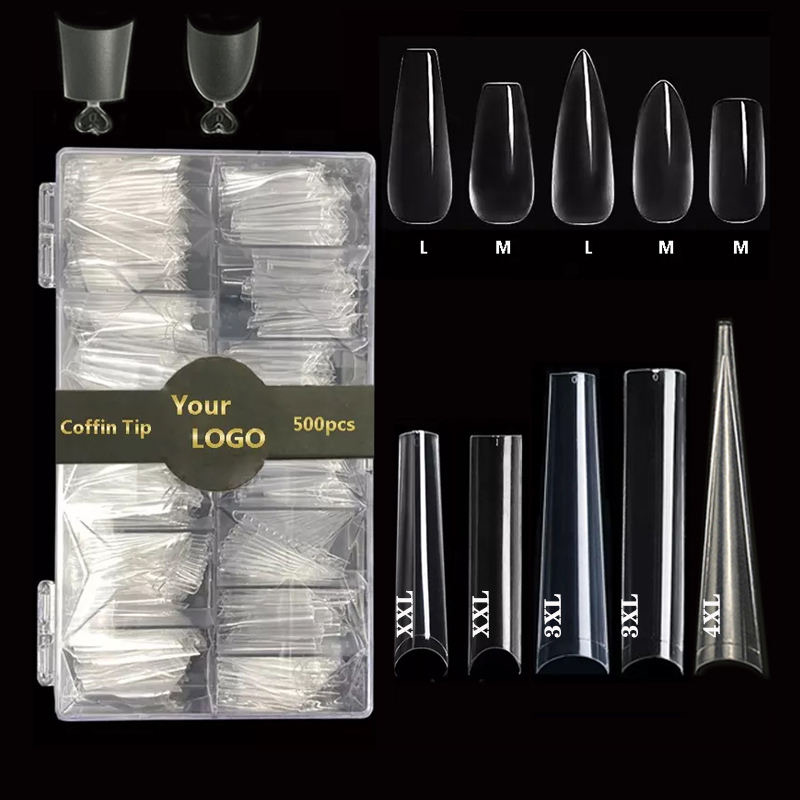
500 pcs/Box Non C-Curve XXL Extra-Long Coffin Nail Tips — Half Cover, ABS
A flatter, non C-curve tip line in XXL, 3XL and 4XL lengths, sold as a 500-piece box. Use it as a profile comparison when your testers report side lifting on flatter nails.
- Supplier
- Zhejiang Free Trade Zone Xuanji E-commerce Co., Ltd.
Prices, minimum order quantities and current pack configurations are set by the supplier and were not confirmed for this guide. Check the live listing before you rely on any figure.
Put size data into your buying and packaging decisions
Once you approve a mould, lock the version into your purchase order and your internal product name. The PO should reference the shape, material, labelled size range, pack configuration, and approved chart revision. Attach the sample photos. If you need custom printing or private-label packaging, do not let the packaging proof become the only specification the factory sees.
The same information improves inventory planning. Instead of treating 500 tips as 500 interchangeable units, learn which numbers are consumed most often in each mould. Your first batches will generate that evidence. Track the sizes placed in customer orders, the sizes returned to stock, and the sizes requested as replacements. If a particular thumb size disappears first, you may need a supplemental single-size purchase rather than another complete box. Confirm with the supplier whether individual-size replenishment is possible before making it a customer-facing promise.
Packaging should protect the size system too. Inner bags or compartments must preserve labels from factory to bench. If you decant tips into a branded box, photograph and count one approved master set, then use a pick-and-check process. A beautiful outer box cannot repair a set with size 2 placed in the size 5 compartment.
What to ask before you place a bulk order
Send the same compact question set to every shortlisted supplier. Ask for the current millimetre chart for the exact listing and exact shape; confirmation that the sample and bulk use the same mould; photos of the largest three sizes beside a ruler; material and full-cover/half-cover confirmation; pack breakdown by numbered size; minimum order quantity for samples and bulk; and whether replacement or individual-size packs can be ordered later.
Then compare answers, not sales language. A supplier that responds with a dated chart, mould confirmation, and clear sample route is easier to develop with than one that gives a lower price but only repeats “standard size.” Price, MOQ, supplier age, response quality, and CPS eligibility matter in the commercial evaluation, but they do not compensate for missing geometry. Fit evidence is the hard gate for this article’s product role.
Your final pre-order checklist
Before a purchase order, verify that you can answer yes to each point:
- Do we know the inside width and centre length for the exact mould, not a similar listing?
- Have we seen or tested the inner curve and sidewall profile?
- Does the sizing kit use the same shape and mould as the product it represents?
- Have we tested the largest sizes on at least one wider or flatter nail case?
- Is the chosen collection’s fit promise narrow enough to be true?
- Are the PO, packaging labels, and internal size record tied to the same chart revision?
- Do we have a plan for the sizes that will run out first?
If any answer is no, delay decoration and packaging. It is cheaper to buy one more sample box than to train customers to expect a size mismatch.
The practical takeaway
The number printed inside a press-on nail is not the fit. It is only a label that becomes useful after you connect it to a specific mould, measurement table, and curve profile. A small brand can turn that complexity into an advantage: source by geometry, test the thumb deliberately, keep sizing kits faithful to the final product, and retain the chart that supports every reorder. That is how you reduce rework before the first bulk order—and build a sizing system customers can trust.