A sizing kit is often treated as a low-cost preliminary item: mail a row of numbered tips, collect five numbers, then make the customer's set. But shape, length, or a revised tip mold can change the physical fit even when familiar numbers remain on the card.
For a small press-on nail brand, the useful question is not whether the kit contains every number. It is whether a customer's trial result remains valid for the exact product family she plans to buy. That depends on shape, length, tip profile, size range, finish, and the version of the physical tip. A sizing kit should therefore be specified, sampled, labelled, and controlled like a product component.
This guide lays out a practical way to keep a kit and finished set aligned. It is written for independent sellers and product developers preparing samples or supplier briefs. It does not assume that all suppliers use the same number system, that different shapes share a mold, or that a supplier will replace a kit automatically when a tip changes. Confirm those points for the exact supplier and SKU before placing an order.
Why shoppers and sellers can end up with different answers
Seller discussions show that mapping supplier tip numbers to customer-facing size groups can be confusing; shoppers also report needing a kit before ordering a custom set. These posts show specific questions, not how common they are.
A marketplace listing ties its kit to a specific shop, shape, and length, and says a new kit is needed if the tips change. That is one seller's practice, not a marketplace rule. Supplier guides cover general sizing, while this guide focuses on version control and receiving checks.
The implication for a brand is straightforward: a customer record such as 2-5-4-6-9 is incomplete unless it points to a defined tip family and version. Treating the five numbers as a customer's permanent universal size can create confusion when your shape, length, or mold changes.
Define the product family before you build its kit
Start with one kit for one specific product family. Give that family an internal name that a supplier and your team can both recognize, such as "short almond, profile A, version 1." Avoid a label like "almond kit" if you sell several lengths or tip profiles under that shape.
Record the attributes that distinguish the family:
- Shape and length, including the supplier's exact names.
- Supplier name, product or mold reference, and your internal SKU.
- The width range and number sequence actually supplied.
- How width is measured: supplier specification, straight measurement, or measurement following the curve.
- Any profile or curvature description the supplier provides.
- The date you received the physical sample and the date it was approved.
Do not fill in missing details with assumptions. If the listing does not state the measurement method or profile, write "not stated" and ask. For an internal record, a clear unknown is more useful than a confident guess. Our wide-thumb sampling guide follows this approach by asking buyers to attach supplier and mold references to samples; use that record style across the rest of the collection rather than keeping fit decisions in chat threads.
This record lets you trace a fit complaint back to the exact kit and product specification.
Keep the kit and the saleable set aligned across five checkpoints
Use the same family definition at each stage.
- The brief. Tell the supplier which shape, length, profile, size range, and sample format you are evaluating. Include your intended customer-facing assortment only as a proposal. Do not assume XS/S/M/L is a supplier standard; define which physical tip numbers make up each preset after measuring and testing the supplier's actual tips.
- The kit sample. Ask for the physical sizing kit or representative sample that a buyer will receive. Label every tip using a method that remains attached to it during handling. Check the sequence against your own record rather than relying on a printed card alone. If you add a measuring card or instructions, confirm that the wording matches how the tips were measured.
- The finished sample. Request the intended saleable product in the same family and compare it with the kit. Confirm that every number used in your presets exists in the saleable set. If the finished set is decorated, inspect that exact sample; a blank tip alone cannot establish how the finished item presents or whether decoration changes the usable fit. Do not claim that decoration always changes sizing. Treat it as a reason to verify the finished item.
- The customer record. Store sizes with the product family and version, not as an unqualified list. For example: "Short almond / profile A / V1: left 2-5-4-6-9; right 2-5-4-6-9." Keep only the data your business needs and follow the privacy rules for your market.
- The reorder. Before a repeat order, compare the new kit and production sample with the approved record. Confirm whether the supplier changed a mold, material, finish, assortment, label, or package. Request written confirmation when the specification is unchanged, and inspect a new sample when it is not.
Use a simple comparison sheet instead of relying on tip numbers
A short comparison sheet prevents "same number" from becoming shorthand for "same fit." For each size in the range, log the size code, measured width, measurement method, shape, length, profile, and the source of the measurement. Add columns for the sizing kit, finished sample, and any difference observed. If a dimension is not available, mark it as not supplied. Do not mix data from different families in one chart.
Measure like with like. A curved width and a straight-across measurement are different quantities. Record the tool and measuring point, use one method across samples, and photograph any setup that is difficult to repeat. Use a caliper when small differences matter; record the observed range across several tips rather than treating one measurement as exact.
Compare actual pieces side by side under the same conditions. Look for missing sizes, duplicated labels, swapped numbers, visibly different profiles, and differences between kit and decorated sample. If a dimension is critical to your assortment, measure several pieces rather than selecting one attractive sample. Record the spread you observed; do not turn a single measurement into a supplier-wide tolerance claim.
When feasible, test with more than one hand. One internal tester cannot represent every nail bed; use the check to spot assortment gaps, not to claim universal fit.
What to ask a supplier before approving the kit
Keep the inquiry specific enough to receive a useful answer. Ask:
- Does this kit use the same shape, length, profile, and mold family as the finished SKU?
- Are the tip numbers and widths the same in both items? Can you provide the width chart and measurement method?
- Are the listed sizes available in the finished assortment, or are some numbers omitted?
- Does the sample shown represent the finished decoration and coating planned for production?
- What identifiers can be printed or attached to the kit so that customers select the right product family?
- If the mold, profile, size range, or printed numbering changes, how will the change be communicated?
- Can you provide a revised sample before production after a specification change?
- Are replacement kits or separate sizes available? If so, what are the terms, minimums, and lead time for this exact listing?
Do not assume that listed size options mean single-size replenishment is available. Ask for the exact size, MOQ, packaging, price, and lead time, and confirm that the supplier can provide it for this listing. Keep the reply with the approved sample; never promise restocking without confirmation.
Keep supplier replies with the approved sample, but verify the physical delivery. Record the exact reference and version rather than writing only "sample approved."
Alibaba listings to evaluate as sizing-kit components
These listings are starting points for sampling, not proof that the tips match a finished SKU. Confirm the exact shape, length, profile, size chart, and physical sample with the supplier before using either product as a customer-facing sizing kit.
A 500-piece, 14-size soft-gel tip box, with a minimum order of 3 boxes and a displayed price of US$2.50–2.95. A 602-piece, 14-size medium sculpted stiletto option follows the same 14-size numbering, with a minimum order of 50 boxes and a displayed price of US$4.25–4.28. The two listings illustrate how far apart the ordering terms can be for a similar number of sizes.
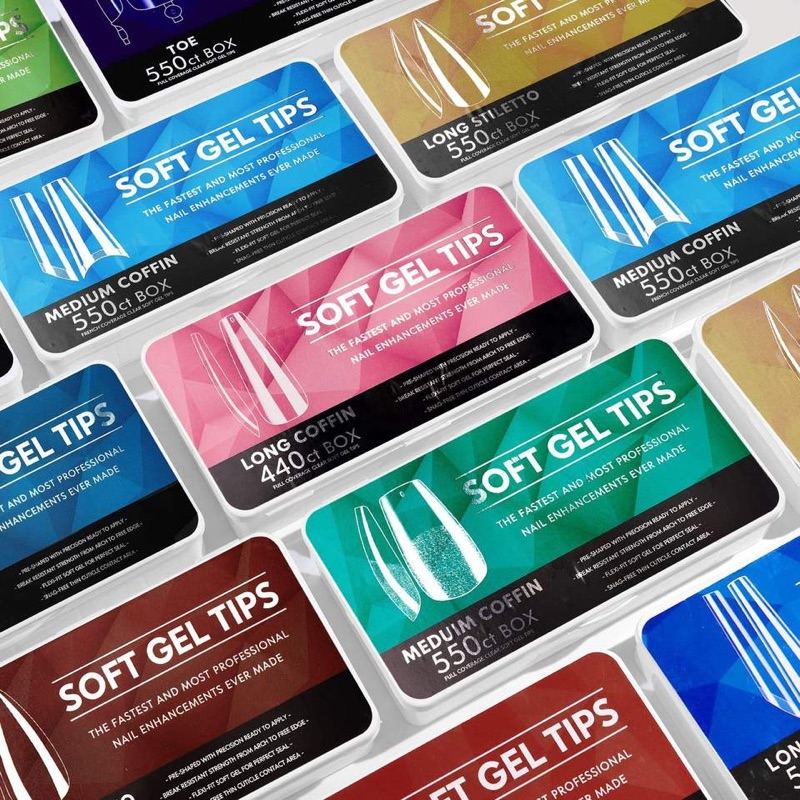
Soft gel nail extension tips, 500 pcs, 14 sizes
A 14-size clear soft-gel tip box listed at a minimum order of 3 boxes and a displayed price of US$2.50–2.95. A candidate for a first sizing-kit comparison — ask for the width chart, the measurement method, and whether the kit uses the same mold family as your finished SKU.
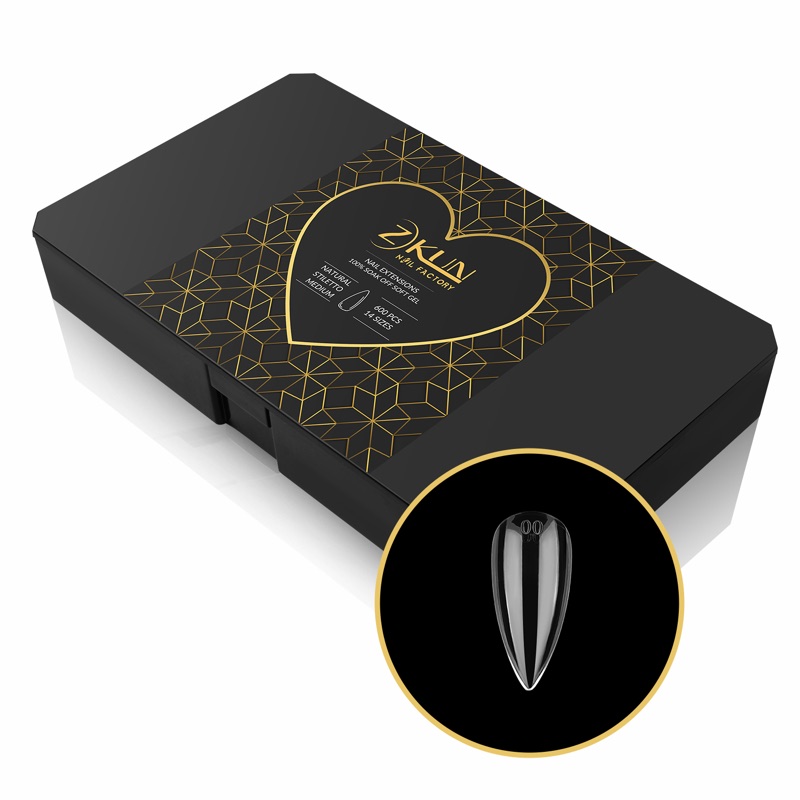
Medium sculpted stiletto soft gel tips, 602 pcs, 14 sizes
A 602-piece sculpted stiletto line across 14 sizes, listed at a minimum order of 50 boxes and a displayed price of US$4.25–4.28. Useful for comparing ordering terms against the smaller pack, but confirm whether the tip family matches the shape you actually sell.
Card photos are the current marketplace listing images and may differ from the delivered product; confirm details on the live listing.
Both CPS links were checked on October 19, 2026. That confirms link access only; affiliate attribution and order tracking still need to be checked in the affiliate account. Listing prices, order minimums, and sales counters can change.
Decide what requires a new sizing kit
Not every product change invalidates a customer's recorded sizes. A new color or artwork may leave the underlying tip unchanged; a new shape or mold may not. Use a written change rule so that customer service does not improvise.
A practical rule is to classify changes as either presentation-only or fit-affecting. Presentation-only changes may include artwork or packaging updates that do not alter the physical tip family. Fit-affecting changes include a different shape, length, profile, mold reference, size sequence, or dimensions. When the supplier cannot confirm that the physical specification is unchanged, treat the change as unverified and compare samples before carrying customer data forward.
For a fit-affecting change, update the family version and test the old kit against the new finished sample. If the old kit no longer predicts the set reliably, offer the appropriate new kit or a remeasurement path. State which products each kit applies to on the product page, order confirmation, and kit instructions. This mirrors the clearest small-brand practice visible in a marketplace listing: the seller names the shop-specific kit and explains that a tip change can require a new one.
Log the date, version change, reason, approver, and customer instructions to update. If details are unconfirmed, say so; never silently treat V1 and V2 as interchangeable.
A receiving check that catches mismatches early
On arrival, check the kit and finished batch against the approved SKU and version. Confirm shape, length, profile, labels, size sequence, and piece count. Make sure every number in a preset is present and the size card matches the contents.
Compare numbered kit tips with the finished sample side by side. Note differences in width, length, profile, finish, or decoration. Check that instructions and chart match the package; hold the batch if they do not. A printed label alone is not proof of equivalence.
If something is off, photograph it with its label and order reference, then ask the supplier for a specific resolution. Hold affected units until the mismatch is resolved. Set sampling depth and acceptance criteria to match order size and risk; this check is not a formal statistical quality-control plan.
Present the kit honestly to customers
State which collection, shape, length, or product family a kit covers, and repeat that scope in the order confirmation. Tell customers how to record both hands, where to send the result, and whether the kit price is credited toward an order.
Avoid claims such as "perfect fit" or "works for every shape" unless they are supported for the exact product. Explain what the kit does and its limits. For example: "This kit records sizes for our short almond V1 tips; it does not establish fit for other shapes or lengths."
State whether saved numbers transfer to another length. For example: "Your recorded sizes apply to short almond V1 only. Use a new kit for medium coffin or any collection marked V2."
A practical release test before you sell
Before listing a new family, run a final release check:
- The kit and finished sample share a documented family and version.
- The available size range and number labels have been physically checked.
- Measurement method and units are stated and used consistently.
- Any preset chart maps to actual pieces in the saleable assortment.
- The kit card and instructions match the package contents.
- A sample from the intended decorated finish has been reviewed.
- The product page explains which line the kit covers and what changes require a new kit.
- Supplier statements about separate sizes, reorders, or replacements are recorded for the specific offer.
- A receiving-check record exists for the approved sample or batch.
If a check fails, pause the affected claim or assortment until corrected. Keep the approved kit as the reference sample and compare each reorder against it before carrying old customer measurements forward.