A silicone scalp massager, also sold as a shampoo brush, is a palm-sized disc or paddle covered in soft rubber teeth, with a handle or a finger strap. It costs very little to make, and the listings promise a great deal: "Stimulates hair growth." "Removes dandruff." "Deep-cleans follicles." "Antibacterial silicone." "Boosts blood circulation." The photo is always a hand lathering long hair in a shower.
Each of those lines is a claim about the scalp, not about the object, and most are made without a method. That matters because the scalp is where real conditions live. Dandruff can be a sign of seborrheic dermatitis, psoriasis or a fungal problem. Hair thinning has many causes. A tool sold as a treatment for these may be used on skin that is inflamed or broken, and a tool that stays damp between uses can grow something unpleasant. Buyers notice: one review on a major retailer's page says the brush started to mould after three weeks, and the replacement did the same within two.
This guide separates the claims with some evidence from those without, summarises what dermatology sources say about dandruff and scalp care, and sets out a repeatable tip, tangle, drying and comfort test. It recommends no product and makes no promise about anyone's hair or scalp.
What the evidence supports, and what it does not
Hair growth. The study behind most "scalp massage grows hair" marketing is a 2016 paper in Eplasty by Koyama and colleagues. Nine healthy Japanese men aged 25 to 46, with no obvious hair loss, had one side of the temporal scalp massaged with an electric massage device for four minutes a day for 24 weeks, with the other side as control; the massage side was chosen at random. The authors report hair thickness increased from about 0.085 mm to about 0.092 mm at 24 weeks. They also ran a laboratory experiment showing stretching forces change gene expression in human dermal papilla cells. The paper's own introduction says the effect of scalp massage on hair growth had not been evaluated in sound clinical trials, and the funding note says the study was funded in part by a company, ANGFA Co Ltd.
Read carefully, that study supports a very narrow statement. It used a specific electric device at a specified speed, not a hand-held silicone brush. It had nine participants and was not blinded. It measured hair thickness, not hair count or regrowth in people with hair loss. Secondary commentary adds that no randomised trial of meaningful size has tested scalp massage alone for pattern hair loss. A later survey study of people using a "standardised scalp massage" protocol for androgenetic alopecia is also cited, but it relied on self-assessment, so it cannot show cause and effect. A reasonable reading: scalp massage is a plausible, low-risk habit, and the evidence for hair growth is low-certainty. A listing that says "promotes hair growth" has gone further than the evidence.
Dandruff. Dandruff has medical causes, and established treatments are medicated shampoos. The American Academy of Dermatology says mild dandruff can usually be treated at home by washing regularly and choosing a shampoo with an ingredient such as zinc pyrithione, salicylic acid, sulfur, selenium sulfide, ketoconazole or coal tar, and that dermatologists also check whether flaking is a sign of seborrheic dermatitis, psoriasis, a fungal infection or eczema. Mayo Clinic gives similar advice and notes that if a dandruff shampoo has not helped after a few weeks, a clinician should see the patient. Mayo also lists, among self-care tips, that when you wash your hair you can gently massage the scalp to loosen flakes.
That is the strongest dermatology-source support we found for a brush: it can help work shampoo into the scalp and loosen flakes. It is not described as a treatment. Mayo's advice on seborrheic dermatitis also says to avoid scratching or picking at the area, because that raises the risk of infection.
Cleaning and product build-up. Dermatologists quoted in consumer-press buying guides say that, in theory, a soft brush can help dislodge scales and flakes and help lather shampoo. That is a modest claim, and we would repeat it as theory, as they do. The AAD adds a practical point on itchy scalps: leaving shampoo on the scalp can irritate it, so rinsing well matters. A tool that makes thorough rinsing easier is arguably more useful than one that scrubs.
Circulation. Scalp massage increases blood flow and softens skin, per the introduction of the Koyama paper, but that does not establish any benefit for hair. A brand's statement that its brush "improves circulation and follicle stimulation" is a mechanism claim with no measurement behind it.
"Antibacterial silicone." Some listings say the silicone resists bacteria and mould. We found this as a seller's statement, not an independent test, and a customer review we saw reports mould. Silicone is a non-porous rubber that is easy to rinse, but a brush with deep gaps between bristles, a hollow handle or a trapped-water cavity can stay damp. To say "antibacterial" you need a laboratory report with the method and organisms named, and a claim about a treated material may be regulated differently in your market — ask a compliance adviser. Our advice is to leave the word out and describe the design and care instructions instead.
The summary for a seller: the product is a gentle massage and lathering tool. It can reasonably be described that way. It should not be described as a treatment for hair loss, dandruff or any condition.
Safety points a listing should not leave out
The scalp can be sensitive, and the people most tempted to use a brush hard are the ones with an itchy, flaky or tender scalp.
AAD guidance on scalp itch notes that an itchy, flaky scalp has several causes, from dandruff to a reaction to a hair product, and that because scalp skin differs from skin elsewhere, a board-certified dermatologist is the best route to a treatment plan if over-the-counter measures do not help. Healthline lists a long set of conditions that cause scabs and sores on the scalp, including psoriasis, contact dermatitis, ringworm and head lice, and says most are not contagious but treatment depends on the cause. A hair-care brand's blog says massaging inflamed or flaky skin can cause micro-tears and spread infection, and that a massager should not be used over active acne or bumps. That is a brand source and we would treat the specific mechanism as unproven, but it matches the common-sense caution that a tool should not be dragged across broken or inflamed skin.
A clinic-run article also lists red flags for which a clinician is more appropriate than a massage routine: patchy hair loss, scalp pain or scaling, sudden heavy shedding, or loss of eyebrows and body hair. We found that in a secondary source, but it is a sensible thing to put on an insert.
Finally, mechanical risks. Consumer-health writers note a brush used carelessly can tangle hair, especially long hair, and that metal tips can pull or scratch. Silicone is the usual recommendation, but not all silicone teeth are soft. Edge, tip shape and stiffness vary a lot.
Five terms the listing uses loosely
Silicone. The word covers a family of materials. A bristle pad sold as silicone may be soft silicone rubber, a thermoplastic elastomer or a blend; the handle may be polypropylene, ABS, wood or bamboo; and the pad may be glued to the handle or moulded around a plastic core. Ask for the material of every part in writing, with a laboratory identification report for the bristle pad. Because a brush stays wet and warm, the join between pad and handle is the part most likely to hold water.
Soft. The industry measure is hardness in Shore A. A listing that says "soft" without a number tells you nothing about how the teeth feel. Ask for the durometer of the bristle material and the base, and record how stiff the teeth feel in your hands. One dermatologist-endorsed shopping guide suggests silicone or fine flexible bristles and warns against boar bristles on the scalp, but even there a firm silicone can feel abrasive: a retail guide's review of a budget model says the bristles can feel abrasive.
Exfoliating. This means the tool removes dead skin or flakes. Used lightly with shampoo, a brush may loosen flakes. Used hard, it can irritate, and irritated scalp skin may flake more. The AAD notes that scratching and masking an issue with products can make matters worse. We would avoid "exfoliate" as a benefit and describe the action as massaging and lathering.
Waterproof / wet and dry. This should mean the whole tool tolerates water and nothing traps it. A review of a removable-bristle model praises being able to take it apart to clean and dry, which points to a design feature worth asking about. Hollow handles, battery compartments and glued seams are where water gets in.
Antibacterial. As above: a claim that needs a report.
What goes wrong with these products
- Sharp or hard teeth. Bristle tips that are blunt in the render but flat or flashed in the real part, or a material harder than the listing implies.
- Tangling and snagging. Closely spaced teeth that catch long hair, or teeth too stiff to slide through wet hair.
- Retained water and mould. Hollow handles, a pad glued with a gap, or a design that sits flat and stays wet.
- Bristle loss. Individual teeth that tear off, or a pad that peels from its base after weeks of wet use.
- Slippery handle. A smooth silicone grip in a shower with soap on it.
- Claims on the box. Treatment or growth claims, and "antibacterial" with no support.
Reading the results: pass, revise or fail
| Result | Pass | Revise | Fail |
|---|---|---|---|
| Material documents | Parts named, report for the pad | Material named but no report | Claim cannot be supported or supplier will not say |
| Tip and edge | Rounded tips, no flash, no snags | Minor flash that can be trimmed at the factory | Sharp or flat-topped teeth that snag |
| Pull and flex | No tooth loss, no cracks after 200 flexes | Occasional tooth loss at high force | Teeth tear under light force or the pad cracks |
| Tangle | Few caught hairs, easy comb-out | Tangling on long or curly hair; add a use note | Heavy tangling or knotting |
| Grip and drop | Secure when soapy, no damage in drops | Slippery grip fixed by a strap or texture | Cracks, detached pads or straps |
| Drying and mould | Little retained water, no spots after a week | Water traps in one area; change the design or the instruction | Visible mould or slime in a week |
| Cleaning and ageing | No colour change, tackiness or peeling after 20 washes | Staining from one product; add a care note | Peeling, tackiness or odour that persists |
| Volunteer panel | No pain or redness, easy to use | Mild tenderness fixed by lighter-pressure instructions | Scratches, lasting redness or pain |
Treat a failure in tip, pull or material as a stop. Treat the rest as a prompt to change the instructions or the listing.
The sample test: eight steps in an afternoon
These are our own screening procedures, not a standard. They compare samples, check the claims you plan to make, and fail weak items early. Use at least three pieces of each model and photograph every defect with a ruler in frame.
1. Material and hardness. Ask the supplier to name the material of each part and supply a laboratory identification report for the bristle pad. Check hardness with a Shore A durometer if you have one, on a flat area of the pad and on a tooth if it is large enough; otherwise ask for their figures and compare by feel across samples. Record the number and the sample, because softness varies between batches.
2. Tip and edge inspection. Look at every tooth tip under a loupe. Check for flat tops, flash (thin rubber fins at the mould line), sharp seams and uneven heights. Measure tip diameter in millimetres on a few teeth, plus tooth length and spacing. Then run the pad over a cotton pad and a sheer nylon stocking and watch for snags. Any snag points to flash or a sharp edge.
3. Bristle pull and flex test. Pull individual teeth sideways and upward with moderate force (a luggage scale or spring gauge on a hook helps you record a number) and note the force at which any tooth tears. Then flex the pad 200 times over your finger and check for cracks at the base of teeth. Repeat after 24 hours in warm soapy water. A tooth that tears off could be swallowed by a child or left in hair.
4. Tangle test. Use a long, wet, detangled hair tress or a long-hair practice head. Apply conditioner, work the brush through for a stated number of strokes with the same pattern for every sample, and count how many hairs are caught, how many knots form and how long combing out takes. Compare against a reference wide-tooth comb. Run it on straight hair and, if you can, on curly or coily hair, since AAD and Mayo both note texture changes how dandruff shampoos should be used and that textured hair can need different handling.
5. Grip and ergonomics. With wet, soapy hands, hold each sample and work it for five minutes in a shower or sink. Record slipping, hand fatigue and whether a strap or finger loop is secure. Drop it three times from head height onto a tiled floor, then check for cracks in the handle, loosened pads and detached straps.
6. Drying and mould screen. Wet each sample thoroughly and soak it in warm soapy water for ten minutes. Shake it out, weigh it, and hang it or leave it where you will tell customers to leave it. Weigh again after 1, 4 and 24 hours to see how much water is retained. Pay attention to hollow handles, seams and the space between pad and handle. Then the harder version: smear a little conditioner and a few loose hairs on the pad, leave it in a humid bathroom or a closed container with a damp cloth for a week, and inspect for slime, odour and spots. This is a screen only; it cannot prove a brush is hygienic, but a brush that stays visibly wet and develops spots in a week will do so at home. If you plan to say anything about bacteria or mould, you need a laboratory test with a named method.
7. Cleaning and ageing. Wash each sample with shampoo and warm water, then with the cleaning method you plan to print, and repeat 20 times. Check for colour change, tackiness, dulling, odour, tooth loss and peeling at the join. Test the effect of a dandruff or oily scalp product: apply a medicated shampoo, leave it for the label time, rinse and inspect for staining. Silicone sellers say silicone can absorb oils and odours and become tacky or yellow over time, so compare a used pad to a new one.
8. Volunteer comfort panel. Recruit at least five adults with intact, non-irritated scalps who do not have scalp conditions or active acne or bumps. Give each a protocol: wet hair, shampoo, light pressure, two to three minutes, three times a week for two weeks. Ask for notes on comfort, tenderness, redness, scratching, tangling and how easy rinsing was. Stop anyone with pain or redness that lasts. To control pressure, have each person practise on a kitchen scale first, so you can state the pressure your instructions recommend. This is not a clinical trial and cannot show any hair or dandruff benefit; it checks that ordinary users can use the tool comfortably and that the instructions are usable.
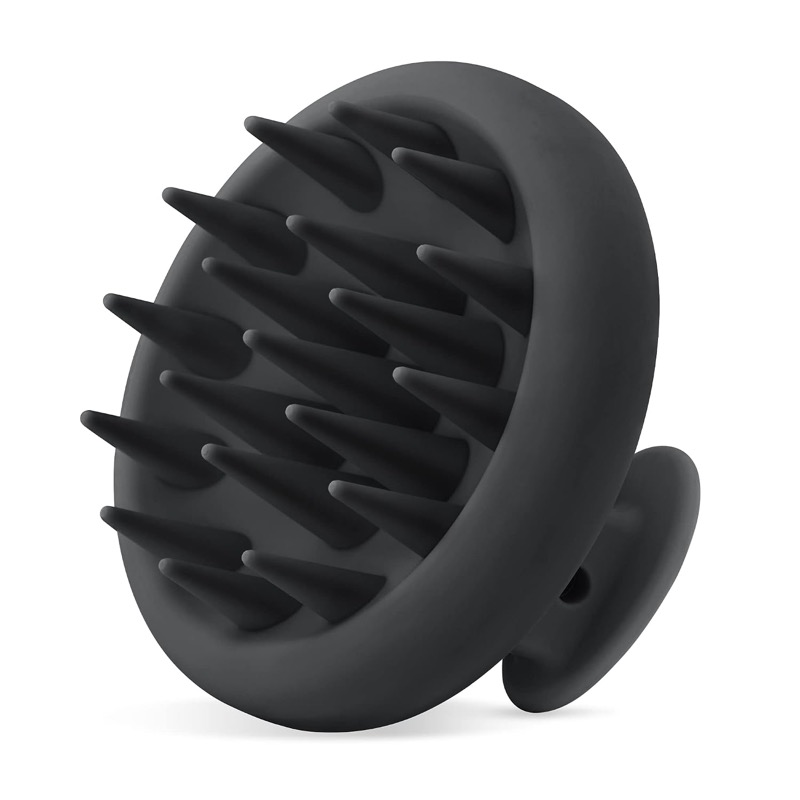
Silicone scalp massager shampoo brush
A retail example with the claim stack this guide examines: hair growth, dandruff removal, deep cleanse. Note the one-piece moulding — that is a design answer to the water-trapping problem, and it is the kind of detail a sample test can confirm or reject.
The supplier brief
- The material of every part (pad, handle, strap, any insert), by name, with a laboratory identification report for the pad.
- The Shore A hardness of the bristles and base, and the tooth count, length, spacing and tip diameter.
- The construction method: one piece, glued, over-moulded or removable, and whether any cavity can hold water.
- A mould-flash control step, and whether tips are inspected.
- Their own tests, if any, for tooth pull-out, flex fatigue and drop, with method and sample size.
- Any claim about antibacterial or mould resistance, with the laboratory report, method and organisms.
- Colour and pigment information, and whether colour transfers to hair in the wash.
- Cleaning instructions they have actually tested.
- Minimum order quantity, lead time, sample policy and replacement terms, on the quotation and not in chat.
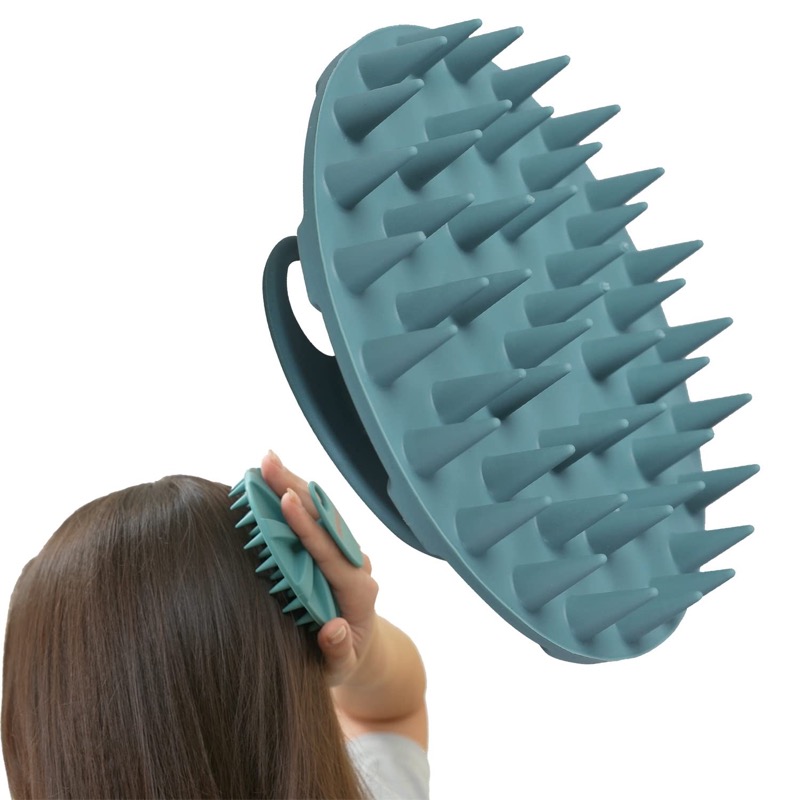
One-piece silicone scalp massager, wet and dry
A second build to compare: one-piece moulding with no cavity, which is exactly the feature that decides whether the mould screen passes. Ask for the Shore A figure rather than the word soft, then test the teeth on a wet tress.
What your listing can say
- Use: "For massaging and lathering shampoo into the scalp with light pressure." This is what the product is, and it is consistent with what dermatology sources say about massaging the scalp when washing.
- Material: "Silicone teeth (Shore A, your measured value), polypropylene handle", with measured values and a report if you have one.
- Design: "Rounded teeth, checked for snags. One-piece pad with no hollow cavity" only if that is true.
- Care: "Rinse after each use and hang to dry. Wash weekly with soap and warm water", with the method you tested, and a note to replace the brush if teeth tear or the pad becomes tacky or discoloured.
- Cautions: "Do not use on broken, inflamed or irritated skin or over active acne or bumps. If you have persistent flaking, itching, scaling, pain or hair loss, see a dermatologist." This is consistent with AAD, Mayo and Healthline guidance.
- Evidence: if you mention research, say a small 2016 study of nine men using an electric massage device reported a small increase in hair thickness, and that it does not show a hand-held brush grows hair. Better still, leave it off the listing.
Avoid "promotes hair growth", "reverses hair loss", "removes dandruff", "treats", "clinically proven", "deep cleans follicles", "unclogs pores" and "antibacterial" unless you have the evidence and the regulatory position for each.
Frequently asked questions
Can I say the massager helps hair growth? We would not. The best-known study used nine men and an electric device and measured thickness, not growth in people with hair loss. A benefit claim for a hand-held brush goes well beyond it.
Does a scalp brush get rid of dandruff? Medicated shampoos are what the AAD and Mayo recommend, with dermatologist review when they fail. A brush may help loosen flakes while you wash, which Mayo mentions as a self-care step, but it is not a treatment.
Is silicone naturally antibacterial? We found no independent evidence. Non-porous silicone is easy to rinse, but design and drying determine whether it stays clean. One retailer review reports mould within a few weeks.
How often should customers use it? Sources give figures such as two to three times a week, but they come from brands and consumer articles. Dermatologists quoted say frequency is mostly personal preference. If you print a frequency, base it on your volunteer panel and say it is a suggestion.
Is a firmer brush better? Not necessarily. Firmness changes how it feels and how likely it is to irritate. Silicone and fine, flexible bristles are the usual advice from dermatologists quoted in consumer guides; a firm brush can feel abrasive. Test comfort with real users.
What about dry use? Some brands sell the same tool for dry scalp massage. If you do, test it dry as well, with hair and any leave-in product, because tangling and comfort change.
What if a customer reports redness, flaking or hair loss? Ask whether they have a diagnosed scalp condition, how hard they press and how often they use it. Advise them to stop and see a healthcare professional if symptoms persist. Do not suggest the brush will fix the problem.
Can children or people with sensitive scalps use it? We found no specific guidance. Say it is intended for adults with healthy, intact skin, and ask a compliance adviser about child-related wording.