A set of squeezable silicone travel bottles is one of the easiest products to list and one of the easiest to get wrong. The photo is always the same: a row of pastel bottles, a clear bag, a passport. The title is always the same too: "Leak-Proof", "TSA Approved", "Food Grade Silicone", "BPA Free", "FDA Approved". Five claims, five kinds of evidence, and on most listings none of them comes with a method or a document.
That matters because the product fails unpleasantly. A bad lip balm tin is a nuisance. A bottle of conditioner that opens inside a suitcase ruins clothes, a laptop sleeve and a customer's trust in one go, and the review that follows says the word "leaked" in the first line. A bottle a few millilitres over the carry-on limit gets thrown away at the checkpoint. A bottle that quietly absorbs the smell of a shampoo and gives it back to the next product is a slower problem, but a real one.
This guide separates the claims with a rule or regulation behind them from the ones that are marketing language, explains why cabin pressure and fill level matter more than "leak-proof", and sets out a repeatable capacity, leak and compatibility test. It recommends no product and makes no safety promise about what you put in the bottles.
Which claims have a rule behind them, and which do not
Start with the rule that really applies. The US Transportation Security Administration states it plainly on its travel checklist: liquids, gels and aerosols in a carry-on must follow the 3-1-1 rule — 3.4 ounces or less per container, one quart-size clear zip-top bag, one bag per passenger. The TSA's FAQ adds that toothpaste, shampoo, conditioner, mouthwash and lotion are among the common items covered, and a TSA page on spreadable and pourable foods puts the test as whether you can spill it, spread it, spray it, pump it or pour it.
Three details are worth knowing before you write a listing.
The limit is about the container. Travel and consumer sources explain that container size is what counts, so a larger bottle half empty still exceeds the limit. We found that in consumer-travel sources rather than a single TSA sentence, so treat it as the commonly stated interpretation, and note that a TSA officer has the final say at the checkpoint. A 2010 TSA blog post describes container size as the security measure and the one-quart bag as the control on total volume per traveller.
3.4 ounces and 100 ml are not the same number. 3.4 US fluid ounces is about 100.6 ml, and 100 ml is about 3.38 ounces. A bottle printed "3.4 oz" and one printed "100 ml" can therefore differ slightly in what they hold, and regions outside the US apply the 100 ml form. Travel guidance notes the EU uses 100 ml containers in a one-litre bag, and that airports with advanced CT scanners have relaxed limits in places, varying by airport. If your customers fly internationally, write capacity in both units and tell them to check the destination airport.
There are exemptions, but cosmetics are not among them. TSA allows medically necessary liquids, and breast milk, formula and juice, in larger quantities with extra screening. In 2021 the TSA corrected a website statement that had suggested sunscreen over 3.4 ounces could be carried if medically necessary, and confirmed sunscreen must meet 3-1-1. A listing should not suggest a larger bottle is allowed for any personal-care product.
Now the claims that do not come from the TSA.
"TSA Approved." This appears on many listings. In the TSA pages we read, the rule is described in terms of container size, bag size and quantity. We did not find a TSA programme that certifies or approves particular bottles. The safest reading of the phrase is "sized to meet the 3-1-1 limit", and a listing should say that, with capacity measured rather than assumed. Ask the supplier what they mean, and ask for a document if they call it a certification.
"FDA approved" and "food grade". These are claims about material, not about the bottle. The relevant US regulation for rubber articles that touch food repeatedly is 21 CFR 177.2600. A silicone manufacturer's own FAQ draws a distinction listings blur: "FDA compliant" means a material meets the extraction requirements of that regulation, while "FDA approved" implies something else. The same manufacturer notes food grade silicone is not automatically medical grade. Another producer argues platinum-cured silicone is the cleaner choice, that peroxide-cured silicone can retain odour, and that a part can pass US extraction limits and still fail a stricter German sensory panel. Those are supplier statements — but together they make a practical point: "food grade" on a listing should be backed by a declaration of compliance naming the regulation, the material and the date. And a food-contact regulation is not a cosmetics-packaging rule. What a cosmetic container must meet in your market is a question for a compliance adviser.
"BPA free". Silicone is not a polycarbonate plastic, so this is rarely false and rarely informative. A caps-and-valves set often has components in more than one material; ask what the cap, inner seal, valve and any pump are made of.
"Leak-proof". There is no rule, no standard and no agreed method behind this word on a consumer travel bottle. It is a promise by the seller. The rest of this guide is about turning it into a result.
Why a bottle leaks on a plane: pressure, air and fill level
Most advice about travel-bottle leaks ends at the same explanation, and it is physics rather than marketing. A bottle closed at ground level traps air. If surrounding pressure drops, that trapped air pushes outward.
How big is the change? US rules for transport-category aeroplanes (14 CFR 25.841) require the cabin to be pressurised so that cabin pressure altitude is not more than 8,000 feet under normal operating conditions at maximum operating altitude. The FAA has since allowed exceptions for flights to and from high-elevation airports, but 8,000 feet is the usual design ceiling. An aviation study guide gives pressure at that altitude as about 10.9 psi, against 14.7 psi at sea level.
From those two figures the arithmetic is straightforward. The cabin at its design limit is about 74 per cent of sea-level pressure. A bottle sealed at sea level with air in it, at the same temperature, would want to occupy roughly a third more volume at cruise, since a drop to three quarters of the pressure means about 1.35 times the volume. That is our calculation from those sources, not a measured result for any bottle, and real flights add temperature changes and often hold the cabin lower than the limit. But it explains the pattern consumers report: flexible bottles that are overfilled, or sealed with a lot of air in them, can push product through the cap on ascent, and a bottle sealed at altitude can behave differently back at ground level.
Practical advice sites repeat two points. One is to leave some empty space; a travel-lifestyle blogger recommends room for pressure changes, and a gear roundup says overfilling is among the commonest causes of leaks. The other is to be careful about squeezing air out before closing: some reviewers note that squeezing the bottle, then closing it, can lead to overfill and a seal problem when the bottle expands again. These are consumer tips rather than test findings, and they conflict in detail — which is the point. The right advice depends on the bottle, the valve and the viscosity of the product. A seller who prints a single fill instruction should have tested it.
Where do leaks come from in practice? Affiliate review pages give a consistent list: caps that rely on thread friction, a single thin gasket, flip tops not fully closed, a self-sealing valve that does not reseal, and silicone walls so thin that the bottle collapses and pumps product out when squeezed in a bag. We would not cite any one of those pages as evidence — they are commercial and some are plainly generated at volume, and several quote confident results such as "nine trips, zero leaks" with no method. What we can say is that the list is a useful inspection checklist, and that none of those pages shows a test you could repeat.
Five terms the listing uses loosely
Silicone. The word covers a family of materials. A bottle sold as silicone may have a silicone body and a polypropylene cap, or a thermoplastic elastomer (TPE) body that feels similar. Buyers notice: one reviewer on a retail page complains the tubes received were not silicone as described, and that the listing was changed after they raised it, though the product was still called silicone. That is one review, not a finding, but it shows what the claim is worth without a material report. Ask for infrared (FTIR) identification of body, cap and valve from a named laboratory. You can also screen a sample: silicone is soft, flexible, slightly tacky and generally does not crease white when bent, while a harder, shinier elastomer is a warning sign. A hint, not an identification.
Squeezable. This means the wall flexes under a hand. It does not say how much force is needed. One reviewer complains a set required hard squeezing and product came out in a jet, making quantity impossible to control. Thick wall plus thick product plus a narrow valve is a combination to test, not assume.
Wide mouth. This describes the neck opening, and it matters because filling is the step most customers complain about. A review of a branded set notes thicker gels and lotions were tricky to fill because the mouth was narrow, while thin liquids were easy. State the opening diameter in millimetres rather than "wide".
No-drip valve. A self-sealing slit in the cap lets product through when squeezed and reseals on release. Common, and also where thick product and trapped residue show up. It does not by itself stop a bottle leaking under pressure, because the seal against the neck is a different part.
3 oz, 90 ml, 100 ml. Nominal sizes. The same retail catalogue can list one bottle as 85 ml, 89 ml, 2.9 fl oz and 3 oz. Check what it holds brim-full and what it holds at a sensible fill line, because the carry-on rule applies to the container's size, not your fill line.
What silicone does to the product, and the product to silicone
Silicone is chemically inert in the way most consumers use the word, but it is not impermeable, and the details bite in a toiletry bag.
The maker of a well-known silicone travel tube publishes a list of product types it advises against and a second list to test overnight before regular use. Its "not recommended" list includes salicylic acid, hair serums and treatments including shine-adding shampoos, conditioners and argan oil products, silicone-based lubricants, DEET-based insect repellent, hydrogen peroxide, sterile products such as contact lens solution and liquid medicines, and caustic or flammable products. Its "test first" list includes alcohols, essential oils, sunscreen and tanning lotion, skin-conditioning oils and castile soap. The same page says silicone is slightly permeable so alcohol can evaporate slowly through it, that a fluid is incompatible if it leaks or changes the colour or shape of the tube, and that most reactions occur overnight. It also recommends sealing tubes in a zip bag. Reseller listings repeat a shorter version: not suitable for oils, alcohols, hair serums, salicylic acid, hydrogen peroxide, or corrosive or flammable products.
That list is one brand's experience of one product, and a different formulation could behave differently. But it points to a well-established mechanism: solvents and oils can swell a silicone elastomer. A patent on silicone elastomer processing notes that low-molecular-weight silicone fluids, hydrocarbons such as mineral oil, and even volatile fragrances can swell silicone, and a solvent-resistance study from a supplier explains that the more compatible a solvent is with the rubber, the more it is absorbed into the cured matrix. Silicone-based hair products are an obvious worry because they are chemically close to the bottle.
There is also a smell problem. A silicone seller's advice article says silicone is slightly porous and can absorb skin oils, makeup residue and food odours, tending to yellow and feel tacky if not cleaned. A retail review of a generic travel bottle says the shower-gel smell disappeared after two or three days, as if the container were drawing the fragrance out. Again, one customer's experience — but a fragrance-heavy product is a reasonable test case for any sample.
Finally, sterility. The brand list above says its tubes are not sterilised and should not be used for sterile products. Do not describe travel bottles as suitable for contact lens solution, eye products or medicines without the evidence and the regulatory position for that use.
Reading the results: pass, revise or fail
| Result | Pass | Revise | Fail |
|---|---|---|---|
| Brim-full capacity vs stated size | Within a small tolerance, and at or under the carry-on limit if sold as such | Slightly over stated size; fixable with a lower fill line or a corrected label | Materially over the limit, or capacity varies a lot between samples |
| Static leak (upside-down, on side) | No mark on paper, no film at valve or thread | Slight film at the valve that clears by the second day | Any droplet or mark |
| Squeeze and bag pressure | Bottles stay closed, no weeping | Weeping only when overfilled; a fill line fixes it | Valve forced open or cap pops under moderate load |
| Reduced pressure | No weeping at the recommended fill line | Weeping at the brim only; a fill instruction fixes it | Weeping at the recommended fill line |
| Cap and valve cycles | No leak or damage after 50 cycles | Slight looseness; revise thread or gasket | Cracks, a valve that stays open, a cap that will not seat |
| Product compatibility | No loss, swelling, odour or staining with the named products | Odour or staining with one fragrance-heavy product; name it in the guidance | Swelling, tackiness or leaks with a product you plan to name as suitable |
| Cleaning | Washes clean, labels survive if you claim they do | Odour carry-over that fades after repeated washing | Stains or odour that persist, or parts that warp |
| Material documents | Part-by-part declaration and a lab report | Declaration without a report | Claim cannot be supported, or the supplier refuses |
A single failed row is not necessarily fatal, but a set that fails the static leak test, or leaks at the recommended fill line under reduced pressure, should not be listed as leak-resistant.
The sample test: eight steps in an afternoon
These are our own screening procedures, not a standard. They compare samples, turn vague claims into numbers, and fail weak bottles early. Use the same product for every bottle in a run, record room temperature, and photograph any failure. Use two or three sets of the same sample if you can, because a single bottle can be an outlier.
1. Capacity: brim-full and at the fill line. Weigh each empty bottle with its cap. Fill to the very brim with room-temperature water, close, wipe dry, weigh again. Water is close to 1 g per millilitre, so the difference is brim-full capacity in millilitres. Then empty and fill to the line you intend to recommend, and repeat. Record brim-full capacity separately from nominal size. If a "100 ml" bottle holds well over 100 ml brim-full, decide whether the listing should say "100 ml capacity" or give a recommended fill. If you plan to sell it as meeting the 3.4 oz limit, check the stated size, not just the fill line, and use a scale or graduated cylinder rather than a calculation. Measure the neck opening in millimetres with callipers and print it.
2. Material and construction. Note the material of each part: body, cap, inner seal, valve, any pump or spray head, any label. Ask for a written material description and, for the body at least, a laboratory report naming the method. Check whether cap threads feel moulded cleanly and whether the cap closes at the same point every time. Look at moulding flash around the valve slit, because a rough slit may not reseal.
3. Static leak test. Fill each bottle with coloured water plus a little dish soap to the recommended fill line, close it the way you will tell customers to close it, and place it upside-down on white absorbent paper for a full day, then on its side for another day. Check for any mark on the paper, any film around the cap thread, and any droplet at the valve. This is the test most reviewers mean by "leak-proof", and it is the easiest to pass. It should be a gate, not a result.
4. Squeeze and bag-pressure test. Put the filled, closed bottles in the bag the customer will use and place a weighted book on top (start at a few kilograms, record it) for an hour, then rotate the bag and repeat. A bottle that collapses and forces product through a closed valve fails, and you want to know the cap holds without the user's help. Add a version with the bottles inside a rigid case if the set includes one.
5. Reduced-pressure test. This is the test that matters for the "TSA" customer. A cabin at 8,000 feet is about three quarters of sea-level pressure, as calculated above. A practical screening approach is a vacuum chamber or bell jar with a hand pump and gauge: place a bottle on absorbent paper, reduce pressure by about 25 kilopascals, hold ten minutes, release. Repeat with bottles filled to the recommended line and to the brim, and with and without squeezing air out before closing. This is a screening idea, not a validated simulation, so be conservative about what you claim. A bottle that weeps at the recommended fill line has a real problem. A bottle that passes does not earn the right to say "tested on aircraft", but it does earn the right to say "tested at reduced pressure equal to a cabin at 8,000 ft, method available on request", provided the method is documented. If you have no vacuum chamber, a laboratory will run one cheaply, and you can ask the supplier for their own report with pressure, hold time and fill level stated.
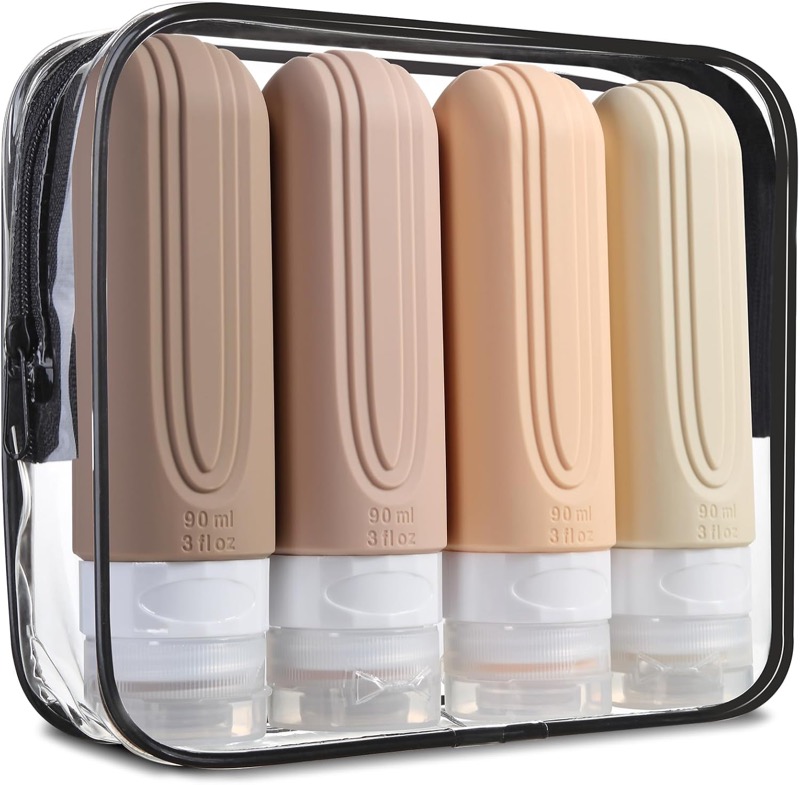
Four 3 oz silicone travel bottles with zip bag
A retail example with the exact claim stack this guide examines: TSA, food grade, 3-layer leak proof, no-drip valve. The printed labels in the photo read 90 ml, which is the kind of nominal-versus-measured gap you should check with a scale.
6. Open-close cycles and dispensing. Open and close each cap 50 times, then re-run the static leak test. Check for thread wear, cap looseness and whether the flip hinge cracks. Then dispense product 50 times, weighing output to see how much comes out per squeeze and whether the valve reseals without leaving a bead. Use at least two viscosities: a thin one such as a toner and a thick one such as conditioner or hand cream. Record how many squeezes it takes to empty the bottle and how much stays behind. The common complaint that thick product is hard to get in or out is a signal to record fill time and squeeze effort.
7. Product compatibility screen. Fill separate bottles with the products your customers will actually use, and leave them 24 hours and again 7 days, upright and in a bag. Include a shampoo or body wash, a conditioner, a lotion, a sunscreen, a strongly fragranced product, a product with essential oils, a hair oil or serum, and an alcohol-based sanitiser with a shorter hold to check evaporation. Compare weight before and after to detect loss through the wall, check for swelling, tackiness, cloudiness, colour change and odour, and smell the empty washed bottle. Most reactions show up overnight, so do not stop at the first hour. Treat any result as specific to that product and that bottle.
Decide which products you will name on the packaging. A short, conservative "suitable for" list backed by this screen is more useful and safer than "for all liquids", and an explicit "not suitable for" list — oils and serums, silicone-based products, alcohol, corrosives, sterile products — mirrors what manufacturers already say.
8. Cleaning and ageing. Wash a set by hand and by dishwasher if you intend to claim dishwasher safety, and compare. One brand says its tubes and collars are dishwasher-safe on the top rack only, and its flip caps should be hand-washed, which shows a "dishwasher safe" claim can be component-specific. Check whether labels survive: a review of one set says the included adhesive labels did not. Check residue, odour carry-over after a fragrance product, and staining after a coloured product such as self-tanner. Finally, flex-fatigue: squeeze a bottle several hundred times and look for whitening, cracks or thinning at the fold.
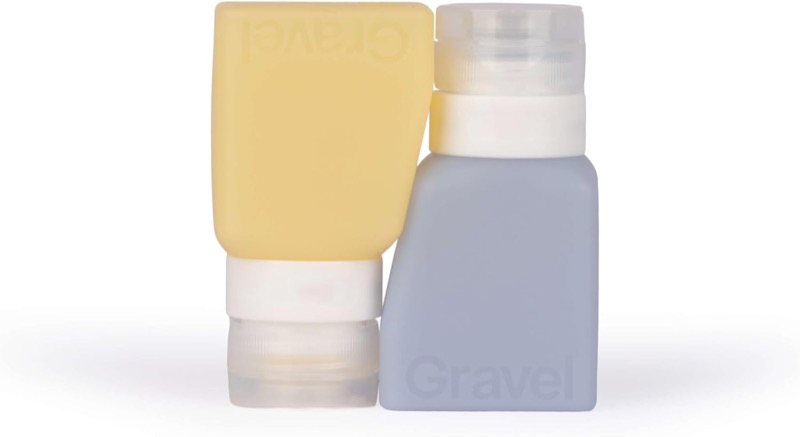
Two 3 oz silicone travel bottles with label system
A second format worth comparing: fewer bottles, interchangeable labels, wide opening. Fewer parts means fewer failure points, and the label system is the kind of detail that decides whether a customer can identify contents without opening each bottle.
The supplier brief
Send a written brief with your sample request:
- The material of each part (body, cap, inner seal, valve, pump or spray head), by name, with a laboratory identification report for the body.
- A declaration of compliance for any "food grade" or "FDA" wording, naming the regulation, the material and the date, and stating what the supplier means by it. Ask whether the silicone is platinum-cured or peroxide-cured, and whether it is post-cured.
- Nominal capacity, measured brim-full capacity and recommended fill line in millilitres, for each size in the set.
- Neck opening diameter and valve type.
- The supplier's own leak report, if there is one, with fill level, pressure change, hold time and number of samples.
- Colour and print information: how colours and printed labels are made, and whether they survive washing.
- Wall thickness or hardness, such as Shore A durometer, because it changes how hard the bottle is to squeeze.
- Packaging details: what the clear bag is made of, and whether the set includes spatulas, funnels or labels.
- Minimum order quantities, lead times and sample policy, written on the quotation and not in chat.
Treat a supplier who will not state the material of the cap and valve as a risk, because those are the parts that leak.
What your listing can say
Write the claim at the level of the evidence you have.
- Only a visual and a static test: "Silicone body, screw-on cap with inner seal. Tested upright and on its side for 24 hours at the recommended fill line." Do not say "leak-proof".
- A reduced-pressure result: "Tested at reduced pressure equivalent to about 8,000 ft with the bottle filled to the marked line; leave air space as shown." State the fill line.
- Capacity: "100 ml (3.4 fl oz) nominal; fill line at 90 ml." Both units, a real fill line, and a note that carry-on rules look at container size.
- Carry-on compliance: "Sized for the 3-1-1 rule (3.4 oz or less per container). Airport rules vary, so check your airline and airport." Avoid "TSA approved" unless you can explain what it means and show a document.
- Material: "Silicone body (platinum-cured, declaration available on request)" only if the supplier's report supports it. Name the other parts honestly.
- Not suitable for: the list from your compatibility screen, with a line saying to test a small amount first.
- Care: the cleaning method you actually tested, with dishwasher claims limited to the parts that survived.
Avoid health claims, avoid saying the bottle is safe for medicines or sterile products, and avoid suggesting it is safe for any liquid. The word "any" is the first one a customer will test.
Frequently asked questions
Is a silicone bottle always leakier than a hard plastic one? No. Some sources claim rigid bottles with thin flip caps leak more on flights, but we found only anecdotal consumer reports and sellers' statements. Closure type, gasket and fill level matter at least as much as body material, and only a test with your own samples will tell you.
Should I print a fill line on the bottle? Yes, if it can be marked cleanly, because a customer cannot leave air space if there is no line to follow. Check that printing survives washing, and that the line sits where your pressure test used it. A review of one set criticised the lack of volume markings on individual bottles.
Is "triple-layer leak-proof" a recognised design? It is a marketing description that appears on many sets, typically meaning a threaded cap, a silicone gasket and a flip top or valve. We did not find a test standard defining it. Ask which three layers are meant, and test the set rather than the label.
Do I need to explain the 3-1-1 rule? You do not have to, but a pointer helps. State capacity in millilitres and ounces, say that the container's size and not the amount inside is what carry-on rules look at, and add that rules differ by airport and country.
Can I advertise the bottles for sunscreen or hand sanitiser? Only if you tested them. A silicone tube maker's guidance puts sunscreen and alcohol on its "test first" list and says alcohol evaporates slowly through the wall. If you do list them, give a hold time, state the result and keep the claim narrow.
Can I advertise them for contact lens solution, eye drops or medicine? We would not. A tube maker describes its tubes as not sterilised and advises against sterile products, and medicines raise regulatory questions we have not researched. Ask a compliance adviser.
Why does the bottle still smell of the last product? Silicone can absorb odours and oils, according to sellers of silicone goods and some consumer reports. Washing helps, and some owners dedicate bottles to one product. A fragrance-heavy product in your compatibility screen will show how bad it is.
What if a customer says the bottle leaked on a flight? Ask for the product, the fill level, how the bottle was closed, whether air was squeezed out, and whether it was in a bag. Compare with your test conditions. The answer is often a fill-level problem, and a good fill instruction is the cheapest fix.