A scrunchie can be soft, smooth and completely wrong for the ponytail it is supposed to hold. Two turns let it slide down. A third keeps the hair up, but the wearer feels a pull at the scalp and has to unwind it carefully. The problem may appear on the first day, while the elastic still springs back. Calling that product “worn out” sends a brand toward the wrong fix.
The wording comes from wearers, not a laboratory: fine-hair discussions describe exactly the two-turn/three-turn dilemma, and so do earlier scrunchie threads. Those posts cannot establish how common the problem is. They do identify a useful product-development question: can one finished tie hold the intended hair bundle at a comfortable number of wraps without making the wearer choose between sliding and pulling?
This guide is for a small brand considering a slim silk or satin-covered scrunchie for fine or low-density hair. It gives a way to diagnose the complaint, compare finished samples and write a repeatable reorder specification. It is equally useful to a shopper who needs to understand why buying another “soft” scrunchie of the same size might repeat the result.
Fit today versus loss of fit later
Put a new scrunchie on the intended ponytail and observe it before washing or extended wear. If it slips immediately at two turns but bites at three, the initial working range is wrong for that combination of tie, hair and hairstyle. If it held comfortably when new and needs another turn after weeks of use, investigate elastic recovery and care history. A seam that opens or an inner elastic that snaps is a third failure. Our guide to scrunchies going loose addresses aging and construction; the decision here is whether the new finished product fits its intended use.
A supplier's elastic and fit guide separates a slipping new scrunchie from one that permanently stretches. That distinction is practical, although the page is a manufacturer explanation rather than comparative test data. Do not diagnose a customer's hair or promise a medical benefit from a particular tie. “Fine” describes strand diameter; “low density” describes how much hair is in the ponytail. A person can have fine strands and plenty of hair, or coarse strands in a small bundle. Ask which situation the product is meant to serve.
Remove the tie by unwinding each turn. Pulling a snug loop down the entire ponytail creates a different complaint and can make a usable construction feel rough. Conversely, a tie that catches individual strands at an exposed seam needs a seam review even when its hold is appropriate. Record the observed failure before buying a stronger elastic.
What a smaller scrunchie actually changes
A scrunchie is an elastic loop enclosed in a fabric tube. Its relaxed loop size, resistance as it expands, casing width and fabric surface all influence how it behaves. A “skinny” label usually refers to the visible fabric profile; it does not give the elastic's relaxed circumference or working resistance. Two skinny products can look similar in a photograph and still require different effort on the same ponytail.
Consumer roundups distinguish slim and mini styles for finer hair from larger styles for more volume. One brand sells two skinny sizes, positioning its smaller option for finer or lower-density hair, and marketplace listings show skinny silk formats too. These are product-format signals, not proof that a given wearer needs the smallest option.
The silk shell is not the spring. A fabric description or momme weight says nothing by itself about elastic loop length. “Satin” also names a fabric construction or finish, not a guarantee that the fibre is silk. For a seller, fabric identity, elastic specification and finished fit must be checked separately. Textile labelling rules explain why a fibre claim such as “100% silk” must be supported for covered products; check the rules applicable to the particular accessory and market rather than assuming a silky appearance is evidence of composition.
Start with the hair bundle and the occasion
Do not approve a tie by stretching it around a wrist. Record a reference hairstyle: low ponytail, high ponytail, half-up section or bun. Measure the bundle's circumference at the point of fastening with a soft tape, without crushing it. Note whether hair is dry, freshly washed, styled with product or carrying extensions. These conditions change the handling result. Record them so the next sample is compared against the same task.
Use more than one reference wearer if the product claims to fit a range. One might have straight fine strands and a small low ponytail; another might have fine strands but much denser hair. They should not be averaged into a single “fine hair” result. If the tie is intended only for a half-up style, test that smaller bundle separately. A shopper can do a simpler version: note the style that slips, how many turns it takes, and whether the same tie holds a larger bun differently.
Define the promised wearing situation before judging hold. An accessory for keeping a low ponytail together while working at a desk faces a different movement pattern from one advertised for exercise. Do not call a sample “all-day secure” because it survives a few seconds of standing still. Equally, an aggressive shake test may be irrelevant to a product sold for gentle home use. Match the check to the claim.
Compare two finished constructions under the same conditions
Order at least two finished sample constructions with a deliberate difference in elastic loop length, resistance or casing width. Ask the maker to identify what changed. If the factory sends two colours from the same pattern, you have not tested the fit variable. If the shell and core both change at once, the result may be useful as a whole-product comparison, but it will not isolate which change improved it.
Before fitting, lay each sample flat and measure its relaxed outside diameter or laid-flat length in the same orientation. Record the width of the visible casing and the finished seam location. These are identification measurements, not a conversion formula for the internal elastic. Measure the usable opening with a consistent hand-applied method agreed with the supplier; avoid pulling to an unrecorded maximum merely to make two samples look comparable. A calibrated force measurement can be requested later if the scale of production warrants it, but a home ruler reading does not create a formal textile test result.
Have each wearer put the samples on in a randomised order, without being told which one is “improved.” Record how many turns she naturally uses, whether the final pass needs force, whether the ponytail shifts during the stated task, and whether she feels pressure. Repeat after a brief removal and reapplication. A single perfect placement by the product designer can hide the struggle a buyer meets at home. Photograph the resting position and the same position after the agreed activity, with permission. Do not turn individual feedback into a population claim.
“Two turns hold” is an acceptance observation only for the named reference bundle and task. It is not a standard size rule. A tie that fits at two turns on a small low ponytail may be awkward on a thick bun. Where the two-turn and three-turn outcomes both remain unacceptable, choose a different finished construction or narrow the intended audience. A velvet-covered tie may grip more, as some long-hair wearers report, but that changes the material experience and belongs in a separate product decision.
The seam and removal matter as much as staying up
At the point where the wearer takes the tie off, inspect the fabric join and any exposed stitching. A loose thread, rough closure or escaped elastic can catch hair even when the ponytail stayed in place. Rotate the seam through the fastening positions during a sample trial; it should not succeed only when the seam happens to face outward. Ask the supplier how the tube is closed, where the elastic is joined and whether the seam finish changes between colours or batches.
Then check whether the wearer can unwind the tie without tugging one section of hair. Ask where the pressure was felt. A tight final wrap at the base of a high ponytail may feel different from a loose low tie, even with the same scrunchie. If a user reports scalp pain or irritation, stop that trial and do not solve it by telling her to tolerate the tension. No accessory is obligated to fit every wearer or every style.
Retail reviews show why both sides deserve attention. Product pages for slim silk ties include fine-haired reviewers who liked the fabric but said the elastic loosened quickly, and others who found the tie smooth yet prone to slipping. These are individual, self-selected accounts. They cannot establish a defect rate or reveal which internal elastic specification either item used.
Retail and sourcing references
The two links below are thin silk-covered ties with different pack sizes and casing specifications. We may earn a commission from qualifying purchases through these links. Neither has been tested for this article; both are comparison units, not endorsements of a two-turn hold.
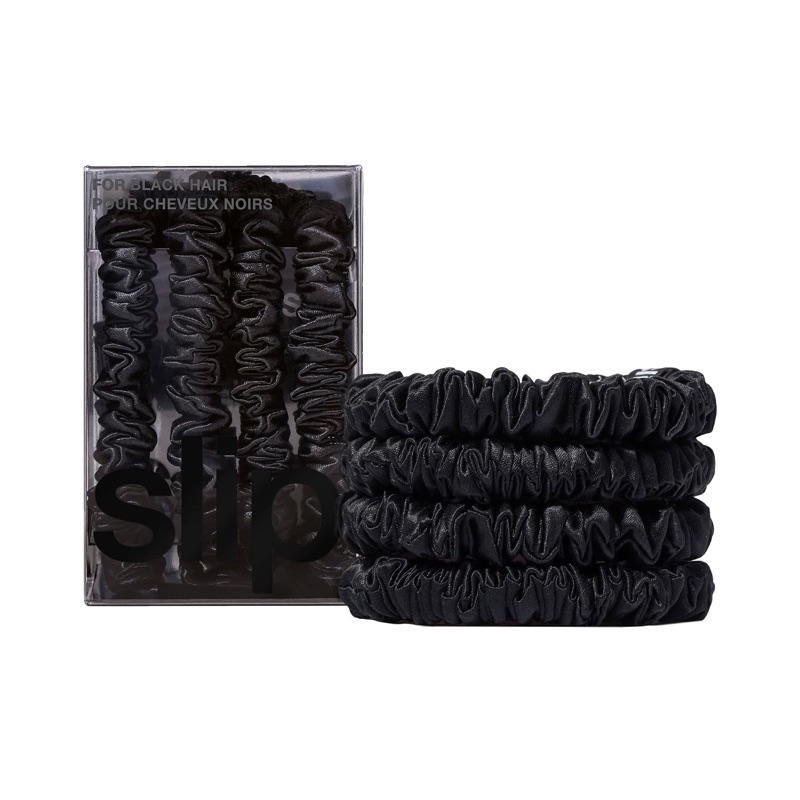
Slip silk skinny scrunchies, black, set of four
A widely reviewed slim silk casing in a four-pack, useful as the small-bundle reference in a comparison. The listing states mulberry silk and a momme figure; neither tells you the elastic loop length, so run the two-turn/three-turn trial on the ponytail you actually sell for.
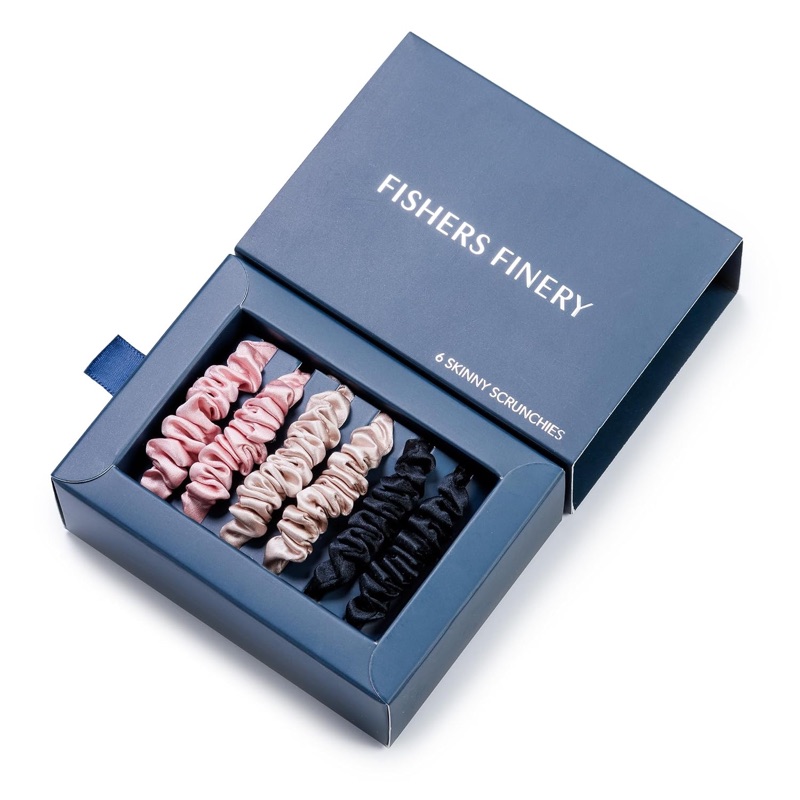
Fishers Finery 25 momme mulberry silk skinny scrunchies
A second construction with a different pack count and casing width, which is the variable worth comparing rather than the colour. Buy it as a physical sample, then log turns, pressure and seam behaviour against the reference ponytail.
Card photos are the current marketplace listing images and may differ from the delivered product; confirm details on the live listing.
A wholesale listing also shows custom labels and colour variants, and is why a buyer should obtain a written offer for the desired material, customisation and sample rather than assume one advertised minimum order covers all three. Such a listing is a place to start a supplier conversation, not a qualified offer of the fit described here.
Turn the preferred sample into an orderable specification
Keep a sealed reference sample with its date, colour, fabric lot when known and supplier part number. The purchase brief should identify the shell fibre content as supported by documentation, its construction and finish, the visible casing width, the relaxed finished size, the elastic material and width if the supplier can disclose them, the joining and closure method, and the agreed working-fit check. Include the packaging count and the label wording. “Premium skinny silk scrunchie” does not preserve any of those details at reorder.
Ask whether a different print, fabric weight or dye lot affects the same finished dimensions and stretch. A changed casing can alter gathering and handling even if the inner elastic is nominally identical. Request a production-intent sample in the proposed colour and pack format. Compare it with the approved reference after the same short wear routine and after the care method you intend to print. This matters most if the brand plans recurring colour drops: consistency beats a pleasing first sample.
For incoming stock, choose a documented sampling plan appropriate to the order rather than pretending that a handful of ties proves the whole lot. Check the package count, colour, fibre documentation, visibly exposed elastic, seams and finished dimensions. Run the reference ponytail trial on selected pieces from more than one carton where practical. Log the carton and result so a problem can be traced. If a supplier substitutes elastic or changes the closure seam, ask for a new approval sample before treating the order as equivalent.
What the product page should promise
“Slim silk-covered scrunchie sampled on small ponytails” is more informative than “no-slip for all fine hair.” Show how the wearer puts it on and removes it in a short demonstration. The page should identify the shell fibre accurately and avoid a promise of preventing breakage, hair loss or pain that the brand has not substantiated. A smooth surface can be a reason to test a product; it is not a guarantee about a person's hair.
Keep the wording tied to what was actually observed. If the fit was only checked on one small low ponytail, say that. If the fibre is a satin-weave polyester rather than silk, say that too — the two are not interchangeable on a label, and buyers increasingly check.
The decision before reordering
The product passes this narrow test when the intended wearer can fasten it at a comfortable number of turns, complete the named activity without repeated readjustment, and remove it without catching strands at the seam. Write down the wearer, hair bundle, style, number of turns, sample identity and result. If the winning tie is secure only by a very tight extra wrap, it has not solved the complaint that started the project.
The useful product is rarely defined by the word “silk” alone. Its shell, loop and finish need to work together on the ponytail you claim to serve. A small brand makes that choice repeatable by preserving the approved physical sample and the exact fit task alongside the purchase order.