A scrunchie can still look polished after its useful life has ended. The outer fabric may be smooth, the color may be intact, and the seam may appear neat—yet the elastic inside no longer holds a ponytail, bun, or braid with the same number of wraps. That makes "it went loose" a more useful product problem than a vague complaint about quality.
Customers describe this problem in practical terms. Some find that a favored scrunchie is stretched out after regular use. Others say a thin version becomes too loose after only a few months, even though they like the outer fabric. Those accounts do not prove the performance of every scrunchie, but they show a clear task: understand what to check before buying another set and what a product brand should test before ordering stock.
The key point is simple. A scrunchie is a fabric-covered elastic system. The shell affects appearance and touch; the internal elastic produces the stretch and recovery. The seam joins that system into a loop. Calling the product "silk," "satin," "gentle," or "oversized" does not tell a buyer how much tension it has, how it will fit different hair volumes, or how it will behave after repeated use.
This guide does not promise that a particular fabric prevents damage, creases, or breakage. It explains how to choose a scrunchie for the job at hand and how a small brand can translate common complaints into measurable sample checks.
Start by defining what "too loose" means
Before replacing a scrunchie, separate a loose loop from a poor match for the hairstyle. A large scrunchie may be intentionally roomy for a low-tension style. A skinny scrunchie may require more wraps and still be working as designed. A thick, dense ponytail may expand the elastic farther than a fine-hair ponytail. The relevant question is whether the scrunchie has changed from its own earlier behavior or whether it was the wrong size and hold level from the start.
Record a simple baseline when a new scrunchie arrives. Note the relaxed circumference, how many wraps are needed for the usual hairstyle, and whether the wearer uses it for a ponytail, braid end, bun, or sleep routine. After ordinary use and washing, compare those observations. If the scrunchie needs fewer wraps, slides more readily, or no longer returns close to its original loop size, that is a concrete change worth considering.
For brands, customer reviews that say "too loose" need the same translation. Ask: loose on what hair volume, after how much use, in what style, and compared with which original fit? This prevents a brand from replacing every elastic with a tighter one and creating a different comfort complaint.
1. Check the relaxed loop size before judging the elastic
The relaxed loop circumference is the starting point for fit. It affects how the scrunchie feels around the wrist, how many wraps are required around the hair, and how much the elastic must extend during use. Two products that look equally full in a product photo can have very different loop sizes beneath the fabric.
Consumers should not rely only on labels such as mini, regular, large, or XL. Look for a stated relaxed size, a clear hand-held photo, or reviews that identify the intended use. If the listing gives only a fabric diameter, it may be showing the gathered outer shell rather than the elastic loop. Those are not interchangeable measurements.
For a brand sample, measure the loop in its relaxed state and after it is extended to a realistic working size. Do not stretch it to the point of distortion and call that normal use. Instead, decide which hair volumes and styles the product is intended to serve, then test within that range. Record the test method on the sample sheet so that a later production check is comparable.
2. Distinguish working stretch from maximum stretch
Every elastic can be pulled farther than it should be used. The maximum stretch seen in a quick product video is not the same as a useful, repeatable working range. A scrunchie that is repeatedly pulled to its limit may feel secure initially but may not be suited to the intended hair volume or wrap count.
A practical consumer test is to place the scrunchie around the usual hairstyle without forcing an extra wrap. Notice whether it has enough hold for the activity and whether it feels acceptable. If it is only secure when stretched to an extreme, choose a size or construction better matched to the task rather than expecting a replacement to solve the mismatch.
For product development, state the target working circumference rather than asking a supplier for "strong elastic." The brief can include the relaxed circumference, the intended expanded circumference, and the expected number of wraps for a defined style. This does not require a laboratory claim. It gives the buyer and supplier a shared physical reference for sampling.
3. Look at the elastic core separately from the fabric shell
The outer shell is what a shopper sees, but it is not the part that creates return force. A silky or satin-looking tube can cover a thin elastic core; a more modest outer finish can cover a different core. The fabric may alter the bulk and surface feel, yet it should not be used as proof that the product will stay tight.
For shoppers, useful listing details include whether the product gives a size, whether it identifies the outer material accurately, whether it is sold as a light or fuller style, and whether it shows the scrunchie in use. A listing that says "silk-like" or "satin" without an actual composition should be read as incomplete material information, not as confirmation of a particular fiber.
For brands, specify the outer material and elastic as separate components. If the manufacturer supplies a material composition, retain that statement with the sample record. Do not use the word silk for a product whose supplied composition does not support it. Likewise, do not call an elastic core latex-free, medical-grade, durable, or non-slip unless the supplier documentation and relevant testing support those exact claims.
This separation also improves problem solving. If the loop goes loose while the shell looks new, the internal elastic is the likely component to inspect first. If the fabric twists or exposes the core, the casing, seam, or construction may be the more relevant issue. Observing the product carefully is better than treating every failure as one generic "stretching" problem.
4. Inspect the join and the casing seam
A scrunchie contains at least two construction questions: how the elastic ends are joined and how the fabric casing is closed. These are not always visible in a retail listing, but their effect can show up after use. A bulky join may create an uneven point in the loop. A casing seam may twist, open, or allow the elastic to shift inside the tube. None of these outcomes should be assumed from a photo alone, but they are reasonable sample checks.
When buying a finished product, look at close-up images and the review section for specific observations about broken seams, exposed elastic, or unusual twisting. Treat individual reviews as individual reports, not a universal verdict. They may still identify the part of the product worth inspecting when it arrives.
When sampling for a brand, gently rotate the scrunchie through the fingers and stretch it within the agreed working range. Check whether the casing stays evenly distributed, whether one point feels much thicker, and whether the seam lies flat. Test several units rather than only the neatest first sample. If there is a failure, write down what happened and where: for example, "elastic becomes visible at the casing seam after normal extension." That is more useful to a supplier than "construction is bad."
Retail options
Use these Amazon links after checking the set size and stated material on the live listing. Confirm the current piece count, dimensions, and care information before purchase because listings and variants can change.
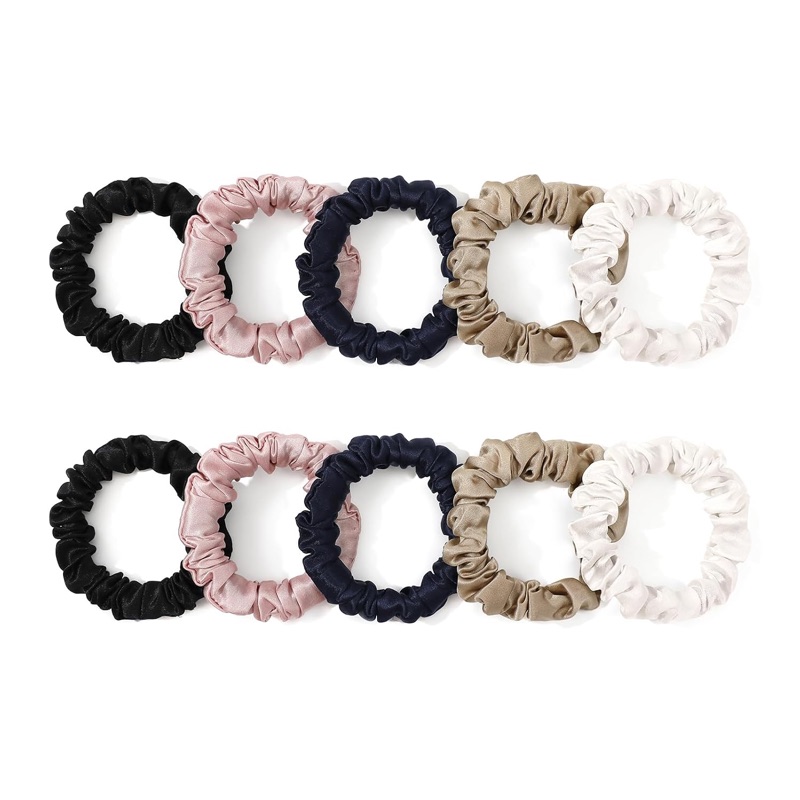
Silk scrunchies, multi-pack — colorful bow ties
A set of silk scrunchies in assorted colours. Use it to check the relaxed loop size and the stated material against the checks in this guide before assuming a silk label means it will hold.
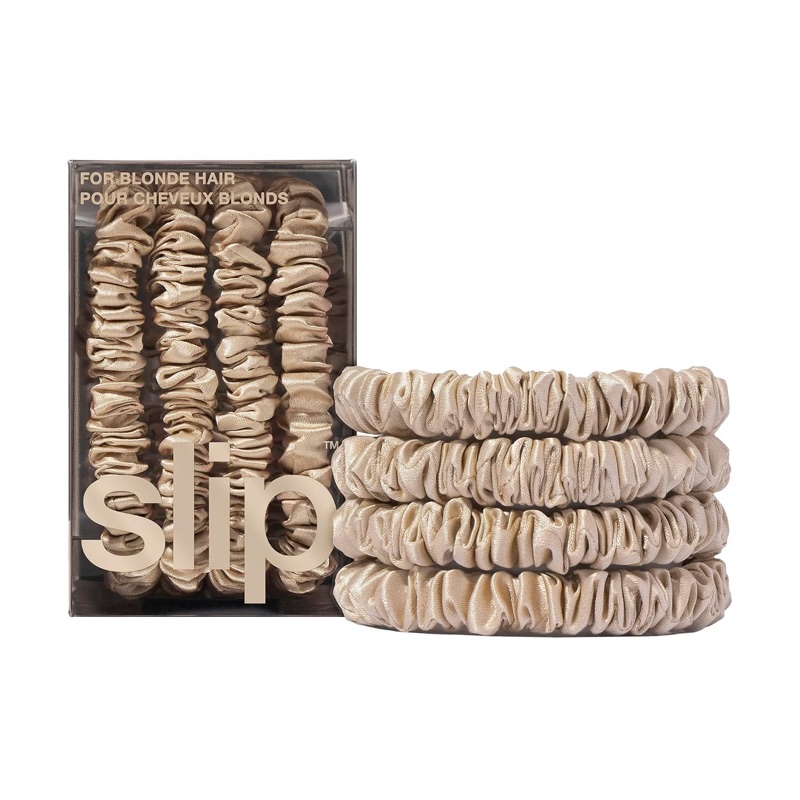
Skinny silk scrunchies, set of four — blonde
A four-pack of skinny silk hair ties in blonde. Useful as the second loop-size and working-stretch comparison when you judge whether a skinny style suits your hair volume.
5. Match the style to the job, not just the trend
Scrunchies are sold in many forms: narrow or skinny loops, standard gathered styles, large-volume versions, and styles with bows or long fabric details. These variations are not merely decorative. A large gathered shell can spread the look of the accessory, but it does not automatically indicate a larger or stronger elastic. A skinny product can be a good match for a small section of hair and a poor match for a thick bun. A bow can change the visual balance without changing the loop size at all.
Choose the style according to the intended task. A buyer who needs a low-profile tie for the end of a braid may prefer a different size from someone who needs a larger loop for a loose bun. A customer using a scrunchie during sleep may prioritize an acceptable feel and simple removal rather than maximum hold. A customer with high-volume hair may need a different working range rather than repeatedly overstretching a smaller loop.
Brands should make this choice visible rather than hiding it behind a single "one size" listing. Use product names that distinguish size or hold intention, display relaxed measurements where possible, and show the scrunchie on representative hair arrangements without implying universal fit. A small comparison table can be more useful than a long list of color names.
6. Include wash and storage in the replacement decision
Elastic changes through use, handling, and care. The outer fabric can also retain styling product, oil, or moisture, which makes a buyer more likely to wash it. That is why care instructions belong in the product decision, not as an afterthought.
Follow the care instructions supplied with the individual product. Do not assume a generic hair-accessory routine applies to every fiber or elastic construction. If the scrunchie is washed, inspect the loop after it is dry before placing it under normal tension again. If it has lost recovery, a temporary tightening method may not restore the original construction or make it reliable for regular use.
For brands, wash testing should reproduce the care method printed on the label. Measure a set of sample loops before and after the agreed process, note changes in the casing and elastic behavior, and keep those notes with the approval sample. A product page should describe care clearly, but it should not turn a limited internal test into a guarantee of lifespan.
Packaging can support this expectation. A small card can state the actual product size, the material wording approved for the item, care instructions, and the number of pieces in the set. If a set contains different sizes, label them separately. This reduces the common mismatch where a customer expects every item in a multipack to perform like the largest one shown in a photo.
Build a better sample brief for a scrunchie set
Before ordering custom scrunchies, turn consumer complaints into a short, testable brief. List the intended use, hair-volume range, relaxed loop circumference, working circumference, outer material description, elastic description, casing style, seam placement, set quantity, colors, labels, and packaging components. If the product has a bow, logo, or oversized shell, state those as separate design elements rather than letting them replace the functional specification.
Request samples in the exact configuration being quoted. A supplier's stock sample may show the general style while using different elastic, fabric, size, or seam construction. Record what was supplied, what was tested, and which points remain unknown. If the supplier cannot confirm a material, customization method, minimum order, or production capability in writing, do not present it to customers as a confirmed feature.
When production arrives, compare a documented selection of units with the approved sample. Check relaxed size, working extension, casing distribution, seams, labels, color, pack count, and packaging. Keep the approved sample and photographs with the order record. That process will not eliminate every return, but it gives a small brand a way to find and correct a repeatable defect rather than relying on vague feedback after sale.
The practical choice
Replace a scrunchie when its current behavior no longer matches the job you need it to do—not merely because it has lost its new appearance. Check its relaxed size, the working stretch used for your hairstyle, the evenness of the casing and seam, and the care information before buying a replacement set.
For product brands, the same checks create a useful specification: choose a defined size and intended use, test a realistic working range, inspect the elastic and casing separately, and document the approved sample. The important decision is not whether a scrunchie is marketed as silk, satin, skinny, or oversized. It is whether the complete construction still performs consistently in the use it was designed for.